

Ignoring an IRS notice does not make it go away. The account moves through an automated escalation that adds penalties and interest every month, then narrows your appeal rights, and can end with a federal tax lien or a wage and bank levy. The earlier you respond, even just to ask for time, the more options stay on the table. Waiting rarely helps and almost always costs more.
TL;DR:
- Waiting to respond after the initial IRS notice leads to escalating penalties, interest, and the risk of tax liens or levies that can seize assets or wages.
- Notices have specific response windows, ranging from 21 days for payment demands to 30 days for levy notices, with fixed court petition periods of 90 or 150 days.
- Ignoring a notice causes long-term financial harm, including public liens, levies on bank accounts and wages, and potential passport restrictions, with appeal rights closing after deadlines.
- Acting early, especially before a final levy notice, allows for negotiations, penalty abatements, or installment agreements that can prevent enforcement actions.
- Engaging a tax professional immediately on receiving a final notice or levy improves chances of resolution and may faster release assets or prevent escalation.
What Is the IRS Escalation Timeline From CP14 to Levy?
The IRS collection process follows a set sequence, and knowing where you sit in that sequence tells you exactly how much time is left before enforcement.
- CP14, first balance due notice. This is the opening letter, sent after the IRS finds an unpaid balance on a filed return. It states what you owe and asks for payment. Ignore it and the clock starts on penalties and interest.
- CP501 and CP503, reminder notices. These follow weeks apart if the CP14 goes unanswered. Tone escalates, but you can still set up a payment plan or dispute the amount without much friction.
- CP504, notice of intent to levy state refund. This is the first real warning shot. It tells you the IRS can seize a state tax refund, and it signals that federal collection action is close behind.
- LT11 or Letter 1058, final notice of intent to levy. This triggers a strict 30-day window to request a Collection Due Process hearing before the IRS can legally levy wages or bank accounts.
- Lien filing and levy action. If the 30 days pass with no response, the IRS can file a Notice of Federal Tax Lien and begin levying wages, bank balances, or other assets.
Every letter in this chain carries a new deadline, but the underlying balance keeps growing the entire time, since interest compounds daily and penalties add up monthly regardless of which notice sits unopened on your counter.
How Do You Decode a Notice and Its Deadline?
Every IRS letter carries a notice code, usually in the top right corner, and that code tells you exactly what kind of action is happening and how much time you have.
- Identify the type first. Is it a demand for payment, a proposed change to your return, or an identity verification request? The IRS notice guide breaks down what each code means and which form to send back.
- Payment demands (CP14, CP501, CP503) generally give 21 days to respond by mail, or 10 business days for larger balances.
- CP504 and the final levy notice (LT11/Letter 1058) carry a firm 30-day window to act or request a Collection Due Process hearing.
- Notice of Deficiency (CP3219A/CP3219N) gives you 90 days, or 150 if you’re mailed abroad, to petition U.S. Tax Court before the assessment becomes final.
- Mail audits sometimes allow a one-time 30-day extension if you call before the deadline, but court-related windows like the 90/150-day rule are fixed by statute and don’t bend for a phone call.
What Are the Real Consequences of Ignoring a Notice?
The cost of silence shows up in four places: penalties, interest, liens, and levies, and each compounds the others the longer a balance sits unpaid.
The failure-to-pay penalty runs 0.5% of the unpaid tax per month, and interest compounds daily on top of that, on both the tax and the penalty itself.
Pro Tip: Run the math on your own balance. An unpaid debt sitting untouched for a year can grow significantly in penalties alone, before daily interest is even added.
Beyond the growing balance, ignoring notices exposes you to:
- A Notice of Federal Tax Lien, filed publicly, which attaches to your property and shows up in title searches, complicating any home sale or refinance.
- A levy, which lets the IRS take wages directly from your paycheck, pull funds from a bank account, or offset a state tax refund.
- Passport certification for seriously delinquent debt, which can block renewal or issuance of a U.S. passport.
- Lost appeal rights. Once the 30-day Collection Due Process window or the 90/150-day Tax Court window closes, you generally can’t get that hearing back.
Even after enforcement starts, the situation is not always permanent. Levies can often be released once an installment agreement or another arrangement is in place, so acting late still beats not acting at all.
What Should You Do at Each Stage of the Process?
The right move depends entirely on which letter is sitting in front of you, but a few steps apply no matter the stage.
- Read the notice completely. Note the tax year, the notice code, the amount claimed, and the exact response deadline. Pull an IRS account transcript to compare the IRS numbers against your own records.
- Decide how to handle the balance. Options include paying in full, a short-term payment extension, or a formal installment agreement with streamlined terms for smaller balances.
- Preserve your appeal rights. If you’ve received a CP504 or a final levy notice, request a Collection Due Process hearing within the 30-day window. If it’s a Notice of Deficiency, file a Tax Court petition before day 90 (or 150 if abroad).
- Explore relief options. Penalty abatement through Form 843, an Offer in Compromise using Form 656, or Currently Not Collectible status can all reduce what you ultimately pay.
- Get help if you’re stuck. If the IRS won’t budge or you’re facing genuine hardship, the Taxpayer Advocate Service exists specifically for cases that standard channels can’t resolve.
Pro Tip: If you’re hiring a CPA or attorney to deal with this for you, file Form 2848 (Power of Attorney) right away. It lets your representative pull transcripts and talk to the IRS directly, which usually moves things faster than doing it solo.
When Should You Bring in a CPA for IRS Problems?
Some situations call for professional help immediately, not after you’ve tried and failed on your own. If you’ve received a final notice of intent to levy, if payroll taxes are involved, if returns are unfiled for multiple years, or if the balance runs into five figures, a tax controversy specialist can typically move faster than an individual working alone.
A representative can pull your transcripts same-day, negotiate an installment agreement, file a Collection Due Process request, or start building an Offer in Compromise package. Before that first call, gather:
- All notices received, in order
- Copies of filed returns for the years in question
- Recent bank and payroll records
- A signed Form 2848 if you want someone else speaking for you
Why Early Engagement Changes the Outcome
Parr & Ibarra CPA sees the same pattern repeatedly: taxpayers who call after the first notice have far more room to negotiate than those who call after a levy hits their bank account. With more than 20 professionals, including multiple CPAs handling tax controversy work across Dallas-Fort Worth, we routinely intervene before enforcement locks in, requesting hearings, correcting misapplied payments, and structuring agreements the IRS will actually accept. Enforcement is sometimes unavoidable by the time we’re called. Even then, an installment agreement or a properly filed Offer in Compromise can undo a levy faster than most people expect.
— Adan
Get Ahead of an IRS Notice Before It Escalates
A DIY approach to an IRS letter works fine right up until it doesn’t, usually the moment a CP504 turns into a final notice and the 30-day clock starts running. Parr & Ibarra CPA gives Dallas-Fort Worth business owners and individuals a faster path through that clock: same-day transcript review, direct IRS calls made on your behalf, and installment agreements or Offers in Compromise built to actually get accepted rather than rejected on a technicality. Our team handles audit representation, collection defense, penalty abatement, and proactive tax planning so the next notice doesn’t catch you off guard. If you’re also behind on 1099 filings tied to the same tax year, a resource like Tax Form Hero’s guide to e-file rejections can help you fix those before they add another layer to the problem. Reach out to Parr & Ibarra CPA today and get a real plan in place before your next deadline passes.
Where to Verify These Rules Yourself
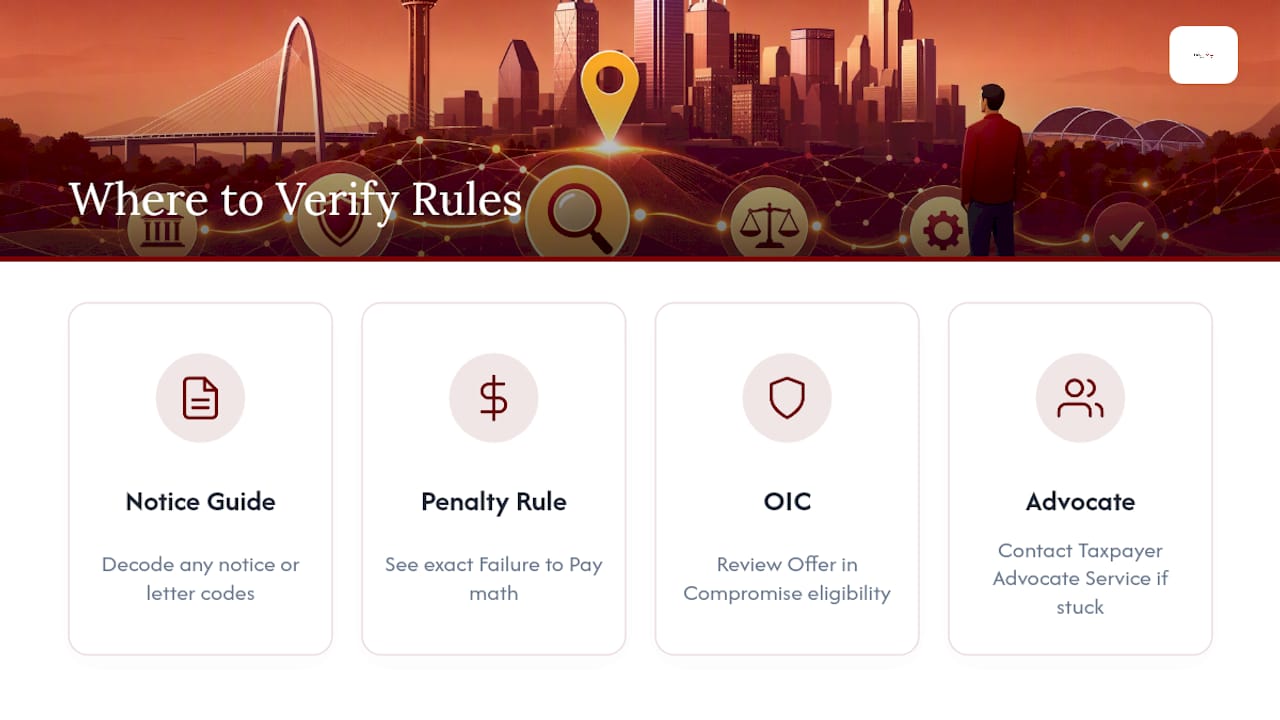
Every deadline and penalty rate in this article comes straight from IRS guidance, and it’s worth bookmarking the source pages directly. Start with Understanding Your IRS Notice or Letter to decode any code you receive, check Failure to Pay Penalty for exact penalty math, review Offer in Compromise eligibility, and contact the Taxpayer Advocate Service if you’re stuck in a loop the normal process can’t fix.
This article is general information, not a substitute for advice from a qualified financial advisor. Consult a qualified financial professional about your own circumstances before acting on anything here.
Sources
FAQ
What Happens If You Don’t Respond to an IRS Notice?
The account moves through automated escalation, penalties and interest keep building, and the IRS eventually files a lien or issues a levy on wages, bank accounts, or state refunds.
What Is IRS One-Time Penalty Forgiveness?
Many taxpayers qualify for first-time penalty abatement, a one-time waiver of certain penalties for those with a clean compliance history, requested by phone or with Form 843.
How Long Do You Have to Respond to an IRS Notice?
It depends on the notice: standard balance-due letters usually give 21 days, a final notice of intent to levy gives exactly 30 days to request a Collection Due Process hearing, and a Notice of Deficiency gives 90 days (150 if mailed outside the U.S.) to petition Tax Court.
What Is the IRS Three-Year Rule?
The IRS generally has three years from the date you file to audit a return, though this window extends to six years for substantial underreporting and has no limit in cases of fraud or unfiled returns.
Can Parr & Ibarra CPA Help After I’ve Already Missed a Deadline?
Yes. Even after a lien or levy, Parr & Ibarra CPA can often negotiate an installment agreement or Offer in Compromise that gets enforcement action released.

