
Disallowed expenses are costs your business actually paid and recorded on your books, but the IRS won’t let you deduct them from taxable income. The biggest culprits: fines and penalties, personal or commuting costs, 100% entertainment, and political contributions. Each one gets added back on your tax return even though it left your bank account. The rules trace back to 26 U.S. Code § 274 and IRS guidance, so keep documentation ready before you claim anything borderline.
TL;DR:
- Fines, penalties, personal expenses, and commuting costs are automatically disallowed by IRS rules and must be added back to taxable income.
- Entertainment expenses are fully disallowed, while business meals are limited to 50% deductibility, requiring careful documentation.
- Mixed-use expenses like cell phones or travel need a clearly documented split to isolate deductible business use from disallowed personal or recreational costs.
- Poor recordkeeping, including missing receipts and vague expense categories, increases the risk of disallowance and audit issues, emphasizing the need for proactive documentation.
- Consulting with a CPA to review your expense classifications before filing helps prevent costly mistakes and simplifies IRS dispute resolution.
What Makes an Expense Disallowed Under Tax Law?
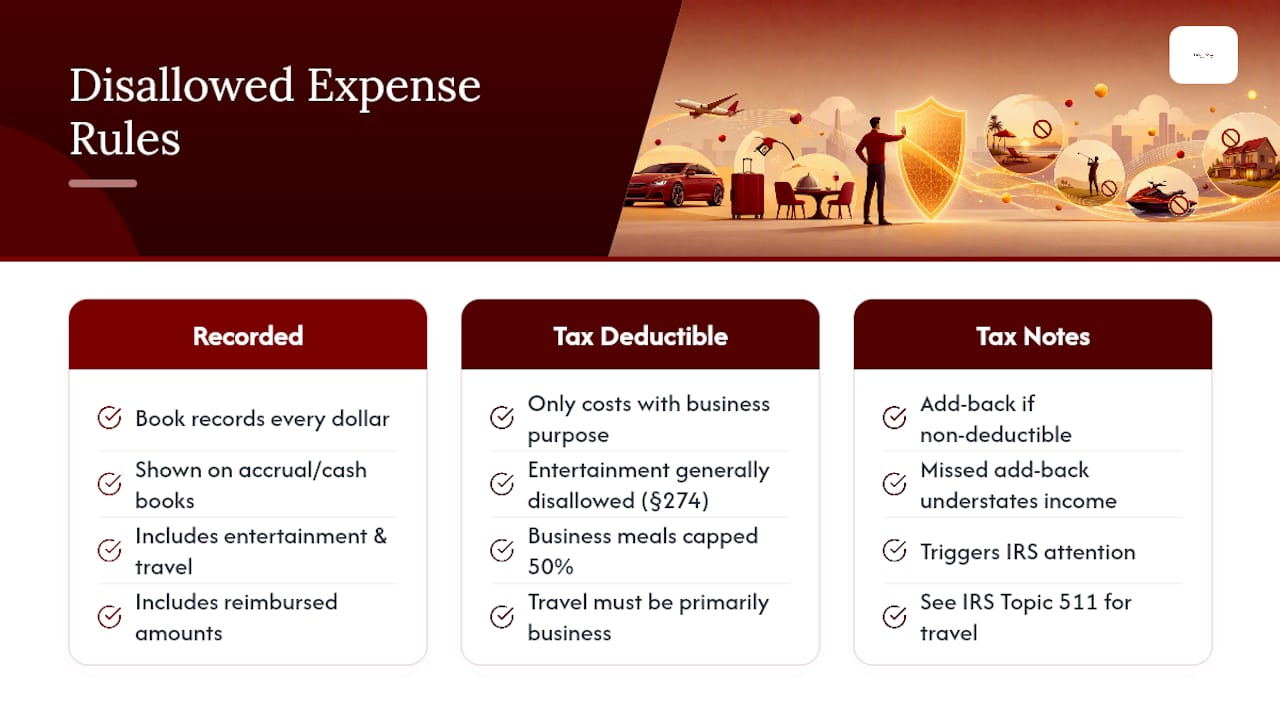
An expense showing up in your books and an expense you can deduct on your tax return are two different animals. Your bookkeeping records every dollar the business spends because that’s what accrual or cash accounting requires. Tax law is stricter. It only lets you subtract costs that Congress and the IRS have decided serve a legitimate business purpose within defined limits.
That gap between “recorded” and “deductible” is where the add-back concept lives. You book the expense normally, then your tax preparer adds it back to income before calculating what you owe. Miss that step, and you’ve understated taxable income, which is exactly what triggers IRS attention.
26 U.S. Code § 274 is the statutory backbone here. It disallows deductions for entertainment, amusement, and recreation outright, and it caps most business meals at 50% deductibility rather than letting you write off the full tab. IRS Topic 511 fills in the travel side: trips must be primarily for business, and lavish or personal travel costs don’t qualify, even if a client dinner happened somewhere along the way.
One wrinkle worth flagging: reimbursement obligations aren’t purely a federal tax question. Some states impose their own rules on what employers must reimburse regardless of tax treatment, so a policy that’s fine under the tax code can still create a labor issue elsewhere. When in doubt, run it past a CPA who knows both sides.
Which Expenses Get Disallowed Most Often?
Certain categories show up on IRS disallowance lists so consistently that any experienced preparer can spot them from across the room. Recognizing them before you file saves you an amended return later.
- Fines and penalties. Traffic tickets, OSHA fines, late filing penalties paid to a government entity. Nondeductible, full stop, regardless of how the fine relates to running your business.
- Personal expenses and commuting. Your drive from home to your regular office is commuting, not a business trip, even if you check email at every red light. Household utility bills run through the business account fare no better.
- Entertainment. Concert tickets, golf outings, a suite at the game. Fully disallowed under Section 274, which is a stricter standard than the 50% haircut applied to a genuine business meal.
- Political contributions and most lobbying costs. Donations to a candidate or party, and the bulk of lobbying expenditures, don’t reduce taxable income no matter how directly they serve your business interests.
- Illegal payments and sham transactions. Bribes, kickbacks, and payments structured to disguise personal spending as a business cost all fail the business purpose test that tax authorities apply.
- Mixed-use expenses. A cell phone plan used for both work and personal calls needs a documented split. Only the business-use percentage is deductible; the rest sits in the disallowed column.
The entertainment versus meals distinction trips up more owners than any other line item on this list. A client dinner where you actually discuss business can hit that 50% limit. The round of golf beforehand cannot.
How Disallowed Expenses Change Your Taxable Income
Here’s the mechanic in plain terms: book expense minus disallowed portion equals what actually reduces your taxable income. Say your business spent some amount on client meals and a smaller amount on entertainment tickets this year. Your books show $5,500 in expenses. The other $3,500 gets added back to income before you calculate tax owed.
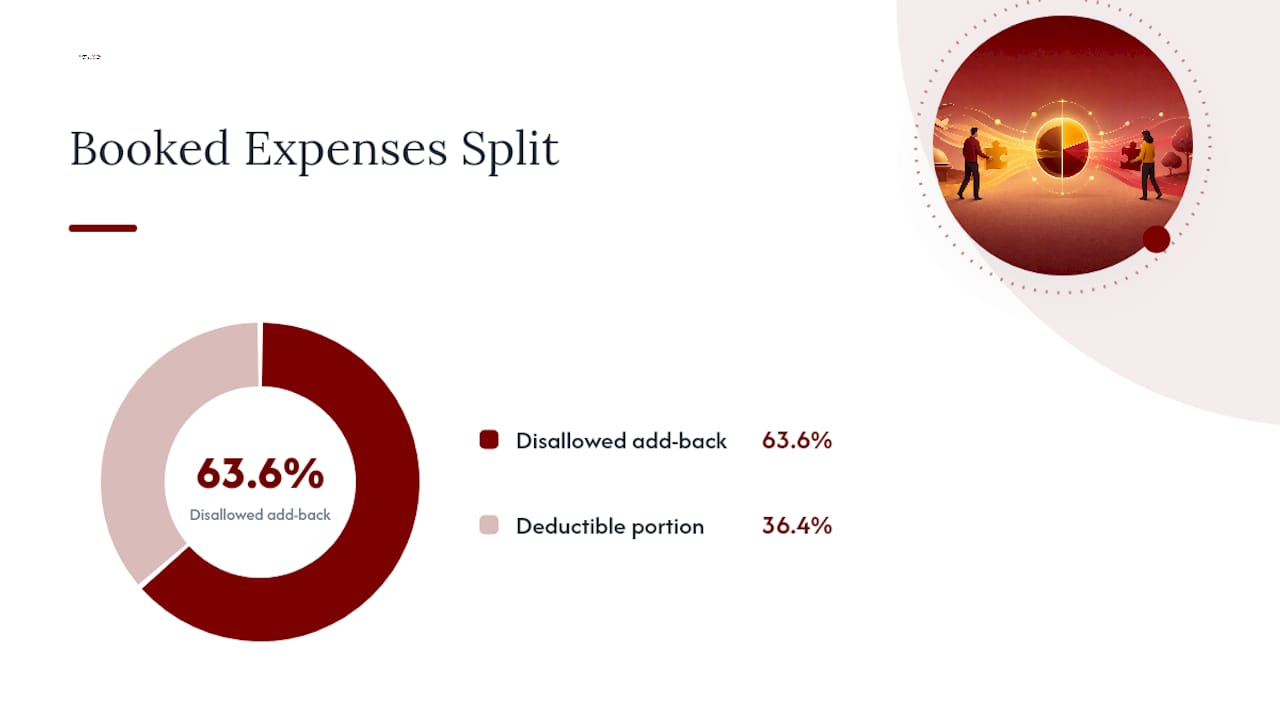
The 50% meals limit is the most common place this math shows up, but mixed-use costs need the same treatment.
Before filing, run through this sequence:
- Pull every expense account and flag anything touching entertainment, fines, or personal use.
- Calculate the deductible portion for partially limited items (meals, mixed-use costs).
- Total the disallowed amounts and confirm they’re added back on the appropriate tax form.
- Cross-check the total against last year’s adjustments to catch anything you missed.
Pro Tip: Reconcile your expense categories monthly instead of waiting until tax season. Catching a miscoded entertainment expense in March is a five-minute fix. Catching it in April of next year, after your return is already filed, means an amendment.
Recordkeeping and Controls That Prevent Improper Claims
Good documentation is your best defense against both an accidental disallowance and outright expense fraud in your comic pressing business expense tracking. Every claim needs a receipt, a stated business purpose, the names of anyone involved, the date, and a link to the relevant client or project. Bank statements alone don’t cut it if the IRS asks why a $200 dinner charge was business related.
A written reimbursement policy backs up your documentation. Set submission deadlines, require manager approval before payment, and put the rules in writing so nobody’s guessing what qualifies.
Watch for these red flags, which show up in fraud cases far more often than owners expect:
- Duplicate receipts submitted under slightly different dates or amounts
- Suspiciously round dollar figures (a $500.00 “meal” is worth a second look)
- Merchant names that don’t match the stated business purpose
Expense fraud commonly hides behind fabricated receipts, inflated amounts, and mischaracterized categories, and segregating approval duties from payment processing catches most of it before money goes out the door. For self-employed owners handling this alone, understanding IRS receipt requirements up front prevents the scramble later.
What to Do When the IRS Disallows a Deduction
Get organized fast. Pull every receipt, invoice, and note tied to the disputed expense, and contact your CPA before responding to the IRS directly. Preserve records rather than tossing anything, even items that seem to hurt your case.
From there, you generally have a few paths: amend the original return if you agree the deduction was wrong, file an administrative appeal if you believe the disallowance is incorrect, or negotiate penalty mitigation if the error was reasonable and not willful. A documented expense policy and monthly-reconciled books make all three paths faster because you’re not reconstructing history under deadline pressure.
If the dispute involves fraud allegations or a large dollar amount, bring in legal counsel alongside your CPA. That’s no longer just a tax question.
A Practitioner’s Checklist for Getting This Right
Most disallowed-expense problems trace back to one of three failures: misclassifying at the point of entry, skipping documentation, or never double checking the numbers before filing. Fix those and you fix most of your exposure.
Run every expense through three steps: classify it correctly the moment it hits your books, document the business purpose while the details are fresh, and verify the total against your tax adjustments before you file. Skipping the middle step is the most common mistake we see, because owners assume they’ll remember why they spent the money. They rarely do, six months later.
A team of CPAs can work through exactly this kind of classification and cleanup with business owners, catching disallowed items before they become audit exposure rather than after.
— Adan
Get Your Expense Classifications Reviewed Before You File
Sorting deductible from disallowed expenses by hand, spreadsheet by spreadsheet, eats hours you don’t have and still leaves room for a costly miss come audit season. Some CPA firms handle classification work directly, reviewing books line by line to flag nondeductible items before they turn into IRS add-backs you didn’t see coming.
Our team runs proactive tax planning services for Dallas-Fort Worth business owners, alongside bookkeeping cleanup for anyone whose chart of accounts has never separated deductible from nondeductible spending. If a prior return already got flagged, we also support audit response and documentation review so you’re not facing the IRS with a shoebox of receipts.
Schedule a consultation and bring your last few months of expense reports. We’ll tell you within that first session what’s likely to get disallowed and what’s safe to keep as is.
This article is general information, not a substitute for advice from a qualified financial advisor. Consult a qualified financial professional about your own circumstances before acting on anything here.
Sources
- 26 U.S. Code § 274 — Disallowance of certain entertainment, etc., expenses
- Business Expenses: Disallowed Deductions – Federal – Topics
- Expense fraud detection: Common schemes, red flags, and controls – Helios
FAQ
What Are Disallowed Expenses?
Disallowed expenses are costs your business paid and recorded on its books that the IRS won’t let you subtract from taxable income, such as entertainment, fines, and personal spending run through the company.
What Are Examples of Disallowable Expenses?
Common examples include traffic fines, entertainment tickets, political contributions, commuting costs, and the personal-use portion of a mixed business and personal expense like a cell phone plan.
Are There Allowable and Disallowable Versions of the Same Expense?
Yes. Business meals are a good example: they’re allowable up to 50% deductibility under Section 274, while pure entertainment costs tied to the same outing are fully disallowed.
What Happens If I Claim a Disallowed Expense by Mistake?
You’ll need to add it back to taxable income, either by catching it before filing or amending the return afterward. Some CPAs review prior filings to identify gaps before the IRS does.
How Do I Know If an Expense Is Disallowed for Tax Purposes?
Check whether it has a documented business purpose, falls outside statutory limits like the entertainment ban in Section 274, or resembles personal spending. When it’s unclear, a CPA review before filing is the safer route.

