

You have Texas sales tax nexus once your gross revenue into the state tops $500,000 in the trailing 12 months, and that includes marketplace sales even when the marketplace already collects the tax. Cross that line and you must get a permit and start collecting by the first day of the fourth month after the month you exceeded it. No grace period beyond that.
TL;DR:
- Crossing the $500,000 Texas revenue threshold triggers sales tax collection responsibilities, with a registration deadline set for the first day of the fourth month after crossing.
- Revenue calculations include taxable, exempt, resale, and marketplace sales, and even sales collected by marketplace facilitators count toward the threshold.
- Businesses must retain marketplace certifications, sales reports, and exemption certificates for at least four years to prepare for audits and ensure compliance.
- Texas recognizes physical and economic nexus separately, with different thresholds and rules for sales tax and franchise tax obligations, making clear distinctions essential.
- Regular, ongoing tracking of gross receipts over 12 months is crucial to avoid automatic nexus creation, penalties, or missing registration deadlines.
What Is Texas Sales Tax Nexus, and How Does It Differ From Physical or Franchise Nexus?
“Nexus” just means a connection strong enough to require you to collect and remit tax in a state. Texas recognizes two separate flavors for sales tax, and confusing them causes most of the compliance mistakes we see.
Physical nexus is the old standard: a warehouse, an office, employees, or inventory stored in Texas creates it automatically, regardless of revenue. Economic nexus is newer and revenue-based. It exists because of South Dakota v. Wayfair, the 2018 Supreme Court decision that let states tax remote sellers based on sales volume alone, without a physical footprint. Texas adopted its version of this rule not long after, setting the threshold at $500,000 in Texas revenue over a rolling 12-month period.
Here’s where sellers get tripped up:
- Sales tax nexus and Texas franchise tax nexus are governed by different rules and different thresholds.
- You can owe franchise tax (Texas’ entity-level margin tax) with a lower revenue bar than the one that triggers sales tax collection duties.
- Meeting the sales tax threshold doesn’t automatically define your franchise tax exposure, and vice versa.
Treating these as one obligation is how businesses end up registered for the wrong tax, or worse, unregistered for one they actually owe.
How Texas Calculates the $500,000 Nexus Threshold
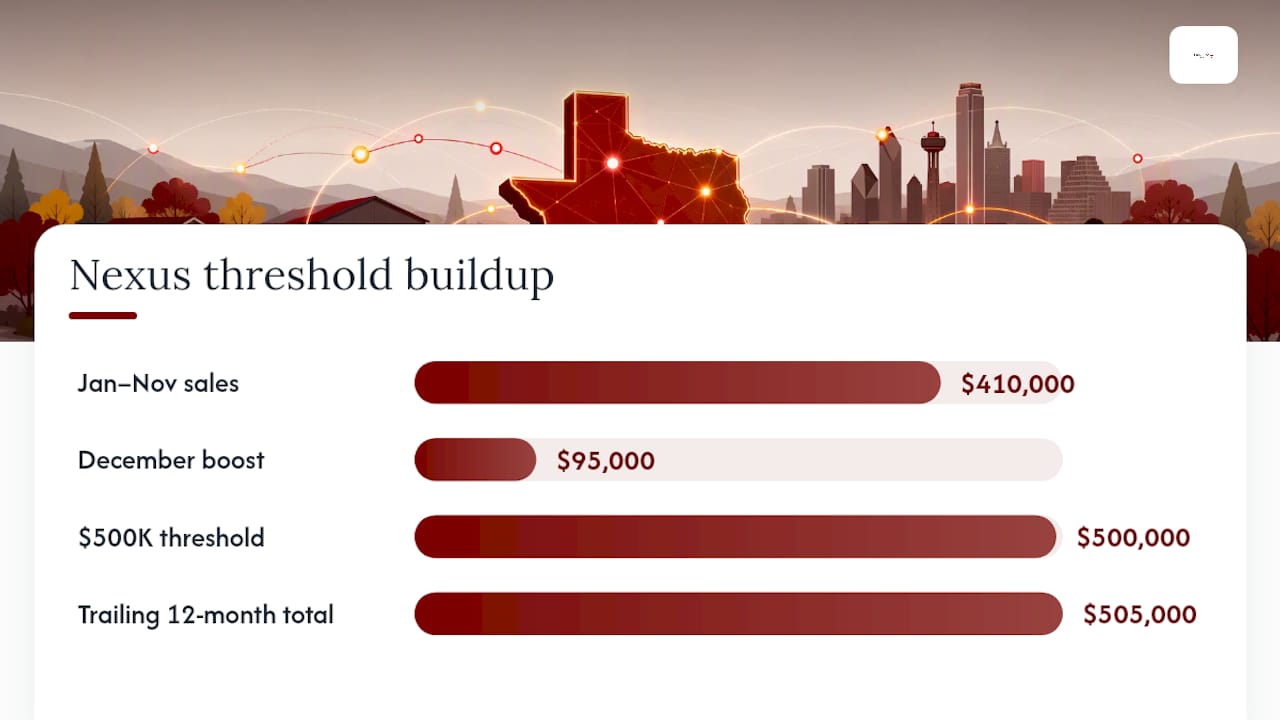
The Texas Comptroller counts total Texas revenue, not just taxable sales. That distinction catches a lot of sellers off guard, because it’s a much broader number than what shows up on a typical sales tax return.
Revenue counted toward the threshold includes:
- Taxable sales of goods and services delivered into Texas.
- Nontaxable sales, including exempt sales and sales to exempt organizations.
- Sales for resale, even though the buyer won’t pay tax on them.
- Separately stated charges for handling, transportation, and installation tied to a Texas sale.
- Sales made through a marketplace, whether or not the marketplace remits the tax.
Pro Tip: Run a rolling 12-month export of Texas gross receipts every month, not just at tax season. Threshold breaches sneak up fast during a strong sales quarter, and “rolling” means the window moves with you.
Here’s a concrete example. Say your business generated $410,000 in Texas revenue from January through November of last year. In December, a marketplace push adds $95,000 in Texas sales. Your trailing 12 months now total $505,000, and you’ve crossed the threshold, even though no single month looked dramatic on its own.
The threshold is calculated on gross receipts, not net of returns or discounts, using a strict 12-calendar-month lookback. Industry guides from firms like Avalara confirm Texas uses this same gross-receipts, rolling-window approach that most economic nexus states adopted after Wayfair.
That last point about marketplace sales deserves repeating, because it’s the single most common miscalculation: even if Amazon, Walmart Marketplace, or Etsy collects and remits Texas tax on your behalf, those sales still count toward whether you have crossed the nexus threshold.
Marketplace Facilitator Rules: Who Collects, and What You Must Keep on File
Texas requires marketplace facilitators to collect and remit tax on sales made through their platforms, which sounds like it takes you off the hook. It doesn’t, not entirely.
Since April 2020, marketplace sales count toward your own nexus calculation regardless of who collects the tax. A marketplace facilitator can certify, in writing, that it’s handling collection on your behalf, and that certification is what protects you if the state ever questions why those sales weren’t taxed directly by you.
What you actually need to keep on hand:
- Written certification from every marketplace facilitator confirming it collects and remits Texas tax on your sales.
- A running total of Texas revenue that includes marketplace sales, so you can accurately assess your threshold status.
- Sales reports from each marketplace platform, reconciled against your own accounting records.
- Resale or exemption certificates for any nontaxable sales you’re including in your revenue count.
Pro Tip: Don’t assume one marketplace’s certification covers another. If you sell on three platforms, get three separate certifications and store them together, not scattered across email threads and platform dashboards.
Retain all of this documentation for at least four years. If the Comptroller’s office ever audits your filings, the absence of a marketplace certification is one of the fastest ways to turn a routine sales tax question into a bigger liability than it needed to be.
Registering for a Permit and Starting Collection Once You’ve Crossed the Line
Timing here is not flexible. Texas gives you a specific window, and missing it means back taxes, penalties, and interest on sales you should have been collecting all along.
- Confirm the crossing month. Identify the calendar month your rolling 12-month Texas revenue first exceeded $500,000.
- Register for a permit before the deadline. You must obtain a Texas sales and use tax permit and begin collecting by the first day of the fourth month after that crossing month. Register through the Comptroller’s online system.
- Decide on the single local use tax rate. Remote sellers can elect a flat, combined local use tax rate instead of calculating hundreds of individual local rates, using Form 01-799 (Remote Seller’s Intent to Elect or Revoke Use of Single Local Use Tax Rate).
- Set up your filing schedule. Your assigned filing frequency (monthly, quarterly, or annually) depends on your tax volume, and getting this wrong at the outset creates avoidable late-filing penalties. Our breakdown of Texas filing deadlines by schedule walks through how the Comptroller assigns frequency.
Sellers close to the threshold often wait to see if a slow month brings them back under it. That’s a mistake. Once you cross, the clock starts, and it doesn’t reset because next month is quieter.
Calculating What You Actually Owe: State Rate, Local Tax, and the Single Rate Election
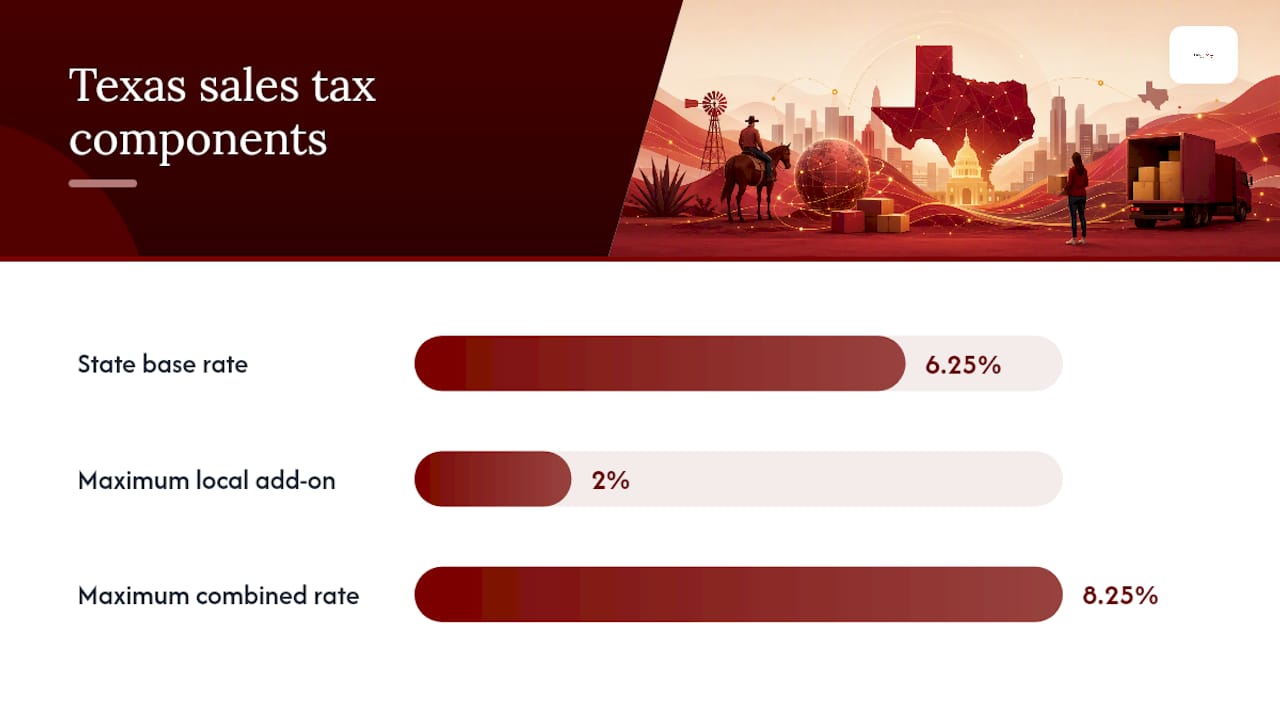
Texas’ base state sales and use tax rate is 6.25%. Local jurisdictions, cities, counties, transit authorities, and special purpose districts, can each layer on additional tax, up to a combined maximum of 2%, which caps the total rate at 8.25% anywhere in the state.
The complicated part isn’t the math. It’s figuring out whose local rate applies.
- Local sales tax applies when the sale is consummated in Texas, meaning the seller has a place of business there, and the rate is based on where that place of business sits.
- Local use tax applies when a remote seller with no Texas location ships an item to a Texas customer, and the rate is based on where the customer first stores or uses the item, its destination.
- For most remote sellers with no Texas footprint, it’s use tax you’re dealing with, which means tracking rates across potentially hundreds of local jurisdictions.
That’s exactly the problem the single local use tax rate solves. Remote sellers can elect one flat combined local rate, published annually by the Comptroller, and apply it to every Texas sale instead of looking up rates by destination address. The trade-off is precision: you might collect slightly more or less than the exact local rate for a given customer, but you avoid maintaining a jurisdiction-by-jurisdiction rate table. For a seller shipping to customers scattered across dozens of Texas cities, that trade is usually worth it.
Recordkeeping and Audit Readiness: What to Keep and Why
Most Texas sales tax audits don’t start with a smoking gun. They start with a documentation gap the seller didn’t realize existed until an auditor asked for it.
Keep these on file, organized and retrievable, not just backed up somewhere:
- Marketplace facilitator certifications, one per platform.
- Monthly sales journals showing Texas revenue by category (taxable, exempt, resale).
- Shipping and delivery records proving where items were used or stored.
- Resale certificates from any wholesale buyers, matched to the transactions they cover.
Retain everything for a minimum of four years, longer if you’re near the threshold and want a clean paper trail justifying your registration date.
Pro Tip: A sudden spike in Texas sales followed by silence on your filings is one of the most common audit triggers. If a big quarter pushed you over the threshold, register proactively rather than waiting for the Comptroller to notice first.
If you’re unsure whether past activity created nexus retroactively, a Texas resale certificate review and a formal nexus opinion from a CPA can clarify your exposure before you consider a voluntary disclosure agreement, which is almost always cheaper than waiting for an audit notice.
How Parr & Ibarra CPA Helps DFW Sellers Operationalize Nexus Decisions
Nexus rules read simply on paper. Applying them to a business with mixed marketplace and direct sales, multiple states, and seasonal revenue swings is a different problem entirely.
A CPA firm works with business owners on exactly this kind of analysis, including guidance on filing frequency and deadlines once a seller crosses the threshold. A nexus review typically produces three deliverables: a clear determination of whether and when nexus was triggered, a registration timeline that matches the Comptroller’s deadlines, and a filing setup that assigns the right frequency from day one.
The value isn’t just getting registered correctly. It’s catching the threshold crossing before it becomes a six-month-old problem discovered during an audit. For sellers running sales across several platforms with different collection arrangements, that kind of ongoing oversight, paired with broader tax planning support, tends to save far more in avoided penalties than it costs in fees.
The Part of Nexus Compliance Everyone Gets Backwards
Most advice on this topic treats nexus like a one-time test: check your revenue, cross the threshold, register. Done. That framing misses what actually causes problems. Nexus isn’t a single event. It’s a moving 12-month window that recalculates every month, which means a seller can drift into nexus quietly, through marketplace growth they weren’t even tracking as “their” revenue.
The conventional advice also underweights franchise tax. Sellers fixate on the $500,000 sales tax number and assume clearing it means they’re square with Texas generally. They’re not. Franchise tax runs on separate rules, and treating the two as one obligation is how businesses end up compliant on paper for the wrong tax.
If I had to prioritize one thing for a seller reading this: build the rolling revenue tracker before you think you need it, not after a marketplace platform sends you a 1099 that makes you nervous. Waiting for certainty means you’ve already been collecting the wrong amount, or nothing, for months you can’t undo.
— Adan
Get a Texas Nexus Review Before Your Next Filing Deadline
Running that rolling 12-month calculation by hand, reconciling three marketplace platforms against your own books, and tracking a registration deadline that moves with every strong sales month is exactly the kind of work that falls through the cracks at a growing business. This kind of nexus analysis can be combined with permit registration, filing frequency setup, and the local use tax rate election to ensure nothing sits half finished.
A first call covers where your revenue actually stands against the threshold, whether you’ve already crossed it without registering, and what a realistic filing timeline looks like from here. If you’re within striking distance of $500,000 in Texas revenue this year, that conversation is worth having before your next filing deadline, not after an audit notice forces it. Start with our tax planning services for Texas business owners to schedule a review.
Where to Verify the Rules Yourself
The Remote Sellers page and its marketplace FAQ cover threshold mechanics and certification requirements directly from the Comptroller. Publication 94-105 explains local sales versus use tax rules in full, and remote sellers electing the flat rate need Form 01-799. For rate lookups by address, the Comptroller’s Sales Tax Rate Locator remains the fastest way to confirm a combined rate before you file.
This article is general information, not a substitute for advice from a qualified financial advisor. Consult a qualified financial professional about your own circumstances before acting on anything here.
Sources
- Remote Sellers – Texas Comptroller
- Local Sales Tax Collection – A Guide for Sellers (Publication 94-105) – Texas Comptroller
- Economic nexus: Find out where you’re on the hook to collect and file sales tax – Avalara
FAQ
What States Have Sales Tax Nexus?
Every state that imposes a sales tax has some form of nexus standard, either physical presence, economic thresholds, or both, since the Wayfair decision let states adopt revenue-based rules alongside traditional physical-presence tests.
What Is Nexus in the State of Texas?
Texas recognizes physical nexus (a location, employees, or inventory in the state) and economic nexus, triggered when a seller’s total Texas revenue exceeds $500,000 over the prior 12 calendar months.
What Is Nexus in US Sales Tax?
Nexus is the connection between a business and a state substantial enough to require that business to collect and remit that state’s sales tax, established through physical presence, economic activity, or both depending on state law.
Is Texas a Reciprocal State for Sales Tax?
Texas doesn’t operate a general sales tax reciprocity system with other states for remote seller nexus purposes; each state applies its own threshold and rules independently, so crossing nexus in one state doesn’t determine your status in another.
Does Registering for a Texas Sales Tax Permit Cover Franchise Tax Too?
No. A sales tax permit only addresses collection and remittance obligations tied to the $500,000 economic nexus threshold; franchise tax nexus is evaluated separately, and a business can owe one without automatically owing the other.

