
Three things determine your tax bill on a short-term rental: the 14-day exclusion, the average-stay tests under 7 or 30 days, and whether you materially participate in running it. Get those right, and you know instantly whether you file Schedule E or Schedule C, and whether self-employment tax applies. Two moves matter now: calculate your average guest stay for the year, and start logging your hours today, not after an audit letter arrives.
TL;DR:
- Most owners will file Schedule E unless they provide hotel-like services or materially participate, which triggers self-employment tax on Schedule C income.
- The 14-day exclusion prevents reporting rental income and deductions if your rental period is 14 days or fewer, but exceeding that makes the income taxable.
- Calculating your property’s average stay and logging work hours promptly are critical for maximizing deductions and verifying material participation during audits.
- Personal use days exceeding 14 or 10% of rental days classify the property as a residence, capping deductions at rental income and requiring expense apportionment.
- Local occupancy taxes vary by jurisdiction and are often collected and remitted by platforms like Airbnb, but owners must confirm and handle taxes themselves when necessary.
What IRS Rules Determine Short Term Rental Taxes Classification?
Three tests decide how the IRS treats your property, and most owners never check any of them.
The first is the 14-day exclusion, sometimes called the Augusta rule. If you rent your dwelling for 14 days or fewer during the year, you don’t report that rental income at all, and you can’t deduct the related expenses either. It applies even if you also live in the property. This rule exists mainly for homeowners who rent out a spare room during a big local event or lease their house for a week during a nearby conference. Rent your lake house for 12 nights during boat show week for $4,000, and that money never touches your return under Publication 527. Rent it for 15 nights, and every dollar becomes reportable income.
The second test looks at average customer stay. Under Treasury Regulation 1.469-1T, a property with an average guest stay of seven days or less isn’t treated as a rental activity for passive-activity purposes at all. That distinction opens the door to non-passive loss treatment if you materially participate. There’s also a 30-day exception when you provide significant services alongside the stay.
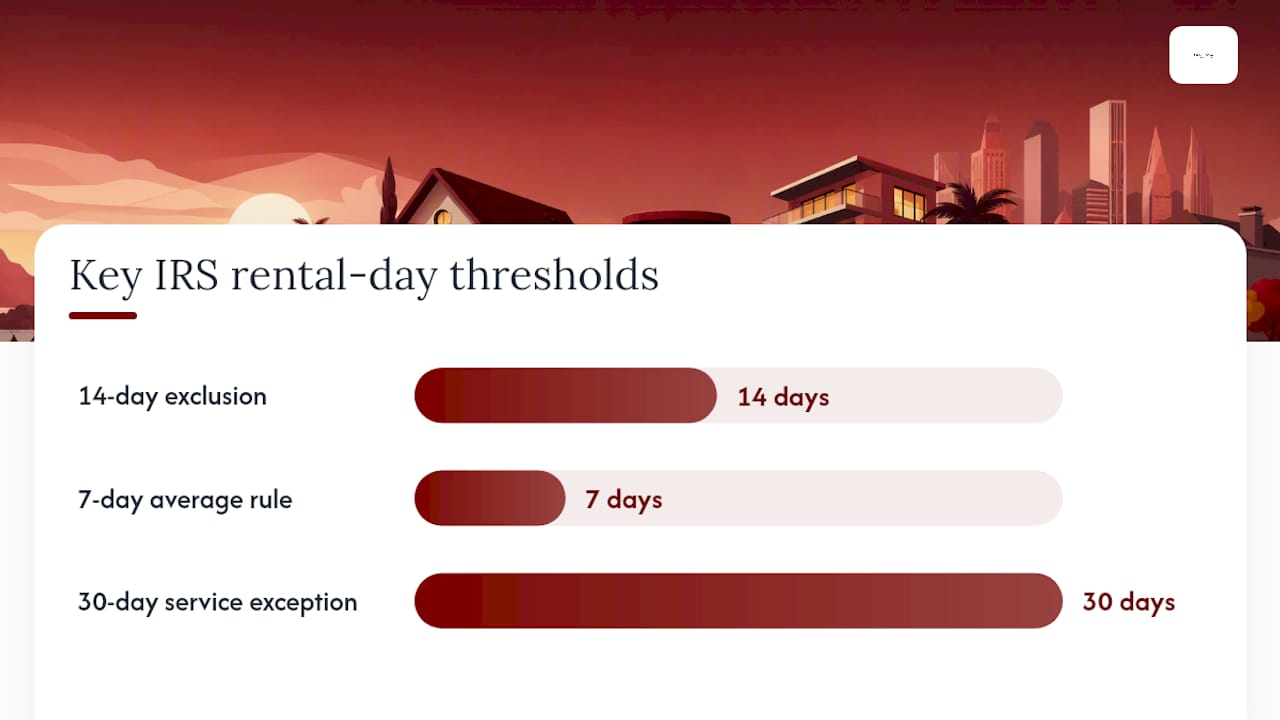
To find your average stay, divide total rental nights by total bookings for the year. A property with 20 bookings totaling 100 nights averages 5 nights per stay, comfortably under the 7-day threshold. A property with 20 bookings totaling 400 nights averages 20 nights, which fails the 7-day test but may still qualify under 30 days.
“Significant personal services” means things beyond routine turnover: daily housekeeping, meals, concierge booking, or transportation. Cleaning between guests and providing linens does not count as significant service. That distinction affects:
- Whether the activity counts as a rental for passive-loss purposes
- Whether losses can offset other non-passive income
- Which tax form you ultimately file
Schedule E or Schedule C: Which One Applies to Your Rental?
Once you know your average stay and service level, the form choice usually follows automatically. Schedule E is the default for rental real estate. Schedule C applies when you’re running something closer to a hotel or bed-and-breakfast business, and it drags self-employment tax into the picture.
- Check your service level first. If you provide only cleaning, linens, and basic supplies, Schedule E almost always applies, regardless of how short the stays run.
- Look for hotel-like services. Daily maid service, prepared meals, or guest transportation under Treasury Regulation 1.1402-2 typically pushes the activity onto Schedule C.
- Confirm the self-employment tax exposure. Schedule C net income is subject to a 15.3% self-employment tax on top of income tax, since the IRS treats it as earnings from a trade or business rather than passive rental income.
- Weigh the trade-off. Schedule C can unlock non-passive loss treatment and avoid passive-loss limits, but it costs more in payroll-style tax. Some owners with heavy losses accept the SE tax hit deliberately; most owners running a straightforward vacation rental should not.
- Document your decision. Keep a written record of exactly which services you provide and why you chose the form you did. Auditors ask this question directly.
Most STR owners belong on Schedule E. The property manager who runs a full-service boutique operation, complete with daily housekeeping and welcome baskets restocked mid-stay, is the exception, not the rule.
What Are the Seven Material Participation Tests?
Material participation is the gateway to treating rental losses as non-passive, which means those losses can offset your W-2 income or other active earnings instead of sitting locked up. Treasury Regulation 1.469-5T lays out seven tests, but three do almost all the work in practice:
- The 500-hour test: you participate more than 500 hours during the year.
- The substantially-all test: your participation constitutes substantially all the activity, even if total hours are modest.
- The 100-hour test: you work more than 100 hours and no one else, including contractors, works more than you.
- Four additional tests cover aggregation of activities, participation in five of the prior ten years, personal service activities, and a facts-and-circumstances catch-all.
Guest messaging, pricing adjustments, coordinating repairs, and sourcing your own cleaner all count toward your hours. Passive activities like reviewing your property manager’s monthly report or researching whether to buy a second unit generally do not.
Pro Tip: Log entries the same day you do the work, not at year-end from memory. Note the date, hours, and specific task, since reconstructed logs carry far less weight in an audit than contemporaneous ones do.
If you own multiple properties, a grouping election lets you combine them into one activity for participation purposes, which can help you clear the hour thresholds. That election has real audit consequences and should be made deliberately, not by default. Our guide to the short-term rental tax loophole walks through the mechanics in more detail.
How Does Personal Use Affect Your Rental Deductions?
Personal use days change your math fast. If you use the property personally for more than 14 days, or more than 10% of the days it’s rented at fair value, whichever is greater, the IRS treats it as a residence rather than a rental. That triggers stricter rules: deductions get capped at gross rental income, and any excess carries forward instead of offsetting other income.
Shared expenses like mortgage interest, property taxes, insurance, and utilities need to be split between rental and personal use based on days used for each purpose.
| Expense Type | Allocation Method | Example (10% personal use) |
|---|---|---|
| Mortgage interest | Rental days ÷ total days used | deductible against rental income |
| Property taxes | Rental days ÷ total days used | deductible against rental income |
| Utilities | Rental days ÷ total days used | deductible against rental income |
| Depreciation | Rental days ÷ total days used, only if not a residence under the 14-day/10% test | Fully disallowed if property counts as a residence |
Say a property was rented 300 days and used personally for 20 days. Push personal use to 35 days on that same schedule, and the residence rules kick in, capping deductions at rental income and carrying the rest forward under Publication 925.
What Can You Deduct, and How Does Depreciation Work?
Ordinary deductible expenses include mortgage interest, property taxes, insurance, repairs, supplies, platform service fees, cleaning costs, and management fees, all outlined in IRS Topic 415. Platform fees from Airbnb or VRBO are fully deductible business expenses, not a reduction of your gross income, so track them separately rather than netting them against booking revenue.
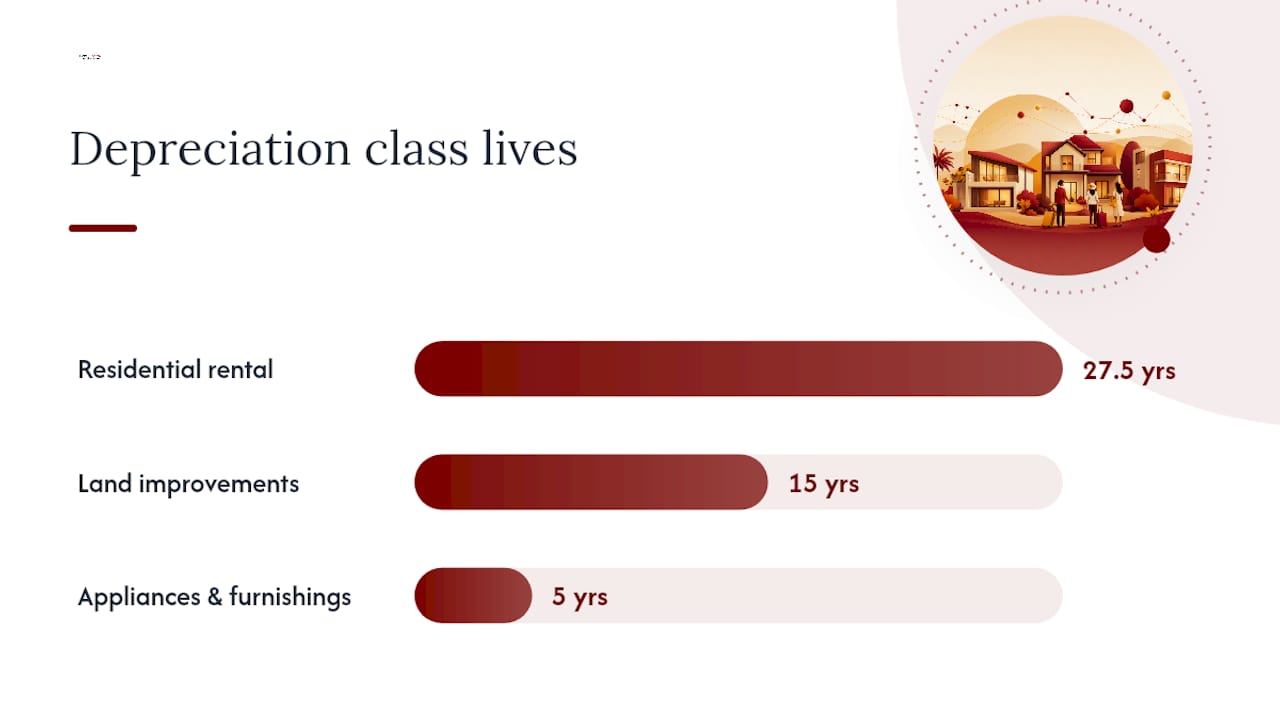
Depreciation is where the bigger dollars live. Residential rental property depreciates over 27.5 years under MACRS, straight-line. That’s the default, and for most small owners, it’s fine.
Cost segregation changes that math. A qualified engineer or CPA-led study breaks the property into components: land improvements, appliances, flooring, and furnishings, many of which qualify for 5-year or 15-year class lives instead of 27.5 years. Reclassified components become eligible for accelerated depreciation, and in years where bonus depreciation applies, some of those reclassified assets can be expensed immediately rather than depreciated gradually.
Bonus depreciation percentages have changed repeatedly since 2018, and the applicable rate depends on when the property was placed in service, so confirm the current-year rate before modeling your deduction.
A few limits still apply regardless of how aggressive your depreciation strategy gets:
- At-risk rules limit losses to your actual economic investment in the property
- Excess business loss limitations can cap how much loss offsets other income in a given year
- Basis limitations mean you can’t depreciate more than what you’ve invested
- A written cost segregation study, not a back-of-envelope estimate, is what survives an audit
Our guide to maximizing deductions for real estate professionals covers the documentation standard in more depth.
Do You Owe Local Occupancy Taxes on Your Rental?
Federal rules get most of the attention, but local taxes on vacation rentals catch more owners off guard. Every state and often every city and county sets its own occupancy tax, sometimes called a hotel tax, lodging tax, or transient occupancy tax, and rates vary widely depending on where the property sits.
Two collection models exist. Some platforms, including Airbnb in many jurisdictions, collect and remit occupancy tax automatically on your behalf. Others leave that responsibility entirely with you, the host, which means you register with the local tax authority, collect the tax from guests at booking, and file periodic returns yourself.
A basic compliance checklist looks like this:
- Confirm whether your platform automatically collects and remits occupancy tax in your specific city and county
- If not, register directly with the state or local tax authority before you list the property
- Build the tax rate into your nightly pricing so you’re not absorbing it out of your margin
- File and remit on the schedule your jurisdiction requires, monthly or quarterly in most areas
- Keep proof of every remittance, since penalties for late or missing filings often include interest plus a flat penalty per period
Don’t assume the platform has it covered. Verify it for your specific address every year, since rules and rates change.
How Do You Reconcile Your 1099-K With Actual Taxable Income?
Platforms issue Form 1099-K reporting gross payments processed on your behalf, and that figure almost never matches what you actually owe tax on. The 1099-K shows total guest payments before platform fees, refunds, or cleaning fee pass-throughs come out. It also gets issued even when you qualify for the 14-day exclusion, which means you need to be ready to explain the mismatch if the IRS ever asks.
- Pull your full platform ledger, not just the 1099-K summary, showing every transaction line by line.
- Back out fees, refunds, and pass-through charges like cleaning fees collected from guests but paid to your cleaner, to arrive at your actual net rental income.
- Match the adjusted figure to what you report on Schedule E or Schedule C, and keep the reconciliation worksheet with your tax file in case of questions later.
Pro Tip: Save your platform’s annual transaction report the day it becomes available. Platforms sometimes restrict access to prior-year detailed ledgers once a new tax year begins.
Keep booking calendars, receipts, participation logs, your cost segregation report if you have one, and lease or management contracts for at least three years, longer if you claimed a loss. That bundle is your audit package if the IRS ever comes calling. Our notes on receipt requirements for self-employed deductions apply directly here even though STR income isn’t always self-employment income.
Which Planning Moves Actually Move the Needle?
Not every tactic here deserves equal attention. Ranked by real impact:
- Start a contemporaneous hour log now. This is the single highest-leverage habit, since it’s the difference between a defensible material participation claim and one that collapses under audit scrutiny.
- Order a cost segregation study when the math supports it. Properties with significant furnishings, land improvements, or high basis tend to see the biggest first-year benefit.
- Consider a grouping election carefully, not automatically, if you own multiple properties and need to clear participation thresholds.
- Keep monthly bookkeeping current rather than reconstructing a year of transactions each March.
The pitfalls that trip up otherwise careful owners: failing to track a co-host’s or cleaner’s hours (which can disqualify you under the 100-hour test), rebuilding participation logs from memory after receiving an audit notice, and mislabeling standard turnover cleaning as a “significant service” to try to justify Schedule C treatment it doesn’t actually support.
Talk to a CPA before tax season, not during it, if you’re carrying large losses, operating in multiple states, or planning a cost segregation study. Multi-state occupancy tax nexus and depreciation elections both get complicated fast, and unwinding a bad election after filing is far harder than getting it right the first time.
How Does Ownership Structure Change Your Tax Picture?
Owning a rental as an individual, through an LLC, or inside a corporation changes reporting mechanics more than most owners expect. A single-member LLC is disregarded for federal tax purposes by default, meaning the income still flows to your personal Schedule E or Schedule C exactly as if you owned the property directly. The LLC shell provides liability protection, not a different tax outcome.
Multi-member LLCs taxed as partnerships file Form 1065 and issue K-1s to each owner, who then reports their share on their personal return. The material participation and passive-loss tests still apply at the individual partner level, so each owner’s involvement gets evaluated separately.
Electing S-corporation or C-corporation treatment changes things more substantially. An S-corp can convert what would be self-employment income into a mix of reasonable salary plus distributions, which sometimes reduces the SE tax bite on active, business-like STR operations. A C-corp introduces double taxation risk on distributed profits, which rarely makes sense for a straightforward vacation rental unless there’s a specific reason tied to a larger business structure.
Most individual STR owners with one or two properties gain little from an entity election beyond liability protection. Owners running multiple properties as an active, service-heavy operation should model the numbers before choosing a structure, since the right answer depends heavily on income level and participation hours.
What Did the Tax Cuts and Jobs Act Change for Rental Owners?
The Tax Cuts and Jobs Act reshaped several provisions that STR owners lean on. Bonus depreciation, expanded under the law, is what makes cost segregation studies so much more valuable than they were before 2018, since qualifying components can be expensed far faster than the standard 27.5-year schedule allows.
The law also introduced the Section 199A qualified business income deduction, which can allow up to a 20% deduction on qualified business income for STR activity that rises to the level of a trade or business, subject to income thresholds and other limitations. Whether your rental qualifies depends heavily on your service level and participation, which loops directly back to the material participation tests covered earlier.
The law also capped state and local tax deductions at $10,000 for individuals, which indirectly affects owners who itemize and previously deducted large property tax bills on personal residences alongside their rental property taxes. That cap doesn’t touch property taxes deducted against rental income on Schedule E, since those remain a business expense rather than an itemized personal deduction. The distinction matters if you own a rental and a high-tax primary residence in the same state.
Vacation Home or Primary Residence: Does It Change Your Taxes?
The tax treatment hinges entirely on how many days you personally use the property relative to rental days, not on what you call it. A property you personally occupy for more than 14 days or more than 10% of rental days, whichever is greater, gets classified as a residence with a rental component rather than a straight investment property.
That classification caps your deductions at gross rental income for the year, disallowing net losses, with any excess deductions carried forward to future years under Publication 925. A property that clears both thresholds, rented most of the year with minimal personal use, gets full rental tax treatment: potential losses, full depreciation, and no gross-income cap.
Your primary residence occasionally rented for a short stretch, say two weeks while you travel, usually falls under the 14-day exclusion instead and generates no reportable income or deductions at all. The dividing line between “vacation home” and “rental property” in the tax code isn’t about the label on your deed. It’s counted in personal-use days, tallied against rental days, every single year.
Does It Matter Whether You List on Airbnb or VRBO?
The tax rules themselves don’t change based on which platform lists your property, but the reporting mechanics and occupancy tax handling do vary in practice. Airbnb collects and remits occupancy tax automatically in many jurisdictions, while VRBO’s tax collection coverage varies more by location, and some smaller booking platforms collect no local tax at all, leaving that obligation entirely on you.
Every platform issues Form 1099-K once you cross the reporting threshold for the year, and each platform’s ledger format differs slightly, which matters when you’re reconciling gross payments against actual taxable income. An owner listing the same property on both Airbnb and VRBO simultaneously needs to combine both platforms’ gross payment figures and reconcile them together, since the IRS looks at your total rental activity, not a per-platform breakdown.
Keep separate booking calendars or a consolidated tracking sheet if you list across multiple platforms, since average-stay calculations for the 7-day and 30-day tests need to reflect all bookings combined, not each platform in isolation. A property averaging 5-night stays on Airbnb and 10-night stays on VRBO doesn’t get evaluated as two separate activities. It’s one property, one average, calculated across every booking regardless of where the guest found the listing.
What Happens When You Rent Part of the Year and Use It Personally the Rest?
Part-year rental use is the most common real-world scenario, and it’s also where owners make the most avoidable mistakes. The core principle: every deductible dollar and every reportable dollar gets prorated based on the split between rental days and personal-use days across the full year, not just the months you actively marketed the property.
Days the property sat vacant and available for rent, but with no guest booked, still count as rental days for allocation purposes; they are not personal-use days simply because no one stayed there.
The mistake owners make most often is claiming a full year of depreciation and full-year expense deductions on a property only actively rented for four or five months. Depreciation and shared expenses need to be prorated for the period the property was actually placed in service as a rental, not claimed as if it operated as a rental for 365 days. Track the exact date you first listed the property as available and the exact date, if any, you converted it back to personal use. That start and stop date is what your CPA needs to calculate an accurate first-year and last-year deduction.
A CPA’s View on Where Owners Actually Get Tripped Up
The material participation tests trip up more owners than any other rule in this guide, and it’s rarely because the hours weren’t worked. It’s because the hours weren’t documented as they happened. Clients routinely tell me they spent 15 hours a week managing their property, and they’re probably right. But “probably right” and “provable” are different things during an audit, and only one of them holds up.
The second pattern I see constantly: owners treat cost segregation as a magic button instead of an economic decision. It’s powerful when the property has real depreciable basis in furnishings and improvements. It’s a wasted fee on a lightly furnished condo with a small basis.
Engage a CPA before you file, not after you get a notice. The fix is always cheaper on the front end.
— Adan
Get Help Applying These Rules to Your Property
Reading the rules and applying them correctly to your specific property, your specific average stay, and your specific mix of personal and rental days are two different things. A tax firm works with property owners who want their short-term rental treated as the tax-advantaged asset it can be, not a source of yearly guesswork.
Our team handles the pieces that matter most from this guide: tax planning built around your material participation status, cost segregation coordination through our strategic business advisory services, ongoing bookkeeping that keeps your reconciliation clean year-round, and representation if the IRS ever questions your position.
If you’re carrying an STR into another tax season without a documented participation log or a clear Schedule E versus Schedule C answer, start with a tax planning consultation with a qualified CPA. They can walk through your specific numbers and position.
Primary Sources Worth Reading Directly
The IRS documents behind this guide contain the exact legal language that governs your specific situation, and they’re worth reading firsthand rather than relying only on secondhand summaries, including this one.
- Publication 527, Residential Rental Property, for the 14-day exclusion and general rental reporting rules
- Treasury Regulation 1.469-1T, covering the average rental period exceptions
- Treasury Regulation 1.469-5T, laying out all seven material participation tests
- Publication 925, Passive Activity and At-Risk Rules, for loss limitation mechanics
- Topic No. 415 and Topic No. 414, for reporting and depreciation basics
Cross-check any strategy against the current version of these documents before you file, since thresholds and bonus depreciation percentages shift from year to year.
This article is general information, not a substitute for advice from a qualified financial advisor. Consult a qualified financial professional about your own circumstances before acting on anything here.
Sources
- Publication 527 (Residential Rental Property) | Internal Revenue Service
- Treasury Regulation 1.469-1T (Passive activity loss provisions) | Internal Revenue Service
- Treasury Regulation 1.469-5T (Material participation) | Internal Revenue Service
- Publication 925 (Passive Activity and At-Risk Rules) | Internal Revenue Service
- Topic No. 415, Renting residential and vacation property | Internal Revenue Service
FAQ
Is there a tax loophole for short-term rentals in 2026?
There’s no secret loophole, but there is a legitimate strategy: qualifying under the 7-day average-stay test and meeting material participation lets losses offset non-passive income instead of sitting locked behind passive-loss limits. It requires real hours, documented contemporaneously, not just a short average booking length.
What are the tax rules for short-term rentals?
The core rules are the 14-day exclusion, the 7-day and 30-day average-stay tests, and the seven material participation tests, which together determine whether you file Schedule E or Schedule C and whether losses offset other income. Local occupancy taxes and 1099-K reconciliation apply on top of these federal rules.
What is the 7% rule for rental property?
There isn’t an official IRS “7% rule.” Owners are likely referring to the 7-day average customer use test under Treasury Regulation 1.469-1T, which excludes properties averaging seven days or less per stay from passive rental activity treatment.
What is the tax loophole for Airbnb?
Short-term Airbnb hosts sometimes use the average-stay and material participation combination to convert rental losses into non-passive losses that offset W-2 or business income. This requires genuinely meeting one of the seven participation tests with real, logged hours, not just qualifying on paper.
Do I need to pay self-employment tax on my rental income?
Only if you provide substantial hotel-like services such as daily housekeeping, meals, or transportation, which pushes the activity onto Schedule C. A standard vacation rental with routine cleaning between guests typically stays on Schedule E and avoids self-employment tax entirely.

