
Two dates decide whether your 1031 exchange defers tax or collapses into a taxable sale: 45 days to identify replacement property, and 180 days (or your tax return due date, if sooner) to close on it. Both clocks start the moment you transfer the relinquished property, run on calendar days including weekends and holidays, and give almost no room for error. Miss either one, and the IRS typically treats the entire transaction as a straight sale.
TL;DR:
- Both the 45-day identification and 180-day exchange deadlines start on the day you close on the relinquished property, including weekends and holidays, with no grace period for misses.
- Using the wrong identification method or submitting an incomplete notice in writing before day 45 can invalidate the entire exchange, risking immediate tax liability.
- Filing a timely extension on your tax return can extend the 180-day period but does not affect the fixed 45-day identification deadline.
- Touching the sale proceeds directly before closing or failing to have proper documentation with your intermediary disqualifies the exchange automatically.
- Starting early preparations, confirming all paperwork meets IRS rules, and reviewing the timeline with a CPA can prevent common mistakes that jeopardize tax-deferred exchange status.
How the 1031 Exchange Timeline Works: Day 0, Day 45, Day 180
Real estate investors get tripped up on one point more than any other: the day you close on the relinquished property is day zero, not day one. Treasury regulations are specific about this. The identification period starts on the date you transfer the relinquished property and ends at midnight on the 45th calendar day following that date, as defined by 26 CFR § 1.1031(k)-1-1). The exchange period similarly starts then and ends at midnight on the earlier of the 180th calendar day or your tax return due date, including extensions.
Here’s what that looks like on an actual calendar. If you close the sale of a rental duplex on June 1, the 45th day for identification falls on July 16, the deadline for delivering a valid identification notice. The 180th day, or exchange period end, falls on November 28, which is the last moment to close on the replacement property. There’s no grace period for either deadline, and no rounding up if a deadline falls on a Sunday.
A few counting rules trip up even experienced investors:
- Weekends count. If day 45 falls on a Saturday, your deadline is still Saturday, not the next Monday.
- Federal holidays count. Thanksgiving or Christmas landing on day 180 does not buy you an extra business day.
- The clock starts on the closing date of the relinquished property, not the contract date or the date funds hit the intermediary’s account.
- Both periods run concurrently from the same starting point. You don’t get 45 days for identification and then a fresh 180 for closing. Everything, including the identification, must happen inside the original 180-day window.
Sell in late October or November, and the math gets tighter fast. A November 15 closing pushes day 45 into early January and day 180 into mid May, right in the middle of tax season, which is exactly where the return due date trap below starts to matter.
Identification Rules: What Counts as a Valid Notice
An identification notice has to clear three bars: it must be in writing, signed by you, and delivered to a permitted recipient, typically your qualified intermediary, before midnight on day 45. Verbal mentions to your real estate agent, a text message to the seller, or a signed purchase contract on the replacement property do not satisfy this requirement on their own. The FS-2008-18 fact sheet from the IRS is direct about this: the notice has to describe the property unambiguously, which for real estate generally means a street address or a legal description.
Beyond the paperwork mechanics, you also have to pick an identification method. Three options exist, and choosing the wrong one can quietly invalidate an otherwise well-intentioned list.
- The three-property rule. You can identify up to three properties regardless of their combined value. This is the default choice for most single-family or small multifamily exchanges where the investor has a short, high-confidence list.
- The 200% rule. You can identify more than three properties as long as their combined fair market value doesn’t exceed 200% of what you sold the relinquished property for. This suits investors casting a wider net across several markets.
- The 95% rule. You can identify any number of properties, with no value cap, but only if you actually acquire 95% of the total value identified. This is the riskiest of the three and rarely used outside of large portfolio exchanges.
Backup lists sound like a smart hedge, but a list that violates one of these three thresholds can void the whole identification, according to guidance tied to Form 8824’s instructions.
Pro Tip: Get written acknowledgment from your intermediary the same day you send your identification notice. If the IRS ever questions timing, that acknowledgment, not the purchase contract, is usually the evidence that saves the exchange.
The Tax-Return Deadline That Can Shorten Your 180 Days
The 180-day window sounds fixed until you run into the “earlier of” clause. Under 26 U.S. Code § 1031, the exchange period ends at midnight on the earlier of 180 calendar days or the due date of your federal tax return for the year you sold the relinquished property, extensions included.
This timing is particularly important for late-year sales. Selling a rental property on November 1 with no extension filed means your tax return due date will fall earlier than 180 days later, thus shortening your exchange period accordingly.
The fix is straightforward but easy to overlook:
- File a timely extension. It pushes your return due date to mid October, which restores the full 180 days for almost any sale date.
- The extension only affects the 180-day exchange period. It does nothing to the 45-day identification deadline, which stays fixed regardless of extensions.
- If you can’t extend for some reason, consider accelerating the replacement closing or exploring a reverse exchange structure instead.
Why Your Qualified Intermediary Holds the Funds, Not You
The IRS is blunt about this one: touching your own sale proceeds, even briefly, before the exchange closes can disqualify the entire transaction. FS-2008-18 warns that actual or constructive receipt of funds defeats deferral, which is why nearly every exchange runs through a qualified intermediary who holds proceeds in escrow between closings.
Before you sign anything, confirm these points with your closing attorney and intermediary:
- Closing instructions route sale proceeds directly to the intermediary’s escrow account, never to you personally.
- Your purchase and sale agreements include exchange cooperation language naming the intermediary.
- You keep the intermediary’s full accounting statement, both closing statements, and written proof the identification notice was delivered.
Pro Tip: If your intermediary can’t produce a written accounting within a day or two of asking, that’s a red flag worth escalating before you close, not after.
Reverse Exchanges: Buying First and Sorting the Timing Later
Sometimes the replacement property shows up before you’ve sold anything. That’s when a reverse exchange, built on the Qualified Exchange Accommodation Arrangement (QEAA) safe harbor, becomes the tool of choice. Under Rev. Proc. 2000-37, an exchange accommodation titleholder takes and holds title to either the replacement or relinquished property while you arrange the other side of the deal.
It solves a real problem but adds real complexity:
- You still have 45 days to identify which property you’re selling and 180 days to complete the whole arrangement.
- An accommodation titleholder, additional legal agreements, and often a separate lender all get added to the transaction.
- Reverse exchanges make sense when a great replacement property will not wait for your sale to close, and the extra coordination is worth the tradeoff.
Your Timeline Checklist: Before Closing Through Day 180
Meeting both deadlines rarely comes down to luck. It comes down to sequencing.
- Before you close the sale. Line up a qualified intermediary and confirm their fee, escrow process, and communication style before you need them under pressure.
- Before you close the sale. Start scouting replacement properties early, ideally before you even list the relinquished property, and get pre-qualified for financing on the likely candidates.
- Days 0 to 45. Draft your written identification notice with exact addresses or legal descriptions, and choose your identification method (three-property, 200%, or 95%) deliberately, not by default.
- Days 0 to 45. Deliver the notice to your intermediary well before the deadline and get written acknowledgment of receipt the same day.
- Days 0 to 45. Keep a backup property or two in reserve in case financing or inspection issues sink your primary choice.
- Days 46 to 180. Confirm the intermediary is disbursing funds according to your purchase agreement, not sitting on a mismatched instruction set.
- Days 46 to 180. Close on the replacement property with time to spare. Don’t plan to close on day 179.
- Days 46 to 180. Retain every closing statement, the intermediary’s accounting, and the identification notice for Form 8824 reporting.
The Mistakes That Sink an Otherwise Solid Exchange
Most failed exchanges don’t fail because of bad luck. They fail because of preventable paperwork and process errors.
- A vague identification, like naming a neighborhood instead of a specific address, generally fails on delivery.
- Sending the notice to your real estate agent instead of the intermediary usually doesn’t count as delivery to a permitted party.
- Touching sale proceeds directly, even for a short window, risks constructive receipt and disqualification.
- Using an intermediary without verifying their solvency or bonding leaves your funds exposed if they run into trouble.
- Misapplying the 200% or 95% rule when building a backup list can void the entire identification, not just the extra properties.
- Sloppy recordkeeping, missing closing statements, no written acknowledgment, makes it hard to defend the exchange if questioned later.
Most of these are avoidable with a second set of eyes. A CPA reviewing your identification notice before day 45, rather than after, catches wording problems while there’s still time to fix them.
How a CPA Keeps Your 1031 Exchange on Schedule
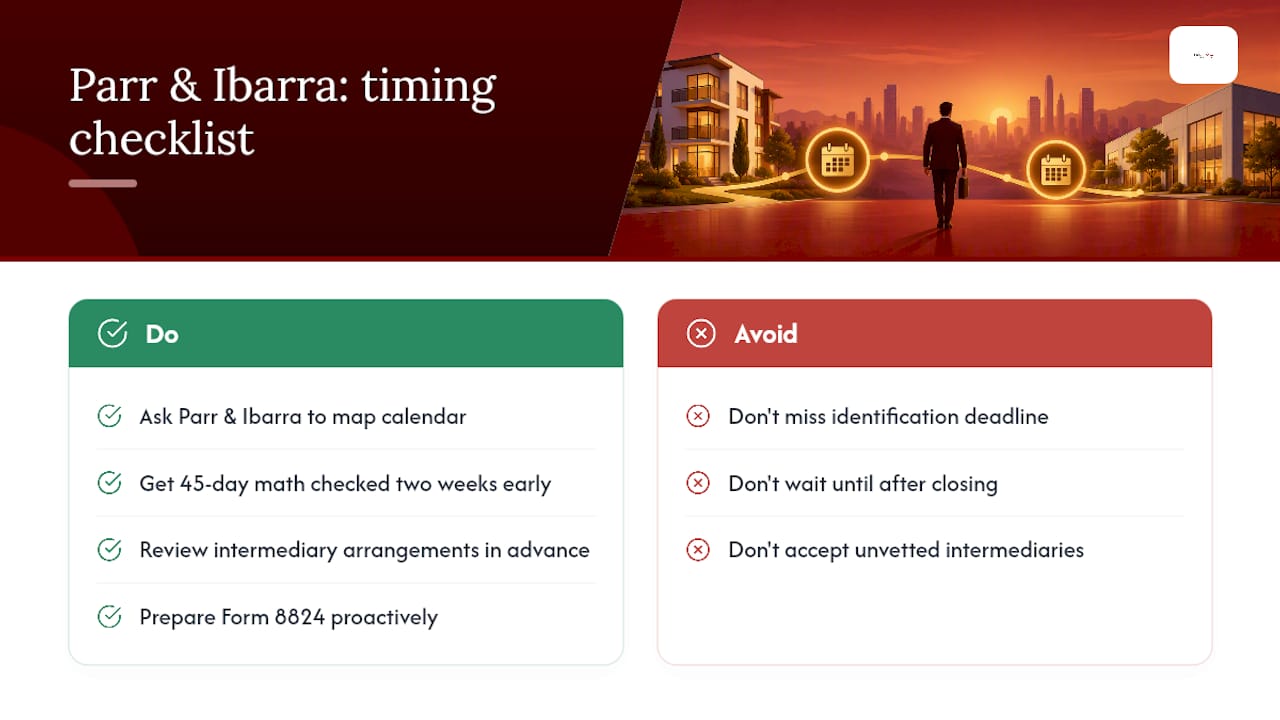
Parr & Ibarra CPA works with Dallas-Fort Worth investors before the sale closes, not after the deadlines have already passed. That means reviewing identification notices for wording and method compliance, vetting the qualified intermediary’s process, and preparing Form 8824 once the exchange closes. Bring your closing statements, intermediary accounting records, identification notices, and replacement property loan documents to that conversation. Coordinating those pieces early, alongside broader real estate tax strategies, is what keeps a tight 45 or 180-day window from becoming a missed one.
What Counts as Boot, and What Form 8824 Requires
A 1031 exchange defers gain, it doesn’t erase it, and the difference between “deferred” and “recognized” comes down to boot. Boot is any value you receive in the exchange that isn’t like-kind real property, cash left over after closing, debt relief where your new mortgage is smaller than your old one, or personal property thrown into the deal. Any boot you receive is taxable in the year of the exchange, even though the rest of the gain stays deferred.

The most common boot trigger is simple: buying a replacement property for less than you sold the relinquished property for, and pocketing the difference. Reducing your debt load without replacing it with new debt or additional cash into the deal creates the same effect. Both situations produce partial, not full, deferral.
Form 8824 is where all of this gets reported to the IRS. The form requires the dates the relinquished property was transferred and the replacement property was identified, along with the fair market values needed to calculate recognized gain versus deferred gain, according to the instructions for Form 8824. You’ll need this filed with your tax return for the year the exchange occurred, using the exact dates from your closing statements and identification notice. Getting those dates wrong, or missing the boot calculation entirely, is one of the more common ways an otherwise valid exchange generates an unexpected tax bill.
A Calendar-First Take on 1031 Timing
The investors who struggle with 1031 exchanges rarely misunderstand the tax code. They misjudge how little slack the calendar gives them. Treating day 45 and day 180 as soft targets instead of hard walls is where most timing failures start. A 1031 exchange defers your gain. It does not make the deadline flexible, and it does not make the tax disappear. Bring your CPA and intermediary into the conversation before you list the property, not after you’ve already got an offer in hand.
— Adan
Parr & Ibarra CPA Can Help You Stay on Schedule
A missed identification deadline costs you the entire deferral, not a partial one, which is why timing coordination matters as much as the tax return itself. Parr & Ibarra CPA brings big-firm technical depth to Dallas-Fort Worth investors with a team of more than 20 professionals, including multiple CPAs, who review identification notices, vet intermediary arrangements, and prepare Form 8824 as part of proactive tax planning rather than after-the-fact cleanup. That means someone checking your 45-day math before you’re two weeks out, not after. If you’re weighing a sale and want your timeline reviewed before you sign anything, reach out to Parr & Ibarra CPA and get your exchange calendar mapped out in advance.
This article is general information, not a substitute for advice from a qualified financial advisor. Consult a qualified financial professional about your own circumstances before acting on anything here.
Sources
FAQ
What is the timeline for a 1031 exchange?
You have 45 calendar days from the closing of your relinquished property to identify replacement property in writing, and 180 days total, or your tax return due date with extensions if that comes sooner, to close on the replacement. Both periods start on the same day and run concurrently under 26 CFR § 1.1031(k)-1.
What is the 200% rule in a 1031 exchange?
It’s one of three identification methods, alongside the three-property rule and the 95% rule, described in guidance tied to Form 8824.
What is the two-year rule for 1031 exchanges?
There isn’t a standalone “two-year rule” governing exchange timing. The deadlines that actually matter are the 45-day identification period and the 180-day exchange period; a two-year holding period sometimes comes up separately in related-party exchange rules, which fall outside the standard timing framework.
Will 1031 exchanges be eliminated in 2026?
Section 1031 remains active law with no scheduled repeal as of this writing, and any change would require new legislation. Investors should still confirm current status with a CPA before relying on 1031 treatment for a planned sale, since tax law can shift with new legislation.
Does filing a tax extension change my 1031 deadlines?
An extension can push out your 180-day exchange period if your return due date would otherwise fall before day 180, but it has no effect on the fixed 45-day identification deadline. That distinction, laid out under 26 U.S. Code § 1031, catches a lot of investors who sell late in the year.

