
Texas requires mixed beverage permit holders to pay a 6.7% gross receipts tax and collect an 8.25% mixed beverage sales tax, with monthly returns due on the 20th day of the following month. The permittee owes both, filing through Webfile, and must submit a report even in months with zero sales.
TL;DR:
- Permit holders must file monthly reports for both the 6.7% gross receipts tax and the 8.25% sales tax, using specific forms, even with zero sales.
- MXBGT cannot be passed to customers as a separate item, while MBST can be itemized and must be based on the actual sales price of each drink.
- Accurate recordkeeping includes daily sales logs, supplier invoices, inventory counts, and POS receipts to prepare for audits and avoid errors.
- Common mistakes include missing zero reports, misapplying MBST and MBGRT bases, and neglecting invoice organization, underscoring the benefit of professional CPA assistance.
Rates and Definitions: What MBGRT and MBST Mean
The Mixed Beverage Gross Receipts Tax (MBGRT) and the Mixed Beverage Sales Tax (MBST) are two separate taxes with two separate bases, and conflating them is one of the most common filing errors we see.
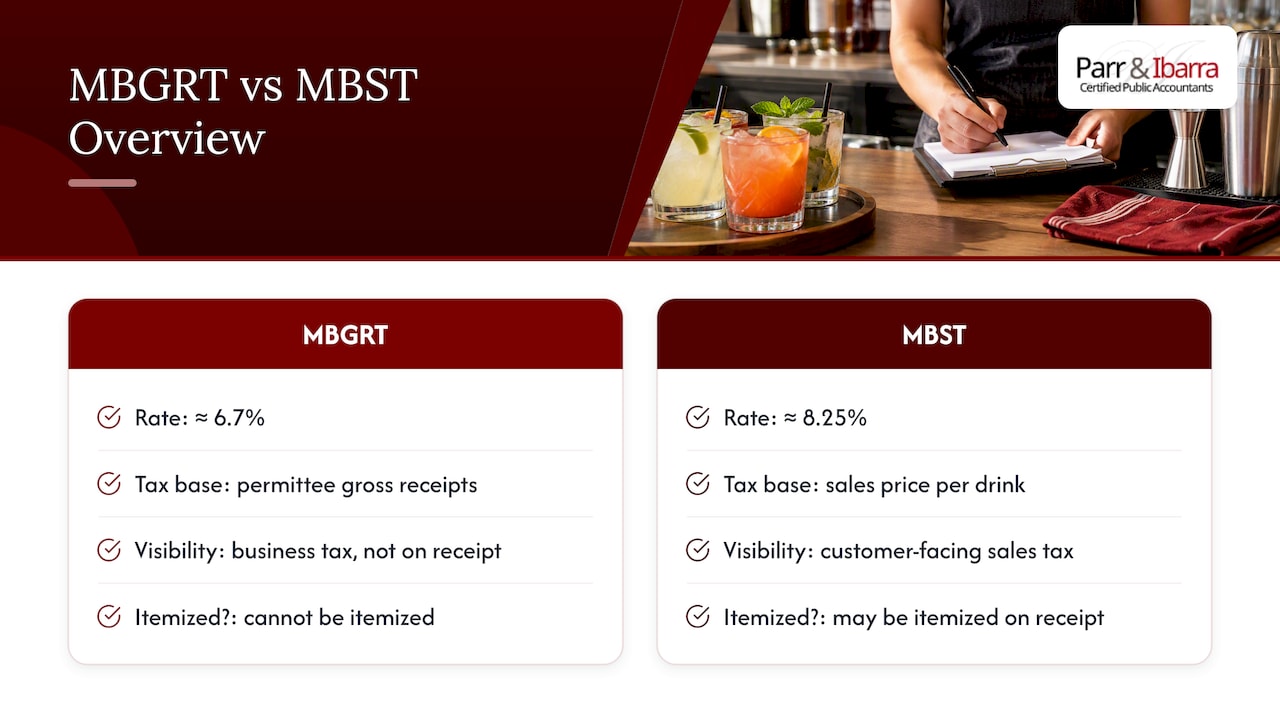
MBGRT applies at approximately 6.7% of a permittee’s gross receipts from selling, preparing or serving alcoholic beverages. It is a tax on the business itself, calculated on total receipts from mixed beverage sales, not on each individual drink. MBST, by contrast, applies at approximately 8.25% of the sales price of each alcoholic beverage and is meant to mirror a standard sales tax charged to the customer.
Both taxes cover distilled spirits, wine, beer, ice and the nonalcoholic mixers used in drinks consumed on the premises, as laid out in Texas Tax Code Chapter 183, which sets the statutory rates, due dates and penalty structure for both.
The billing distinction matters for your books. MBST can be itemized on the receipt or folded into the menu price, as long as your records consistently reflect which method you use. MBGRT cannot be passed to the customer as a separate line item: it is a cost of doing business, paid out of gross receipts, not collected at the register.
Who Must Pay and Which Sales Count
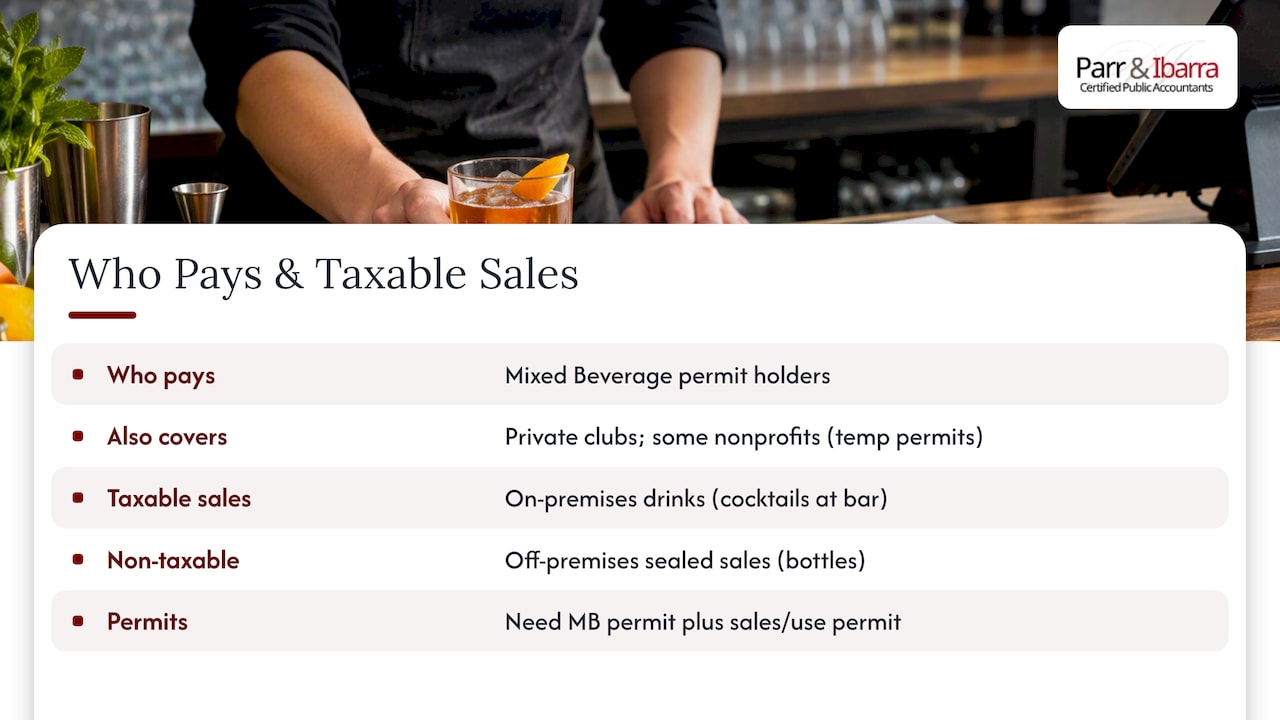
Mixed beverage tax obligations attach to holders of a Mixed Beverage Permit, and the rule extends to private clubs and, in many cases, nonprofit organizations running a temporary event permit that involves on-premises alcohol service. If your establishment serves drinks that customers consume on-site, you are almost certainly a mixed beverage permittee for tax purposes.
The on-premises distinction is the line that separates taxable mixed beverage sales from ordinary sales tax transactions. A cocktail served at the bar falls under MBGRT and MBST. A sealed bottle of beer sold for off-premises consumption typically falls under general sales and use tax instead. Edge cases trip up even experienced operators: a bartender mixing a drink using alcohol the customer brought in, a tasting fee charged at a wine bar, or a nonprofit gala serving wine under a temporary permit can all trigger mixed beverage tax depending on how the transaction is structured.
Holding a mixed beverage permit does not replace your sales and use tax permit. Most on-premises retailers need both to stay compliant.
Filing, Payment, and Systems: Meeting the 20th-Day Deadline
Both MBGRT and MBST are filed monthly, with returns generally due by the 20th day of the month following the reporting period. When the 20th lands on a weekend or legal holiday, the deadline shifts to the next business day, according to the Comptroller’s mixed beverage FAQ. A report covering January sales is due February 20, for example, pushed to the next business day if that date falls on a Saturday or Sunday.
Both taxes can typically be filed and paid through the Comptroller’s Webfile system, which also handles Texas sales tax filings on a similar schedule. A few operational points matter more than they first appear to:
- Permittee tax reports must be filed even if there were no mixed beverage sales during the period.
- Payment should accompany the return, not trail it by days or weeks.
- MBGRT reports typically use Form 67-100, with Form 67-101 as a related schedule.
- MBST reports use Form 67-103, with Form 67-104 as its companion schedule.
Missing a single monthly report, even a $0 one, starts the penalty clock the same way a missed payment does.
Penalties, Interest, and Security Requirements
Late filing or late payment on either tax carries a flat $50 penalty on top of percentage-based charges. A return filed between 1 and 30 days late adds a 5% penalty, and anything beyond 30 days adds another 5% on top of that. Interest begins accruing on the 61st day after the original due date, compounding the cost of letting a late report sit unresolved.
The Comptroller can also require a bond or other security instrument from permittees with a history of late payment or nonpayment, effectively forcing you to prepay your own risk. Beyond the financial penalties, repeated tax delinquency can create friction with TABC, since permit renewal and standing can be affected by unresolved state tax issues. A pattern of late mixed beverage filings rarely stays contained to just the tax side of the business.
Recordkeeping and Audit Readiness
TABC guidance calls for keeping invoices and purchase records on the premises for inspection, with two years commonly cited as the practical retention window. Digital records satisfy this requirement as long as they are accessible on-site and can be converted to paper on request, which means a cloud-based POS system works, provided staff can actually pull the records during an inspection.
A tight recordkeeping system for mixed beverage tax should include:
- Daily sales logs broken out by taxable on-premises sales versus exempt or off-premises sales.
- Supplier invoices for all alcohol purchases, organized by month.
- Inventory counts that reconcile against purchase and sales records.
- POS tickets or receipts showing how MBST was applied on each sale.
Pro Tip: Reconcile your daily POS sales totals against your monthly MBGRT and MBST reports before you file, not after; catching a mismatch in week one is far cheaper than catching it in an audit.
Forms, Downloads, and a Quick Completion Checklist
The Comptroller’s mixed beverage forms page hosts the PDFs you need: Form 67-100 for MBGRT reporting, Form 67-101 as its supplement, Form 67-103 for MBST reporting, Form 67-104 as its supplement, and Forms 67-102 or 67-105 for continuous bonds when the state requires one. Operators with multiple locations file a location supplement alongside the main report so receipts are allocated correctly across addresses.
Before submitting either report, run through this short checklist:
- Confirm the reporting period matches the correct calendar month.
- Verify gross receipts exclude MBST collected from customers.
- Match the location ID on the form to the correct permit address.
- Double check that any bond or security filing is current before submission.
Two Worked Examples and the Zero-Report Rule
Say a bar’s mixed beverage gross receipts for the month total $50,000. MBGRT owed is $50,000 times 6.7%, or $3,350, paid by the permittee out of that revenue.
Now say a single cocktail sells for $12.00 before tax. MBST at 8.25% adds $0.99 if itemized separately, bringing the total to $12.99.
- MBGRT base: gross receipts minus any MBST collected as a separate line item.
- MBST base: the sales price of each alcoholic beverage, whether itemized or embedded in the price.
The Mixed Beverage Taxes FAQ confirms that permittees must file monthly reports even with no sales to report, a rule that catches seasonal bars and newly licensed venues off guard more often than any rate calculation does.
What We See Go Wrong, and When to Call a CPA
The recurring mistakes we encounter are rarely about the rates themselves. Owners skip $0 reports during slow months, fold MBST into the MBGRT base by mistake, or let invoice storage slide until an inspection forces the issue. Monthly bookkeeping and a simple reconciliation habit catch most of this before it becomes a penalty. We think the right moment to bring in a CPA is before an audit notice arrives, not after: once penalties repeat or an exemption question gets complicated, the cost of getting it wrong outpaces the cost of getting help.
— Adan
How Parr & Ibarra CPA Supports Mixed Beverage Permit Holders
Staying current on two monthly tax filings, on top of running a bar or restaurant, is where most compliance slips start. We handle monthly bookkeeping that feeds directly into accurate MBGRT and MBST reporting, set up Webfile processes so filings go out on time every month, and step in when an audit notice or penalty letter lands on your desk.
We work with hospitality clients on the full cycle: reconciling daily sales against monthly reports, organizing invoice retention so TABC inspections go smoothly, and flagging exemption questions before they turn into disputes. If your reporting has fallen behind or you simply want one less deadline to track, our tax services page is the place to start, and our restaurant and bar industry page covers how we support hospitality businesses specifically.
This article is general information, not a substitute for advice from a qualified financial advisor. Consult a qualified financial professional about your own circumstances before acting on anything here.
FAQ
What is mixed beverage tax in Texas?
Mixed beverage tax in Texas is actually two taxes: the 6.7% Mixed Beverage Gross Receipts Tax paid by the permittee, and the 8.25% Mixed Beverage Sales Tax charged on alcoholic beverages sold for on-premises consumption. Both are filed monthly with the Texas Comptroller.
Are drink mixes taxable in Texas?
Yes. Nonalcoholic mixers and ice used in preparing alcoholic beverages for on-premises consumption are included in the taxable base for both MBGRT and MBST, even though they are not alcohol themselves.
Is tax 8.25% in Texas?
The 8.25% rate applies specifically to the Mixed Beverage Sales Tax on alcoholic drinks served for on-premises consumption, which is separate from the 6.7% Mixed Beverage Gross Receipts Tax paid by the permittee. General Texas sales tax rates differ by jurisdiction and apply to other categories of goods and services.
How much is a mixed beverage permit in Texas?
Mixed beverage permit fees are set and published by the Texas Alcoholic Beverage Commission rather than the Comptroller, and they are not publicly listed in the sources used for this tax guide. Contact TABC directly for current permit fee schedules tied to your specific license type.
Sources
- Mixed Beverage Gross Receipts Tax — Texas Comptroller
- Texas statutes — Chapter 183. Mixed Beverage Taxes

