

Self-employed taxpayers and business owners who use a personal vehicle for work can deduct business mileage, while most W-2 employees cannot claim unreimbursed commuting after the One Big Beautiful Bill Act. The IRS standard mileage rate for business use climbed to 76 cents per mile effective July 1, 2026, up from 72.5 cents per mile earlier in the year. You can use that flat rate or track actual vehicle costs, but either path requires a contemporaneous mileage log.
TL;DR:
- Business site travel, client visits, and qualifying home office trips count; commuting does not, and assignments lasting over a year lose temporary status.
- For 10,000 miles driven after July 1, standard mileage yields $7,600; if actual costs total $9,000 and business use is 80%, actual expenses yield $7,200.
- Standard mileage is unavailable when five or more vehicles operate simultaneously for business, and choosing it for a leased vehicle commits you throughout the lease.
- Record each trip contemporaneously with its date, mileage, business purpose, and destination; GPS data must capture all four details to support the deduction.
- Employers can reimburse staff through an accountable plan without creating taxable wages, but those reimbursements do not produce a separate employee deduction.
2026 IRS standard mileage rates and effective dates
The IRS adjusted its optional standard mileage rates mid-year, a move it makes when fuel costs and vehicle operating expenses shift enough to justify a correction. For 2026, the rates break down as follows:
- Business use: 72.5 cents per mile from January 1 through June 30, then 76 cents per mile effective July 1, 2026.
- Medical and moving mileage: 23.5 cents per mile, unchanged by the mid-year adjustment.
- Charitable mileage: 14 cents per mile, a rate set by statute rather than adjusted annually.
The IRS Revenue Bulletin announcing the revised rates modifies the earlier Notice 2026-10 and confirms the July 1 effective date for the business rate increase. Each rate also carries a built-in depreciation component used to reduce your vehicle’s basis when you later sell or trade it in, a detail worth flagging to whoever prepares your return since it affects gain or loss calculations down the road.
Who qualifies and which trips are deductible vs commuting
The business mileage deduction belongs primarily to self-employed people and business owners: Schedule C filers, sole proprietors, partners, and owners of pass-through entities who use a personal vehicle for work. Not every mile you drive counts, though, and the line between deductible business travel and nondeductible commuting trips up a lot of taxpayers.
- Travel between two business locations, such as driving from your office to a second job site, is fully deductible.
- Trips to meet clients, pick up supplies, or run business errands qualify as business mileage.
- Driving from a qualifying home office to a client’s location can count as business mileage when your home serves as your principal place of business.
- Ordinary commuting from home to a regular, fixed workplace remains personal and nondeductible, even if you conduct business calls along the way.
Rev. Rul. 99-7 governs the trickier cases involving temporary work locations. Trips between your home and a temporary job site are generally deductible, but Publication 463 notes that an assignment expected to last more than a year stops being temporary and loses that treatment. If you work from a fixed office most days but occasionally travel to a short-term project site, that distinction determines whether the miles count.
Standard mileage vs actual expense method: which saves more
You get to pick between two calculation methods, and the right choice depends on your vehicle, your expenses, and how it was acquired. Topic No. 510 lays out the basic mechanics of each.
The standard mileage method multiplies your business miles by the IRS rate and replaces a laundry list of operating costs in one figure. Parking fees and tolls are deductible on top of that rate, so you don’t lose those costs by choosing simplicity.
The actual expense method instead tracks every real cost of operating the vehicle: depreciation or lease payments, fuel, insurance, repairs, and registration fees. You then apply your business-use percentage (business miles divided by total miles) to the total. This method takes more bookkeeping but can produce a bigger deduction for a vehicle with high financing costs or heavy depreciation.
A few rules limit your flexibility:
- Choosing standard mileage for a leased vehicle locks you into that method for the entire lease term.
- Taxpayers operating five or more vehicles simultaneously for business cannot use the standard mileage rate and must use actual expenses.
- Switching from standard mileage to actual expenses in a later year triggers different depreciation rules than if you’d used actual expenses from the start.
One figure worth running every year: at 76 cents per mile, 10,000 business miles driven after July 1, 2026 produce a $7,600 deduction under the standard method, before adding parking and tolls. If your actual costs for that same vehicle (gas, insurance, repairs, depreciation) total $9,000 and your business-use percentage is 80%, the actual expense method yields $7,200, slightly less in this example. Running both calculations is the only way to know which applies to your situation.
How to calculate and report the deduction on your return
The arithmetic itself is simple. Multiply your total business miles for the year by the applicable rate, remembering to split the calculation across the two 2026 rate periods if you drove meaningful miles both before and after July 1.
- Add business miles driven January 1 through June 30 and multiply by 72.5 cents, then add business miles from July 1 through December 31 multiplied by 76 cents.
- Combine both figures, add deductible parking and tolls, and enter the total on Schedule C, Part II, under car and truck expenses.
- Complete Form 4562 if you’re claiming vehicle depreciation under the actual expense method or if you need to report listed-property details in Part V, which covers passenger automobiles and requires mileage and business-use percentage entries.
- Keep a copy of your mileage summary with your tax file in case the IRS requests substantiation later.
Self-employed taxpayers deduct these costs directly against business income. W-2 employees, by contrast, generally cannot deduct unreimbursed mileage at all following the One Big Beautiful Bill Act changes; employer reimbursements made through an accountable plan remain nontaxable to the employee but don’t generate a separate deduction. If you employ staff who drive for business, structuring reimbursements through an accountable plan avoids creating taxable wages.
Recordkeeping and substantiation: what to log and what receipts to keep
The IRS doesn’t take your word for business mileage. Publication 463 requires a contemporaneous record, meaning one kept at or near the time of each trip rather than reconstructed later from memory.
A compliant mileage log needs four elements every time:
- The date of each trip.
- Starting and ending odometer readings, or total miles driven.
- The business purpose of the trip.
- The destination and, where relevant, the client or site visited.
You can keep this on paper in a dedicated notebook, in a spreadsheet you update weekly, or through a GPS-based mileage tracking app that logs trips automatically and exports monthly reports. GPS records satisfy the IRS as long as they capture all four required details, not just raw location data. Parking and toll receipts should be kept separately from the mileage log itself, since those are documented by receipt rather than by trip entry.
Pro Tip: Reconcile your mileage log against your odometer or GPS export at the end of each month, not at tax time, so a missing week doesn’t turn into a guessing game in April.
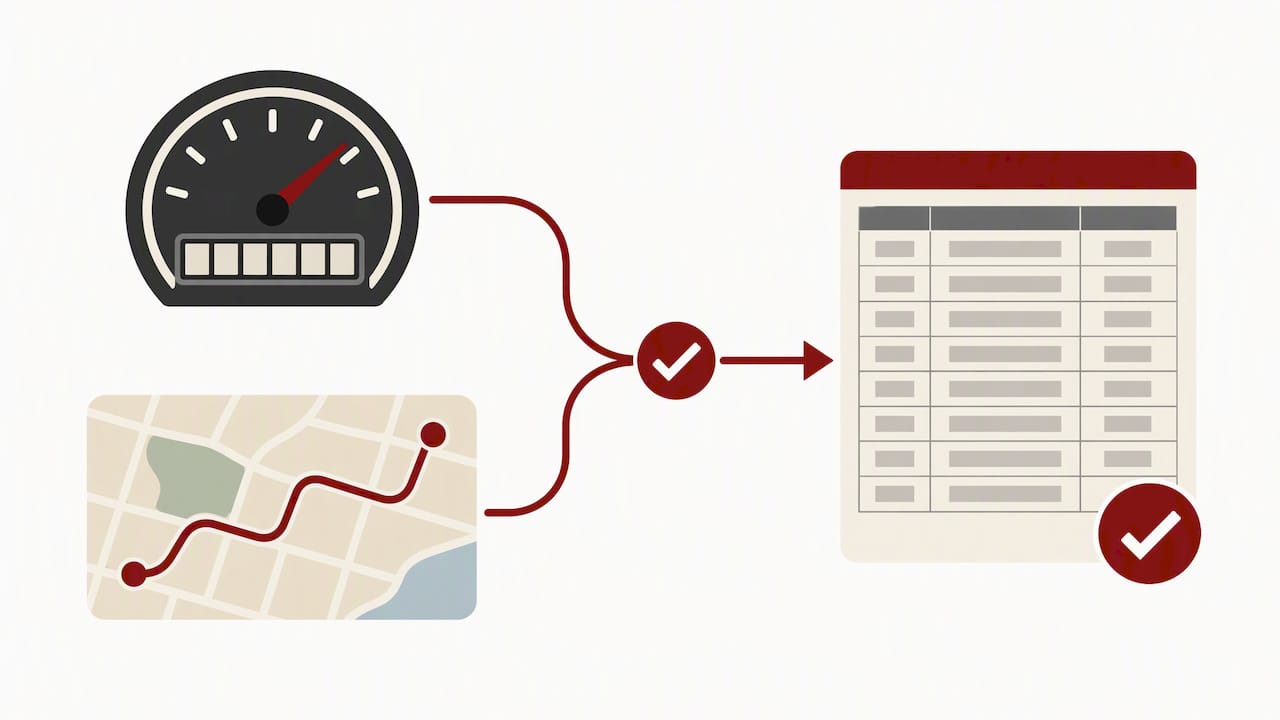
A log missing even one of the four elements can give an examiner grounds to disallow part of the deduction, so completeness matters more than volume.
Common pitfalls, audit triggers, and practical tips to avoid mistakes
Mileage deductions draw IRS attention disproportionately because they’re easy to inflate and hard to verify without good records. A few patterns show up again and again in exams.
- Logs reconstructed months later, often recognizable by suspiciously round numbers or identical daily mileage figures.
- Commuting miles folded into business totals without separating the regular commute from legitimate business trips.
- Switching mileage methods on a leased vehicle, which violates the lease-term commitment rule.
- Claiming 100% business use of a vehicle that’s also used for personal errands, without a log showing the split.
When the IRS does examine a mileage claim, examiners typically request the mileage log itself, calendar or appointment records that corroborate trip purposes, and receipts for parking and tolls claimed separately. IRS guidance has long recommended that taxpayers compute the deduction under both methods before filing, since the gap between them can be meaningful depending on vehicle costs.
Running both calculations annually is one of the more reliable ways to catch an error before it becomes an audit issue, according to longstanding IRS recordkeeping guidance. Keep contemporaneous logs, retain every parking and toll receipt, and reconcile your odometer or GPS data on a monthly rather than annual basis.
Parr & Ibarra CPA perspective: how a CPA partnership makes mileage claims defensible
Mileage deductions look simple until an examiner asks for backup. Our tax planning and bookkeeping practice focuses on catching the gaps before the IRS does: reviewing mileage logs for the four required elements, advising on which method actually produces a larger deduction for a given vehicle, calculating depreciation when the actual expense method applies, and preparing Form 4562 correctly for listed property. When a return does get questioned, we provide audit support to assist with documentation requests. Combining big-firm technical depth with a community-focused team means mileage records get careful scrutiny to ensure accuracy.
— Adan
Get help claiming your business mileage deduction correctly
Between tracking two 2026 rate periods, choosing a calculation method, and keeping a log that survives IRS scrutiny, mileage deductions take more precision than a quick spreadsheet entry. Our tax preparation and tax planning services cover exactly this kind of detail, alongside bookkeeping, outsourced CFO support, and audit assistance when a return needs defending. If you want your 2026 mileage deduction calculated correctly the first time, schedule a consultation through our tax services page and let us handle the math.
This article is general information, not a substitute for advice from a qualified financial advisor. Consult a qualified financial professional about your own circumstances before acting on anything here.
FAQ
How does the new $6,000 deduction work?
This refers to a separate federal deduction tied to the One Big Beautiful Bill Act changes rather than the mileage deduction itself, and it does not replace or combine with standard mileage calculations. Consult a tax professional to confirm how it applies to your specific filing situation, since eligibility rules differ from the vehicle mileage rules covered here.
What are the new business mileage rates for 2026?
The IRS business mileage rate was 72.5 cents per mile from January 1 through June 30, 2026, then rose to 76 cents per mile effective July 1, 2026. Medical and moving mileage stayed at 23.5 cents per mile, and charitable mileage remained 14 cents per mile for the full year.
What are the IRS rules for mileage deductions?
Self-employed taxpayers and business owners can deduct business mileage using either the standard mileage rate or actual vehicle expenses, but not ordinary commuting between home and a regular workplace. The IRS requires a contemporaneous log showing the date, mileage, business purpose, and destination of each trip, and leased vehicles using standard mileage must stick with that method for the full lease term.
Is it worth claiming mileage on taxes?
For most self-employed taxpayers who drive meaningfully for work, yes: even a modest number of business miles at 76 cents per mile adds up to a real deduction against business income. The better question is which method, standard mileage or actual expenses, produces the larger number for your specific vehicle and driving pattern, which is worth calculating both ways each year.
Sources
- Standard mileage rates | Internal Revenue Service
- IRS Revenue Bulletin: Revised standard mileage rates (IRB 2026-29)

