
Staying compliant starts with four habits: keep business and personal money in separate accounts under your EIN, reconcile your books every month, record owner draws as equity rather than expenses, and match your bookkeeping to whatever tax return your LLC’s classification requires, whether that’s Schedule C, Form 1065, or Form 1120-S. The biggest risks that undo all of it are commingled funds, misclassified wages, and missed payroll deposits.
TL;DR:
- Keeping business and personal finances separate and reconciling accounts monthly are essential to avoid commingled funds and ensure compliance.
- LLCs default to different bookkeeping requirements: Schedule C for disregarded entities, Form 1065 with K-1s for partnerships, and payroll records for S-Corps or full accrual books for C-Corps.
- Electing S-Corp status requires owners to pay themselves reasonable wages through payroll, with quarterly filings and proper documentation to avoid penalties.
- Proper tracking of capital accounts, contributions, profits, and guaranteed payments is critical for multi-member LLCs to prevent disputes and IRS scrutiny.
- When complexity increases (more members, multi-state operations, inventory, or audits), engaging a CPA ensures books remain compliant and operationally useful.
How LLC Tax Classification Changes Your Bookkeeping
Your LLC’s federal tax classification decides which books you keep and which forms those books need to support. A single-member LLC is a disregarded entity by default, meaning profit and loss flow to your personal return on Schedule C. Multi-member LLCs default to partnership treatment, filing Form 1065 with a K-1 issued to each member. Either structure can elect S-Corp or C-Corp treatment instead, which changes the bookkeeping load substantially.
Each classification requires distinct records:
Disregarded entity: income and expense ledger supporting Schedule C, no payroll unless you have employees
Partnership: per-member capital accounts, allocation schedules, and Form 1065 with K-1s
S-Corp election: payroll records, W-2s, Form 941, and a clear split between wages and distributions
C-Corp election: full accrual-basis books, retained earnings tracking, and Form 1120
Classification also dictates how owner transactions get coded. A draw is a return of equity for a disregarded entity or partnership. For an S-Corp, that same withdrawal might need to be wages first, subject to payroll tax, before anything can be treated as a distribution.
Bookkeeping Checklist for Single-Member LLCs
Running a one-owner LLC doesn’t mean simple books. It means fewer moving parts, but the same discipline. Skip the discipline and you risk the exact thing an LLC is supposed to prevent: a court treating your business and your personal finances as one.
- Open a dedicated business bank account and credit card, tied to your EIN, before you take your first client payment.
- Never post a personal expense to the business account, even “just this once” for something you plan to reimburse later.
- Record every owner withdrawal as a draw against equity, not as a business expense. Draws don’t reduce taxable income.
- Log owner contributions (cash or assets you put into the business) as paid-in capital, not revenue.
- Reconcile the bank and credit card accounts monthly, categorize every transaction, and produce a profit-and-loss statement and cash flow summary before moving to the next month.
- Flag and resolve uncoded or “ask my accountant” transactions weekly instead of letting them pile up for tax season.
Pro Tip: Keep a running folder, digital or physical, labeled by month, with bank statements, receipts, and invoices already sorted. When a lender or the IRS asks for documentation, the difference between an afternoon of pulling files and a week of scrambling is usually just this one habit.
A single-member setup that follows this list end to end supports Schedule C cleanly and gives you real numbers to run the business by, not just numbers to survive tax season. The Bookkeeping for Small Business Owners 2026 Guide walks through the monthly close in more depth if you want a template to hand to a bookkeeper.
Capital Accounts and K-1 Reporting for Multi-Member LLCs
Partnership bookkeeping adds a layer single-member LLCs don’t have to think about: tracking what each member actually owns of the business, not just what the business owns overall. Get this wrong and members receive K-1s that don’t match reality, which invites IRS scrutiny fast.
Each member needs an individual capital account that rolls forward with:
- Beginning balance plus contributions (cash, property, or services at fair value)
- Allocated share of profit or loss, per the operating agreement
- Distributions taken during the year
- Ending balance, which becomes next year’s starting point
Guaranteed payments deserve their own line. Unlike a distribution, a guaranteed payment to a member for services or capital is treated as an expense to the partnership and ordinary income to the member, taxed differently than a distributive share of profit. Confusing the two is one of the most common errors that trips up multi-member LLCs at year-end.
Before your CPA can prepare Form 1065 and issue K-1s, bookkeeping needs to hand over reconciled capital accounts, an allocation schedule matching the operating agreement’s profit-sharing terms, and documentation for any guaranteed payments made during the year. Skipping the reconciliation step is the fastest way to generate a K-1 a member disputes in April.
What Changes When You Elect S-Corp or C-Corp Status
Electing S-Corp treatment is often a smart move once net income is high enough that splitting owner pay between wages and distributions meaningfully reduces self-employment tax. But that tax benefit comes with a bookkeeping trade-off most owners underestimate going in.
Once you elect S-Corp status, the IRS expects you to pay yourself “reasonable compensation” through actual payroll, not just periodic draws. That means:
- Running payroll on a regular schedule, with W-2s issued annually
- Filing Form 941 quarterly to report and deposit payroll taxes
- Keeping payroll tax deposits current, since late deposits carry penalties the IRS enforces aggressively
- Documenting how you arrived at a “reasonable” salary figure, in case of audit
Payroll compliance by the numbers: once an S-Corp election is active, payroll isn’t optional bookkeeping housekeeping. It’s a legal requirement tied directly to the entity’s tax status, and missing a 941 filing or a payroll tax deposit creates exposure well beyond a late fee.
S-Corp status also tends to push owners toward accrual accounting, since matching revenue to the period it’s earned makes it far easier to plan reasonable compensation and estimate quarterly tax payments accurately.
The Recordkeeping Checklist That Protects Your LLC
The IRS requires businesses to keep records that substantiate income and deductions for as long as those records might matter to a tax return, and that standard shows up again whenever an examiner, lender, or landlord asks a question your memory can’t answer.
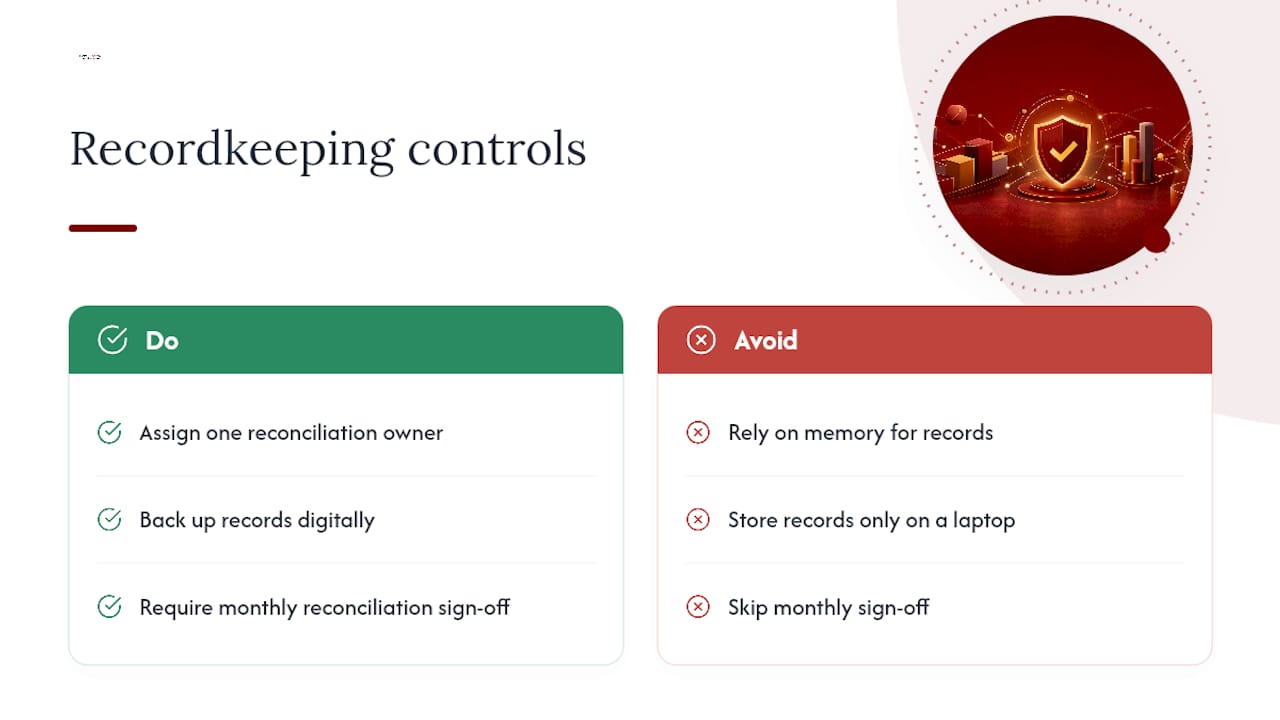
Beyond the documents themselves, three internal controls make the difference between organized books and a scramble: assign one person as the responsible party for reconciliations, back up records digitally so a laptop failure doesn’t erase a year of work, and require a monthly sign-off once reconciliations are complete.
Bookkeeping compliance doesn’t stop at the federal level either. The SBA’s guidance on staying legally compliant points to state-level obligations, annual reports, franchise tax filings, and license renewals, that tie directly into your books, since missing one can lapse your LLC’s good standing even when your federal filings are perfect.
A Simple Monthly and Quarterly Bookkeeping Routine
A routine only works if it’s boring enough to repeat without willpower. Here’s the sequence that keeps books audit ready without eating a whole weekend every month.
- Pull bank and credit card feeds and clear any duplicate or pending transactions.
- Reconcile each account against its statement balance, resolving discrepancies before moving forward.
- Categorize every transaction, flagging anything unclear for follow-up instead of guessing.
- Generate the profit-and-loss statement and balance sheet, and compare them to the prior month.
- File receipts and invoices tied to that month’s transactions in your document system.
Quarterly, layer on estimated tax payments, payroll tax deposits if you’re running an S-Corp, and sales tax remittances if you collect it. Each of those needs its own supporting record trail, since a missed sales tax filing in one state can trigger penalties independent of anything happening on your federal return.
Pro Tip: Set up bank feed rules for recurring vendors and clients early. A rule that auto-categorizes your recurring software subscription saves maybe thirty seconds each time, but across a year of transactions, that’s the difference between a two-hour close and a two-day one.
When It Makes Sense to Bring In a CPA
Some LLCs outgrow spreadsheet bookkeeping fast, and there are clear signals worth watching for rather than waiting for a filing deadline to force the decision.
- You’ve added a second or third member and need capital accounts tracked correctly for K-1 purposes
- You’ve elected S-Corp status and now need payroll run and reasonable compensation documented
- You operate in more than one state and face multi-state tax registration
- You’re holding inventory, which complicates cost accounting beyond simple cash-basis tracking
- You’ve been flagged for an audit, or you simply want your books audit-ready before that happens
Books that are technically compliant but operationally useless still cost you money, in missed deductions, in bad cash flow decisions, and in the hours you spend untangling a mess that a monthly close would have prevented.
Parr & Ibarra CPA works with Dallas-Fort Worth business owners at exactly these inflection points, combining a monthly close process with payroll management and compliance audit support so growing LLCs don’t outrun their own records.
What Twenty Years of Bad Books Have in Common
Every messy set of LLC books traces back to the same three failures: commingled accounts, draws recorded as expenses, and payroll treated as optional after an S-Corp election. Fix those three and most compliance problems disappear before they start.
Big-firm rigor paired with a community-sized relationship tends to catch these issues before they become IRS problems, not after. If your own books haven’t been audited by a second set of eyes in a while, that’s usually the first sign it’s time.
— Adan
Hand Your Books to People Who Live in the Tax Code
A spreadsheet template gets you started, but it won’t flag a misclassified draw or catch a missed 941 deposit before it becomes a penalty. Parr & Ibarra CPA is the alternative to guessing your way through compliance: a Dallas-Fort Worth team of over 20 professionals, including multiple CPAs, running monthly reconciliations, payroll, and tax filings as one connected process instead of separate fire drills.
Whether you’re a single-member LLC ready to hand off the monthly close or a multi-member partnership needing capital accounts done right, the bookkeeping services outlined here cover the exact ground this article walks through. If your books have already fallen behind, the cleanup process gets you current before the next filing deadline. Book a consultation and bring your last three months of bank statements. That’s enough for Parr & Ibarra CPA to tell you exactly where your books stand.
Where to Verify This Yourself
For primary guidance, see the IRS pages on recordkeeping and Schedule C, plus the SBA’s compliance guide. For a deeper walkthrough, see Parr & Ibarra CPA’s bookkeeping guide.
This article is general information, not a substitute for advice from a qualified financial advisor. Consult a qualified financial professional about your own circumstances before acting on anything here.
Sources
- Tax Guide for Small Business (Publication 334) | Internal Revenue Service
- Stay legally compliant | U.S. Small Business Administration
- LLC Accounting Guide: Setup, Tax Rules & Bookkeeping Requirements — Vertaccount
FAQ
Should My Bookkeeping Business Be an LLC?
Forming an LLC for a bookkeeping practice separates your personal assets from business liability and lets you choose your tax classification, which most sole practitioners find worth the setup cost once revenue grows past a few clients.
How Do I Keep My LLC Compliant?
Keep business and personal accounts separate, reconcile your books monthly, file the tax return your classification requires (Schedule C, Form 1065, or Form 1120-S), and stay current on state annual reports and licenses.
What Are Common LLC Bookkeeping Mistakes to Avoid?
The most damaging mistakes are commingling personal and business funds, recording owner draws as expenses instead of equity withdrawals, and skipping payroll after electing S-Corp status.
How Do I Keep Books for a One-Person LLC?
Open a dedicated business bank account under your EIN, record every draw and contribution as equity rather than income or expense, and reconcile the account monthly to produce an accurate profit-and-loss statement.

