
A defined benefit plan is an employer-sponsored retirement plan that promises each participant a specific benefit at retirement, set by a formula rather than by investment results. For a profitable business owner in their 40s, 50s or 60s, it can also be the largest tax deduction available: contributions are sized to fund the promised benefit, so they can far exceed what a 401(k) allows. The price is real. You take on investment risk, annual actuarial work and a compliance calendar you cannot skip.
This guide covers how these plans work, the 2026 limits, what they cost to run, how a cash balance plan differs, and how to tell whether one fits your business.
TL;DR
- A defined benefit plan promises a formula-based benefit. The employer, not the employee, carries the investment and longevity risk.
- For 2026, the annual benefit limit is the lesser of 100% of average pay over the highest three consecutive years or $290,000, up from $280,000 in 2025.
- The plan needs an enrolled actuary every year and a Form 5500 with Schedule SB, generally due July 31 for a calendar-year plan.
- It fits steady, high-profit owners who are close to retirement and can commit to funding. It is a poor fit for volatile income.
- A cash balance plan is a hybrid design that many small businesses prefer because the benefit is easier to explain and track.
What a defined benefit plan actually is
The IRS describes a defined benefit plan as one that provides a benefit based on a fixed formula. The formula usually weighs salary, age and years of service. Most people know the idea as a traditional pension: a monthly check for life, such as a set amount starting at age 65.
The contrast with a 401(k) is the whole point:
| Defined benefit plan | 401(k) or other defined contribution plan | |
|---|---|---|
| What is fixed | The benefit at retirement | The contribution |
| Who bears investment risk | The employer (plan sponsor) | The employee |
| Annual contribution | Calculated by an actuary, varies year to year | Chosen within set limits |
| Ongoing administration | Actuary, Form 5500 with Schedule SB | Lighter, though still regulated |
| Deduction potential | Often much higher for older owners | Capped at a lower dollar limit |
The Department of Labor frames the responsibility side: under ERISA, the people who exercise discretionary control over plan management or assets are fiduciaries, and the sponsor of a defined benefit plan carries the funding obligation. That is why owners should treat this as a governance decision, not just a tax move.
The 2026 limits that shape the deduction
Two numbers matter most.
The benefit limit. For 2026, a participant’s annual benefit cannot exceed the lesser of 100% of their average compensation for the highest three consecutive years or $290,000. The 2025 figure was $280,000.
The pay cap. The maximum compensation that can be counted when figuring contributions and benefits is $350,000 for 2025 and $360,000 for 2026.
Notice that there is no flat contribution ceiling. The deductible amount is whatever the actuary calculates is needed to fund the benefit, within these limits. One published 2026 guide to cash balance plans illustrates that estimated contributions rise with age for an owner earning $300,000 or more, which is the logic at work: the fewer years left to fund the benefit, the more must go in each year. Treat any such illustration as a rough estimate. Your own number comes only from an actuary running your census data.
A simple way to picture it
Suppose an owner is 58, takes steady W-2 pay near the compensation cap, and already maxes out a 401(k). The remaining years to a target retirement age of 65 are short, so the actuary must fund the target benefit quickly. That produces a large annual contribution, and the business deducts it. The same owner at 40 would see a much smaller required contribution, because there is time for the money to grow. This is why defined benefit plans attract owners later in their careers.
That example is illustrative, not a quote. Actual contributions depend on plan design, assumptions and the staff you employ.
What it costs to run: the part owners underestimate
The tax deduction gets the attention. The overhead decides whether the plan was a good idea.
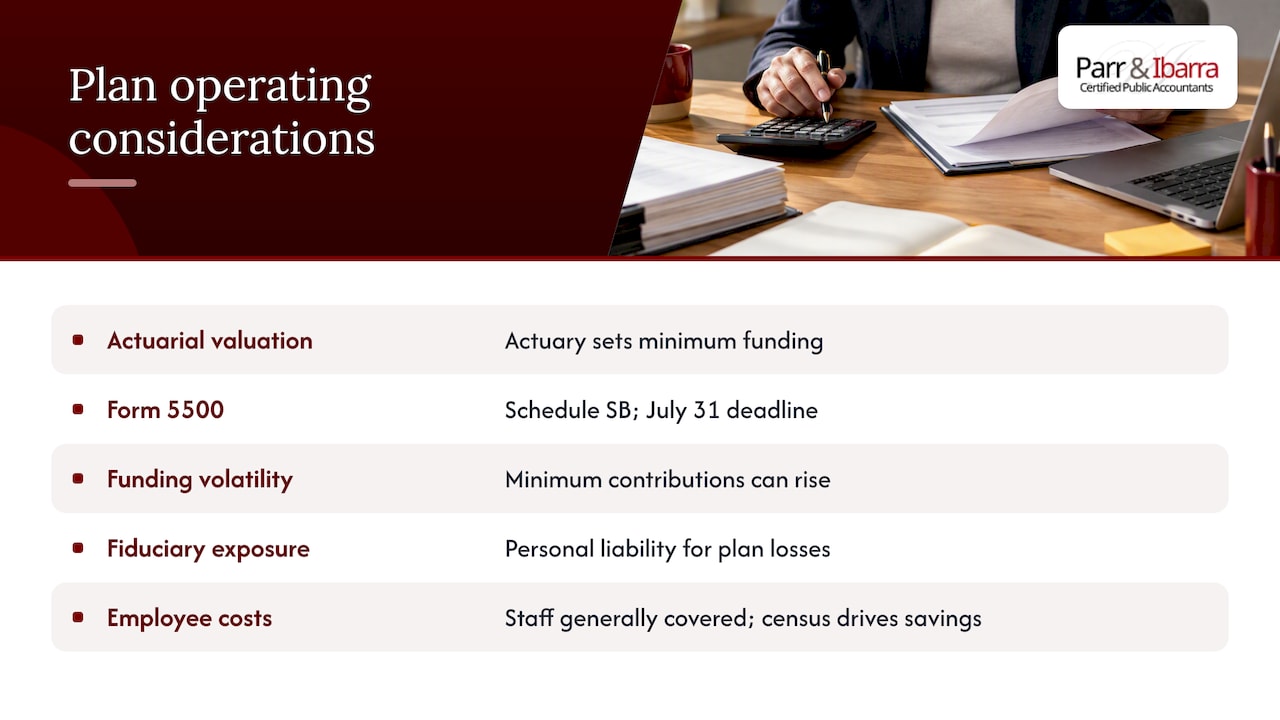
Annual actuarial valuation. Unlike a 401(k), these plans need an enrolled actuary to determine minimum funding. The IRS notes the work rests on actuarial assumptions, market performance and mortality tables. For 2026, the IRS published updated static mortality tables for these plans.
Form 5500 and Schedule SB. The IRS, Department of Labor and PBGC created the Form 5500 series to meet ERISA reporting rules. A defined benefit plan files Form 5500 with a Schedule SB signed by the enrolled actuary. It is generally due by the last day of the seventh month after the plan year ends, so July 31 for a calendar-year plan, with an extension available on Form 5558. Late filing carries steep penalties: up to $1,100 per day from the DOL, plus $1,000 for failing to provide actuarial information.
Funding volatility. Required contributions are not optional once the plan exists. If markets fall or assumptions change, the minimum can rise. Budget for a bad year, not just a good one.
Fiduciary exposure. The DOL warns that fiduciaries who fall short of the plan’s funding and investment requirements can be held personally liable for losses. A documented, prudent investment process is mandatory.
Employee costs. If you have staff, they generally must be covered under the plan’s nondiscrimination rules. Your employee census is a major driver of net savings, so run the numbers before you commit.
Retroactive adoption and its catch
Adopting a plan by your business tax return due date, including extensions, and treating it as effective for the prior year is possible under the SECURE Act. The IRS Form 5500 guidance is clear that this brings added paperwork, including retroactive actuarial certification and retaining both the current-year and the retroactive-year Schedule SB. Retroactive adoption is a useful safety valve for a surprisingly profitable year, but it is not a substitute for planning in advance.
Cash balance plans: the hybrid most small businesses consider
A cash balance plan is legally a defined benefit plan, but it presents the benefit as a hypothetical account. Each participant gets a pay credit, often a percentage of pay or a flat amount, plus an interest credit set by the plan. The statement looks like a 401(k) balance even though the employer still guarantees the credits and carries the investment risk.
The IRS’s own audit guidance explains why hybrids spread: they deliver more predictable, portable and transparent outcomes than traditional final-average-pay plans, which reward long-tenured employees. For a business owner, the appeal is that a cash balance design still allows much larger funded and deductible amounts than a defined contribution plan alone.
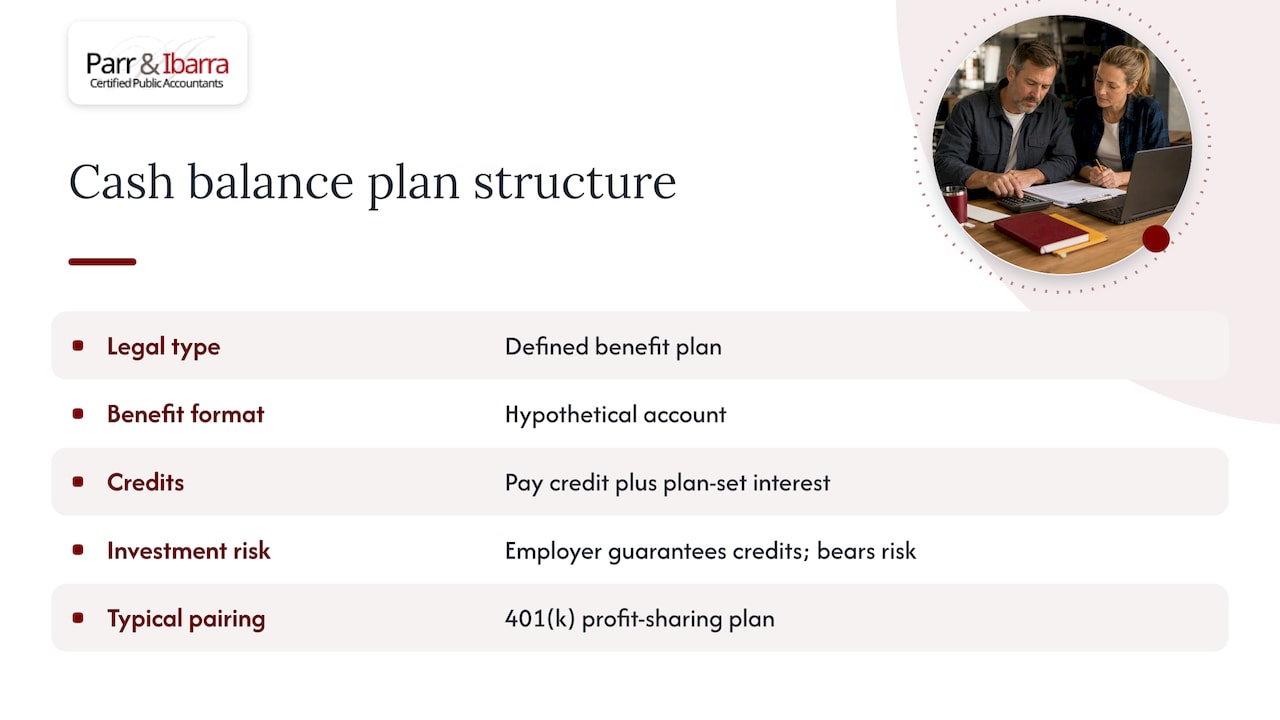
The usual small-business setup pairs a cash balance plan with a 401(k) profit-sharing plan. That combination is where owners see the biggest total deductions, though the profit-sharing piece is often limited by the way the two plans interact. The details depend on your plan documents and your actuary’s testing, so do not assume the maximum from a general illustration.
Traditional versus cash balance, side by side
| Feature | Traditional defined benefit | Cash balance |
|---|---|---|
| How the benefit is stated | Monthly income at retirement | Hypothetical account balance |
| Who it favors | Long-tenured, older participants | Mobile workforce, easier communication |
| Portability | Limited | Lump sum can usually be rolled over at departure |
| Fit for a small practice | Possible | Most common |
If you employ younger staff, the cash balance format often explains the benefit more clearly and avoids surprising anyone with accrual math.
What happens if the plan ends: PBGC
When a single-employer plan terminates without enough money, the Pension Benefit Guaranty Corporation guarantees vested benefits up to legal limits. For 2026, the maximum monthly guarantee for a worker retiring at 65 under a straight-life annuity is $8,113.64, and for a 60-year-old it is $5,273.87. The guarantee varies with age, termination year and annuity form.
For owners, the practical reading is this: PBGC protection is for participants, not a shield for the sponsor. If you terminate the plan, you will want a clean wind-down, adequate funding and a plan for how the assets are distributed or rolled over. Do that with your CPA and actuary before you decide, not after.
Is a defined benefit plan right for you?
It tends to fit when most of these are true:
- Income is high and steady. You can reliably fund a large contribution for at least several years.
- You are within roughly 10 to 15 years of retirement. This is general professional experience, not a rule. The tax advantage grows with age.
- You have already maxed your 401(k). There is nothing left to shelter with simpler tools.
- The employee cost is acceptable. Coverage for staff is part of the math.
- You accept the ongoing overhead. Actuary fees, filings and fiduciary duties are permanent line items.
It tends to be a poor choice when profits swing widely, when you may sell the business soon without a plan for the plan, or when cash flow is already tight. A required contribution in a lean year is a hard lesson.
Sole proprietors, S corporation owners, partners in professional practices and real estate operators with consistent management income are common candidates. Whether the deduction works for you also depends on how your pay is structured, which is why it belongs inside a broader owner compensation conversation. Our guide on tax-efficient owner compensation for 2026 covers the salary and distribution side, and the qualified business income deduction guide explains how a large retirement deduction can interact with that benefit.
Questions to answer before you call an actuary
- What do my last three years of income look like, and what do I forecast?
- How many employees do I have, and what are their ages and pay?
- Could I fund this plan in a year when revenue drops by a third?
- What is my exit horizon? A sale or succession changes the plan’s fate, and our business succession and exit planning work is built around that question.
How to set one up
- Model the deduction. Have your CPA project taxable income and test whether a plan gives a net benefit after costs.
- Engage an enrolled actuary and a third-party administrator. They design the formula, run valuations and sign Schedule SB.
- Adopt the plan document by your deadline, remembering the retroactive option and its extra compliance.
- Fund on schedule. Minimum contributions have due dates.
- Invest prudently and document it. Fiduciary duty is personal.
- File Form 5500 with Schedule SB every year and calendar the July 31 deadline.
- Review annually. Adjust the design as income, staff and goals change.
Advisory support matters at each step because tax law, ERISA and actuarial funding all interact. A useful outside read on how professional guidance and costs balance against tax benefits is this overview of wealth transfer planning in the U.S., which is worth reading if the plan is part of your estate picture.
Once the plan is funded, the assets still need a sensible cash and liquidity approach. Retirement-income planning ideas such as sizing a cash buffer by income gap can help you think about the point where distributions begin.
Our perspective
We see defined benefit plans as a planning decision first and a tax product second. The owners who benefit most are not those who chase the biggest deduction. They are the ones who looked at three years of forecasts, an honest cash-flow stress test and an exit horizon before signing anything.
A plan like this changes the books. It adds a recurring funding obligation, a filing calendar and a fiduciary file. That is why it works best when bookkeeping is clean, payroll is accurate and someone is watching cash month by month. When those pieces are in place, the deduction is a strategy. When they are not, it is a stress source.
Our approach for owners across Dallas-Fort Worth is to run the decision alongside the rest of the tax picture: entity structure, compensation, depreciation, state considerations and what you want your life to look like in ten years. Sometimes the answer is a cash balance plan. Sometimes it is a simpler 401(k) design, or waiting a year until income is steadier. We would rather tell you that than sell you a plan.
— Adan
Working with a CPA on a plan like this
A defined benefit plan touches tax planning, payroll, bookkeeping and forecasting at once. At Parr & Ibarra CPA we serve individuals, business owners and real estate investors in Dallas-Fort Worth, with a team of more than 20 professionals, including multiple CPAs, and bilingual English and Spanish service. If you are weighing a plan, our tax planning team can model the deduction against your real numbers and coordinate with the actuary and administrator. If you want help beyond the plan, our outsourced CFO and comptroller services keep funding and cash flow in view all year.
For broader planning context, start with tax planning strategies for business owners in 2026.
FAQ
What is the difference between a defined benefit plan and a 401(k)?
A defined benefit plan promises a set benefit at retirement and the employer carries the investment risk. A 401(k) fixes the contribution and the employee carries the risk. Defined benefit plans also require an actuary and annual Form 5500 filings with Schedule SB.
How much can a business owner contribute to a defined benefit plan?
There is no flat contribution cap. An actuary calculates what is needed to fund the benefit, which for 2026 cannot exceed the lesser of 100% of average pay over the highest three consecutive years or $290,000 per year. Older owners with high, steady pay generally see higher contributions.
Is a cash balance plan the same as a defined benefit plan?
It is a type of defined benefit plan. The benefit is shown as a hypothetical account balance with pay and interest credits, which makes it easier to communicate and more portable. The employer still guarantees the credits and bears the investment risk.
When is the Form 5500 due for a defined benefit plan?
Generally by the last day of the seventh month after the plan year ends, so July 31 for a calendar-year plan. Form 5558 can extend the deadline. Penalties for late filing can be significant, so put the date on your calendar when the plan is adopted.
Can I start a defined benefit plan after the year ends?
Often yes. Under the SECURE Act you can adopt a plan by your business tax return due date, including extensions, and treat it as effective for the prior year. It requires retroactive actuarial certification and extra Schedule SB paperwork, so talk to your CPA and actuary early.
Sources
- IRS: Defined benefit plan
- IRS: Defined benefit plan benefit limits
- IRS: Publication 560 (2025)
- IRS: Notice 2025-40, 2026 static mortality tables
- IRS: Form 5500 corner
- IRS: Audit techniques for defined benefit plans
- U.S. Department of Labor: Fiduciary responsibilities
- PBGC: Maximum monthly guarantee
- Cash balance plan 2026 guide

