
The four core inventory accounting methods, FIFO, LIFO, weighted average, and specific identification, each produce a different cost of goods sold and ending inventory value from the same purchases. During inflation, LIFO typically lowers taxable income while FIFO reports higher ending inventory, and both choices must follow IRS Publication 538 and US GAAP rules once you have made your selection.
TL;DR:
- LIFO offers significant tax deferral benefits during inflation, but requires IRS Form 970 and complicates foreign reporting due to IFRS restrictions.
- FIFO and weighted average are easier to administer and better suited for businesses with stable costs or fungible inventory, while specific identification is for high-value, unique items.
- Switching methods triggers IRS Form 3115 and a Section 481 adjustment, making method changes complex and requiring professional guidance.
- The choice between methods can substantially affect gross profit, taxable income, and inventory valuation, especially over multiple years of inflation.
The core methods: FIFO, LIFO, weighted average, and specific identification
Every inventory method answers the same question differently: when you sell a unit, which cost do you assign to it? The answer changes your cost of goods sold, your ending inventory balance, and ultimately your tax bill.
First-in, first-out (FIFO) assumes the oldest inventory sells first. To calculate COGS under FIFO, you take the cost of your earliest purchased units until you have covered the quantity sold. Ending inventory then reflects your most recent purchase costs. FIFO suits businesses selling perishable goods, fashion items, or anything with a real physical flow from old stock to new, think grocery stores, bakeries, or electronics retailers.
Last-in, first-out (LIFO) assumes the newest inventory sells first. COGS is calculated from your most recent purchase costs, while ending inventory reflects older, sometimes decades-old, cost layers. LIFO works best for businesses holding large, homogeneous stockpiles where physical rotation does not matter, such as lumber yards, oil and gas, or metal distributors. It is permitted under US GAAP but carries unique compliance requirements we cover below.
Weighted average cost blends the cost of all units available for sale into a single average cost per unit, then applies that average to both COGS and ending inventory. You calculate it by dividing total cost of goods available for sale by total units available. This method fits businesses with fungible, commingled inventory, such as grain, fuel, or chemicals, where tracking individual purchase lots is impractical.
Specific identification tracks the actual cost of each individual unit sold. There is no formula to average or rotate: you simply match the item sold to its exact purchase invoice. This method is required, practically speaking, for businesses selling unique, traceable items like vehicles, jewelry, art, or custom machinery.
A few other valuation approaches appear in practice, though they are less commonly used as primary methods:
- Retail inventory method: estimates ending inventory by applying a cost-to-retail ratio to the retail value of goods on hand, common in retail chains with thousands of SKUs.
- Lower of cost or market: requires writing inventory down when replacement cost or market value falls below recorded cost, applied alongside whichever primary method you use.
- Dollar-value LIFO: pools inventory into categories and measures changes in dollar value rather than tracking physical units, reducing recordkeeping for businesses with many similar items.
Each method carries a different administrative burden. Specific identification demands meticulous per-unit tracking and works poorly at scale unless your inventory system supports serialized records. FIFO and weighted average are the easiest to administer with standard accounting software, since most systems automate the cost flow calculation. LIFO requires the most recordkeeping discipline, particularly if you use dollar-value LIFO pools or the inventory price index computation method, because you must maintain historical cost layers indefinitely and recalculate index values each year.
Here is a quick summary of which method typically fits which inventory profile:
- Perishable or date-sensitive goods: FIFO, because it mirrors actual physical flow and prevents spoilage losses from sitting in ending inventory values.
- Bulk commodities or fungible stock: weighted average or LIFO, since individual unit tracking adds no value.
- High-value unique items: specific identification, because each unit has a distinct cost and often a distinct resale value.
- Large retail operations with thousands of SKUs: the retail inventory method, paired with FIFO or weighted average for cost-flow assumptions.
Your choice is not purely theoretical. It flows directly into your financial statements and your tax return, which is where the real consequences show up.
How your method choice changes financial statements and taxes
The method you choose changes four numbers every stakeholder cares about: cost of goods sold, gross profit, taxable income, and the inventory value on your balance sheet. These are not rounding differences. In a sustained inflationary environment, the gap between FIFO and LIFO results can be substantial over several years.
When costs are rising, FIFO assigns your oldest, cheaper costs to COGS, which produces lower COGS, higher gross profit, and higher taxable income. Your ending inventory, valued at recent higher costs, looks stronger on the balance sheet, which can help with loan covenants or creditor evaluations that weight asset values. LIFO does the opposite: it assigns your newest, more expensive costs to COGS, producing higher COGS, lower reported profit, and lower taxable income. Ending inventory under LIFO reflects old, often understated cost layers, which can make your balance sheet look weaker even if your business is healthy.
When costs are falling, these effects reverse: FIFO produces higher COGS and lower taxable income, while LIFO produces lower COGS and higher taxable income.
One rule complicates this tradeoff significantly: the LIFO conformity rule. If you use LIFO for tax reporting, you generally must also use LIFO when reporting income, profit, or loss to shareholders, creditors, or other owners, according to coverage in the Journal of Accountancy. You cannot report rosier LIFO-free profits to your bank while claiming LIFO’s tax savings on your return. That tradeoff, lower reported profit in exchange for lower taxes, is the central decision point for any business considering LIFO.
A few practical consequences follow from these mechanics:
- Profitability ratios like gross margin and net margin shift materially depending on method, which affects how lenders and investors interpret your performance.
- Inventory turnover and current ratio calculations depend on your ending inventory value, so switching methods can change how liquid your business appears.
- Loan covenants tied to EBITDA, net income, or inventory asset coverage can be triggered or avoided depending on which method you use.
Businesses that adopt LIFO during high inflation can defer a meaningful amount of tax liability, though the exact savings depend on your inventory turnover, cost trends, and tax bracket, which is why this decision deserves a documented analysis before you file Form 970 rather than a rough guess.
US tax and compliance rules you need to follow
Inventory accounting is not purely a bookkeeping choice. The IRS has specific rules governing when you must account for inventory at all, which methods are acceptable, and what paperwork you must file to adopt or change a method.
IRS Publication 538 establishes that businesses required to account for inventory must generally use an accrual method for purchases and sales, even if they use cash accounting elsewhere. The publication lists acceptable valuation methods: specific identification, FIFO, LIFO, weighted average, retail, and lower of cost or market. It also outlines exceptions: small-business taxpayers under certain average annual gross receipts thresholds may qualify to treat inventory as non-incidental materials and supplies rather than useful inventory accounting, according to Publication 538. That exception can simplify compliance considerably, but electing it affects your accrual accounting obligations and deserves careful review before you make the switch.
If you decide to adopt LIFO, you file Form 970 to make the election. Once adopted, changing away from LIFO, or switching between other inventory methods, generally requires Form 3115, Application for Change in Accounting Method. A method change is not simply a bookkeeping adjustment: it typically triggers an IRC Section 481 adjustment, which spreads the cumulative income effect of the change over a set period rather than recognizing it all at once. Filing without proper IRS consent, or treating a change as a correction rather than a method change, can create significant tax exposure.
Here is what this means in practice:
- Adopting LIFO requires Form 970 filed with the tax return for the year you first use LIFO.
- Changing methods later generally requires Form 3115 and IRS consent, not just a note to your accountant.
- A Section 481 adjustment calculates the cumulative difference between your old and new method and spreads it over the required period rather than hitting one year’s return.
International reporting adds another layer. US GAAP permits LIFO as an acceptable inventory method, but IFRS does not allow it at all, according to accounting standard summaries covering the two frameworks. If your business has foreign subsidiaries, foreign investors, or any need to consolidate financials under IFRS, using LIFO domestically creates a reconciliation problem: you will need to maintain a parallel FIFO or weighted-average calculation for IFRS-based reporting, which adds real recordkeeping cost.
Pro Tip: Before filing Form 970 to adopt LIFO, model the cumulative LIFO reserve impact on your balance sheet for at least three years forward, not just the first-year tax savings.
How to choose the right method for your business
Choosing a method is less about finding the theoretically “best” option and more about matching the method to your inventory type, cost environment, and reporting needs. Start with these criteria:
- Inventory type: unique, high-value items point toward specific identification; fungible, commodity-style stock points toward weighted average or LIFO.
- Cost volatility: if your input costs rise steadily, LIFO’s tax deferral becomes more attractive; if costs are stable, the method choice matters less.
- Tax posture: a profitable business facing a high marginal tax rate benefits more from LIFO’s deferral than one with modest taxable income or net operating losses to use up.
- Reporting audience: businesses that need strong balance sheets for lenders or investors often lean toward FIFO, since LIFO can understate inventory value and depress reported earnings.
- Systems and staff capability: LIFO’s recordkeeping demands, especially dollar-value LIFO, require either a capable accounting system or outside support to maintain accurately.
Before settling on a method, run through this checklist with your bookkeeper or accountant: Does your inventory physically rotate in a predictable order? Are your costs trending up, down, or flat over a multi-year horizon? Do you report financials to a bank, investor, or board that weights balance sheet strength? Will you ever need IFRS-compliant financials for a foreign parent, subsidiary, or acquirer? Can your current accounting software handle the method you are considering without manual workarounds?
A few situations are red flags that call for professional help rather than a do-it-yourself decision: any exposure to IFRS reporting, since LIFO is off the table entirely; a planned or forced method change, since that requires Form 3115 and careful Section 481 planning; and any scenario where the tax difference between methods is large enough to materially affect cash flow. In those cases, the cost of professional guidance is small relative to the risk of a miscalculated filing.
Pro Tip: If you are unsure whether your inventory qualifies for the small-business exception under Publication 538, ask your CPA to run the gross receipts test before you assume you can skip formal inventory accounting.
Worked examples: comparing FIFO, LIFO, and weighted average
Numbers make the differences concrete. Say your business starts the month with 100 units in beginning inventory at $10 each, then makes two purchases: 150 units at $12 each, and 100 units at $14 each. During the month, you sell 250 units. Total units available for sale: 350. Total cost available for sale: $1,000 + $1,800 + $1,400 = $4,200.
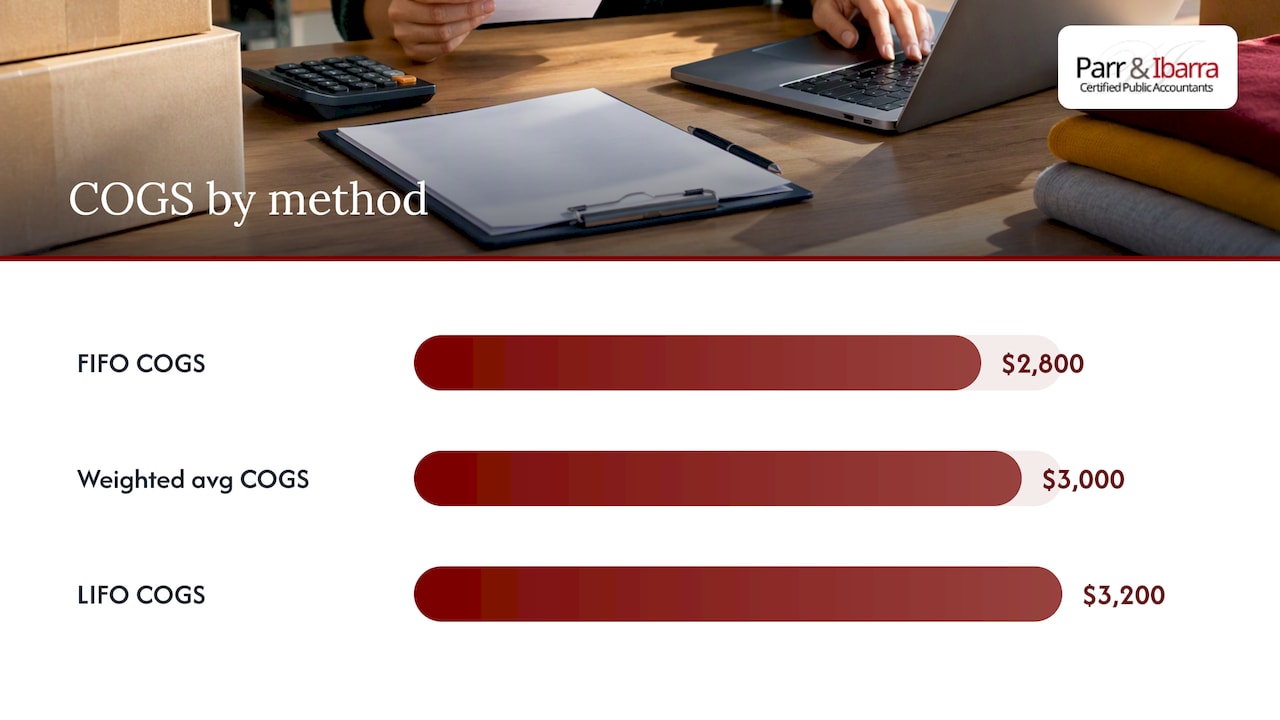
Under FIFO, you sell the oldest units first: 100 units at $10 ($1,000), then 150 units at $12 ($1,800), covering the full 250 units sold. COGS equals $2,800. Ending inventory is the remaining 100 units at $14, or $1,400.
Under LIFO, you sell the newest units first: 100 units at $14 ($1,400), then 150 units at $12 ($1,800), covering the 250 units sold. COGS equals $3,200. Ending inventory is the remaining 100 units at $10, or $1,000.
Under weighted average, you divide total cost by total units: $4,200 divided by 350 units equals $12 per unit. COGS for 250 units sold equals $3,000. Ending inventory for the remaining 100 units equals $1,200.
- FIFO COGS: $2,800, ending inventory: $1,400.
- LIFO COGS: $3,200, ending inventory: $1,000.
- Weighted average COGS: $3,000, ending inventory: $1,200.
The spread between FIFO and LIFO COGS in this illustrative example is $400, a direct swing in reported gross profit and taxable income for the same month of sales. That gap widens the longer costs rise and the larger your inventory volume, which is exactly why the method choice compounds over years rather than staying a one-time decision.
This same math scales directly into QuickBooks, NetSuite, or any ERP system you use: the formulas do not change, only the volume of transactions. Most accounting software automates FIFO and weighted average natively, while LIFO, particularly dollar-value LIFO, often requires either a specialized module or manual schedule maintenance outside the core system. If your bookkeeper handles job costing alongside inventory, tools like QuickBooks job costing integrations can help keep inventory costs tied to specific jobs or projects without duplicating data entry.
Applying these choices for Dallas-Fort Worth businesses
We work with business owners across Dallas-Fort Worth who are weighing exactly this decision, often after a year of unpredictable supplier costs or a lender asking pointed questions about inventory valuation. The right method depends on your specific cost trends and reporting needs, not a generic rule of thumb, which is why we start every inventory accounting engagement with a review of your actual purchase and sales data rather than a template recommendation.
We bring technical depth to that review, with a team of professionals including CPAs, while staying responsive to the day-to-day realities of running a local business.
A few ways we typically support this work:
- We help you select and document an inventory method that fits your actual cost environment and tax posture.
- We maintain the records your chosen method requires, including LIFO layer tracking when applicable.
- Our CFO services model the multi-year impact of a method change before you commit to filing the necessary forms.
A practical recommendation and your next step
For many small businesses with moderate inventory volume and stable costs, weighted average offers the simplest path to accurate, defensible records. Businesses facing sustained cost inflation or large inventory balances should model LIFO’s tax deferral before dismissing the added recordkeeping. Bring your last two years of purchase and sales detail to your first conversation with a CPA, along with any lender reporting requirements, so the recommendation reflects your actual numbers.
— Adan
How we can help you implement the right method
Once you know which method fits your business, the harder part is maintaining it correctly year after year, and that is where most of our inventory accounting work actually happens. We handle the bookkeeping that keeps your cost layers accurate, model the tax impact of a method change before you file, and provide CFO support when inventory valuation decisions affect compliance or reporting.
Services relevant to this decision include:
- Tax planning and preparation to model the taxable income effect of your method choice and prepare Form 3115 if you need to change methods.
- Bookkeeping services to maintain accurate cost layers and support audit-ready records.
- Outsourced CFO and comptroller support for ongoing financial leadership when inventory values affect your broader reporting.
Reach out with your last two years of inventory and purchase records, and we will walk through what your current method is costing or saving you.
This article is general information, not a substitute for advice from a qualified financial advisor. Consult a qualified financial professional about your own circumstances before acting on anything here.
FAQ
What are the methods of accounting for inventory?
The four primary methods are FIFO, LIFO, weighted average cost, and specific identification, each described in IRS Publication 538 as acceptable for tax purposes. Related approaches like the retail inventory method and lower of cost or market are often applied alongside these primary methods rather than as standalone choices.
Does US GAAP use LIFO or FIFO?
US GAAP permits both LIFO and FIFO as acceptable inventory accounting methods, along with weighted average and specific identification. IFRS, by contrast, does not allow LIFO at all, which creates reconciliation work for US businesses with foreign consolidation needs.
What are the two main types of inventory accounting methods?
Inventory accounting methods generally split into cost-flow assumptions, like FIFO, LIFO, and weighted average, and direct-tracking methods, like specific identification. The first group estimates which costs apply to units sold, while the second matches the actual cost of each specific unit.
What are the acceptable inventory methods under GAAP?
GAAP accepts FIFO, LIFO, weighted average, specific identification, dollar-value LIFO, and the retail inventory method, paired with the lower of cost or market rule for valuation adjustments. IRS Publication 538 outlines the tax-side version of these same acceptable methods, along with the procedural steps for adopting or changing them.
How do I change my inventory accounting method with the IRS?
Changing an inventory accounting method generally requires filing Form 3115 and securing IRS consent, since a change triggers an IRC Section 481 adjustment that spreads the cumulative income effect over a set period. Adopting LIFO for the first time instead requires Form 970, filed with the return for the year you begin using it.
Sources
- IRS Publication 538, Accounting Periods and Methods (about page)
- Journal of Accountancy — LIFO conformity rule and reporting implications

