

The passive activity loss rules say that losses from passive activities, mainly rentals and businesses you don’t materially participate in, can generally only offset passive income. They can’t offset your wages or active business income. If your passive losses are larger than your passive income, the excess is suspended and carried forward, unless an exception such as the rental real estate allowance applies. This guide walks through what counts as passive, how the limits work, the numbers that matter, and the ways owners and investors legitimately get these losses used.
TL;DR
- A passive activity is a trade or business where you don’t materially participate, or a rental activity. Losses from these generally offset only passive income.
- Disallowed losses aren’t gone. They carry forward and can be released against future passive income or when you fully dispose of the activity.
- Rental real estate has a special allowance of up to $25,000 if you actively participate, phased out between $100,000 and $150,000 of modified adjusted gross income.
- Material participation (for example, more than 500 hours a year) and real estate professional status can turn a passive loss into a nonpassive one.
- Form 8582 is how you calculate the limit, and it is generally required unless you meet every exception condition.
What the passive activity loss rules actually do
Congress wrote these limits into 26 U.S.C. § 469 to stop taxpayers from using paper losses on investments they weren’t running to wipe out taxes on wages and other active income. The IRS summarizes the result plainly: passive activity losses that exceed passive income are generally disallowed for the current year.
The mechanics follow from that. The tax code sorts your income into buckets. Wages, active business income and most portfolio income sit in one group. Passive activity income sits in another. Losses in the passive bucket can only reduce income in that same bucket. You can’t push them across.
A passive activity loss, in the language of the Form 8582 instructions, happens when your total losses from all passive activities, including unallowed losses carried from prior years, exceed your total passive income for the year.
The rules also reach beyond individuals. Closely held corporations and personal service corporations face their own passive loss limits, which the IRS covers in the Form 8810 instructions.
What counts as a passive activity
There are two categories, and the Form 8582 instructions define both:
- A trade or business in which you do not materially participate. Think of a limited partner stake in a restaurant, or an LLC interest in a business you fund but don’t work in.
- A rental activity, regardless of how much you participate, with the major exception for real estate professionals described below.
The flip side matters just as much. A business where you do materially participate is nonpassive, and its losses are not subject to this limit. That is why the participation question is where most planning happens.
Some things are not passive income or loss at all. Wages, interest and dividends from ordinary investments, and gains from selling stock aren’t passive activity income. That is why owning a rental that loses money doesn’t let you shelter your brokerage gains the way many new investors expect.
Material participation: the test that decides most cases
For a business (not a rental), the question is whether you work in it regularly, continuously and substantially. IRS Publication 925 lays out seven tests. You need to meet only one for a given activity in a given year. Among them:
- You participate for more than 500 hours during the year.
- Your participation is substantially all of the participation in the activity, by anyone.
- You participate more than 100 hours, and no one else participates more than you.
- You materially participated in any five of the last ten tax years.
The publication also covers the remaining tests, including those for significant participation activities and personal service activities. If you’re deciding how to document your time, the practical advice is simple: keep a contemporaneous log of dates, hours and tasks. Reconstructed calendars after an audit notice rarely hold up as well as a record made at the time.
Founders and operators who are building a business often assume they pass this test automatically. Usually they do. The risk is in the second or third business, the one a partner runs while you hold an equity stake. If you want a broader frame on how passive and active income differ for planning purposes, this piece on passive versus active income is a reasonable companion read.
Rental activities: passive by default
Rental real estate is generally passive no matter how many hours you spend on it, according to IRS Topic no. 425. The exception is a taxpayer who qualifies as a real estate professional. A landlord who personally repairs, screens tenants and does the books still has passive losses unless one of the exceptions below applies.
This surprises many owners, and it explains why so many rental owners see “suspended loss” carryforwards building up on their returns year after year.
The $25,000 special allowance
The most useful exception for small landlords is the special allowance. If you actively participate in a rental real estate activity, you may deduct up to $25,000 of losses against nonpassive income, per the Form 8582 instructions. Active participation is a lower bar than material participation. In general it means you make management decisions such as approving tenants, setting rents and approving repairs, rather than putting in a minimum number of hours.
The income phaseout
The allowance shrinks as your income rises. Per the same instructions, it begins to phase out when modified adjusted gross income (MAGI) exceeds $100,000, and it is eliminated at $150,000. For married taxpayers filing separately who lived apart all year, the range is $50,000 to $75,000.
Here is how that works in practice, using the IRS’s 50 percent reduction mechanics. The figures below are an illustration, not a client example.
| MAGI | Phaseout applied | Maximum allowance |
|---|---|---|
| $100,000 or less | None | $25,000 |
| $110,000 | Reduced by half of the $10,000 excess | $20,000 |
| $125,000 | Reduced by half of the $25,000 excess | $12,500 |
| $150,000 or more | Fully phased out | $0 |
The consequence: a household with two good salaries and a rental that loses money on paper will often get no current deduction from that rental. The loss isn’t forfeited. It is suspended.
Why your passive loss was disallowed
If you’re staring at a return and wondering why a loss didn’t reduce your tax, the usual causes are these:
- No passive income to absorb it. The loss exceeded passive income from all activities combined.
- Income above the phaseout. Your MAGI wiped out the $25,000 allowance.
- You didn’t actively participate in the rental, so the allowance never applied. This is common with rentals managed entirely by others under an arrangement where you make no decisions, or with limited partnership interests.
- You failed every material participation test for a business you assumed was active.
- Another limit hit first. Per 2025 IRS guidance on Form 8582, losses must clear basis and at-risk rules (Form 6198) before the passive loss limits are even evaluated.
When a loss is partly disallowed across several activities, it isn’t picked at random. Publication 925 says a ratable portion of the loss from each passive activity is disallowed, so each activity carries forward its own share.
Suspended losses: where they go and how they come back
Disallowed passive losses carry forward indefinitely. The Form 8582 instructions describe three ways they get used:
- Against passive income in a later year, from any passive activity.
- Against the special rental allowance in a year when your income falls into the allowed range.
- When you dispose of the entire interest in a fully taxable transaction to an unrelated party.
The third path is the one investors should plan around. Publication 925 describes it as the full disposition rule: sell your whole interest to an unrelated buyer in a taxable sale, and the suspended losses become deductible. Partial sales, gifts and sales to relatives don’t get the same result, so the structure of an exit matters. If you’re considering a sale, how different capital gains treatments work for investors belongs in the same conversation, because the gain and the released losses interact.
A related concept is the former passive activity. Under Publication 925, this is an activity that was passive in a prior year but isn’t in the current year, such as a rental you now materially participate in as a real estate professional. Remaining prior-year unallowed losses can be deducted up to the current-year net income from that specific activity.
Ways owners legitimately make passive losses usable
There are two broad strategies: change the character of the loss, or create passive income to absorb it.
Qualify as a real estate professional
If you meet the real estate professional requirements in Publication 925, your rental activities can be treated as nonpassive, provided you also materially participate in them. At a high level, the tests require that more than half your personal service time during the year be in real property trades or businesses in which you materially participate, and that you work more than 750 hours in them. Spouses combine hours in some respects but not others, and the details are strict. Courts examine log quality closely, so this is a place to document carefully and get advice before filing. Our related piece on deductions for real estate professionals goes further.

Short-term rentals and the average stay rule
Under the regulations, some rentals aren’t treated as “rental activities” for passive loss purposes, including those with a short average customer stay, which Publication 925 discusses. A short-term rental owner who also materially participates may therefore deduct losses against other income. This is the basis of what many online posts call the short-term rental loophole, and it is also an audit magnet when hours and stay lengths aren’t documented. We cover it in depth in our guides to the short-term rental tax loophole and the rules that decide short-term rental taxes.
Generate passive income
Passive losses can offset passive income. An owner with a loss-making rental and a profitable passive investment may use one against the other. Sometimes it makes sense to look at restructuring or timing, but only where the economics also make sense. A tax saving that rides on an investment you wouldn’t otherwise make is rarely a good trade.
Wait, and plan the exit
Sometimes the right answer is to accept the carryforward. Income may fall (a sabbatical, a retirement year, a slow business year), bringing you back under the $100,000 threshold, or you may sell a property and release years of suspended losses at once. Tracking those balances accurately each year is the unglamorous work that makes this possible.
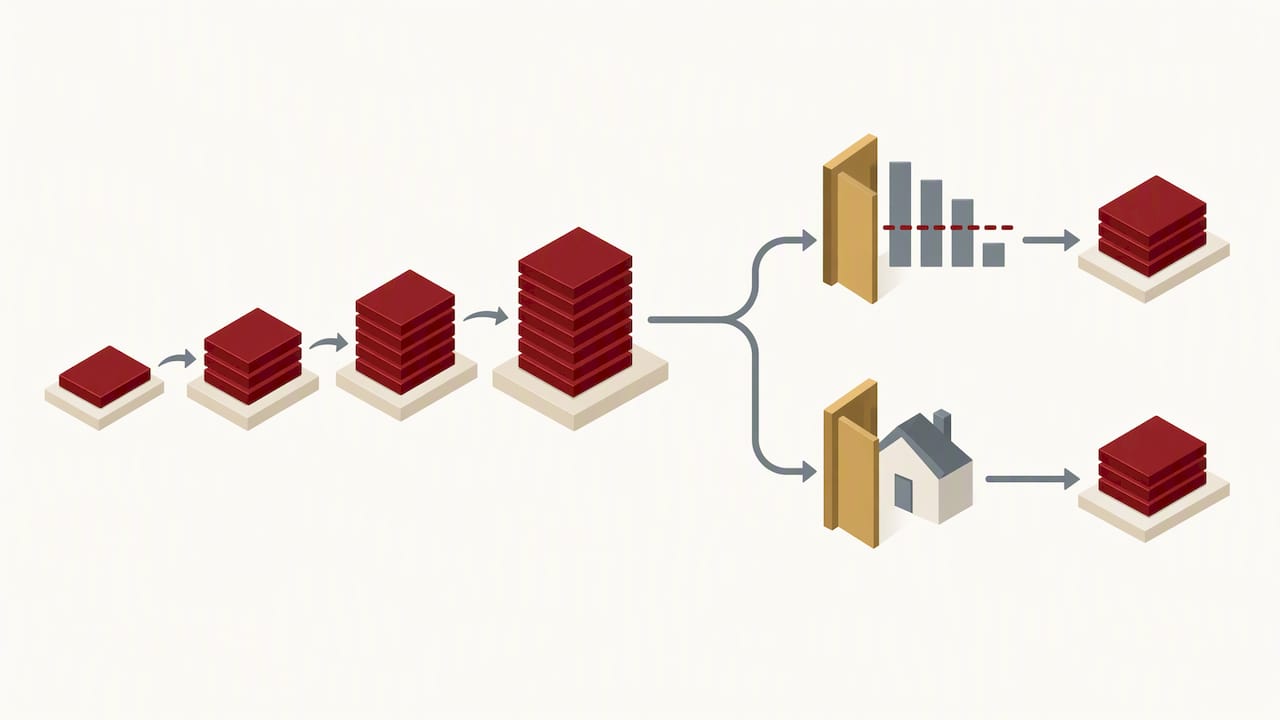
Calculating and reporting: Form 8582
Form 8582 is where the limit is computed. It tallies current-year passive income and losses, adds in prior-year unallowed losses, applies the special allowance if you qualify, and arrives at what you can deduct now versus what carries over. According to the instructions, you generally must file it unless every condition for an exception is met, including limits on the number of activities, prior-year unallowed losses, loss amounts and MAGI.
A workable annual process looks like this:
- List every activity and label it passive, nonpassive or rental, with your reasons.
- Gather income and loss figures for each, including carryforwards from last year’s Form 8582.
- Confirm basis and at-risk limits are applied first.
- Test material participation or active participation and store the logs with your records.
- Complete Form 8582 and carry each activity’s suspended amount forward by name, not as one lump.
That last step is the one most often missed in do-it-yourself returns. When you finally dispose of one property, you need to know that property’s carryforward, not a pooled total.
Where a CPA earns the fee
The rules are simple to state and unforgiving in application. Three situations call for professional help rather than software defaults: grouping multiple activities into one, qualifying as a real estate professional or short-term rental operator, and selling an interest that carries significant suspended losses.
At Parr & Ibarra CPA, we work with Dallas-Fort Worth business owners, real estate investors and individuals on year-round tax planning and preparation. That means looking at your participation hours, income level and exit timing before the year ends, when there are still choices, rather than explaining a disallowed loss after filing. Our staff includes multiple CPAs, and we serve clients in English and Spanish. If you hold rentals or interests in businesses you don’t run, bring last year’s Form 8582 and we’ll tell you where your suspended losses stand.
Common mistakes to avoid
- Assuming hours make a rental nonpassive. For rentals, hours alone don’t change the default. Real estate professional status or the short average stay rule must apply.
- Ignoring the phaseout. MAGI of $150,000 or more eliminates the special allowance for most filers.
- Losing track of carryforwards. Without activity-by-activity records, you can’t claim the release on sale.
- Weak participation records. Estimates produced after the fact are the usual reason these positions fail.
- Skipping basis and at-risk. Passive rules come after those limits, so a loss can be reduced before this analysis starts.
FAQ
What are the passive activity loss rules in simple terms?
They prevent you from using losses from passive activities to reduce income from wages or active businesses. Passive losses can only offset passive income. Any excess is suspended and carried forward to later years, subject to the exceptions covered above.
Is there an income limit that eliminates passive losses?
For the $25,000 rental real estate allowance, yes. According to the Form 8582 instructions, it starts to phase out at $100,000 of MAGI and is gone at $150,000. For married filing separately and living apart all year, those figures are $50,000 and $75,000. The losses are suspended, not lost.
Why is my passive loss not allowed?
Usually because it exceeded your passive income, your income was too high for the special allowance, or you didn’t actively participate in the rental. A basis or at-risk limit may also have reduced it first. Check last year’s Form 8582 to see which applied.
Can I ever deduct suspended passive losses?
Yes. You can use them against future passive income, against the special allowance in a year your income qualifies, or in full when you sell your entire interest in a fully taxable transaction to an unrelated party, per the Form 8582 instructions.
Do I always have to file Form 8582?
Not always, but generally yes if you have passive losses. The form is required unless all of the exception conditions are met, including limits on prior-year unallowed losses and your MAGI. A CPA can confirm whether you fall within the exception.
Sources
- 26 U.S.C. § 469, Passive activity losses and credits limited
- IRS Topic no. 425, Passive activities, losses and credits
- Instructions for Form 8582 (2025)
- 2025 Instructions for Form 8582 (PDF)
- Instructions for Form 8810 (2025)
- IRS Publication 925 (2025), Passive Activity and At-Risk Rules
- Passive Income vs Active Income: Using Both to Grow Your Money

