
Your nonprofit passes the public support test by keeping public support at 33.33% or more of total support, measured on a rolling five-year basis, under either the 509(a)(1)/170(b)(1)(A)(vi) test or the 509(a)(2) test. Fall below that line without a strong facts-and-circumstances case, and the IRS can reclassify your organization as a private foundation. Check your Schedule A (Form 990) every year, not just when a big grant lands.
TL;DR:
- Nonprofits must monitor their public support percentage annually, aiming to stay above 33.33% over five years, or risk IRS reclassification as a private foundation.
- Major donors contributing more than 10% of projected revenue or investment income exceeding 20% of total support warrant early review to prevent tipping.
- Factors like large one-time gifts, investment income spikes, or loss of small donors can negatively impact the five-year average and trigger consequences.
- Proper documentation, including donor agreements and financial statements, is essential to demonstrate ongoing support efforts to auditors and funders.
- Building and reviewing a quarterly rolling support model with CPA support helps detect risk factors early and ensures ongoing nonprofit compliance.
What Is the Public Support Test for Nonprofits?
Public charities prove they serve the public, not a narrow interest group, by passing one of two IRS tests. The IRS defines these as the 509(a)(1)/170(b)(1)(A)(vi) test and the 509(a)(2) test, and both generally run on a five-year rolling window.
The 509(a)(1) test suits organizations funded mainly by donations, membership dues, and government grants: think community foundations, food banks, and religious charities. If your public support percentage lands between 10% and 33.33%, you can still qualify using the facts-and-circumstances test, which weighs your fundraising outreach, board composition, and ongoing public engagement.
The 509(a)(2) test fits organizations that earn a meaningful share of revenue from program services, ticket sales, tuition, or membership fees, such as museums, theaters, and schools. This test caps how much investment income and unrelated business taxable income (UBTI) can count toward total support. Once investment and UBIT income cross one-third of total support, the organization risks failing outright, regardless of donation levels.
How to Calculate Public Support: A Step-by-Step Approach
The core formula is simple: divide public support by total support. Clear the 33.33% mark and you pass. The complexity lives in what counts in each bucket.
Public support generally includes:
- Gifts, grants, and contributions from individuals, corporations, and foundations
- Membership dues that don’t function as a fee for a specific service
- Government grants and contracts that support your mission broadly
Total support adds in program service revenue, investment income, and most other receipts, then applies exclusions.
Two limits change the math significantly. First, the 2% donor cap under 170(b)(1)(A)(vi): any single donor’s contributions count toward the numerator only up to 2% of total support for the five-year period. A $500,000 gift from one foundation might only contribute $40,000 toward your public support numerator if your total support is $2 million. Second, under 509(a)(2), gross investment income and UBTI are excluded from public support and counted separately against a one-third ceiling.
Timing matters too. The five-year rolling computation means each year’s Form 990 filing recalculates using the current year plus the prior four. A single unusual year doesn’t sink you immediately, but it stays in the average for four more filings after that. Report the calculation on Schedule A, Part II (for 509(a)(1) organizations) or Part III (for 509(a)(2) organizations), matching the line items to your Form 990 revenue statement.
Why Tipping Happens and What It Costs You
“Tipping” describes the moment your public support percentage drops below the threshold and stays there long enough that the IRS reclassifies your organization as a private foundation. The consequences reach further than a label change.
- Excise taxes apply. Private foundations owe a net investment income tax and face strict rules on self-dealing, minimum distributions, and excess business holdings that public charities don’t.
- Grant eligibility narrows. Many foundations and government agencies restrict funding to public charities, so reclassification can cut off major revenue sources right when you need them most.
- Reporting burden increases. Private foundations file Form 990-PF instead of Form 990, with more detailed disclosure of grants, investments, and compensation.
- Donor deductibility can shift. Some contribution limits for donors change under private foundation status, which can quietly discourage the exact large gifts you’re trying to attract.
The pitfalls that lead here are predictable: a single mega-gift that dwarfs everything else, a strong investment year that spikes UBIT or capital gains income, the quiet loss of several recurring small donors, or simply not tracking the five-year rolling average until the annual filing forces the issue. Because the calculation rolls forward, one bad year doesn’t just cost you once. It drags down four subsequent filings unless later years overcorrect.
What Documentation Do Grant-Makers and the IRS Expect?
Passing the math is only half the job. Auditors and funders both want a paper trail showing the numbers are real and repeatable.
Keep these on hand year-round:
- Signed donor agreements and grant award letters showing the terms and restrictions on each major gift
- Board minutes documenting oversight of fundraising strategy and financial review
- Audited financial statements, or reviewed statements for smaller organizations
- Your three most recent Form 990 filings with Schedule A calculations
- Fundraising campaign records if you’re relying on the facts-and-circumstances test
Schedule A, Part VI, is where the narrative evidence for the facts-and-circumstances test lives. If your percentage sits between 10% and 33.33%, this section needs to show a genuine, ongoing effort to attract public support, not just a one time appeal letter.
Grant-ready organizations show diversified revenue, an engaged and independent board, and clean audits, because funders are screening for stability, not just IRS minimums.*
Building a CFO-Level Public Support Model
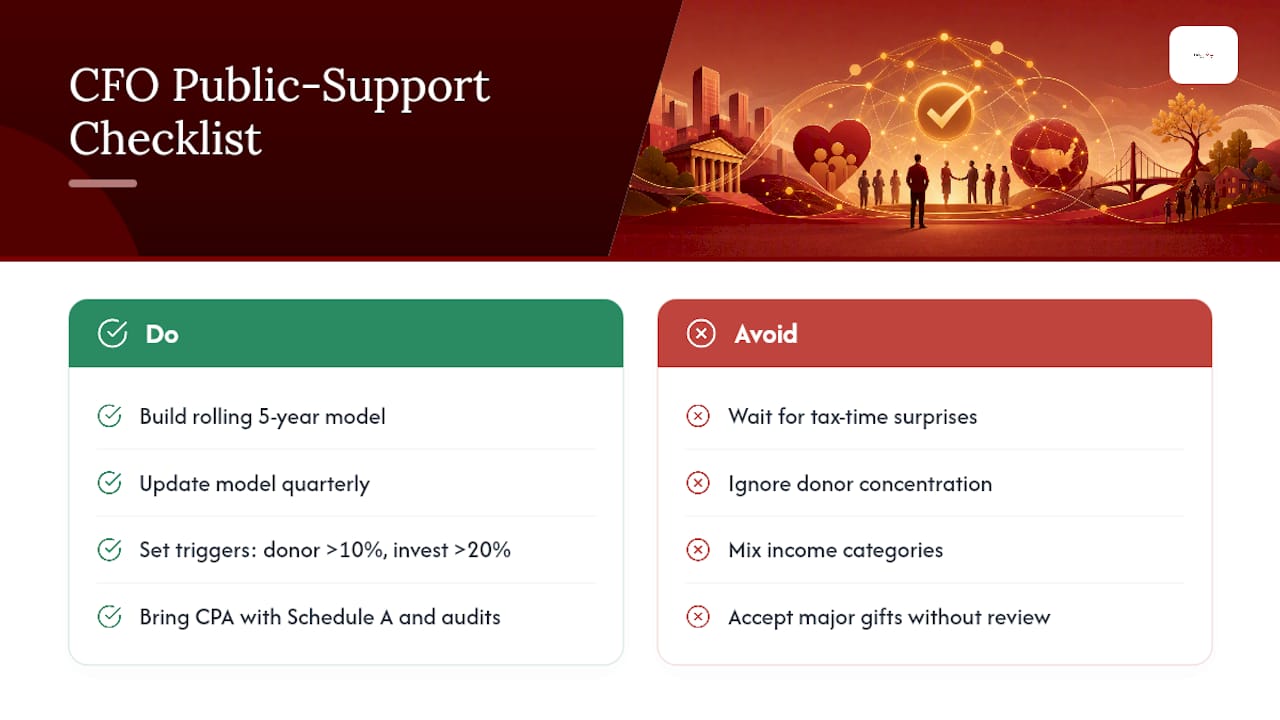
Waiting for your accountant to flag a problem at tax time is the wrong approach. Build a rolling five-year model that separates public support, program revenue, and investment/UBIT income into distinct columns, updated quarterly rather than annually.
Set trigger thresholds before you need them. A useful early-warning line: if any single donor’s raw gift exceeds 10% of projected annual revenue, or if investment income creeps past 20% of total support under a 509(a)(2) calculation, flag it for board review immediately rather than waiting for the Form 990 cycle. This kind of modeling turns a one-year spike into a manageable five-year adjustment instead of a surprise reclassification letter.
On the fundraising side, widen your donor base deliberately. A grant accounting system that tracks restricted versus unrestricted funds by source makes it far easier to see concentration risk before it becomes a filing problem. Document board engagement in fundraising strategy, since that record supports both governance best practice and any facts-and-circumstances argument you might need later.
Bring your CPA into the conversation once you see a donor concentration warning, an investment income spike, or before you accept a transformational gift that could reshape your five-year average. Come to that meeting with your last three years of Schedule A worksheets, current donor schedules, and your latest audited financials.
How Parr & Ibarra CPA Supports Nonprofit Compliance
Running a five-year public support model by hand, while also managing payroll, grant reporting, and a board that wants plain answers, is where most nonprofit finance teams get stretched thin. A CPA firm can build nonprofit compliance work around that exact gap: a team of professionals who bring big-firm technical depth to Schedule A calculations without treating your organization like a file number.
That means hands-on help with Form 990 and Schedule A preparation, rolling public support modeling that flags tipping risk before it shows up on a filing, and audit readiness work that gets your financial statements into the shape funders expect. For organizations that need ongoing financial leadership rather than a once-a-year filing relationship, some firms also offer outsourced CFO and financial planning support built for nonprofits juggling multiple grant sources and board reporting demands.
If your latest Schedule A numbers are trending the wrong direction, or you simply want a second set of eyes before your next major gift lands, start with a conversation about your tax and compliance services needs.
A Practical Note From a CPA Firm
Most nonprofits treat the public support test as a once-a-year math problem instead of an ongoing risk to manage. That’s backwards. By the time a Schedule A calculation shows trouble, the rolling average already reflects damage from up to five prior years, which means one clean year rarely fixes it.
Run your rolling model quarterly, not annually, and review your Schedule A the moment a major gift or investment gain lands. Our nonprofit management guide covers the governance side of this in more depth.
— Adan
This article is general information, not a substitute for advice from a qualified financial advisor. Consult a qualified financial professional about your own circumstances before acting on anything here.
FAQ
What Percentage Is Required to Pass the Public Support Test?
Your organization needs public support equal to at least 33.33% of total support, calculated over a five-year rolling period, though a facts-and-circumstances case can work between 10% and 33.33%.
What Happens If a Nonprofit Fails the Public Support Test?
Failing the test, known as “tipping,” can trigger reclassification as a private foundation, bringing excise taxes, stricter distribution rules, and Form 990-PF filing instead of Form 990.
Where Do We Report the Public Support Calculation?
Public charities report the calculation on Schedule A of Form 990, using Part II for the 509(a)(1) test or Part III for the 509(a)(2) test.
When Should We Bring in a CPA for Public Support Issues?
Engage a CPA firm like Parr & Ibarra CPA as soon as your rolling model shows donor concentration climbing, investment income rising near the one-third limit, or before accepting a gift large enough to reshape your five-year average.

