A step-up in basis resets the tax cost of an inherited asset to its fair market value on the date the owner died. When you later sell, you pay capital gains tax only on growth after that date. The gain that built up during the owner’s lifetime generally drops out of income tax for good.
That one rule can be worth tens or hundreds of thousands of dollars on a family home, a block of stock or a rental property. It also has exceptions that catch people off guard, including retirement accounts, jointly owned property outside community property states, and assets with weak valuation records. Here is how the rule works, where it does not apply, and what to do before you sell.
TL;DR
- Inherited property generally takes a basis equal to its fair market value at the date of death, not what the original owner paid.
- If the executor files an estate tax return (Form 706), they may elect a valuation date six months after death instead.
- Retirement accounts and income in respect of a decedent, such as unpaid receivables, do not get a step-up.
- In community property states like Texas, both halves of a couple’s community property can step up when one spouse dies.
- Keep the date-of-death valuation. It is the proof behind your basis when you sell.
What a step-up in basis means
“Basis” is the starting number the IRS uses to measure your taxable gain. Normally it is what you paid, plus improvements, minus depreciation. Sell for more than that and you owe tax on the difference.
Inheritance changes the starting number. According to the Congressional Research Service, the basis of an asset inherited at death is adjusted to its fair market value at that time, rather than its original cost. The Congressional Budget Office adds that appreciation during the decedent’s lifetime is not included in taxable income and is not subject to capital gains tax. Tax applies only to the change in value between the stepped-up basis and your sale price.
The term is a little misleading. If the asset lost value, the basis can “step down” to the lower date-of-death value. The rule resets to market value in either direction.
A worked example
Say your father bought stock decades ago for $40,000. At his death it is worth $400,000.
| Scenario | Your basis | Sale price | Taxable gain |
|---|---|---|---|
| You inherit the stock (step-up) | $400,000 | $410,000 | $10,000 |
| Your father gifted it to you while alive (carryover basis) | $40,000 | $410,000 | $370,000 |
The numbers are illustrative, but the pattern is real. Waiting until death to transfer appreciated assets often produces a much smaller tax bill for the heir than a lifetime gift of the same asset. That is why the timing of a transfer is a planning decision and not just a paperwork one.
Which assets get a step-up
The rule applies to property that is included in the decedent’s estate and passes to an heir. That commonly covers:
- Stocks, bonds, mutual funds and brokerage accounts held in the decedent’s name
- Real estate, including a primary home, land and rental property
- Business interests, such as shares in a closely held company or a partnership interest
- Other valuables, such as art, collectibles and vehicles
The IRS states the general rule in Publication 551: for property acquired from a decedent, basis is generally its fair market value at the date of death.
What does not step up
Not everything an heir receives qualifies. The Center for Agricultural Law and Taxation notes that retirement accounts and income in respect of a decedent, such as accounts receivable, do not receive a stepped-up basis.
In practice that means:
- Traditional IRAs and 401(k)s. Distributions are taxed as income to the beneficiary. The account’s value at death does not wipe out that tax. Required distribution timing for inherited accounts is its own topic, and our guide to RMD rules covers the deadlines.
- Unpaid receivables and similar income items. The income was earned but not yet taxed, so it stays taxable when collected.
- Assets you were given before death. A lifetime gift keeps the giver’s basis. Only property that passes at death resets.
If a decedent owned a mix of these, each asset needs to be sorted on its own. A single “inheritance total” hides very different tax outcomes.
How the date-of-death value is set
The default is simple: fair market value on the day the owner died. For publicly traded stock, that is a market price. For a house, a business or land, it usually takes a professional appraisal.
The six-month alternate valuation option
The executor has one choice that can change the number. Under IRS Publication 551, if the executor files an estate tax return on Form 706, they may elect an alternate valuation date six months after death. The IRS also confirms on its gifts and inheritances page that basis may then be the value on that alternate date.
Two points matter here:
- The election is tied to filing Form 706. If no estate tax return is filed, there is no six-month alternate date to use.
- It is the executor’s election for the whole estate, not something each heir picks asset by asset.
That answers a question many readers type into search: the “six month rule” is not a holding-period rule and not a deadline for selling. It is an optional valuation date.
For real property used in farming or a closely held business, Publication 551 also describes special-use valuation under section 2032A, which can affect basis. That choice has its own requirements and is worth raising with a CPA before the estate return is prepared.
Who needs to file Form 706
Most estates never owe federal estate tax. Our page on Form 706 and portability explains the filing threshold, which is $15,000,000 for estates of people dying in 2026, and why some married couples file anyway to preserve a deceased spouse’s unused exemption. For the difference between the federal estate tax and state-level taxes on heirs, see our explainer on estate tax vs. inheritance tax.
Community property: a second step-up for spouses
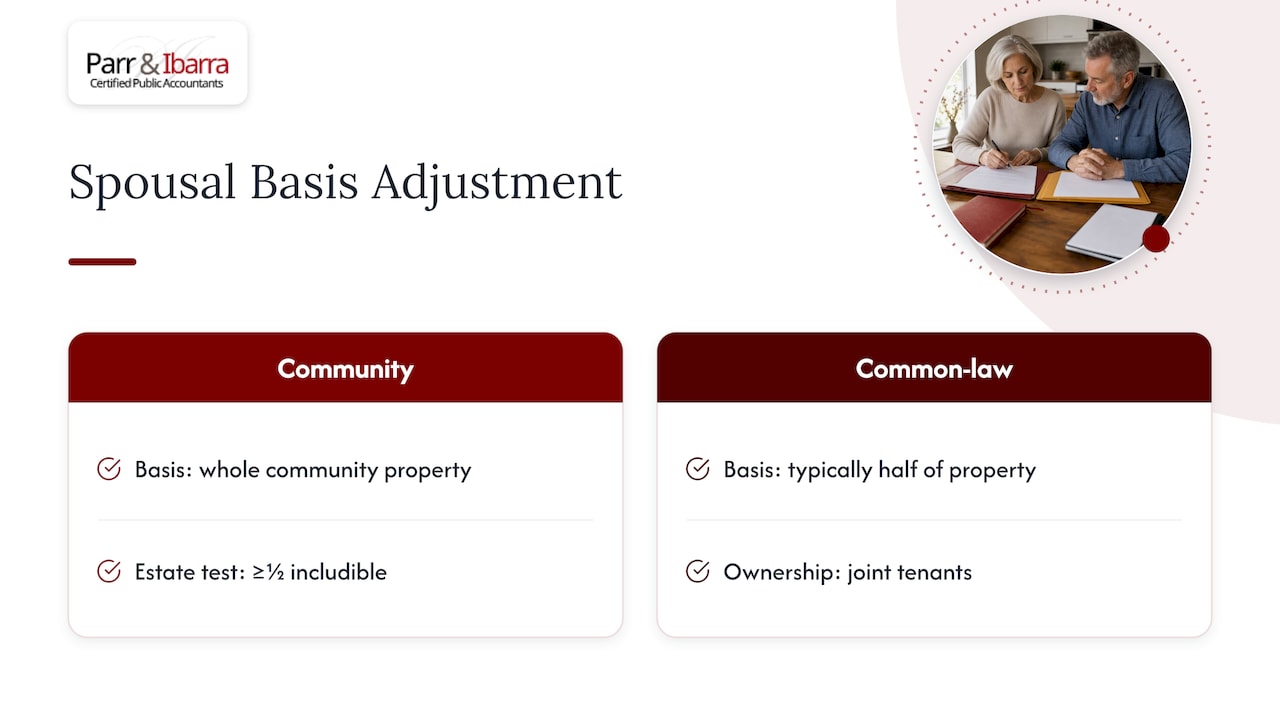
This is where Texas readers have an edge. In a community property state, when one spouse dies, the whole community property generally gets new basis, including the surviving spouse’s half.
The IRS describes it in Publication 555: the total fair market value of the community property becomes the basis of the entire property, as long as at least half of it is includible in the decedent’s gross estate. Publication 551 lists the community property states as Arizona, California, Idaho, Louisiana, Nevada, New Mexico, Texas, Washington and Wisconsin.
Compare that with common-law states. The Center for Agricultural Law and Taxation says that in non-community property states, spouses who own property as joint tenants typically get a step-up on only half when the first spouse dies.
Example for a Dallas-Fort Worth couple
A married couple buys a home in Plano for $250,000 as community property. It is worth $700,000 when the husband dies.
- Community property: the surviving wife’s basis in the whole home becomes $700,000. A sale at $710,000 produces a $10,000 gain.
- Same house, common-law joint tenancy: typically only the decedent’s half steps up, so her basis would be about $475,000 (her $125,000 half plus his $350,000 half). A sale at $710,000 would show a gain of about $235,000 before any home-sale exclusion.
The numbers are illustrative, but the gap is why title and character of property matter so much.
Why characterization matters
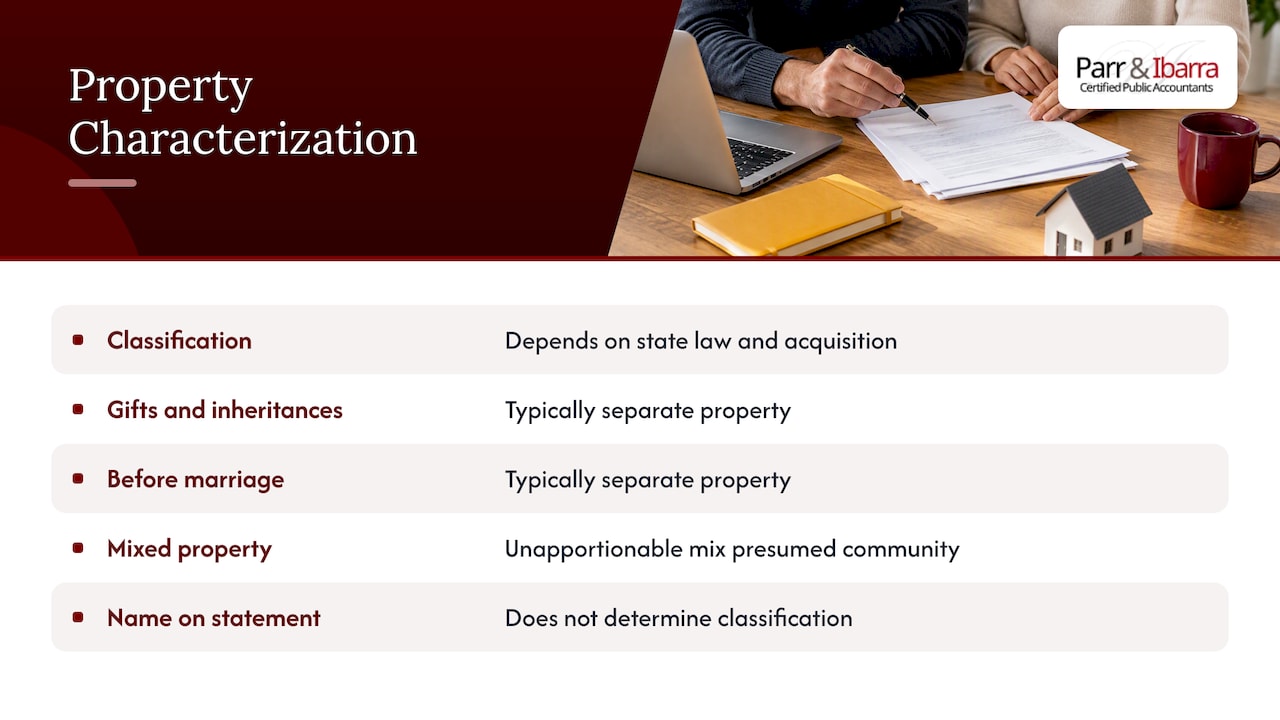
Whether an asset is community or separate depends on state law and how it was acquired, not on whose name is on the statement. Inheritances and gifts received by one spouse, and property owned before marriage, are typically separate. Commingling can blur the line. The IRS Internal Revenue Manual says that when separate and community property are so mixed they cannot be apportioned, the whole is presumed community. That cuts both ways, so records and clear titling pay off.
If you are sorting out how marital property rules work in your state, this overview of marital property vs. separate property is a helpful starting point. For Texas families without a will, our pages on intestate succession in Texas and Texas intestacy and the small estate affidavit show who ends up owning what, which feeds directly into who gets the step-up.
Do you owe capital gains tax on an inheritance?
Readers often ask whether inheriting $300,000 means a capital gains bill. Receiving the asset does not trigger one. Capital gains tax arises when you sell, and the amount depends on your stepped-up basis, not on the inheritance’s headline value.
Take that $300,000 and sell it:
- If you sell shortly after death for about $300,000 and the date-of-death value was $300,000, your gain is roughly zero.
- If you hold it and it grows to $340,000, you are taxed on the $40,000 increase.
- If it falls to $280,000 and you sell, you may have a capital loss.
Inherited property is generally treated as long-term for holding-period purposes no matter how soon you sell, as explained in IRS Publication 551. That usually means the long-term capital gains rates apply to any gain. Our guides on how capital gains tax works and the different capital gains tax treatments walk through rates and categories.
If you do sell at a loss on other holdings in the same year, tax loss harvesting rules, including the 30-day wash sale window, determine whether those losses can offset gains.
Cash itself has no basis issue. Inherited cash is not a gain, though interest it earns after you receive it is taxable.
Records that protect your basis
Your basis is only as good as your proof. If the IRS questions a sale, you need to show the date-of-death value.
Per Publication 551, here is what to gather:
- If a Form 706 was filed: the executor may give you a Schedule A (Form 8971). Beneficiaries of those estates are often required to use the reported estate tax value as the initial basis.
- If no estate tax return was filed: an appraisal made for state inheritance or transmission tax purposes can serve as supporting evidence.
- For everything else: a qualified appraisal dated near the date of death, brokerage statements showing the date-of-death price, and county valuation records for real estate.
Get the appraisal early. Reconstructing a home’s value years later, after renovations, is slower and harder to defend.
Is the step-up a “loophole”?
People use that word because the rule lets lifetime appreciation escape income tax entirely. The Congressional Research Service notes that the estate tax has historically served as a backstop to that escape, though high exclusion limits have made it less effective in that role in recent years.
To be clear, it is current law under the tax code, not a gap. Proposals to replace it with carryover basis, under which heirs would take the decedent’s adjusted basis and pay tax on unrealized gain when they sell, have been discussed for years. Because the law can change, anyone building a plan around the step-up should have it reviewed periodically instead of assuming it is permanent.
Planning around the step-up
A few principles come up often when we work with families and business owners:
- Think before gifting appreciated assets. A lifetime gift carries the giver’s low basis to the recipient. Keeping the asset until death can produce a better tax result, though it has other estate and control consequences.
- Review titling. For married couples, how property is held decides whether half or all of it steps up. Texas couples should confirm community property status in writing where possible.
- Treat retirement accounts differently. Since they do not step up, many families use them for charitable gifts or plan the order of withdrawals, and leave appreciated brokerage assets and real estate for heirs.
- Coordinate with business exits. If the decedent owned a business, the structure of a later sale matters. Our comparison of asset sale vs. stock sale shows how structure shifts the tax result.
- Mind depreciated property. Rental real estate that steps up gets a new basis for depreciation going forward, which affects short-term rental taxes and other ongoing reporting.
These are strategies to discuss with a CPA and an estate attorney, because the right answer depends on the size of the estate, the type of assets and your family situation.
Work through your inheritance with a CPA
We help Dallas-Fort Worth families and business owners sort out inherited assets, document date-of-death values and plan sales so the tax bill matches the law. Our tax planning and preparation team can review an inheritance before you sell, and our estate and elder planning services help you structure your own assets with basis in mind. Both are available in English and Spanish.
FAQ
Do all inherited assets get a step-up in basis?
No. Most property included in the decedent’s estate, such as stocks, real estate and business interests, does. Retirement accounts and income in respect of a decedent, such as unpaid receivables, do not. Assets gifted before death also keep the giver’s original basis.
What is the six-month rule for stepped-up basis?
It refers to the alternate valuation date, six months after death. The executor may elect it only if an estate tax return on Form 706 is filed. If elected, it applies to the estate’s property and can produce a basis different from the date-of-death value.
Does the surviving spouse get a step-up on community property?
In a community property state such as Texas, generally yes, on the whole. The total value of the community property, including the survivor’s half, can become the new basis if at least half is includible in the decedent’s estate. In common-law states, joint tenants typically get a step-up on half.
Do I owe capital gains tax if I inherit $300,000?
Not simply by inheriting. Tax applies when you sell, and only on the gain above your stepped-up basis. If you sell for close to the date-of-death value, the taxable gain is usually small or zero.
Sources
- Tax Treatment of Capital Gains at Death, Congress.gov
- Change the Tax Treatment of Capital Gains From Sales of Inherited Assets, Congressional Budget Office
- Publication 551, Basis of Assets, IRS
- Publication 551 (Rev. December 2025), IRS
- Publication 551 (Rev. December 2024), IRS
- Gifts and inheritances, IRS
- Publication 555, Community Property, IRS
- Internal Revenue Manual 4.25.5, Estate and Gift Tax Issues, IRS
- Gifting, Selling, or Inheriting: A Question of Basis, Center for Agricultural Law and Taxation