Texas use tax is the tax you owe when you buy a taxable item or service for use in Texas and the seller does not charge Texas sales tax. The state rate is 6.25 percent, plus up to 2 percent in local tax, and the buyer is the one responsible for reporting it. At Parr & Ibarra CPA we work with Dallas-Fort Worth business owners, nonprofits and real estate investors, and this is the rule that most often hides inside ordinary purchasing: equipment ordered from out of state, software, supplies, and items brought in from abroad.
TL;DR
- Use tax is the companion to sales tax. If a Texas sales tax was not charged on a taxable purchase you store, use or consume in Texas, you owe it directly to the Comptroller.
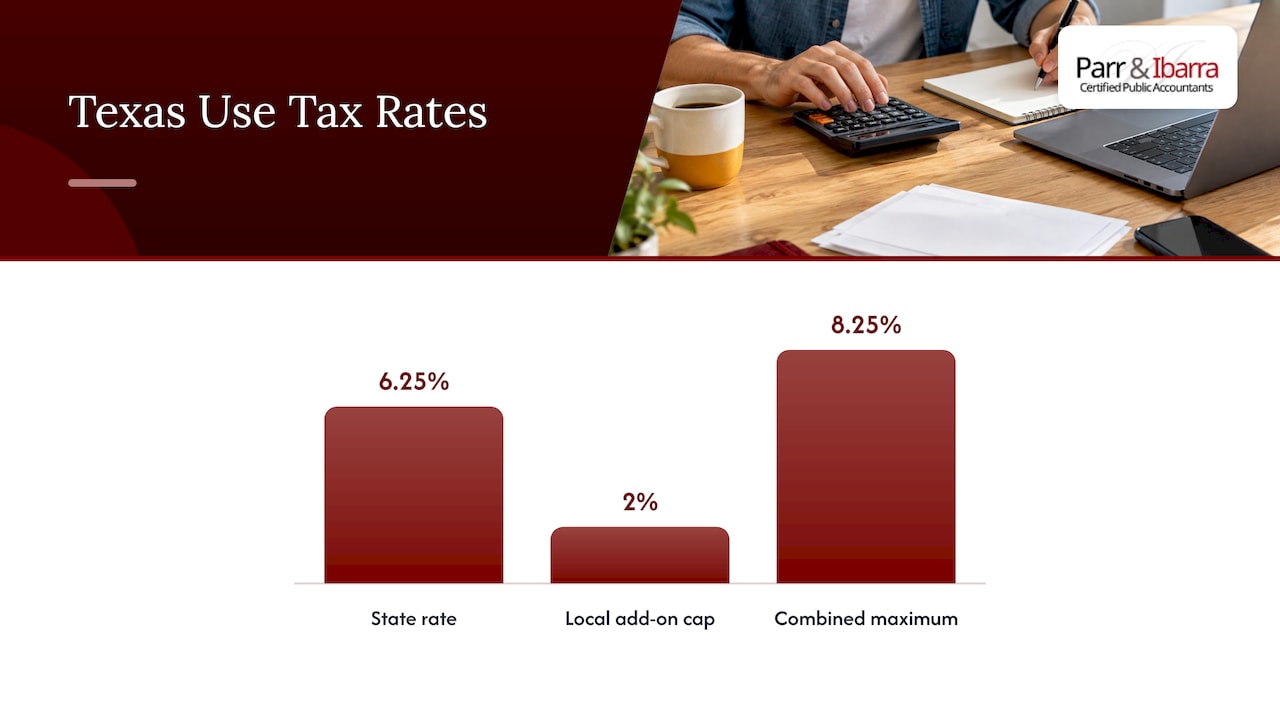
- The state rate is 6.25 percent. Local tax can add up to 2 percent, for a combined maximum of 8.25 percent, based on where you first use or store the item.
- Tax legally paid to another state is credited against what you owe in Texas, so you pay only the difference.
- Permit holders report use tax on their regular sales tax return. Buyers without a permit file Form 01-156.
- Unpaid tax draws interest starting 60 days after the due date, so purchases are worth reviewing before the return goes out.
What Texas use tax is, and how it differs from sales tax
Sales tax is collected by the seller at the time of sale. Use tax is owed by the purchaser when the seller does not collect Texas tax. The Texas Comptroller describes use tax as a nonrecurring tax that complements sales tax, imposed on the storage, use or other consumption of taxable tangible personal property or taxable services in Texas, at the same 6.25 percent state rate.
The legal basis is Texas Tax Code Section 151.101, which taxes the storage, use or consumption in Texas of a taxable item purchased from a retailer, at the same percentage as the sales tax. The Comptroller also notes that remitting use tax on out-of-state purchases protects Texas retailers from out-of-state sellers that may not collect Texas tax.
The practical point is simple. The two taxes never stack on the same purchase. Either the seller charged you Texas sales tax, or you owe use tax. Under Section 151.303, an item is exempt from use tax if its sale was already subject to sales tax or you have already paid use tax on it.
When you owe use tax
You owe use tax when three things are true: the item or service is taxable in Texas, you store, use or consume it in Texas, and Texas sales tax was not charged. The Comptroller lists the common situations:
- Purchases from out-of-state sellers that do not collect Texas tax, including online orders shipped into Texas.
- Items bought in another country and brought back for use in Texas. The Comptroller’s own example is taxable goods bought in Mexico.
- New off-highway vehicles bought from an out-of-state retailer for use in Texas.
- Items bought under a direct payment permit, and out-of-state gifts, catalogs and promotional goods delivered to Texas at a business purchaser’s direction, per 34 Tex. Admin. Code Section 3.346.
Liability stays with the person using the item. Under Section 151.102, it continues until the tax is paid to the state. You are released only if you pay the tax to a Texas retailer or other Comptroller-authorized collector and receive a purchaser’s receipt.
Online orders and shipping
For online purchases, use tax is due on taxable items shipped or delivered into Texas, and shipping and handling charges are part of the sales price. So a $5,000 piece of equipment with $200 freight and no Texas tax charged creates a use tax base of $5,200, not $5,000.
If you import hardware or other equipment, customs duty is a separate matter from use tax, and importers need to track both. This overview of import duty on hardware brought into the U.S. covers the federal side.
Services count too
Use tax is not limited to physical goods. A service is taxable only if it falls within a category listed in Texas Tax Code Section 151.0101, but when it does and you use the result in Texas without being charged tax, the same use tax logic applies. If you are unsure whether a vendor’s service is taxable, ask before you pay the invoice, because the liability falls on you.
What is not taxed
The Texas rules contain real exemptions. A few matter to the readers we work with most:
- Groceries. Items like flour, sugar, bread, milk, eggs, fruits and vegetables are not subject to sales and use tax, though many other items sold in grocery and convenience stores are.
- Occasional sales. Section 151.304 exempts certain occasional sales, such as the sale of an entire business’s operating assets, and one or two non-amusement retail sales in 12 months by a nonhabitual seller. A permit holder buying under the first of these exemptions must accrue and remit use tax.
- Qualified research property. According to SUT Review’s Texas news page, Senate Bill 2206 ended the sales and use tax exemption for property used in qualified research effective January 1, 2026, replacing it with a larger franchise tax research credit. Companies that relied on the exemption should review their purchasing with that change in mind.
- Resale. Items you buy to resell are bought tax-free with a valid certificate. Our guide to the Texas resale certificate, Form 01-339 shows how to document this. If you later use the item yourself instead of reselling it, use tax can come into play.
The rate: state plus local
The state use tax rate is 6.25 percent. Local jurisdictions (cities, counties, transit authorities and special-purpose districts) can add up to 2 percent, for a maximum combined rate of 8.25 percent.
The local piece depends on where you are. Per Publication 94-105, local sales tax follows the seller’s place of business, while local use tax follows where the customer first stores, uses or consumes the item. Every jurisdiction with a local sales tax also has a local use tax at the same rate, and local use tax is not due if the same type of local sales tax is already due. Under Section 3.346, local use tax applies only where you are engaged in business in the jurisdiction receiving the delivery.
To find the rate for a specific address, use the Comptroller’s Sales Tax Rate Locator. Rates change by quarter. The Comptroller’s October 2026 quarterly update lists cities that added or increased taxes, others that dropped to 8.00 percent, and one city whose tax was abolished after a merger. Check the latest update for your address before you calculate.
The remote seller rate
Some out-of-state sellers collect a single local use tax rate instead of looking up each destination. The Comptroller certified 1.75 percent as that rate for calendar year 2026, based on the statewide average local rate for the fiscal year ending August 2025. It is reset each year. If you paid that rate to a remote seller, you owe no additional tax on that purchase.
The credit for tax paid to another state
If you paid another state’s sales or use tax on the same item, Texas gives you credit for it. Section 151.303 grants a credit for similar tax paid to another state if that state gives a similar credit to Texas taxpayers, and the Texas Multistate Tax Compact provision entitles a purchaser to full credit for legally imposed sales or use taxes paid to another state and its subdivisions.
The credit is applied in a set order. Under 34 Tex. Admin. Code Section 3.338, it goes first against state use tax, then transit, special-purpose district, county and finally municipal use tax.
Worked example
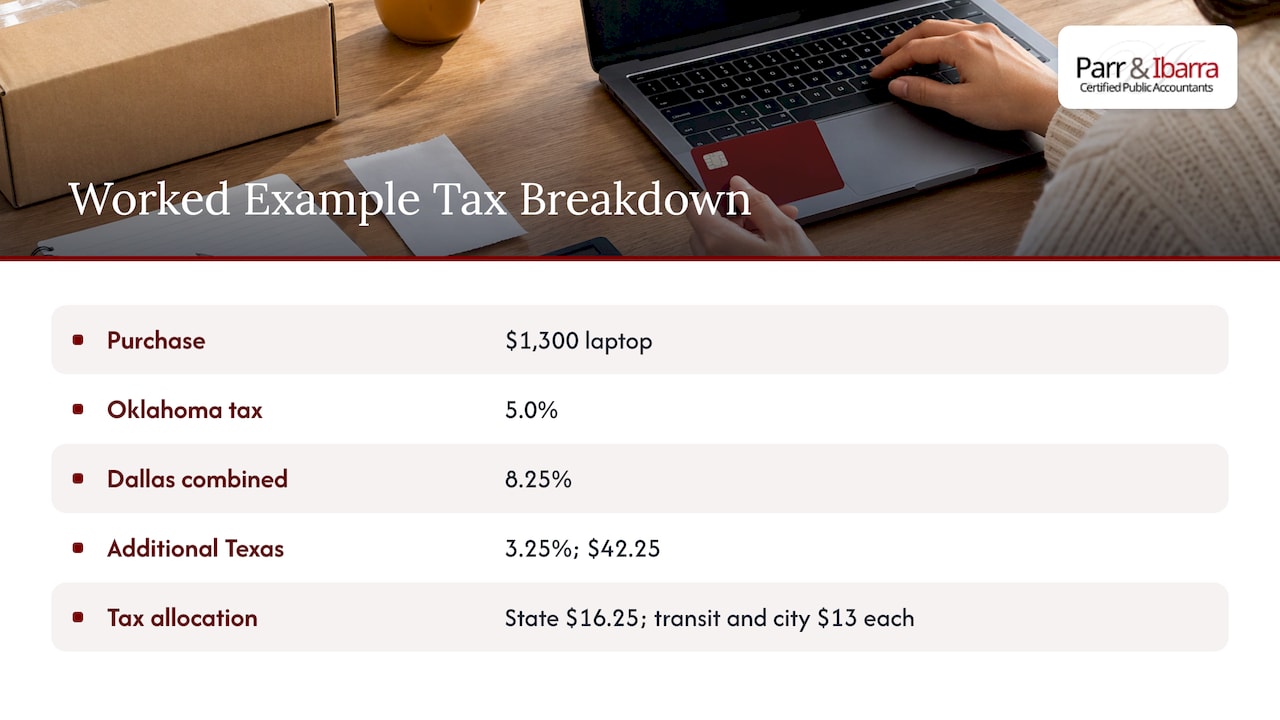
The rule’s own example is a $1,300 laptop bought in Oklahoma at 5.0 percent tax and used in Dallas, where the combined rate is 8.25 percent. The additional Texas tax is 3.25 percent, which is $42.25: $16.25 state, $13.00 transit and $13.00 city.
One caution: the credit covers only tax that was legally due in the other state. The Comptroller’s Auditing Fundamentals manual gives the case of an Oklahoma vendor that wrongly charged tax on a phone order shipped to Dallas. No credit was allowed, the full Dallas use tax was assessed, and the buyer was left to seek a refund from the vendor. Keep invoices that show the other state’s tax, and make sure the seller actually owed it.
How to report and pay
How you report depends on whether you hold a Texas sales and use tax permit.
- Add up the purchases. Go through invoices, card statements and accounts payable for taxable purchases with no Texas tax charged. Include freight and the credit for any other-state tax.
- Find the rate. Use the address where the item is first stored or used.
- Permit holders: report it in Item 3, Taxable Purchases, of your next regularly scheduled return.
- Non-permit holders: file Form 01-156. If you owe under $1,000, it is due by January 20 of the following year. Once your use tax reaches $1,000, it is due by the 20th of the following month.
- Pay on time. Payment is by the due date, and electronic payment through TEXNET follows set cutoff times.
For permit holders, returns follow your filing schedule. Quarterly returns are due April 20, July 20, October 20 and January 20, monthly filers report by the 20th of the following month, and yearly filers by January 20. If the date falls on a weekend or legal holiday, the next working day applies. Our guide to Texas sales tax filing frequency explains how the schedules are assigned.
Permit holders also must keep adequate records and file a return even when nothing is due. Under Section 151.512, unpaid taxes draw interest beginning 60 days after the due date.
Where use tax goes wrong
Most use tax problems are not about the rule. They come from purchasing that no one reviews:
- Equipment ordered by different people. A manager buys a printer online, a contractor ships fixtures from another state, and no one ties the invoices to the return.
- Mixed-use items. An item bought tax-free for one purpose and then used for another can create a liability. The Comptroller’s agriculture guidance, for example, treats tractors used partly for non-farm work as losing the exemption, with tax due on the original price.
- Wrongly claimed credits. Another state’s tax counts only when it was legally due there.
- Nonprofits assuming they are exempt. Exemption status depends on the entity and the purchase, so confirm it purchase by purchase.
- Real estate and acquisitions. Furniture, fixtures and equipment bought for properties or business acquisitions often come from many vendors. Our tax due diligence work for business acquisitions looks at exposures like this before a deal closes.
A month-end review of coded expense accounts catches most of it. That is where clean books pay off: when purchases are categorized by vendor and state, finding untaxed items takes minutes rather than days.
How we help Dallas-Fort Worth owners
Use tax is a small line on a return but a recurring one, and it sits where tax and bookkeeping meet. Parr & Ibarra CPA offers bookkeeping and accounts payable services and tax planning and tax preparation for individuals, business owners, nonprofits and real estate investors across DFW, with a team of more than 20 professionals that includes several CPAs. We also serve clients in English and Spanish.
If you want purchasing, bookkeeping and tax filings working from the same records throughout the year, start with our guide to tax planning for Texas business owners in DFW, or contact us through our main site.
FAQ
Do individuals owe Texas use tax, or only businesses?
Individuals owe it too. If you buy a taxable item from an out-of-state seller that does not charge Texas tax, or bring a taxable item back from another country, you owe use tax on the purchase price. Without a permit, you report it on Form 01-156.
What is the Texas use tax rate?
The state rate is 6.25 percent, and local use tax can add up to 2 percent for a combined maximum of 8.25 percent. The local portion is based on where you first store, use or consume the item. Look up the exact rate for your address with the Comptroller’s Sales Tax Rate Locator.
Do I owe use tax if I already paid sales tax in another state?
You get a credit for tax legally paid to the other state. You owe only the difference between that tax and the Texas combined rate. If the other state’s tax was higher than the Texas rate, there is no additional Texas tax.
When is Texas use tax due?
Permit holders report it on their next regular return. Non-permit holders file Form 01-156 by January 20 of the following year if they owe under $1,000, or by the 20th of the month after reaching $1,000. Interest on unpaid tax begins 60 days after the due date.
Sources
- Use Tax, Texas Comptroller
- Texas Tax Code Chapter 151
- Online Orders: Texas Purchasers and Sellers, Publication 94-171
- Texas Tax Code Section 151.303
- 34 Tex. Admin. Code Section 3.346
- Grocery and Convenience Stores, Publication 96-280
- Tex. Tax Code Section 151.304
- Texas Sales and Use Tax News, SUT Review
- Sales and Use Tax, Texas Comptroller
- Local Sales and Use Tax Collection, Publication 94-105
- New and Additional Tax Rate Changes, October 2026
- Tax Policy News, January 2026
- Texas Tax Code Chapter 141, Multistate Tax Compact
- 34 Tex. Admin. Code Section 3.338
- Auditing Fundamentals, Texas Comptroller
- Texas Sales and Use Tax FAQ, permits
- Texas Tax Code Title 2, Chapter 151 index
- Import duty on hardware brought into the U.S.