A 13-week cash flow forecast is a weekly projection of the cash you expect to receive and pay out over the next quarter, rebuilt every week so the view never shrinks. It tells you which week your bank balance gets tight while there is still time to act. The model is simple. The work is in getting the inputs right and in keeping it current. If you would rather have a CPA firm build and maintain it with you, our outsourced CFO and comptroller team does that for Dallas-Fort Worth businesses.
TL;DR
- A 13-week cash flow forecast lists cash in and cash out by week for one quarter, starting from your actual bank balance.
- It runs on the direct method: cash on the day it moves, not profit on the income statement.
- “Rolling” means that each week you record what really happened, drop that week and add a new week 13.
- Build it from invoices, bills, payroll and tax calendars, then set a minimum cash floor that flags trouble weeks early.
- The forecast is only as good as its weekly update and a single owner who keeps it honest.
What a 13-week cash flow forecast is
Thirteen weeks is one fiscal quarter. The forecast shows, week by week, how much money is expected to come into your accounts and go out, and when. AICPA & CIMA describes cash flow forecasts as an essential business tool for exactly that reason, and it recommends a rolling 13-week cycle.
The key word is cash. Your profit and loss statement can show a profitable month while your checking account is empty, because a customer has not paid yet, because you bought inventory early, or because a quarterly tax payment landed. The forecast ignores those accounting timing effects and asks one question for each week: what will the bank balance be on Friday?
What “rolling 13 weeks” means
A static forecast covers a fixed quarter and gets shorter as time passes. A rolling forecast keeps its length. At the end of each week you:
- Replace that week’s forecast with what actually happened.
- Drop the finished week.
- Add a new week at the far end, so you are always looking 13 weeks ahead.
The actuals you record also tell you how reliable your estimates are, which is the part owners tend to skip and the part that makes the next forecast better.
Why 13 weeks, and not 4 or 52
A 13-week horizon is long enough to see a quarter-end, a payroll-heavy stretch, a tax deadline and a slow collection cycle coming. It is short enough that you can estimate with real customer invoices and real bills rather than guesses. A 12-month forecast is a different tool: it helps you plan hiring, equipment purchases or a financing decision, but it works with monthly totals and cannot show you the Thursday when payroll clears before a big customer pays.
Owners use the 13-week view for several practical jobs:
- Spotting a shortfall early. A gap you see eight or ten weeks out gives you time to speed up collections, delay a purchase or arrange a credit line on your terms. A gap you see on Monday morning leaves you taking whatever financing is available.
- Deciding what to do with surplus cash. If the forecast shows cash building, you can plan a debt paydown, an equipment purchase or a tax set-aside instead of letting it drift.
- Talking to a lender. CFO.com reports that 13-week forecasts built from invoice-level receivables and payables data support the analysis that lenders and investors look for. A forecast that you update weekly and that matches your bank activity shows credibility.
- Testing scenarios. What if your largest customer pays 30 days late? What if you add two employees in week 6? You change one line and see the effect on every week after.
What goes into the model
The structure is four rows repeated across the weeks. Imeg’s rolling forecast guide lays them out as a beginning cash balance (last week’s ending balance), projected cash receipts, projected cash payments, and an ending balance that is the sum of the first three. Its spreadsheet uses 14 columns: 13 forecast weeks plus a column for actual results so you can compare week one after it closes.
Cash in
- Customer collections from open invoices, placed in the week you realistically expect payment, not the due date
- Cash sales, deposits and retainers
- Loan draws, owner contributions or proceeds from selling an asset
- Tax refunds or other one-time receipts
Cash out
- Payroll, including the employer payroll taxes and benefits that leave your account on separate days
- Vendor bills and rent
- Inventory and supplies purchases
- Loan payments, lease payments and insurance premiums
- Tax payments: estimated income tax, sales tax, payroll tax deposits and, for Texas entities, franchise tax
- Owner draws and distributions
Keep non-cash items out entirely. Depreciation, accruals and amortization do not move your bank balance, and that is why the model is built on the direct method rather than starting from net income. If you want the full comparison of the direct, indirect and rolling approaches, we cover it in our guide to cash flow forecast methods.
How to build it, step by step
Step 1: Start with the real bank balance
Use the actual balance across your operating accounts as of the start of week 1, after reconciling outstanding checks and deposits in transit. This is where most forecasts quietly go wrong: if your books are behind, your opening number is wrong and every week inherits the error. Clean, current bookkeeping is the foundation, which is why owners who outsource it to our bookkeeping team find the weekly forecast far easier to maintain.
Step 2: Load receivables by expected payment week
Pull your accounts receivable aging report and go invoice by invoice. For each one, ask when this customer actually pays, based on history. A customer on net 30 terms who has paid in 45 days for the past year goes in at 45 days. Use the invoice-level view CFO.com describes, not a single line for “collections” that assumes everyone pays on time.
Then add revenue you have not invoiced yet: recurring billing, work in progress, expected sales. Mark these as less certain than invoiced amounts. Many owners use a more cautious timing for them.
Step 3: Load payables and fixed commitments
List open vendor bills with their due dates, then add recurring commitments: rent, insurance, loan payments, subscriptions. Decide deliberately which bills you pay on due date and which you can stretch, and put them in the weeks you really will pay them. If you use a bill-pay process, that schedule is your input.
Step 4: Map payroll to the exact pay dates
Payroll is usually the biggest and least flexible outflow. Put net pay on the pay date and the related payroll tax deposits and benefit withdrawals in their own weeks. Our guide to payroll tax obligations explains what you owe and when, and our payroll management guide shows how to keep it on schedule. Our payroll services take that run off an owner’s desk.
Step 5: Add the tax calendar
Taxes are the line item that surprises owners most, because the money leaves in lumps. Put each of these in the week it is due:
- Quarterly estimated income tax payments for owners of pass-through businesses. Our S corp estimated taxes guide walks through how they are set.
- Payroll tax deposits
- Sales and use tax remittances
- Texas franchise tax and, where it applies, business personal property tax in Dallas
The tax lines are also where planning pays off. A payment you can reduce or time better through tax planning changes your cash picture directly, and you can only plan for it if it is on the calendar.
Step 6: Set a minimum cash floor
Pick a minimum balance you never want to fall below. A common starting point is enough to cover one payroll cycle plus a cushion; the right number depends on how steady your receipts are. Flag any week where the projected ending balance goes under the floor. That flag is the early warning the whole exercise exists to produce.
Step 7: Calculate each week’s ending cash
For every week: beginning cash plus total receipts minus total payments equals ending cash. That ending number becomes next week’s beginning cash. Nothing more complicated than that.
A worked example
This is an illustration with made-up numbers for a small Dallas-area service company, not data from a real client.
| Line | Week 1 | Week 2 | Week 3 | Week 4 |
|---|---|---|---|---|
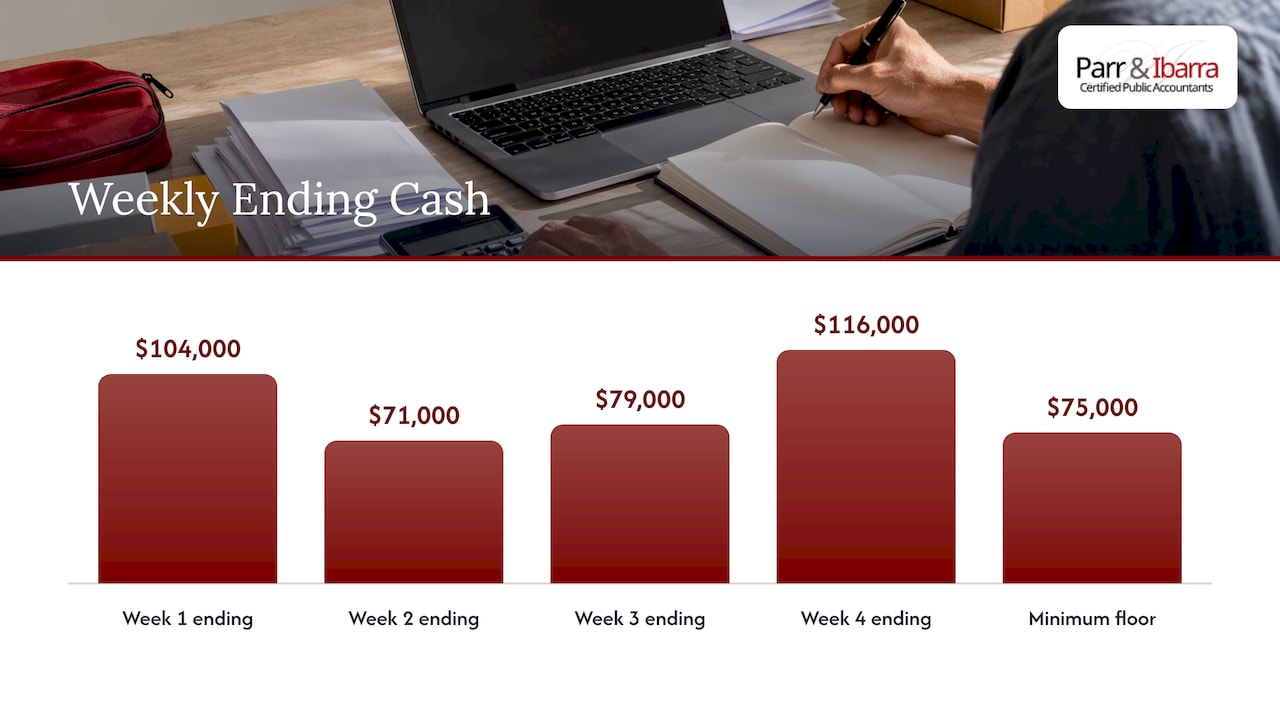
| Beginning cash | $120,000 | $104,000 | $71,000 | $79,000 |
| Customer collections | $48,000 | $52,000 | $90,000 | $60,000 |
| Other receipts | $0 | $0 | $5,000 | $0 |
| Payroll and payroll taxes | $(46,000) | $(2,000) | $(46,000) | $(2,000) |
| Vendor bills | $(14,000) | $(21,000) | $(16,000) | $(19,000) |
| Rent and insurance | $(4,000) | $(2,000) | $(3,000) | $(2,000) |
| Estimated tax payment | $0 | $(60,000) | $0 | $0 |
| Ending cash | $104,000 | $71,000 | $79,000 | $116,000 |
With a $75,000 minimum cash floor, week 2 is flagged: the estimated tax payment lands in the same week as a thin collection week, and the balance falls $4,000 under the floor. Ten weeks of warning would give the owner room to ask a large customer to pay early, to move a vendor payment a week, or to open a credit line before it is urgent. A single-week surprise would not.
Notice what the monthly view would have shown: the four weeks combined end higher than they began. The problem exists only at weekly resolution.
Keeping it rolling: the weekly routine
The forecast earns its keep in the update. A simple weekly routine looks like this:
- Record actuals. Enter what really came in and went out last week for each line.
- Compare to forecast. Look at the variance by line, not just the total. A zero total can hide a large collections miss offset by a delayed bill.
- Investigate large variances. Set a threshold, such as any line off by more than a set dollar amount or percentage, and find out why. Late customer, early vendor, wrong estimate?
- Roll forward. Drop the finished week and add a new week 13 with its expected receipts and payments.
- Re-read the floor. Check which weeks now fall under your minimum, and decide what to do.
- Keep a change log. Note any time you move a receipt to a later week or a payment to a later week. This prevents the common habit of quietly pushing a cash problem into the outer weeks week after week without admitting it.
Assign one person as owner of the whole model, with someone responsible for each input: sales for expected billings, the person who runs accounts payable for bills, HR or payroll for headcount changes. When nobody owns it, it decays within a month.
Common mistakes to avoid
- Starting from net income. The indirect method hides timing. Use actual cash movement.
- Using due dates instead of payment dates. Forecast on how customers behave, not on their terms.
- Forgetting tax and payroll tax lumps. These are predictable, so they should never be a surprise.
- Never recording actuals. A forecast without a variance check never improves.
- Building it once and filing it. A static 13-week forecast is out of date by week 3.
- Ignoring books that are behind. A forecast on top of unreconciled accounts gives false confidence.
Weekly cash forecast layout for a spreadsheet
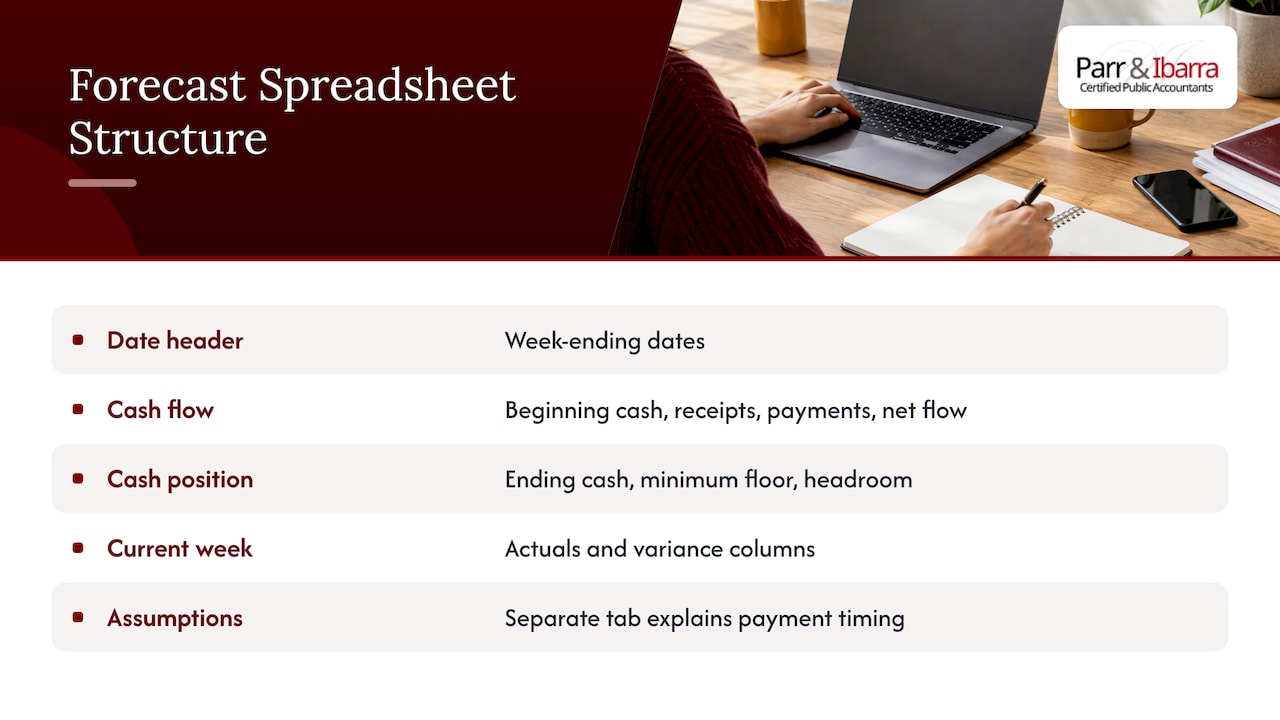
You do not need special software to start. A workable template has a header row of week-ending dates, then sections in this order: beginning cash; receipts by category; payments by category; net cash flow; ending cash; minimum cash floor; and headroom over the floor. Add a column for actuals and a column for variance next to the current week. Use color for any week under the floor. Keep assumptions on a separate tab so anyone reading the model can see why a payment sits in a given week.
If your business bills clients for time, such as a consultancy, agency or freelance practice, build collections from your billing and retainer calendar. For ideas on running the finance side of a service business, this piece on freelancer finance productivity is a useful companion to your weekly routine.
Where a 13-week forecast fits with your other numbers
The 13-week view is one layer. Your monthly budget-versus-forecast review covers the profit side, and our piece on monthly forecasts for small business CFOs shows how the two fit together. A clean month-end process, like the one in our month-end close checklist, gives you reliable opening balances and receivable reports. And if you hold inventory, the inventory accounting methods you use affect your reported margins, while the cash forecast tracks what you actually pay suppliers and when.
Nonprofits and real estate investors can use the same structure. A nonprofit puts grant disbursements, pledges and donor campaigns on the receipts side and watches restricted funds separately. A real estate investor puts rents, debt service, property taxes, insurance and capital projects by week, and watches the weeks when a loan payment and a repair bill coincide.
When to hand it to a CPA
Most owners can build the first version in an afternoon. The harder part is the discipline: pulling accurate receivables every week, tying the opening balance to the bank, placing tax and payroll deposits correctly, and reading the variances. This is where owners often decide it should not be one more thing on their own list.
Parr & Ibarra CPA is a Dallas-Fort Worth firm with a team of more than 20 professionals, including multiple CPAs, serving local business owners, entrepreneurs, nonprofits and real estate investors, with services in English and Spanish. Our outsourced CFO and comptroller service and financial planning and analysis work sit alongside bookkeeping, payroll and tax planning, so the numbers feeding your forecast come from one coordinated team rather than four separate vendors. To talk through your own cash picture, start at our main page.
FAQ
What is a 13-week cash flow forecast?
It is a weekly projection of cash coming in and going out over the next 13 weeks, which is one quarter. It starts from your real bank balance and shows the expected ending cash for each week. It is rolled forward every week so the horizon stays 13 weeks.
What does “rolling 13 weeks” mean?
Each week you replace the forecast for the week that just ended with actual results, drop that week, and add a new week at the end. You always see a full 13 weeks ahead. The comparison of actuals to forecast also shows you where your estimates tend to miss.
How is a 13-week cash budget different from a 12-month rolling forecast?
The 13-week version works weekly, from invoices and bills, and is built to catch short-term shortfalls. The 12-month rolling version works in monthly totals and supports bigger decisions such as hiring, equipment or financing. Many businesses keep both.
How do I calculate ending cash each week?
Add the week’s cash receipts to the beginning balance, then subtract the week’s cash payments. The result is the ending balance, which becomes the next week’s beginning balance. Compare it each week to your minimum cash floor.
Do I need software to do this?
No. A spreadsheet with 13 week columns, an actuals column and the four core rows is enough to start. What matters is accurate inputs, a weekly update and a named owner.
Sources
- How a 13-week cash flow cycle can help your business, AICPA & CIMA
- Rolling 13-Week Cash Forecast, Imeg
- The Importance of 13-Week Cash Flow Forecasts, CFO.com