

A nonprofit is a legal entity organized to serve a public or community purpose without distributing profits to private individuals. That single distinction shapes everything from how you file taxes to how you recruit board members. Nonprofit status is state-level incorporation, while tax-exempt status is a separate federal IRS designation. Confusing the two is the most expensive mistake new founders make. Across the United States, 75 million people volunteered over 5 billion hours supporting charitable organizations in a single year. That scale reflects how deeply nonprofits are woven into American civic life and why getting the legal and operational details right matters from day one.
What does it take to legally start a nonprofit?
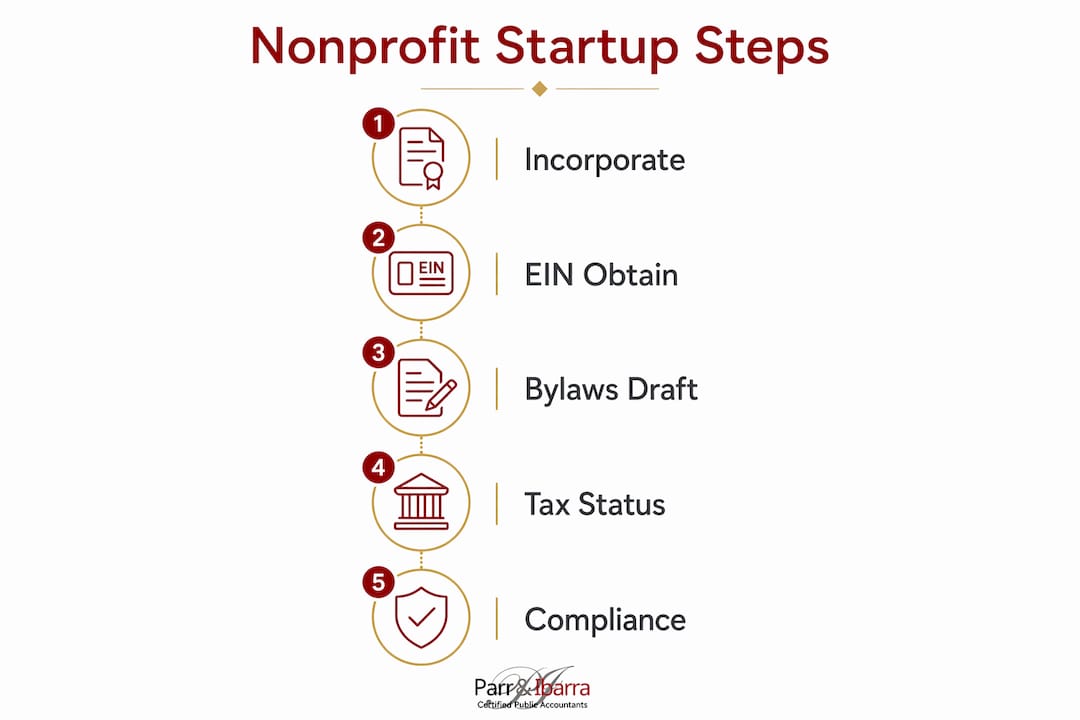
Starting a nonprofit requires a specific sequence of legal steps. Skipping any one of them creates gaps that the IRS or your state will find later.
State incorporation comes first
File articles of incorporation with your state’s secretary of state office. This document names your organization, states its purpose, and identifies your registered agent. Only after this step do you legally exist as a nonprofit entity. Incorporation does not grant tax-exempt status. That comes separately from the IRS.

Federal tax-exempt status requires its own application
After incorporating, apply to the IRS for 501©(3) status using either Form 1023 or Form 1023-EZ. Small organizations earning under $50,000 annually can use the streamlined Form 1023-EZ, which carries a lower $275 filing fee and simpler requirements. Larger or more complex organizations must file the full Form 1023, which requires detailed program descriptions, financial projections, and governance documents. The table below compares the two options directly.
| Feature | Form 1023 | Form 1023-EZ |
|---|---|---|
| Eligible organizations | All 501©(3) applicants | Gross receipts under $50,000 |
| Application fee | $600 | $275 |
| Complexity | Detailed narratives required | Short online form |
| Processing time | Several months | Typically faster |
| Best for | Larger or complex nonprofits | Small, straightforward missions |
Other required documents and registrations
You also need an Employer Identification Number (EIN) from the IRS, written bylaws, and a conflict-of-interest policy. Most states require separate registration for charitable solicitation before you can legally fundraise. Most founders spend between $500 and $2,000 on startup costs before raising their first dollar. Budget for filing fees, legal review, and registered agent services when planning your launch timeline.
Before incorporating, consider whether a fiscal sponsorship arrangement might serve your goals better. Fiscal sponsorship allows faster launch with lower overhead but limits your governance control compared to full incorporation. For founders who want to test a program before committing to full compliance obligations, it is a legitimate path worth evaluating.
Pro Tip: Your articles of incorporation must include a dissolution clause that explicitly names another IRS-approved exempt organization or government entity to receive your assets if you shut down. Without this clause, the IRS will reject your 501©(3) application outright.
What are the ongoing compliance requirements for nonprofits?
Earning tax-exempt status is not a one-time achievement. Maintaining it requires consistent annual action and documented governance practices.
The most visible obligation is the annual IRS Form 990 filing. Organizations with gross receipts under $200,000 and assets under $500,000 may qualify for the simplified Form 990-EZ, while very small organizations may use the 990-N postcard. Religious organizations and certain political groups may be exempt entirely. Choosing the wrong form signals poor governance to donors and grant reviewers.
Key ongoing compliance tasks every charitable organization must manage:
- Annual IRS Form 990 filing on time, using the correct variant for your size
- State charitable solicitation renewal in every state where you fundraise
- Board meeting minutes documented and retained for at least three years
- Conflict-of-interest policy reviewed and signed annually by all board members
- Public support test maintained to confirm you receive broad community backing, not just one major donor
- Reasonable compensation review for any paid officers or staff, documented with comparability data
All surplus revenue must be reinvested in the mission, and officer salaries must stay within IRS-defined reasonable limits. Violations trigger excise taxes and can cost you your exempt status entirely.
Pro Tip: Choosing the right Form 990 variant is not just a compliance checkbox. Filing the full Form 990 when you qualify for a shorter version actually builds donor confidence by showing transparency.
What are the most effective nonprofit fundraising ideas?
Revenue diversification is the single most important factor in long-term sustainability for charitable organizations. Organizations that rely on one funding source are one grant cycle away from a crisis.
The strongest fundraising programs combine multiple revenue streams:
- Individual donors: Monthly giving programs generate predictable cash flow and lower the cost of donor retention compared to one-time campaigns.
- Foundation grants: Grants from private foundations and government agencies fund specific programs. The IRS public support test rewards broad donor bases, so grant income alone can actually threaten your exempt status if it dominates your revenue.
- Corporate partnerships: In-kind donations of goods, services, or employee volunteer hours reduce operating costs without touching your cash budget.
- Events: Galas, 5K runs, and auctions build community visibility alongside revenue. Hybrid events combining in-person and virtual attendance now reach wider audiences than traditional formats.
- Earned income: Fee-for-service programs, training workshops, and merchandise sales tied to your mission create revenue that is not dependent on donor generosity.
Donors give more when they see measurable impact. A quarterly impact report showing specific outcomes, such as meals served, students tutored, or families housed, consistently outperforms generic thank-you letters in donor retention. Pair that with a donor-advised fund option for major gift prospects, and you create a giving pathway that works for donors at every level.
Pro Tip: When applying for nonprofit grants for funding, align your program language directly with the funder’s stated priorities. Grant reviewers flag applications that describe a program in general terms and then request funding for something more specific.
How do you build effective nonprofit governance and operations?
Strong governance is the infrastructure that keeps a charitable organization compliant, funded, and mission-focused. Weak boards are the leading cause of nonprofit failure, not weak fundraising.
A working board needs members with distinct, complementary expertise. Every effective nonprofit board should include someone with financial literacy, legal knowledge, fundraising experience, and deep community connections. A board composed entirely of passionate advocates with no financial or legal background creates blind spots that auditors and grant reviewers will find.
Board member duties and operational responsibilities every organization should formalize:
- Attend and participate in all scheduled board meetings, whether in person or remote
- Review financial statements monthly and flag variances from the approved budget
- Approve major contracts and expenditures above a board-defined threshold
- Sign and review the conflict-of-interest policy annually
- Participate in fundraising by making a personal gift and opening doors to their networks
- Oversee executive director performance through annual written evaluation
- Ensure audit readiness by maintaining fund accounting separation between restricted and unrestricted funds
Remote boards work well with strict meeting structures and financial controls, but only when those controls are written into policy, not just practiced informally. Document everything. The IRS and state regulators look at board minutes during audits and investigations.
Maintaining financial separation between any related for-profit operations and your nonprofit is non-negotiable. Shared bank accounts, shared staff without documented cost allocation, or shared leadership without clear role separation can trigger IRS penalties and revocation of your exempt status. This is one of the most common and most preventable compliance failures in the sector.
For organizations building their financial systems from scratch, bookkeeping practices for nonprofits differ from standard small business accounting because fund accounting tracks money by restriction, not just by category. Set this up correctly from the beginning, and your annual Form 990 preparation becomes straightforward. Set it up wrong, and every audit becomes a reconstruction project.
You can also review CFO-level financial oversight duties to understand what financial leadership looks like at the board and executive level, even if your organization is too small to hire a full-time CFO.
Key Takeaways
A nonprofit’s long-term success depends on getting three things right from the start: legal formation, ongoing compliance, and diversified funding.
| Point | Details |
|---|---|
| Nonprofit vs. tax-exempt | State incorporation and IRS 501©(3) status are separate steps; both are required. |
| Startup costs | Budget $500–$2,000 for filing fees, legal review, and registered agent services before launch. |
| Annual compliance | File the correct Form 990 variant each year and renew state charitable solicitation registrations. |
| Revenue diversification | Combine individual donors, grants, events, and earned income to protect against funding gaps. |
| Board governance | Document all policies, financial controls, and meeting minutes to stay audit-ready at all times. |
What most nonprofit guides get wrong about governance
Running a nonprofit for years has shown me one consistent pattern: founders spend enormous energy on the mission and almost none on the governance structure that protects it. By the time a compliance problem surfaces, it is usually years in the making.
The most overlooked issue is board composition at startup. Founders tend to recruit friends and early supporters, people who believe in the cause but lack the financial or legal expertise the board actually needs. That gap does not show up immediately. It shows up when you face your first audit, your first grant rejection due to weak financial controls, or your first IRS inquiry about officer compensation.
Continuous compliance vigilance matters more than most people realize. Getting 501©(3) status approved feels like crossing a finish line. It is actually the starting line. The IRS can revoke exempt status for sustained noncompliance, and reinstatement is expensive and slow.
Transparent financial reporting is not just a legal obligation. It is your most powerful fundraising tool. Donors who receive clear, specific impact reports give more and give longer than donors who receive only thank-you letters. The organizations I have seen grow fastest are the ones that treat financial transparency as a competitive advantage, not a burden.
If you are unsure whether your governance structure, compensation practices, or financial systems meet current IRS standards, get a professional review before you need one. Reactive compliance is always more expensive than proactive compliance.
— Adan
How Parr & Ibarra CPA supports nonprofit compliance and tax planning
Nonprofit tax compliance is not a side specialty. It requires specific knowledge of IRS exempt organization rules, Form 990 variants, and state-level registration requirements that change regularly.
Parr & Ibarra CPA works with nonprofit leaders in the Dallas-Fort Worth area on IRS tax-exempt applications, annual Form 990 preparation, and year-round financial planning. The team of over 20 professionals, including multiple CPAs, brings the depth of a large firm with the personal attention of a local practice. Whether you are applying for 501©(3) status for the first time or need help choosing the right Form 990 for your current size, Parr & Ibarra CPA provides guidance built around your specific situation. Review tax planning best practices tailored for organizations like yours, or contact the team directly to schedule a consultation.
FAQ
What is the difference between a nonprofit and a tax-exempt organization?
A nonprofit is a state-level legal entity incorporated under state law. Tax-exempt status is a separate federal designation granted by the IRS, most commonly under Section 501©(3). You must apply for both independently.
How long does it take to get 501©(3) status?
Processing time varies by form type and IRS workload. Form 1023-EZ applications are typically processed faster than full Form 1023 applications, which can take several months.
What happens if a nonprofit fails to file Form 990?
The IRS automatically revokes the tax-exempt status of any organization that fails to file Form 990 for three consecutive years. Reinstatement requires a new application and back filing of missing returns.
Can a nonprofit pay its founders or staff?
Yes. Nonprofits can pay reasonable salaries to founders, officers, and staff. The IRS requires that compensation be comparable to what similar organizations pay for similar roles, documented with written comparability data.
What is a dissolution clause and why does it matter?
A dissolution clause is a required provision in your articles of incorporation that directs your assets to another IRS-approved exempt organization or government entity if your nonprofit closes. Without it, the IRS will reject your 501©(3) application.

