
Estate tax is paid by the estate before assets are distributed; inheritance tax is paid by beneficiaries after they receive their share. The two rarely overlap for the same dollar, and only one of them exists at the federal level. There is no federal inheritance tax, and the federal estate tax now only touches estates worth more than $15 million per person for deaths after December 31, 2025, so most families will never see a federal estate tax bill at all.
That doesn’t mean you’re in the clear. A handful of states still tax inheritances directly, and a smaller group tax the estate itself before it ever reaches you. This guide walks through:
- The legal difference between estate tax and inheritance tax, with a real-number example
- Federal filing rules, including Form 706 and the portability trap that catches surviving spouses off guard
- Which states tax what, and how much
- Why capital gains and step-up in basis often matter more than either tax
- What executors and heirs should do first, and when to call a CPA
Check your state’s specific rules before assuming you owe nothing, and talk to a CPA if the estate involves a business, real estate, or assets in more than one state.
Key Takeaways
Estate tax is paid by the estate before distribution, inheritance tax is paid by beneficiaries after distribution, and the federal government only imposes the former.
| Point | Details |
|---|---|
| Know who pays | Estate tax comes out of estate assets before distribution; inheritance tax is paid by the beneficiary after receiving their share. |
| Federal exemption is high | The $15 million per-person exemption for 2026 means most estates owe no federal estate tax at all. |
| File Form 706 for portability | Filing within nine months preserves a surviving spouse’s ability to use any unused exemption, even when no tax is due. |
| State rules vary sharply | Only 12 states plus D.C. levy an estate tax and six levy an inheritance tax, with exemptions and rates differing widely by state. |
| Step-up in basis often matters more | Assets held until death reset to fair market value, frequently saving heirs more than estate tax planning ever would. |
| Get professional guidance early | Parr & Ibarra CPA helps executors and heirs in Dallas-Fort Worth navigate Form 706 filings, portability, and valuations from the start. |
This article is general information, not a substitute for advice from a qualified financial advisor. Consult a qualified financial professional about your own circumstances before acting on anything here.
Estate Tax vs. Inheritance Tax: The Core Difference
The estate tax hits the pile of assets itself, calculated on the total value of what someone owned at death, and it’s paid out of estate funds before a single dollar reaches an heir. The inheritance tax hits the person receiving the money, calculated on what each beneficiary actually gets, and that beneficiary writes the check.
Here’s the mechanical difference laid out in order:
- Who’s liable. The estate’s executor pays estate tax from estate assets. The individual beneficiary pays inheritance tax, sometimes directly to the state, sometimes through a reduction from the amount they receive.
- What’s taxed. Estate tax uses the gross estate value (all assets, minus allowed deductions) as its base. Inheritance tax uses each recipient’s individual share, and the rate often depends on how closely related that recipient is to the deceased.
- When it’s assessed. Estate tax is calculated once, at the estate level, shortly after death. Inheritance tax is calculated separately for every beneficiary, sometimes months apart if distributions happen in stages.
Picture a $2 million estate split between a surviving spouse and an adult child in a state that taxes inheritances. The spouse typically pays nothing. The child might owe a state inheritance tax on their share, because most inheritance tax states carve out steep exemptions for spouses and often for children too, while charging higher rates to more distant relatives or unrelated heirs.
Pro Tip: Ask early in probate whether your state taxes the estate, the inheritance, or neither. That single question determines whether you or the estate’s executor is responsible for writing a check.
How Federal Estate Tax Works: Exemption, Form 706, and Portability
The federal basic exclusion amount is $15 million per person for transfers after December 31, 2025, following changes enacted through OBBBA. A married couple can shield up to $30 million combined with proper planning. At that threshold, the overwhelming majority of American estates owe zero federal estate tax, which is exactly why this guide spends more time on state rules and capital gains than on federal exposure.
Filing still matters even when no tax is due. Here’s when Form 706 comes into play:
- It’s required for U.S. citizen or resident estates that exceed the filing threshold based on gross estate value plus adjusted taxable gifts.
- It must generally be filed within nine months of the date of death, with a six-month extension available on request.
- It’s the only mechanism for electing portability, which lets a surviving spouse claim the deceased spouse’s unused exemption amount.
Miss that nine-month window without requesting an extension, and portability can be lost permanently, even if the estate itself owed nothing. That’s the trap: an executor sees no tax due, assumes there’s no reason to file, and inadvertently costs a surviving spouse millions in future shelter.
If any of the estate’s assets or gifts touch the generation-skipping transfer tax (leaving assets to grandchildren, for instance), the GST exemption tracks the same $15 million figure and needs coordinated planning.
One more wrinkle worth flagging: nonresident, noncitizen decedents face a far lower exemption, as little as $60,000, with U.S.-situs assets like American real estate or corporate shares still exposed. Cross-border estates need specialized advice well before filing deadlines arrive.
Which States Tax Estates or Inheritances?
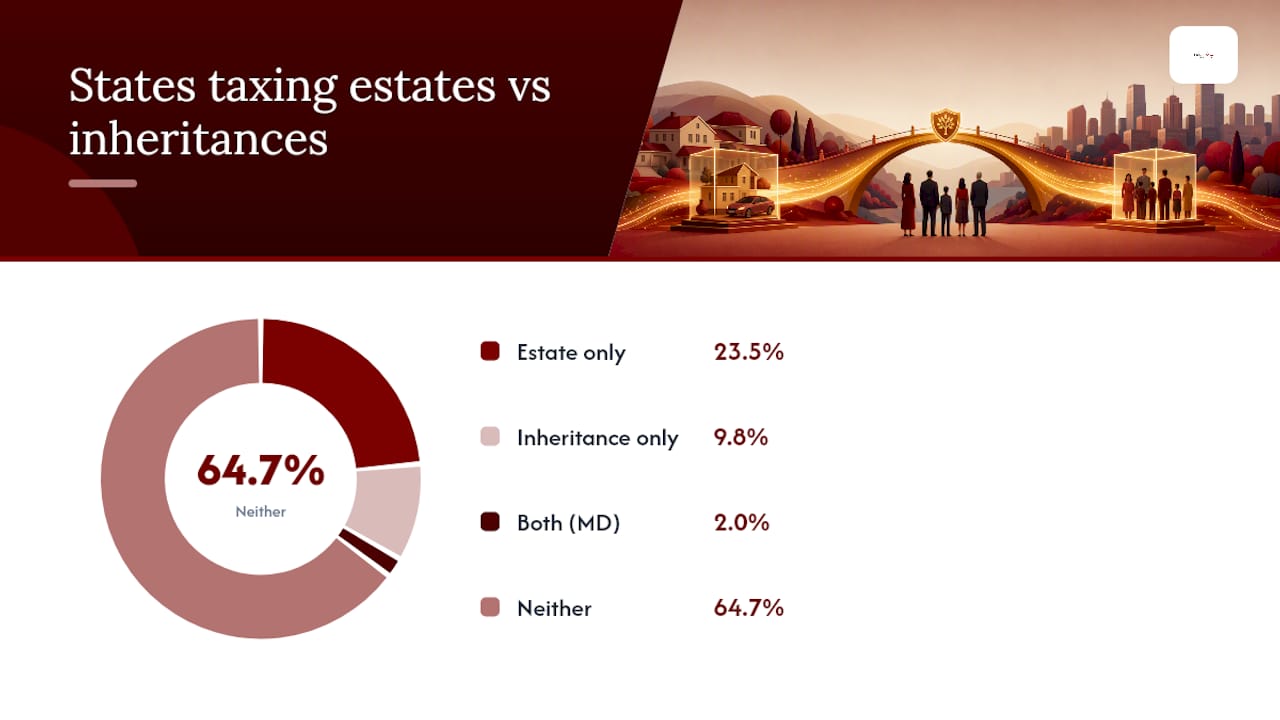
State exposure is where most families actually encounter this issue, since federal estate tax rarely applies anymore. As of 2023, 12 states plus Washington D.C. levy an estate tax, and six states levy an inheritance tax, with Maryland alone taxing both. Combined, state and local governments collected several billion dollars from these taxes in 2021, a fraction of federal estate tax revenue but far from trivial for the families who owe it.
State exemptions swing widely. In 2022, thresholds ranged from $1 million in states like Oregon and Massachusetts up to $9.1 million in Connecticut and $6.11 million in New York, and top rates in some states reach 20%. A $1.5 million estate that owes nothing federally could still trigger a state estate tax bill in a low-exemption state.
Inheritance tax states typically organize beneficiaries into classes:
- Spouses are almost universally exempt.
- Children and grandchildren usually get a partial exemption and a lower rate.
- Siblings, nieces, nephews, friends, and unrelated beneficiaries often pay the highest rates with the smallest exemptions.
| Category | What it means for heirs |
|---|---|
| Estate tax states | Tax assessed on the total estate before distribution; exemptions vary by state, some far below the federal $15 million level |
| Inheritance tax states | Tax assessed on each beneficiary’s share; rate depends on relationship to the deceased |
| Both estate and inheritance tax | A state (Maryland) applies separate calculations at the estate level and again at the beneficiary level |
| No estate or inheritance tax | The majority of states impose neither, leaving only federal rules in play |
State laws change more often than federal rules, and several states have phased out or adjusted their estate tax in recent years. Verify current thresholds with your state’s department of revenue or a CPA licensed in that state before assuming last year’s rules still apply.
Step-Up in Basis: Why Capital Gains Often Cost More Than Estate Tax
For most families below the federal exemption, capital gains tax on inherited assets matters more than estate tax ever will. Under IRC Section 1014, an inherited asset generally gets a new cost basis equal to its fair market value on the date of death. That step-up erases decades of unrealized gain in one stroke.
Compare the two paths an asset can take:
- Lifetime gift: The recipient inherits the giver’s original cost basis (carryover basis). Sell later, and you owe capital gains tax on the full appreciation since the original purchase, sometimes decades of growth.
- Inheritance at death: The heir’s basis resets to fair market value at death. Sell shortly after inheriting, and there’s often little or no taxable gain at all.
Say a parent bought stock for $50,000 that’s worth $400,000 at death. A child who inherits and sells soon after owes capital gains tax on very little, because the basis reset to $400,000. Had that parent gifted the same stock during life, the child would inherit the original $50,000 basis and owe tax on $350,000 of gain upon sale.
Pro Tip: If you’re planning to give away an appreciated asset, run the numbers on holding it until death instead. For many estates under the exemption, the step-up in basis saves heirs far more than any lifetime gifting strategy. Our guide to capital gains tax treatments breaks down how basis rules interact with different asset types.
What Executors and Heirs Should Do First
The first few months after a death set the tone for everything that follows. Work through these steps roughly in order:
- Inventory everything. List real estate, bank and brokerage accounts, retirement accounts, business interests, and personal property. You can’t determine tax exposure or file anything without a complete picture.
- Get professional valuations. Real estate, closely held businesses, and unusual assets need documented appraisals, both for Form 706 (if required) and to establish the stepped-up basis heirs will rely on later.
- Decide whether Form 706 is required. Even below the filing threshold, consider filing anyway if a surviving spouse might benefit from portability down the road.
- Plan for liquidity before distributions. Banks and custodians often freeze accounts pending formal clearance, and that delay can leave an estate cash-poor exactly when funeral costs, legal fees, and interim expenses come due.
- Handle state inheritance assessments separately. If your state taxes inheritances, the state typically calculates each beneficiary’s liability based on their relationship and share, and beneficiaries pay before or upon receiving their distribution.
Pro Tip: Loop in a CPA or estate attorney the moment you’re named executor, not after you’ve already missed a deadline. Ask specifically about the Form 706 nine-month window, portability, and whether any assets need appraisal before you can even calculate what’s owed. If the estate includes litigation exposure or valuation disputes, a firm offering CPA expert witness and litigation support can help resolve contested figures before they delay probate further.
How Parr & Ibarra CPA Supports Estate and Inheritance Tax Planning
Parr & Ibarra CPA works with individuals, families, and business owners across Dallas-Fort Worth on the exact issues this guide covers: Form 706 filings, portability elections, asset valuations, and executor support during a stressful window. The firm pairs big-firm technical depth with a community-focused approach that keeps the process from feeling like a black box.
An engagement typically includes:
- A review of whether Form 706 filing makes sense, even when no tax is owed, to preserve portability for a surviving spouse
- Coordination on asset valuations and documentation that support the stepped-up basis heirs will use later
- Ongoing tax planning that looks past the immediate filing toward cash flow and long-term tax mitigation
With a team of more than 20 professionals, including multiple CPAs, Parr & Ibarra CPA builds tailored plans rather than one-size-fits-all filings.
Where Estate and Inheritance Taxes Came From
The federal estate tax dates back to the Revenue Act of 1916, introduced partly to fund World War I and partly to address concentrated wealth in the Gilded Age’s aftermath. Inheritance taxes actually predate it at the state level, some tracing back to the 1800s, built on a different premise: that a windfall received by an individual is itself a form of income worth taxing, separate from whatever tax already applied to the deceased’s earnings during life.
That philosophical split still explains the structure today. Estate tax treats death as a taxable event for the accumulated wealth itself, regardless of who eventually receives it. Inheritance tax treats each transfer to each beneficiary as its own taxable event, which is why the rate can shift dramatically based on the relationship between the giver and the recipient.
Congress has adjusted the federal exemption repeatedly over the decades, from a few hundred thousand dollars in earlier eras to $15 million today. States have moved in less predictable directions. Some have repealed their estate tax entirely in the past two decades to stay competitive with neighboring states for retirees and wealthy residents. Others have held on, arguing the revenue funds services that broader income taxes can’t fully cover. The result is the patchwork you see today: a high, stable federal threshold most people will never reach, layered under a shifting mix of state rules that can still catch heirs by surprise.
Marriage Changes the Math More Than Almost Anything Else
Spousal transfers get treated more favorably than any other transfer under both estate and inheritance tax rules. The federal unlimited marital deduction lets a spouse leave any amount to a surviving spouse without triggering federal estate tax, regardless of size. State inheritance tax systems mirror that logic almost universally, exempting spouses entirely or taxing them at the lowest available rate.
Portability adds another layer specific to married couples. When one spouse dies and doesn’t use their full exemption, the survivor can claim the unused amount, provided the executor files Form 706 and elects portability within the deadline. Skip that filing, and the surviving spouse permanently loses access to their late spouse’s exemption, even if remarriage or a later death would have made it valuable.
Divorce and remarriage complicate this further. A former spouse generally has no claim to marital exemptions, and blended families often need explicit planning to make sure children from a first marriage aren’t unintentionally shortchanged if a surviving second spouse inherits everything first. Unmarried partners get none of these benefits under federal law or in most states, regardless of relationship length, which makes proactive planning far more urgent for couples who never formalized their relationship legally.
Trusts and How They Shift Estate and Inheritance Tax Outcomes
Trusts don’t eliminate taxes by themselves, but they change who’s responsible for what and when, a crucial consideration in long-term care and inheritance planning. A revocable living trust avoids probate but does nothing to reduce estate tax exposure, since the grantor still legally owns the assets until death. An irrevocable trust, by contrast, can remove assets from the taxable estate entirely, because the grantor gives up ownership and control in exchange for that tax benefit.

Irrevocable life insurance trusts (ILITs) are a common tool for this exact purpose: they keep life insurance proceeds out of the taxable estate, which matters most for families near or above state estate tax thresholds. Credit shelter trusts, sometimes called bypass trusts, historically helped married couples use both spouses’ exemptions before portability existed as an alternative, and they still make sense in some situations, particularly for growth assets where locking in today’s exemption before future appreciation matters.
For inheritance tax purposes, trusts can matter differently depending on the state. Some states tax trust distributions to beneficiaries the same way they’d tax a direct inheritance, based on the beneficiary’s relationship to the person who funded the trust. Others treat trust assets differently based on when and how the trust was structured. This is one area where state-specific advice isn’t optional. A CPA or attorney needs to look at your specific state’s rules before assuming a trust structure that works in Texas will produce the same inheritance tax outcome in Pennsylvania or Kentucky.
Common Strategies Families Use to Reduce the Tax Bill
Most legitimate strategies fall into a few categories, and which one makes sense depends heavily on where an estate sits relative to the federal and state thresholds.
For estates near or above the federal $15 million exemption, lifetime gifting still plays a role, particularly using the annual gift tax exclusion to move assets out of the estate gradually without using up lifetime exemption. Grantor retained annuity trusts (GRATs) and family limited partnerships let families transfer appreciating assets at a discounted value for gift tax purposes while retaining some control or income stream. Our overview of using a family limited partnership in a financial strategy walks through how that structure works in practice.
For estates well below the federal exemption but exposed to state estate or inheritance tax, the calculus shifts. Moving to a state without either tax before death is a real option some retirees pursue, though residency rules are stricter than people assume and require genuine relocation, not just a change of address. Charitable giving reduces the taxable estate at any size and can be structured to provide income to heirs first through charitable remainder trusts.
For most families under the federal exemption, though, CPAs increasingly emphasize income-tax optimization over estate-tax avoidance, since the step-up in basis already delivers most of the available tax benefit without any trust structure at all.
Gifts During Life vs. Bequests at Death: The Tax Treatment Gap
The IRS treats a lifetime gift and a bequest at death very differently, and the gap widens the longer an asset has appreciated. Lifetime gifts use the annual exclusion (a set amount per recipient per year that avoids gift tax reporting) or eat into the giver’s lifetime exemption once that annual amount is exceeded. Critically, the recipient inherits the giver’s original cost basis, carryover basis, meaning whatever gain has built up transfers along with the asset.
Bequests at death work through the estate process instead, subject to estate tax only if the estate exceeds the exemption, and the recipient gets the stepped-up basis discussed earlier. That basis difference alone can be worth more than any gift or estate tax consideration for a mid-size, appreciated asset like real estate or closely held stock.
There’s a practical trade-off buried in this comparison. Gifting during life removes future appreciation from the estate entirely, since whatever the asset gains in value after the gift belongs to the recipient, not the estate. But it sacrifices the basis step-up. Holding the same asset until death preserves the step-up but keeps the appreciation inside the taxable estate until death. For families near an estate tax threshold, that’s a real calculation, not a default choice. For families well under any threshold, holding until death to capture the basis reset usually wins.
Penalties and Interest for Late or Incorrect Filings
Missing a filing deadline or underreporting an estate’s value carries real financial consequences beyond the tax itself. Interest compounds daily on any unpaid balance from the original due date, regardless of whether an extension was granted for filing.

The steeper cost, as mentioned earlier, is often invisible on the penalty notice: losing portability. An executor who skips filing Form 706 because no tax appears to be due doesn’t get a penalty letter for that decision, since nothing was technically required. But if the surviving spouse later needs that unused exemption, and the nine-month window (or the extension period) has closed, that exemption is gone, permanently, with no penalty notice to warn anyone it happened.
State-level penalties for inheritance and estate tax filings vary but generally follow a similar structure: percentage-based penalties for late filing, additional penalties for underpayment, and daily or monthly interest accrual. Some states are notably aggressive about auditing valuations on real estate and business interests, since those are the categories most prone to disputes. Getting a qualified appraisal at the time of death, rather than reconstructing one later, is the cheapest insurance against a penalty dispute down the road.
A Practical Note on Priorities After the BEA Change
The jump to a $15 million exemption changes what actually deserves your attention. For most families, elaborate trust structures built to dodge estate tax now solve a problem that no longer exists, while the basis step-up quietly does the heavy lifting. Complex trusts still earn their keep for genuinely large estates, blended families, or anyone with real state-level exposure. If your estate plan was drafted before this exemption jumped, it’s worth a fresh look with a CPA who can tell you whether it’s still solving the right problem.
— Adan
Get Help With Form 706, Portability, and Estate Filings
Filing deadlines, portability elections, and asset valuations aren’t the kind of thing to figure out from a blog post while you’re also handling a funeral and grieving family members. Parr & Ibarra CPA handles the technical side of estate and inheritance tax matters for Dallas-Fort Worth families and executors directly, so you’re not piecing together IRS instructions on your own during an already difficult stretch.
Before an initial consult, gather a rough asset inventory, any existing estate planning documents, and the date of death, since those three things let a CPA quickly assess whether Form 706 is required and whether portability is worth electing. From there, expect a conversation about valuations, deadlines, and whether your specific situation calls for anything beyond a straightforward filing.
If you’re an executor facing the nine-month clock, or a business owner rethinking your own estate plan under the new exemption, start a tax planning conversation with Parr & Ibarra CPA before deadlines force the decision for you.
Sources
- Instructions for Form 706 | Internal Revenue Service
- How do state and local estate and inheritance taxes work? | Tax Policy Center
- Understanding inheritance taxes | Vanguard
- Estate planning in a post-OBBBA world | The Tax Adviser
FAQ
How much tax do you pay if you inherit $100,000?
It depends entirely on your state and your relationship to the deceased. There’s no federal inheritance tax, so if you live in one of the states without an inheritance tax, or you’re a spouse or child in most inheritance tax states, you may owe nothing at all.
Do you pay both estate tax and inheritance tax?
It’s possible but uncommon. Maryland is currently the only state that imposes both an estate tax and an inheritance tax, so a Maryland estate could face the estate tax at the state level while individual beneficiaries also owe inheritance tax on their share.
Which states have no estate tax or inheritance tax?
The majority of states impose neither tax, leaving only the federal estate tax rules in play, and even those rarely apply given the $15 million exemption. Only 12 states plus D.C. currently levy an estate tax, and six levy an inheritance tax, so most of the country falls outside both systems.
How much can you inherit without paying taxes?
At the federal level, there’s no cap on how much a beneficiary can inherit tax-free, since the federal estate tax is paid by the estate, not the heir, and only applies above $15 million per person. State inheritance tax exemptions vary, but spouses and often children are exempt or receive a substantial exemption before any tax applies.

