
If you have even one employee working in a state where your company has never registered, you likely owe withholding, State Unemployment Insurance (SUTA), or both. The default rule is simple: withhold income tax for the state where the employee actually performs the work, not necessarily where your business is headquartered. Residency rules, reciprocity agreements, and “convenience of the employer” tests can override that default, which is exactly where most employers get tripped up.
Three things need to happen this week if you have any out-of-state workers:
- Confirm exactly where each employee physically performs their job, day by day, not just their mailing address.
- Check whether you’re registered for withholding and SUTA in every one of those states.
- Update your payroll system’s jurisdiction rules before the next pay cycle runs.
Pro Tip: Start a running log now of when each remote hire’s work location changed. States increasingly use automated data matching to catch unregistered employers, and a paper trail showing you caught the shift yourself beats one showing an auditor caught it first.
Key Takeaways
Employers must withhold based on where work is actually performed, register wherever nexus exists, and review that footprint every quarter to avoid retroactive penalties.
| Point | Details |
|---|---|
| Default withholding rule | Withhold for the state where the employee physically performs the work, unless residency or reciprocity rules apply. |
| Watch convenience-of-the-employer states | States like New York can tax remote workers as if in-state if remote work is the employee’s choice, not the employer’s requirement. |
| SUTA follows different rules | Unemployment insurance liability uses the 26 USC §3306(j) localization test, which can differ from your income tax withholding state. |
| Document location changes quarterly | Track employee work locations by day and log the reasoning behind every remote arrangement to support audits later. |
| Get local CPA support | Parr & Ibarra CPA helps Dallas-Fort Worth employers manage payroll registration, nexus reviews, and audit-ready documentation. |
What Counts as Multi-State Payroll?
Multi-state payroll applies the moment an employee’s work touches more than one state’s tax jurisdiction, whether that’s a full-time remote hire, a commuter who lives across a state line, or a project manager who spends six weeks a year on a job site in another state. It also applies if your business itself has a physical presence, like an office or warehouse, in a state where none of your employees live.
Run through this quick checklist for every employee:
- Where does the employee live?
- Where do they regularly perform their work?
- Do they travel to another state for meetings, installations, or client work, even occasionally?
- Does your company have a physical footprint (office, warehouse, job site) in a state beyond where the employee resides?
A Dallas-based company that hires a fully remote bookkeeper in Oklahoma has multi-state payroll from day one. So does a Fort Worth contractor whose crew spends three weeks on a project in Louisiana. So does an employee who lives in Texas but commutes daily to an office in Oklahoma. Each scenario carries different withholding and registration consequences, which is why a location-by-location review matters more than a one-size-fits-all policy.
How Do You Decide Which State to Withhold For?
The starting point is straightforward: withhold for the state where the employee physically performs the work. That single rule, however, has three major exceptions that trip up otherwise careful payroll teams.
Residency taxation. Most states tax their residents on worldwide income, regardless of where the work happens. An employee who lives in one state but works in another may owe tax to both, with a credit from the resident state offsetting double taxation.
Reciprocity agreements. Some neighboring states have signed reciprocal deals that let an employee withhold only for their state of residence rather than their work state. These agreements aren’t universal and don’t cover every neighboring pair of states, so check the specific states involved rather than assuming one exists.
Convenience-of-the-employer rules. A handful of states, New York being the best known example, tax remote workers as if they worked in-state if the employee is working remotely for their own convenience rather than at the employer’s requirement. This rule has become a real liability generator as remote work has expanded, because an employer can end up owing withholding in a state where the employee has never set foot.
- Confirm whether either state involved has a reciprocity agreement before assuming dual withholding is required.
- Document the reason for remote work arrangements. “Employer required” versus “employee preferred” can determine whether convenience rules apply.
- Revisit sourcing determinations any time an employee’s schedule or location changes, not just once at hire.
Pro Tip: Keep a one-page memo for every remote arrangement stating who initiated it and why. If a convenience-of-the-employer state ever audits the account, that memo is often the deciding piece of evidence.
When Do You Need to Register in a New State?
Nexus, the legal threshold that obligates you to register and withhold in a state, gets triggered more easily than most employers expect. A single employee working from home in a state counts. So does a short-term service visit, a leased warehouse, or even a trade show booth staffed by your team for a few days. States have gotten better at catching unregistered employers because automated data matching between agencies flags mismatches between where wages are reported and where employer accounts exist.
Once nexus exists, you typically need to open:
- A state withholding tax account for income tax purposes.
- A SUTA/SUI account with the state’s unemployment agency.
- Local tax accounts where cities, counties, or school districts levy their own payroll taxes.
Registration usually requires your federal EIN, business formation documents, an estimate of first payroll date and wages, and sometimes a bond or security deposit depending on the state’s unemployment insurance rules. Processing time varies widely, so don’t wait until the first paycheck is due to start the paperwork.
The most reliable defense is a proactive one. Build a quarterly nexus review into your compliance calendar rather than reacting after an employee mentions they’ve moved. Centralize documentation, work locations, registration confirmations, and reciprocity determinations, in one system so anyone on your HR team can answer “are we registered there?” in under five minutes.

What Payroll Taxes Vary Most From State to State?
Payroll tax obligations stack up differently in every state, and assuming your home state’s rules apply everywhere is one of the fastest ways to underwithhold. Four categories matter most.
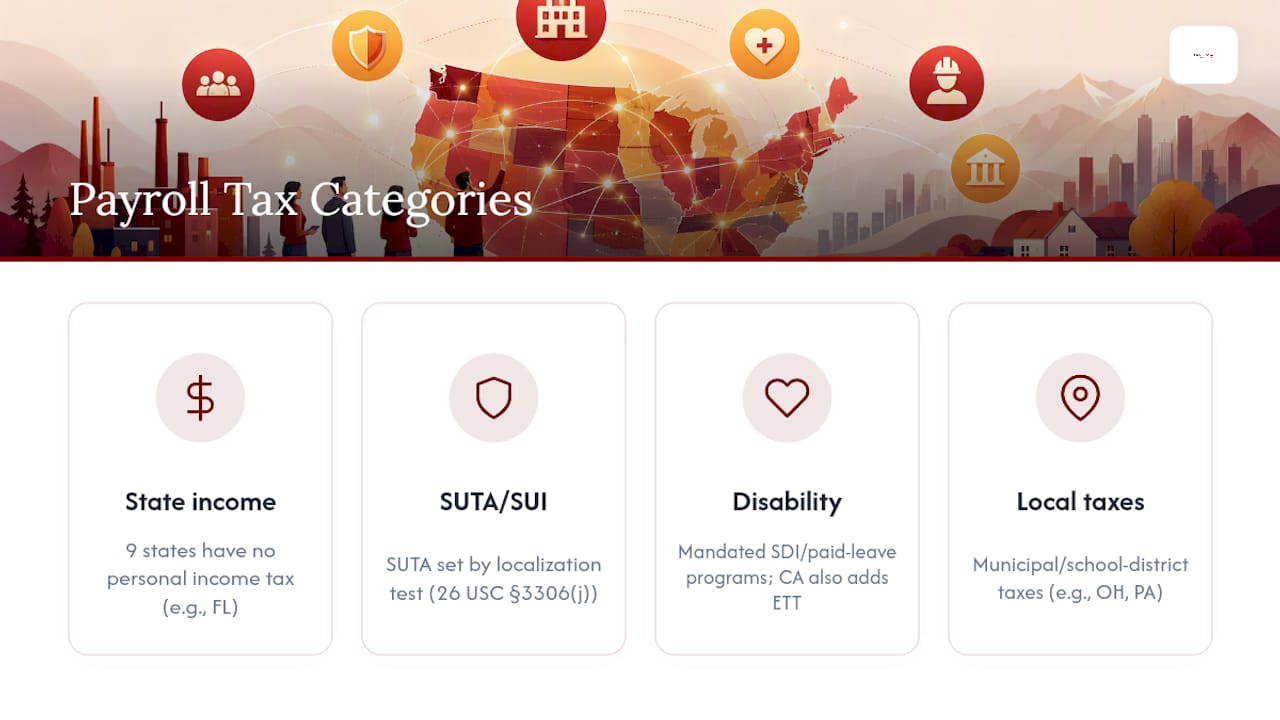
State income tax. Nine states, Alaska, Florida, Nevada, New Hampshire, South Dakota, Tennessee, Texas, Washington, and Wyoming, don’t levy a personal state income tax at all. A Dallas employer with a remote hire in Florida skips state withholding entirely for that employee, but SUTA and any local taxes still apply. Don’t mistake “no income tax” for “no payroll tax obligations.”
SUTA/SUI. Unemployment insurance liability isn’t decided by where you withhold income tax. Federal law under 26 USC §3306(j) sets a localization test: service performed in the state, then base of operations, then place of direction and control, then employee residence, in that priority order. That means an employee’s SUTA state can differ from their income tax withholding state, and Stripe’s guidance on multistate compliance treats this as one of the most commonly missed distinctions in growing companies.
Disability and paid-leave contributions. Several states run mandatory disability or paid family leave programs funded through payroll deductions. California layers on Employment Training Tax (ETT) for employers and State Disability Insurance (SDI) withheld from employees, on top of standard UI and personal income tax withholding, an example of how one state alone can require four separate payroll tax lines.
Local taxes. Cities, counties, and even school districts in certain states levy their own payroll or occupational taxes independent of the state government. Ohio’s municipal income taxes and Pennsylvania’s local earned income taxes are common examples that catch out-of-state employers off guard.
Best Practices for Managing Payroll Across State Lines
Getting multi-state payroll right isn’t about hiring more staff. It’s about building a few specific habits into your existing process.
- Capture telework approvals in writing. A short form documenting when and why an employee started working from a new location closes the gap that convenience-of-the-employer audits target.
- Test your payroll system before you need it. Run sample paychecks through every state your employees touch, not just the ones you’re currently registered in, to confirm locality logic and reciprocity settings are configured correctly.
- Set a travel policy that triggers a compliance flag. Any employee spending more than a few weeks a year in another state for work should trip an internal review, not surface for the first time during tax season.
- Run the quarterly nexus review as a standing meeting, not an ad hoc task. Treating your payroll footprint as something that shifts continuously rather than a one-time setup keeps small changes, a new remote hire, an extended client visit, from becoming a year-end surprise.
Pro Tip: Most payroll software can flag a new state on an employee’s timesheet automatically. Turn that alert on. It’s the cheapest nexus detector you’ll ever install.
Good documentation habits pay for themselves. Employers who can show a consistent, dated record of location tracking and registration decisions are in a dramatically stronger position if a state agency ever asks questions, compared to those piecing together an explanation after the fact.
What Happens If You Get Multi-State Payroll Wrong?
Retroactive withholding corrections are expensive in ways that catch employers off guard. Fixing three years of missed withholding for one employee doesn’t just mean back taxes, it typically means penalties, accrued interest, and the administrative cost of amended returns across multiple filing periods. Advisory guidance consistently points to proactive review as the cheaper path compared to correcting errors after they compound.
If you discover a gap, don’t just file amended returns and hope for the best. Many states offer voluntary disclosure programs that can reduce penalties significantly if you come forward before an audit starts. Keep every piece of location and sourcing documentation you have, timesheets, remote work approvals, travel records, because that evidence is what supports your position during a review.
A documented nexus review cadence, paired with a clean voluntary disclosure package, is often what separates a manageable penalty from a punitive one during state audit negotiations.
Once the exposure spans multiple states or multiple years, bring in a CPA rather than handling it internally. A tax advisor can help you weigh voluntary disclosure against amended filings and negotiate with each state’s specific enforcement posture.
The Real Compliance Gap Nobody Talks About
Most payroll guidance treats multi-state compliance as a software problem: buy the right system, configure the jurisdiction settings, done. That’s incomplete. The actual failure point, in practice, is almost always a documentation gap, not a calculation error. Payroll software will withhold the correct amount for the state you tell it to. It won’t tell you that an employee quietly moved states four months ago, or that a “temporary” client visit turned into a standing weekly commute.
The convenience-of-the-employer rules make this worse. They punish employers for not asking the right question at the start of a remote arrangement, “is this required by us or requested by them?”, and that question rarely gets asked in the excitement of making a new hire. By the time it matters, during an audit or a residency dispute, nobody remembers the original conversation.
What actually reduces risk isn’t a bigger payroll budget. It’s a habit: reviewing location data quarterly and writing down the reasoning behind every remote arrangement while it’s fresh. Employers who treat multi-state payroll as a one-time setup task are the ones who get the expensive surprise later. Employers who treat it as a recurring, five-minute check tend not to.
— Adan
How Parr & Ibarra CPA Supports Multi-State Employers
Multi-state payroll gets complicated fast, and most Dallas-Fort Worth business owners don’t have the bandwidth to track nexus triggers across a dozen states while also running their business. Parr & Ibarra CPA combines big-firm technical depth with a community-focused approach, delivering proactive tax planning tailored to individual employers rather than generic compliance templates.
The firm’s support goes past filing. Its team of more than 20 professionals, including multiple CPAs, handles bookkeeping, payroll management, and CFO advisory work so growing companies get financial clarity alongside compliance. For employers navigating registration questions or working through payroll tax obligations across state lines, that combination of hands-on service and specialized payroll knowledge closes the gap that generic software can’t.
Get Ahead of Multi-State Payroll Risk Before It Costs You
Software can calculate withholding correctly once you tell it the right state. What it can’t do is catch the remote hire who quietly moved, the client visit that turned into a standing weekly trip, or the reciprocity agreement your last provider never configured. That’s the gap Parr & Ibarra CPA closes for Dallas-Fort Worth employers: a team that reviews your actual employee locations, checks registration status against real nexus rules, and builds the documentation that protects you if a state ever asks questions.

If you’ve read this far because something about your current payroll setup feels uncertain, that instinct is usually right. Start with a tax planning consultation to get a specific read on where your multi-state exposure actually sits, and what to fix first.
Federal and State Resources to Confirm Your Obligations
Start with the IRS’s CPEO guidance for federal employer registration questions, and check state-specific portals like California’s EDD for examples of how individual states structure their payroll tax programs. SHRM’s compliance resources offer practical checklists, and Parr & Ibarra CPA can walk through your specific registration questions directly.
This article is general information, not a substitute for advice from a qualified financial advisor. Consult a qualified financial professional about your own circumstances before acting on anything here.
Sources
- What states don’t have income tax (Rippling)
- Multi-State Taxation (American Payroll Association)
- Multistate tax filing: Here’s what to know (Stripe)
- California EDD: Payroll taxes
FAQ
What Does Multi-State Payroll Mean?
Multi-state payroll means an employer has employees who live, work, or travel across more than one state’s tax jurisdiction, which can trigger withholding, SUTA, and registration obligations in each state involved.
What Payroll Taxes Do Employers Pay in the United States?
U.S. employers generally handle federal income tax withholding, Social Security and Medicare (FICA), federal unemployment tax (FUTA), state income tax withholding where applicable, state unemployment insurance (SUTA), and in some states, disability or local taxes.
How Does Working in Multiple States Affect My Taxes?
You typically owe tax to the state where you perform the work, and possibly to your resident state as well, though reciprocity agreements between certain states can eliminate the need to file or withhold in both.
Which States Have the Highest Payroll Tax Burden?
States with disability insurance and paid-leave programs layered on top of standard withholding, California being the clearest example with UI, ETT, SDI, and personal income tax combined, tend to carry the heaviest employer and employee payroll tax load.
Can a CPA Help With Multi-State Payroll Registration?
Yes. A firm like Parr & Ibarra CPA can review your employee locations, determine where nexus exists, handle state registration, and build the documentation needed to defend your positions if a state ever audits your payroll.

