
A budget is the financial plan you commit to for the year; a forecast is the updated prediction you revise as reality unfolds. Budgets set fixed spending limits and revenue targets, usually locked for a full fiscal or calendar year. Forecasts adjust monthly, or even weekly, based on actual performance. Both matter, but only when you stop treating them as the same tool.
TL;DR:
- Most small businesses should update their rolling forecast monthly to maintain an accurate view of cash flow and performance, especially if liquidity is tight.
- The annual budget typically remains fixed for the year, serving as a target, while forecasts adjust regularly based on actual data, reducing the risk of cash shortfalls or misinformed decisions.
- Variance analysis between the budget and forecast helps identify whether assumptions were too optimistic or too conservative, guiding quick corrective actions.
- Clear distinction and communication between budgets, forecasts, and projections are crucial to avoid confusion and maintain credibility with leadership and investors.
- A unified financial model, shared assumptions, and regular review cadence support better alignment, accountability, and timely decision-making.
Budget vs Forecast: The Core Difference
The confusion between these two terms costs businesses real money, usually in the form of bad hiring decisions or misread cash positions. A budget is a static, detailed financial plan that sets targets, allocates resources, and locks spending limits, typically built once a year. A forecast is the opposite by design: a living estimate that gets updated as new data comes in.
Think of the budget as the map you drew before the trip and the forecast as the GPS recalculating your arrival time based on current traffic. You don’t redraw the map every time traffic shifts. You also don’t ignore the GPS just because the map said something different three months ago.
What Is a Budget?
A budget is a detailed financial plan, almost always built for a fiscal year, that translates strategy into numbers: revenue targets, department spending caps, headcount limits, and capital allocations. It’s the document a CFO presents to the board and the one department heads get measured against all year.
Ownership matters here. The finance team typically builds the budget, but each department head owns their piece of it, which is what creates accountability. A marketing director who blows through her budget in Q2 has to answer for it, regardless of what the forecast says three months later.
Common line items in a small business budget include:
- Revenue targets by product line or service category
- Payroll and contractor costs
- Marketing and customer acquisition spend
- Rent, utilities, and fixed overhead
- Capital expenditures (equipment, software licenses, buildouts)
Budgets can be amended, but rarely are, and never casually. A mid-year budget revision usually signals something significant happened, like a lost major client or an unplanned acquisition, not routine drift.
What Is a Financial Forecast (and How It Differs From a Projection)?
A financial forecast estimates the likely financial outcome based on current trends, actual performance, and revised assumptions. Unlike the budget, a forecast is dynamic and gets updated regularly, often monthly or quarterly, sometimes weekly for cash-sensitive businesses.
Finance teams use forecasts for cash planning, board updates, and answering the question every CEO eventually asks: “Are we going to hit the number?” Common formats include:
- Cash-flow forecasts, often on a 13-week horizon for short-term liquidity
- Revenue forecasts, updated monthly against pipeline and booking data
- Rolling forecasts, extending 12 to 18 months and refreshed every period
A projection is a different animal entirely. Where a forecast estimates the probable outcome, a projection models a hypothetical scenario, built on “what if” assumptions rather than current trends. You build a projection when raising capital, evaluating an acquisition, or modeling the financial impact of launching a new product line. It answers “what could happen if,” not “what will likely happen.”
Key Differences: Detail, Purpose, Time Frame, and Cadence
The practical differences between a budget and a forecast come down to five axes, and knowing which one governs a given decision keeps a finance team out of trouble.
- Intent. A budget is a target you’re held to. A forecast is an expectation you adjust as facts change.
- Flexibility. Budgets stay fixed for the fiscal year barring a major event. Forecasts flex with every new data point.
- Update frequency. Budgets get set once annually. Forecasts update monthly, weekly, or even daily in cash-tight businesses.
- Audience. Budgets go to department heads for accountability. Forecasts go to leadership and boards for steering decisions.
- Measurement use. Budgets measure performance against a fixed benchmark. Forecasts measure whether the business is trending toward or away from that benchmark.
The behavioral risk shows up when teams blur these lines. If a sales director treats the forecast as a new target instead of an honest estimate, forecasts start getting inflated to look good, and leadership loses the one tool meant to give them an accurate read on the business. CFI’s FP&A guidance frames this well: budgets are for governance, forecasts are for steering, and conflating the two damages transparency.
The practical fallout is concrete, as seen in cash flow for stables: a practical guide for yard owners, where careful cash management can make or break a small business. A company that keeps hiring against a stale annual budget while the forecast shows declining revenue is burning cash it doesn’t have. A retailer that only adjusts marketing spend at year-end, instead of reacting to a forecast showing softening demand in Q3, misses the window to course-correct.
Which Comes First: Budget or Forecast?
The normal sequence runs strategic plan, then budget, then ongoing forecast. Leadership sets the strategic direction first (where the company wants to be in three years), the budget translates that into a one-year financial plan, and the forecast then tracks reality against that budget throughout the year.
Budgets typically get built after strategic planning wraps because the budget needs the strategic priorities to know what to fund. Forecasts come after because they need a baseline (the budget) to measure against.
There are real exceptions:
- Early-stage startups with no revenue history often should lead with a forecast, since a rigid annual budget built on guesses is close to fiction.
- Businesses in rapidly shifting markets (a company navigating a supply chain shock, for instance) may need to forecast first and treat the “budget” as a loose directional guide rather than a fixed commitment.
If your revenue is predictable and your market is stable, budget first. If you’re pre-revenue or your market just changed underneath you, forecast first and firm up the budget once patterns emerge.
Rolling Forecasts and Projections: When to Use Each
A rolling forecast extends a fixed number of months into the future (commonly 12 to 18) and rolls forward every period, so you’re always looking the same distance ahead instead of watching your visibility shrink as the calendar year winds down. That’s the core advantage over a static annual budget: you never end up staring at three months of visibility in October.
Cadence should match your business profile:
- Private companies under $50 million in revenue: monthly rolling forecast refresh is the practical minimum
- Businesses with tight cash positions: weekly 13-week cash flow forecasts
- Companies preparing for a raise or major decision: a separate, clearly labeled projection
Statistic to know: finance teams managing companies under $50 million in revenue treat a monthly forecast update as the baseline standard, with weekly cash forecasts becoming common practice when liquidity is tight.
Label your outputs carefully. A forecast represents management’s committed view of the likely outcome; a projection is a conditional “if this, then that” model. Mixing the two erodes credibility with investors and boards, who expect to know exactly which one they’re looking at.
Turning the Gap Into Action: Variance Analysis
The budget vs forecast gap isn’t a problem to hide from leadership. It’s the single best diagnostic tool a finance team has. Regularly comparing budget to forecast reveals whether your original assumptions were too optimistic, too conservative, or just wrong, and tells you what to fix.
Run this workflow monthly, at minimum:
- Collect actuals from your bookkeeping system, reconciled and closed.
- Update forecast drivers (pipeline conversion, churn, headcount changes) based on those actuals.
- Calculate variance between budget and both actuals and forecast, by line item.
- Diagnose the cause: timing shift, one-off event, or a structural change in the business.
- Propose corrective action before the next leadership meeting, not after.
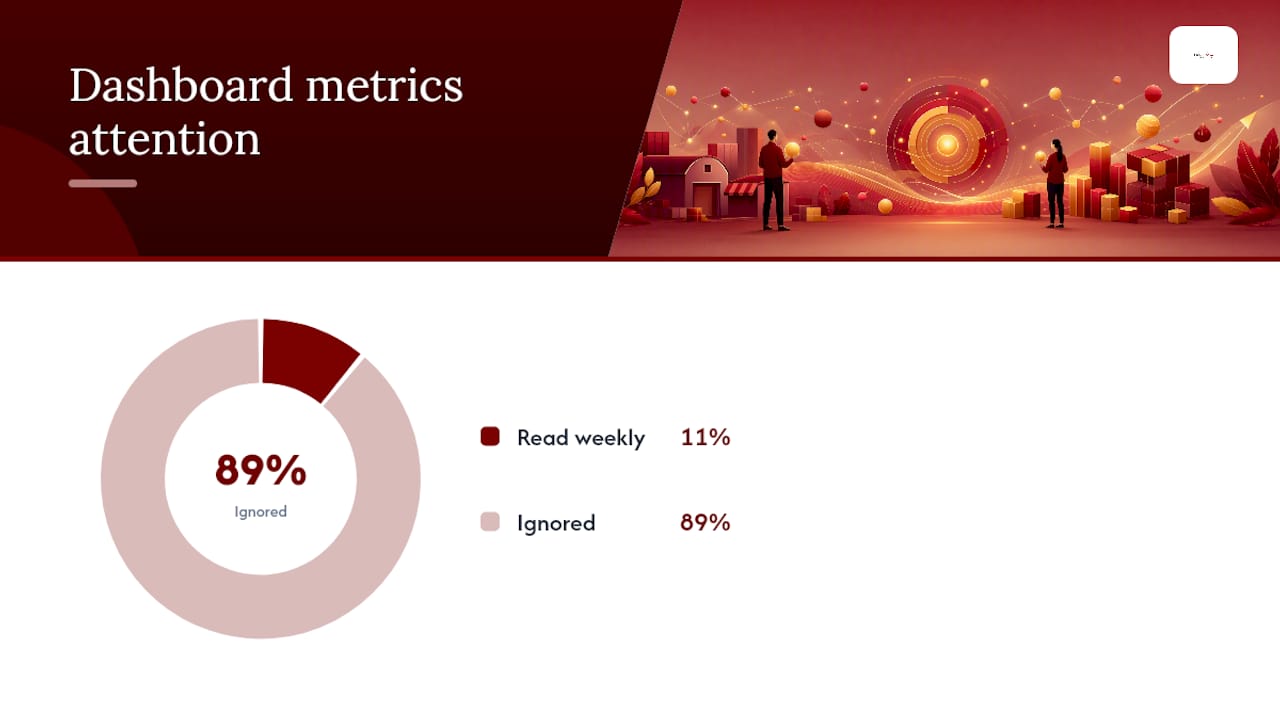
Track a small set of KPIs consistently: revenue against budget, cash runway in months, and gross margin trend. A dashboard cluttered with 40 metrics gets ignored. One with five gets read every week.
Pro Tip: *Present variance to leadership in terms of dollars and decisions, not just percentages.
Clean bookkeeping is what makes any of this possible. If your actuals aren’t reconciled and current, your variance analysis is just comparing one guess to another.
How Parr & Ibarra CPA Applies This for Small Businesses
Parr & Ibarra CPA builds budgets and forecasts the way most small businesses actually need them: practical, updated on a real cadence, and tied to decisions leadership is about to make, not just a compliance exercise filed away after year-end.
Clients working with the outsourced CFO advisory team typically receive:
- A rolling forecast refreshed monthly, tied directly to bookkeeping actuals
- Variance reports that flag where the budget assumptions were off, and why
- Scenario projections built separately when a client is evaluating a hire, an acquisition, or a capital purchase
- Cash flow visibility that connects payroll timing, tax obligations, and seasonal revenue swings
Most small business owners bring in an advisor once they realize they’re flying on last year’s assumptions with no way to check them against reality. The outcome that matters most is visibility: knowing your cash runway before it becomes a crisis, and having a clear, corrective plan ready before the board or your bank asks for one.
Best Practices for Aligning Budgets and Forecasts
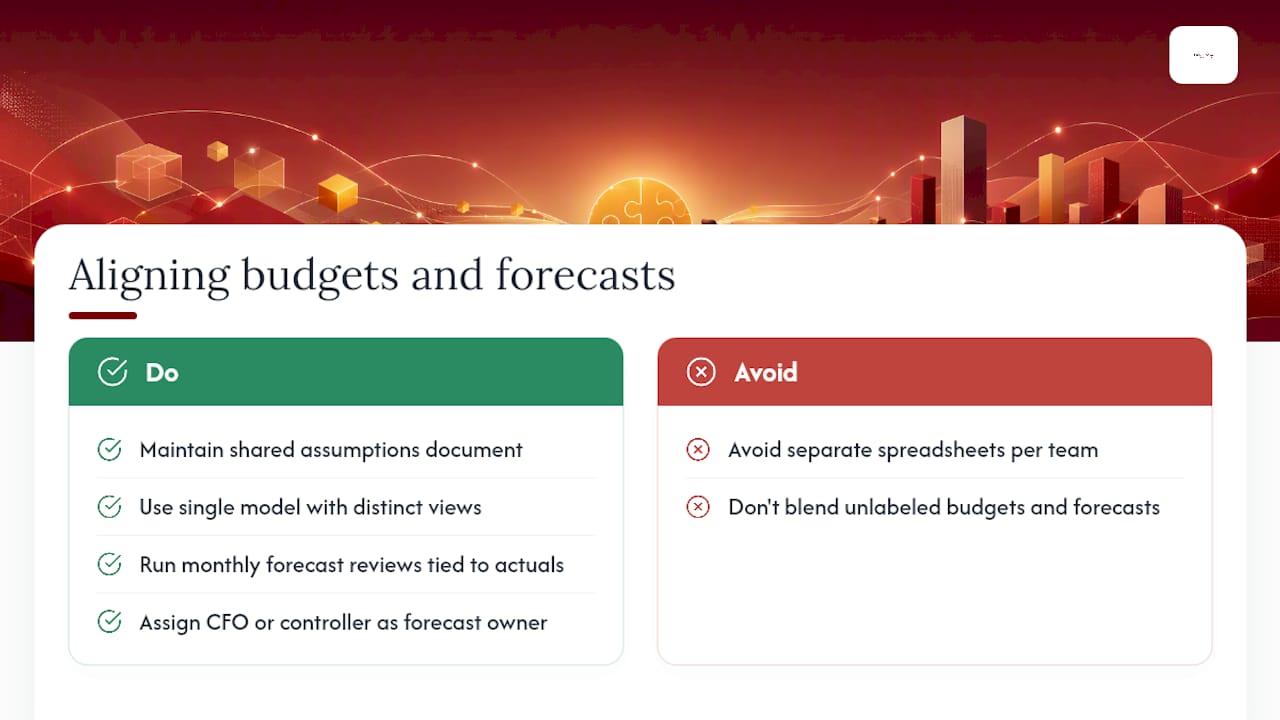
Misalignment between budget and forecast usually isn’t a math problem. It’s a communication problem. The fix starts with a shared assumptions document: every driver behind both the budget and the forecast (growth rate, hiring plan, pricing changes) should live in one place both teams reference, not two spreadsheets built independently.
Keep the model itself unified. Rather than maintaining separate files for budget, forecast, and projection, best-practice FP&A workflows use a single financial model with distinct views for each purpose. That single-source approach prevents the version creep that happens when three departments are quietly working off three different spreadsheets with three different assumptions about next quarter’s revenue.
Set a review cadence and stick to it. Monthly forecast reviews, tied to actuals, keep the gap between budget and reality visible instead of surprising everyone in December. Assign clear ownership too: the CFO or controller should own the forecast process, while department heads own their piece of the budget and answer for variance in their area.
Finally, separate the roles explicitly when presenting to leadership or a board. Budgets answer “did we hit our target?” Forecasts answer “where are we headed?” Projections answer “what if we made this specific decision?” A single deck that blends all three without labeling which is which invites the exact confusion that damages trust with investors and lenders alike.
Why Most Companies Get This Wrong
The conventional advice treats budgeting and forecasting like a compliance checklist: build the annual budget, file it, revisit it in twelve months. That’s backwards. The budget is the least useful document in your finance stack by month six if nobody’s checking it against a live forecast.
What gets underestimated is how much damage comes from treating the forecast like a second budget. The moment a sales team starts padding forecast numbers to look good instead of reporting what they actually expect, leadership loses its only early-warning system. I’d argue the forecast discipline matters more than the budget discipline for a growing small business, precisely because it’s the tool that catches problems while there’s still time to act on them.
Prioritize the monthly forecast refresh before you perfect the annual budget process. A rough forecast updated honestly every month beats a polished budget nobody revisits until it’s too late to matter.
— Adan
Sources
- Budget vs. Forecast vs. Projection: Differences & Uses | CFI
- Budgeting vs. Financial Forecasting: What’s the Difference? | Investopedia
- Financial Forecast vs. Financial Projection: Key Differences | NetSuite
FAQ
Which Comes First, Forecast or Budget?
The typical sequence is strategic plan, then budget, then ongoing forecast, since the budget needs strategic priorities to allocate against and the forecast needs the budget as a baseline to measure. Early-stage startups or businesses in fast-changing markets often reverse this and lead with a forecast instead.
What Is the Difference Between a Budget and a Rolling Forecast?
A budget is a fixed annual plan that sets targets and spending limits for the fiscal year. A rolling forecast extends a set number of months forward (commonly 12 to 18) and updates every period, so visibility never shrinks as the year progresses.
What Is the Difference Between a Forecast and a Flexible Budget?
A standard forecast estimates the likely financial outcome and updates regularly based on actuals and trends. A flexible budget, by contrast, is a budget variant that adjusts its spending targets based on actual activity levels (like sales volume), while still functioning as a governance benchmark rather than a predictive tool.
Is a Financial Projection the Same as a Forecast?
No. A forecast estimates the most likely outcome based on current data and trends, while a projection models a hypothetical “what if” scenario built on specific assumptions, commonly used for capital raises or major strategic decisions.
How Often Should a Small Business Update Its Forecast?
Many private companies refresh their forecast monthly, while businesses managing tight cash positions often use weekly 13-week cash flow forecasts.

