
An IRS installment agreement lets you pay tax debt in monthly installments instead of one lump sum, and most taxpayers fit one of three paths: a short-term plan for balances you can clear in 180 days, a streamlined long-term plan for debt under $50,000, or a partial payment plan if you can’t pay in full before the collection period expires. If your balance is under $50,000 and you’re current on filings, start with the Online Payment Agreement tool. If you need to disclose income, assets, and expenses to qualify, that’s the point to call a CPA.
TL;DR:
- Taxpayers owing under $50,000 and current on filings should use the online payment agreement tool for a streamlined, low-cost plan with minimal documentation.
- Application fees vary widely from $29 for direct debit online to $178 for mail applications without direct debit, making online direct debit the most cost-effective method.
- Short-term plans are suitable for debts under $100,000 to be paid within six months, while larger balances over $50,000 or unsecured by quick pay-off require detailed financial disclosures.
- Business debts below $50,000 without trust fund taxes qualify for simple plans; thresholds drop to $25,000 if trust fund taxes are involved.
- A CPA’s review of financial disclosures significantly lowers the risk of rejected applications and ensures payments are sustainable over the agreement’s duration.
Types of IRS Installment Agreements: Which One Fits Your Situation
The IRS sorts installment agreements by balance size and how much financial detail you have to hand over. Get the type right before you apply, because picking the wrong one wastes a submission and, in some cases, restarts the clock on IRS review.
Short-term payment plans cover balances under $100,000 in combined tax, penalties, and interest, and give you a few months to pay in full. There’s no setup fee, which makes this the cheapest option by far, but the runway is short. It fits someone who just needs a few months, say, a self-employed contractor waiting on a large invoice to clear.
Simple long-term payment plans (what most people mean by “streamlined”) apply to individual balances under $50,000, per the IRS guidance on simple payment plans. Business thresholds run lower when trust fund taxes like payroll withholding are involved. You get monthly payments stretched out, typically up to 72 months, without submitting a full financial statement.
Guaranteed installment agreements are a subset of the streamlined category reserved for relatively small balances as defined by the IRS. If you owe $10,000 or under, have filed and paid on time for the past five years, and agree to pay off the balance within three years, the IRS must approve your request. No negotiation, no financial disclosure.
Partial payment installment agreements (PPIAs) come into play when you genuinely cannot pay the full balance before the Collection Statute Expiration Date, which is typically several years from assessment. This is the only type that requires a full Collection Information Statement, because the IRS needs to verify you truly can’t pay more.
- Owe under $100,000 and need under six months: short-term plan, no fee
- Owe under $50,000 (individual) and current on filings: simple long-term plan
- Owe $10,000 or less with a clean five-year history: guaranteed IA
- Owe more than you can pay off before the CSED: PPIA, financial disclosure required
Eligibility Rules and the Thresholds That Decide Your Path
Every installment agreement application starts with one non-negotiable requirement: you must be current on all required tax returns. The IRS won’t set up a payment plan for a debt year while you’re still missing a filing from another year. File first, then apply.
For individuals, the two numbers that matter most are $50,000 and $100,000. Owe $50,000 or less and you qualify for the simple long-term plan with minimal paperwork. Owe up to $100,000 and you can still get a short-term plan if you can clear the balance in 180 days. Cross $50,000 without being able to pay it off quickly, and you’re headed toward a financial disclosure regardless of how the debt happened.
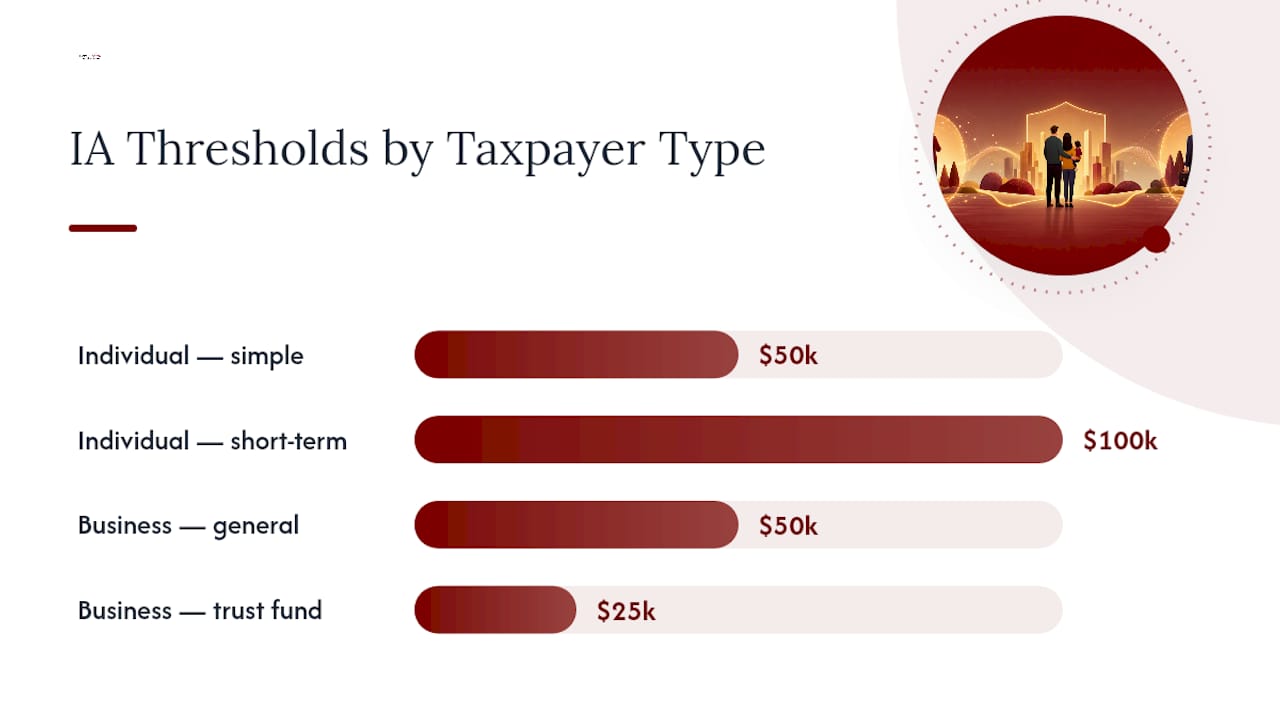
Business thresholds are lower and split by tax type. According to IRS guidance, businesses generally qualify for a simple plan at $50,000 without trust fund taxes, but that threshold drops to $25,000 when payroll trust fund taxes are part of the balance. The IRS treats trust fund money (income tax and FICA withheld from employee paychecks) more strictly, since it was never the business’s money to begin with.
A few other factors change your eligibility overnight:
- A missed payment or new tax assessment on an existing agreement can trigger default review.
- Filing a new return with a balance due while an IA is active may void the agreement unless you contact the IRS first.
- Low-income taxpayers, generally those at or below 250% of the federal poverty level, qualify for reduced or waived setup fees regardless of which plan they use.
If your situation touches any of these edges, that’s usually where DIY applications start running into trouble.
Fees, Payment Methods, and What Interest Really Costs You
User fees depend entirely on how you apply and how you pay, and the gap between the cheapest and most expensive option is larger than most people expect.
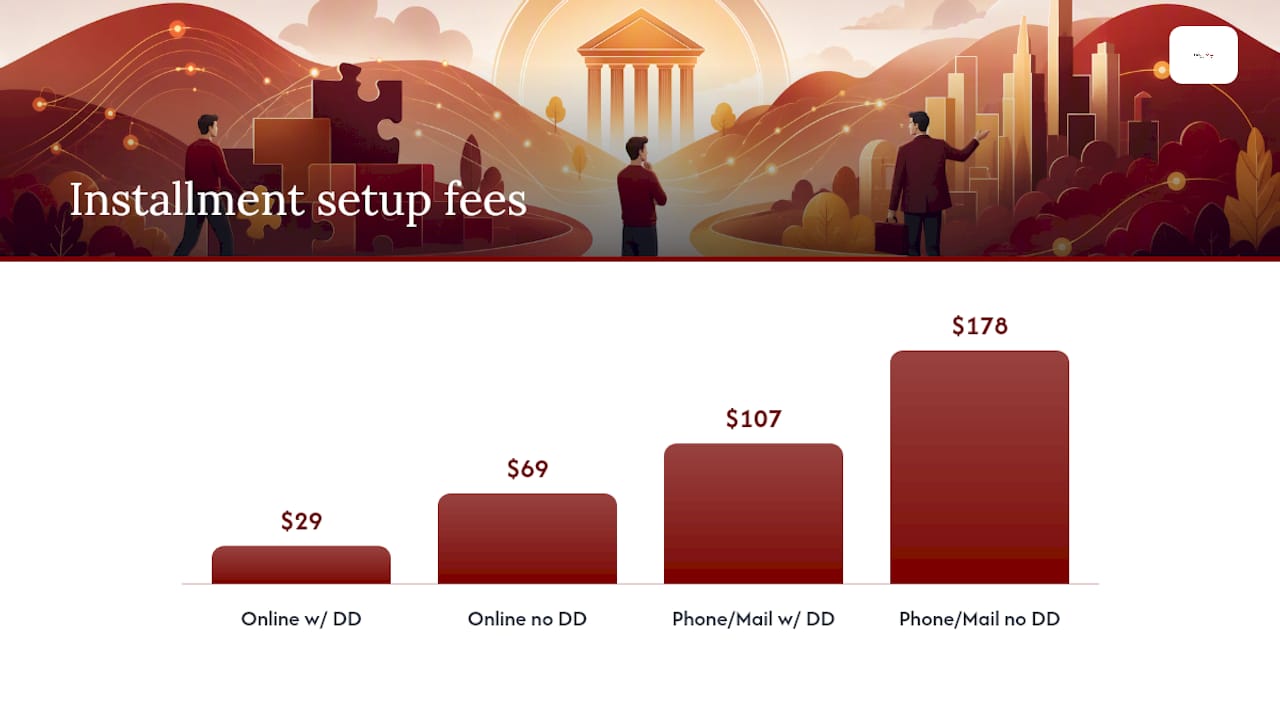
Statistic Callout: Setting up direct debit through the Online Payment Agreement tool costs $29, while applying by phone or mail with direct debit runs $107. Skip direct debit entirely and apply online without it, and the fee jumps to $69; do the same by phone or mail, and it’s $178, according to the current fee schedule.
That fee spread alone should push most people toward direct debit. Beyond cost, direct-debit agreements carry meaningfully lower default rates, since the payment happens automatically instead of depending on you remembering to send it.
- Direct debit installment agreement (DDIA): lowest fees, lowest default risk, automatic monthly withdrawal
- IRS Direct Pay: free, but requires you to manually schedule or make each payment
- Debit or credit card: convenient, but processors charge their own transaction fees on top
- Check or money order by mail: works, but slowest and easiest to miss a deadline on
Low-income taxpayers can request a reduced or reimbursed fee using Form 13844, which the IRS reviews alongside your application.
One thing every payment plan shares: interest and penalties keep accruing the entire time you’re paying. Longer payment terms increase total interest and penalties since the IRS continues to accrue these charges during the installment agreement period. Shorter terms, where you can manage them, save real money.
How to Apply: Online Tool vs. Mailing Form 9465
Most eligible taxpayers should start with the Online Payment Agreement tool, since it’s faster and cheaper than every other route.
- Create or log into your IRS online account, which requires identity verification through a government photo ID.
- Confirm your balance and filing status. The OPA tool checks whether you meet the $50,000 threshold for a simple long-term plan or other criteria for a short-term plan.
- Choose direct debit if your bank information is ready. It lowers your fee immediately and reduces the odds of a missed payment later.
- Submit the application. Eligible taxpayers get an immediate determination, according to IRS guidance on the OPA process.
If you’re responding to an IRS notice, owe more than $50,000, or don’t qualify for the online tool for any reason, you’ll file Form 9465 by mail instead. Include your proposed monthly payment amount, the date you can pay each month, and bank details if requesting direct debit. Mailed applications typically get a response within about 30 days, though that stretches longer during peak filing season from February through April.
Before you start either method, gather your total balance owed, bank routing and account numbers for DDIA, and a government photo ID for online identity verification. Having that ready turns a process that can drag on for weeks into one you finish in a single sitting.
Financial Disclosure for Partial Payment Plans: Forms 433 and Collection Standards
Partial payment installment agreements are the one type where the IRS wants to see your full financial picture before agreeing to anything, and that starts with picking the right disclosure form.
Form 433-F is the streamlined Collection Information Statement most individuals use, according to Topic No. 202. Form 433-A goes deeper for individuals with more complex finances, itemizing specific asset categories and income sources. Form 433-B is the business equivalent, covering company assets, receivables, and operating expenses.
Once you submit a 433 form, the IRS measures your claimed expenses against its Collection Financial Standards, a set of allowable spending benchmarks for housing, transportation, food, and other necessities by region and household size. Claim more for rent or car payments than the local standard allows, and the IRS will usually cap what it counts, then apply the difference toward your monthly payment instead.
- The IRS subtracts allowable expenses from disclosed income to calculate your proposed monthly payment.
- Anything above the Collection Financial Standards for your area generally doesn’t reduce what the IRS expects you to pay.
- Approved PPIAs face periodic reviews, and the IRS can adjust your payment up or down based on updated financials.
- The Collection Statute Expiration Date sets the outer boundary on how long the plan can run.
Pro Tip: Keep receipts and documentation for every expense you claim on a 433 form. Missing paperwork during a periodic review is one of the most common reasons the IRS raises a PPIA payment.
Staying in Good Standing and What Happens if You Default
Once your agreement is approved, the rules for keeping it are straightforward but unforgiving. Pay on time every month, file every future return on time, and pay any new tax balance in full when it comes due. Miss any of those three, and the IRS can terminate the agreement.
Default triggers real consequences: the IRS can file a Notice of Federal Tax Lien if one isn’t already on record, resume levy action against wages or bank accounts, and reinstate collection activity that had been paused. According to IRS guidance on payment plans, a default or rejection generally comes with a 30-day window before enforcement resumes, giving you a short runway to appeal or fix the issue.
- Set up automatic bank alerts so a payment never quietly bounces.
- Contact the IRS immediately if you anticipate missing a payment, before the due date, not after.
- Use the Collection Appeals Program if you believe a termination notice was issued in error.
- Request a modification through your online account or by phone if your income changes.
Pro Tip: If a new balance shows up while you have an active agreement, call the IRS before it defaults automatically. Adding the new debt to the existing plan is often possible if you act inside that 30-day window.
Why a CPA Changes the Outcome, Not Just the Paperwork
Self-setup works fine for guaranteed and simple long-term agreements where the numbers are clean and the balance falls under $50,000. Where it gets risky is anywhere the IRS asks for a financial statement.
A CPA earns their fee mainly on accuracy. Collection Information Statements get rejected or adjusted constantly because DIY filers underreport allowable expenses or misclassify income, and a practitioner who works with Collection Financial Standards regularly knows which categories the IRS actually recognizes in your area. That knowledge alone often produces a lower, more sustainable monthly payment.
Hire a CPA specifically when you’re proposing a PPIA, dealing with business trust fund tax debt in Texas, coming off a prior default, or facing multi-year balances across several tax periods. These are the situations where a documentation gap or a missed allowable expense category costs real money over the life of the agreement.
- Business owners with payroll trust fund exposure should get professional representation before applying.
- Anyone proposing a partial payment plan benefits from a CPA’s review of the 433 form before submission.
- Prior defaults often need negotiation, not just resubmission.
Before meeting with a CPA, gather recent pay stubs, bank statements, a list of monthly expenses, and prior-year tax returns. Firms offering tax resolution and IRS representation typically start with exactly that document set.
Official IRS Resources Worth Bookmarking
Apply directly through the Online Payment Agreement application if you’re under the eligibility thresholds. Read the Payment Plans and Installment Agreements overview for a full rundown on plan types and fees. Use Form 9465 instructions if you’re mailing your application instead. Check Topic No. 202 for guidance on which 433 form applies to your situation, and review the Collection Financial Standards before estimating what monthly payment the IRS will accept.
When DIY Works and When It Doesn’t
Setting up your own guaranteed or simple long-term plan online is fine if your balance sits under $50,000 and your filings are clean. The moment a financial disclosure enters the picture, a PPIA, a business trust fund balance, or a prior default, the math gets subjective, and that’s where professional judgment earns its cost. If you’re unsure which category you’re in, that uncertainty itself is the answer: talk to a CPA before you submit anything.
— Adan
Get Help Setting Up or Fixing Your Installment Agreement
Parr & Ibarra CPA works directly with Dallas-Fort Worth business owners and individuals who need more than a form filled out, they need someone who can read a Collection Information Statement the way the IRS reads it. Where a DIY application either gets rejected or locks you into a payment you can’t sustain, our team builds the financial disclosure around what the Collection Financial Standards actually allow, so the monthly number you agree to is one you can keep. That matters most for business owners carrying trust fund tax exposure or anyone proposing a partial payment plan after a prior default. If you’re staring at a notice and unsure whether to apply online or call for help, start with a review of your tax resolution options and bring your last two years of returns and a current profit-and-loss statement to the first conversation.
This article is general information, not a substitute for advice from a qualified financial advisor. Consult a qualified financial professional about your own circumstances before acting on anything here.
FAQ
What are the guidelines for using an IRS installment agreement?
You must be current on all required tax filings before applying, and the plan type you qualify for depends on your balance: under $100,000 for a short-term plan, under $50,000 for a simple long-term plan, and financial disclosure required above that or if you can’t pay before the CSED.
How does the IRS calculate an installment agreement payment?
For simple and guaranteed plans, you propose the amount and term yourself within IRS limits. For partial payment plans, the IRS subtracts allowable expenses under the Collection Financial Standards from your disclosed income to arrive at a monthly figure.
What is the minimum monthly payment the IRS will accept?
There’s no fixed universal minimum; it depends on your balance, the plan length, and, for PPIAs, what your disclosed income and allowable expenses support. Guaranteed agreements generally require paying off $10,000 or less within three years.
How long do you have to pay an IRS installment agreement?
Short-term plans run up to 180 days, simple long-term plans commonly extend up to 72 months, and partial payment plans can run until the Collection Statute Expiration Date, generally ten years from the original assessment.

