
You qualify for an offer in compromise if you have filed every required tax return, you are current on estimated payments or federal deposits, you are not in an open bankruptcy case, and you can show the IRS your offer reflects the most it could realistically collect from you. Meeting those gates gets your foot in the door; the Offer in Compromise Pre-Qualifier tool and Form 656-B will tell you whether the math works. From there, expect a 20% down payment on lump-sum offers, unless you qualify for the Low-Income Certification exception.
TL;DR:
- Most offers are accepted when the proposed amount meets or exceeds the IRS-calculated reasonable collection potential, based on assets and disposable income.
- Successful submission requires clear documentation of income, assets, and recent tax filings, with separate applications for personal and business debts.
- The IRS only considers offers under three grounds: doubt as to liability, doubt as to collectibility, and effective tax administration, with doubt as to collectibility being the most commonly accepted.
- Calculating the IRS’s minimum acceptable offer involves assessing fair market value minus debts for assets, plus future income minus living expenses, over 12 or 24 months.
- Filing an offer without accurate financial records, proper forms, or before resolving eligibility issues like bankruptcy or delinquent returns almost guarantees rejection.
What Are the Eligibility Requirements for an Offer in Compromise?
Before the IRS will even look at your offer, you have to clear a handful of procedural tests. Miss one, and your submission gets returned unopened, fee and down payment included, without any evaluation on the merits.
Here’s the actual checklist the IRS runs against every submission:
- All required returns filed. Every year you owed a return, it needs to be filed, not just the years tied to the debt you’re compromising. A pending extension for the current year is fine, but the prior years must be complete.
- Current on estimated payments. If you’re self-employed or otherwise required to make quarterly estimated tax payments, you need to be caught up for the current year before the IRS considers your offer.
- No open bankruptcy proceeding. Form 656-B is explicit on this: taxpayers in an active bankruptcy case are not eligible for an OIC. The bankruptcy court, not the IRS collection division, handles debt resolution during that period.
- Employer deposit compliance. If you run a business with employees, you must have made all required federal tax deposits for the current quarter and the two preceding quarters. This is one of the most common reasons business offers get bounced.
- A qualifying liability on the books. You need at least one tax debt that has actually been assessed and billed. You can’t compromise a liability that doesn’t exist yet.
One detail that trips up a lot of business owners: personal and business tax debts almost always require separate Forms 656 and separate application fees, even when the same person is behind both. Treating mixed personal-and-business debts as one offer is a fast way to get the whole package rejected on a technicality.
Pro Tip: Run your numbers through the Pre-Qualifier before you spend a dollar on preparation. It won’t guarantee acceptance, but it will tell you in minutes whether you’re wasting your time on an offer the IRS is unlikely to approve.
What Are the Three Grounds for an IRS Offer in Compromise?
The IRS only accepts an offer under one of three legal grounds: doubt as to liability, doubt as to collectibility, and effective tax administration. Each one applies to a different kind of problem, and picking the wrong one is a common reason offers get rejected outright.
- Doubt as to liability. You genuinely dispute that you owe the tax, or you dispute the amount. Maybe the IRS assessed income you never received, or applied a penalty that doesn’t fit your facts. This ground uses a different form entirely, Form 656-L, and requires you to submit evidence supporting your position, not just a number you’d prefer to pay.
- Doubt as to collectibility. You owe the tax, and you don’t dispute it, but you genuinely cannot pay the full balance now or through an installment plan before the collection statute expires. This is the ground most taxpayers use, and it’s the one governed by the Reasonable Collection Potential formula covered next.
- Effective tax administration. You owe the tax and could technically pay it in full, but doing so would create an exceptional economic hardship, or collecting it in full would be unfair or inequitable given your specific circumstances. This ground shows up more often with individual taxpayers facing serious medical situations or other extraordinary circumstances than with businesses.
Doubt as to collectibility carries the highest volume of accepted offers because it’s the one built around a verifiable financial formula rather than a subjective hardship argument. Effective tax administration succeeds far less often, and only with documentation that goes well beyond a standard financial statement.
How Do You Calculate Reasonable Collection Potential?
Reasonable Collection Potential, or RCP, is the number the IRS uses to decide whether to accept your offer. If your offer is at or above your RCP, the IRS has a strong incentive to accept it; if it’s below, expect a rejection or a counteroffer. The formula itself is straightforward, even if the inputs take work to document correctly.
RCP = Net Realizable Equity in Assets + Future Remaining Income
Here’s what feeds into each half of that equation:
- Net realizable equity in assets. Take the quick-sale value of each asset (generally 80% of fair market value for real estate and vehicles), then subtract what you owe against it. A home worth $300,000 with a $250,000 mortgage contributes very differently than one that’s paid off.
- Future remaining income. Take your monthly gross income, subtract IRS-allowed necessary living expenses using the national and local standards, and multiply the remainder by either 12 (for lump-sum offers paid within five months) or 24 (for periodic-payment offers paid over 6 to 24 months).
- Add the two totals. That sum is your RCP, and it becomes the floor for what the IRS will accept.
Here’s a simplified worked example for a single taxpayer with $85,000 in back taxes:
In this example, the taxpayer’s minimum acceptable offer sits around $31,600, not the $85,000 owed. That’s the entire point of the program: the IRS isn’t forgiving debt out of generosity, it’s settling for the realistic collection ceiling given the taxpayer’s actual assets and cash flow.
The most common way self-prepared offers blow this calculation is overstating allowable expenses. The IRS caps most living expense categories using published national and local standards, not your actual spending, so a taxpayer claiming $2,000 in monthly groceries when the standard allows $800 will see that expense adjusted right back down, and the resulting RCP go up.
Pro Tip: Round conservatively and document every asset value with a real source, an appraisal, a Kelley Blue Book printout, a bank statement. An RCP that looks too low because of guessed numbers is the single fastest route to a rejection letter.
What Forms and Fees Does an Offer in Compromise Require?
Every OIC application runs through the same paperwork, and skipping a piece is one of the most avoidable ways to get your offer returned before anyone even reviews your numbers.
- Form 656 is the actual offer, where you state your proposed amount and payment terms, used for doubt as to collectibility and effective tax administration.
- Form 656-L replaces Form 656 specifically for doubt as to liability claims, and it requires supporting evidence rather than financial disclosures.
- Form 433-A (OIC) is the financial statement for individuals and self-employed taxpayers, covering income, expenses, assets, and liabilities.
- Form 433-B (OIC) is the equivalent statement for businesses, covering payroll, receivables, equipment, and business bank accounts.
- Form 656-B, the Offer in Compromise booklet, walks through every requirement, checklist item, and mailing address by state.
The application carries a $205 fee, plus an initial payment tied to your payment structure: 20% of the total offer for lump-sum offers, or the first installment for periodic-payment offers. Both the fee and the down payment are waived under the Low-Income Certification, which applies to individuals at or below a certain income threshold based on federal poverty guidelines for their household size.
Payments have to come through legitimate, unencumbered funds, checks, money orders, or EFTPS. Funds from a garnishment, a retirement account withdrawal that triggers penalties, or an anticipated tax refund don’t count, and using them can flag the offer as improperly funded. If you’re on a periodic-payment plan, you must keep making those payments while the IRS evaluates your offer; missing one before a final decision is one of the more overlooked ways offers get returned.
Mail goes to the address listed in Form 656-B for your state, or you can start the process digitally through your Individual Online Account or the Pre-Qualifier tool to confirm the basics before committing to a mailed package. Accurate return preparation matters here too, since an amended or incomplete prior-year return can stall the whole application; Parr & Ibarra CPA’s tax preparation guidance covers what a clean filing history actually requires.
What Documents and Errors Most Often Sink an Offer?
Beyond the forms themselves, the IRS wants a paper trail behind every number on your 433-A or 433-B. Missing documentation is the single most preventable reason offers get returned rather than evaluated.
- Gather income proof. Recent paystubs, profit-and-loss statements, or 1099 income records for at least the past three months.
- Pull bank statements. Every account you hold, personal and business, for the last three to six months, to support both your cash position and your expense claims.
- Document asset values. Real estate appraisals or county assessments, vehicle valuations, and retirement or investment account statements.
- Confirm business records. Ledgers, federal tax deposit confirmations, and payroll filings if the offer involves a business entity.
- Verify identity documents are current. An expired or deactivated ITIN is a quiet but real reason offers stall in processing.
The recurring mistakes worth flagging separately: missing a required return, forgetting the application fee or down payment, valuing an asset at retail instead of quick-sale price, and, worst of all, filing while a bankruptcy case is still open. Cross-check your package against the Form 656-B checklist line by line before mailing it.
How Long Does the IRS Take to Decide an Offer in Compromise?
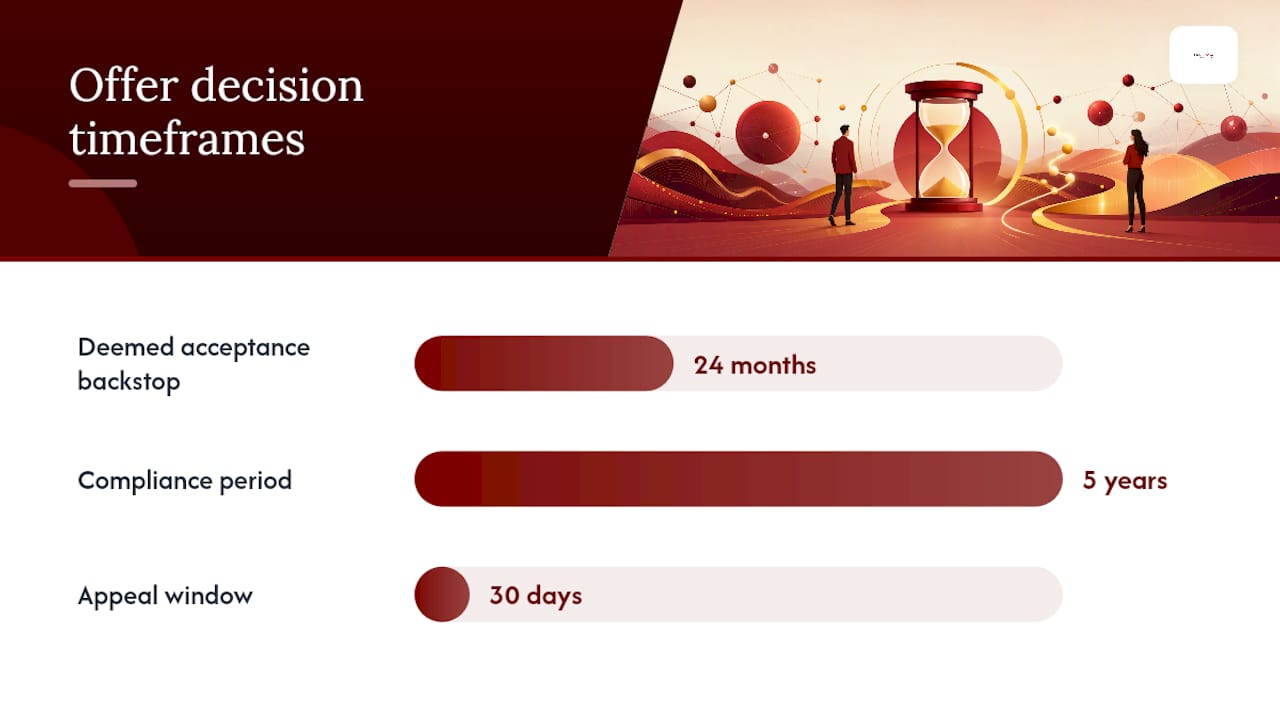
Processing times vary and can be several months or longer depending on case complexity and examiner assignment. There’s a built-in backstop: if the IRS hasn’t made a determination within 24 months of receipt, the offer is deemed accepted by law, though that clock excludes time spent in appeals or certain other delays.
While your offer is pending:
- Most active collection efforts, levies and new enforcement action, are generally suspended.
- Any existing federal tax lien stays in place and isn’t released until the offer is paid in full.
- The collection statute of limitations is typically extended for the time your offer is under review.
If accepted, you must stay compliant with all filing and payment obligations for five years; defaulting during that window can revive the original debt, penalties and interest included. A returned offer means the IRS sent it back without full evaluation, usually for a missing item; a rejected offer means the IRS reviewed it and disagreed with your numbers, which you can appeal through the IRS Independent Office of Appeals within 30 days.
When Should You Hire a CPA for an Offer in Compromise?
Self-prepared offers carry a notably lower acceptance rate, mostly because taxpayers miscalculate RCP or submit financial statements with gaps the IRS flags immediately. Reconstructing a year of disorganized bookkeeping into a defensible 433-B, for example, is a different skill set than running a business day to day.
Consider bringing in a professional when:
- Your business has commingled personal and business accounts or thin bookkeeping records.
- You own real estate, vehicles, or investment accounts that need defensible valuations.
- You’ve already faced a levy, lien, or prior IRS collection action.
- Your liability spans both personal and business tax debt, requiring separate offers.
Our team works through these exact issues for business owners and individuals, handling the bookkeeping cleanup, asset valuation, and 433-A/433-B preparation that determine whether an RCP calculation holds up under IRS review.
Pro Tip: If your bookkeeping is more than a few months behind, fix that first. A clean set of books, reconciled and current, changes how the IRS views your collectibility before you even file the offer.
What Do Clients Get Wrong Before Filing an Offer in Compromise?
The mistake I see most often isn’t the math on Form 433-A, it’s the year of financial neglect leading up to it. People wait until they owe six figures before they start reconciling bank accounts or tracking deductible expenses, and by then the offer process becomes a forensic reconstruction project instead of a straightforward filing.
One client came to us with three years of unfiled business returns and a looming levy threat. Getting current on those filings, cleaning up the books, and building an accurate RCP took real work, but it turned an unworkable debt into a settlement the client could actually pay. The lesson holds for almost every case: accurate bookkeeping, timely estimated payments, and an early conversation with a CPA usually prevent the need for an offer in compromise altogether.
— Adan
Get Professional Help Preparing Your Offer in Compromise
Professional services are available as an alternative to filing an offer in compromise alone. These services include building the full OIC package, Form 433-A or 433-B completion, defensible asset valuations, bookkeeping cleanup, and direct IRS representation, so your Reasonable Collection Potential calculation reflects your actual financial position instead of a guess that gets rejected. That accuracy is the difference between a returned offer and one that gets a fair hearing.
Because tax debt is usually the symptom of a bigger planning gap, we also help clients fix the underlying cash flow and tax strategy issues that led to the debt in the first place. If you’re facing a balance you can’t pay in full, start with our tax planning services for business owners to see how we approach both the immediate settlement and the longer-term fix.
Key IRS Forms and Resources for an Offer in Compromise
- Form 656: the offer document and payment terms, plus the deemed-acceptance rule.
- Form 656-B booklet: full eligibility rules, checklists, and mailing addresses.
- Topic 204: official summary of the three acceptance grounds.
- Offer in Compromise Pre-Qualifier: free preliminary eligibility and estimate tool.
This article is general information, not a substitute for advice from a qualified financial advisor. Consult a qualified financial professional about your own circumstances before acting on anything here.
Sources
- Topic no. 204, Offers in compromise | Internal Revenue Service
- Form 656-B (Offer in Compromise Booklet) (PDF)
- Form 656 (Offer in Compromise) (PDF)
- Offer in compromise | Internal Revenue Service
- Offer in Compromise Pre-Qualifier
FAQ
What Is the Downside of an Offer in Compromise?
The IRS scrutinizes your entire financial life, application fees and down payments are largely nonrefundable even if rejected, and you must stay fully tax-compliant for five years after acceptance or risk default.
How Much Will the IRS Accept for an Offer in Compromise?
The IRS generally accepts an amount equal to your Reasonable Collection Potential, the sum of your net realizable asset equity plus your future disposable income over 12 or 24 months, not a negotiated discount off your total balance.
How Hard Is It to Get an Offer in Compromise Approved?
It’s genuinely difficult without accurate documentation. Self-prepared offers frequently fail because taxpayers miscalculate their RCP or submit incomplete financial statements, which is why professional preparation through a firm like Parr & Ibarra CPA improves the odds of a defensible submission.
Can the IRS Reject an Offer in Compromise?
Yes. The IRS rejects offers when the amount falls below your calculated RCP, when documentation is incomplete, or when you don’t meet the basic eligibility gates, such as being current on filings or free of an open bankruptcy case.

