
The FICA Tip Credit lets eligible employers, mainly food and beverage businesses and now some beauty service providers, recover the employer share of Social Security and Medicare taxes (7.65%) paid on employees’ tips. It’s a nonrefundable credit claimed on Form 8846. Unused amounts carry back one year or forward up to 20. The fastest path to real savings starts with pulling your payroll data and running the numbers.
TL;DR:
- The FICA Tip Credit allows eligible businesses to recover the employer’s Social Security and Medicare taxes paid on employee tips, with unused credits carrying over up to 20 years.
- Qualification depends on industry and tip-reporting rules, especially requiring voluntary tips and proper reporting of cash tips of $20 or more within a month.
- Proper calculation involves tracking hours, wages, and tips, ensuring auto-gratuities are not mistaken for tips, and using the correct industry wage basis.
- Claiming the credit requires accurate recordkeeping, filing Form 8846, and coordinating with overall tax planning to avoid double deductions or errors.
- Engaging with a CPA can simplify past-year recoveries, ensure audit readiness, and optimize the credit’s financial benefit for restaurant and salon owners.
What Is the FICA Tip Credit?
The FICA Tip Credit comes from Section 45B of the tax code, and it works differently than most payroll relief employers hear about. It’s an income tax credit, not a payroll tax refund, and it belongs to the business, not the employee. The credit equals the employer’s share of Social Security and Medicare taxes, split into 6.2% for Social Security and 1.45% for Medicare, paid on tips above a specific wage floor.
Don’t confuse this with the FLSA tip credit, which lets employers pay tipped staff below minimum wage as long as tips make up the difference. That’s a wage-law mechanism from the Department of Labor. The FICA Tip Credit is a completely separate tax benefit, and it has nothing to do with the personal tip-income deduction some employees may claim on their own returns. Because it’s nonrefundable, it only offsets tax you actually owe, though the carryforward window gives you two decades to use it up.
Who Qualifies for the FICA Tip Credit?
Eligibility hinges on your industry and how tipping works there. Restaurants, bars, and other food and beverage establishments where tipping is customary have always qualified. Starting with tax years after December 31, 2024, certain beauty service employers, including barbering, hair care, nail care, esthetics, and spa treatments, joined the list too.
A few rules determine which tips actually count:
- Tips must be voluntary cash or charge amounts customers choose to leave, not amounts the business imposes.
- Employees must report cash tips of $20 or more in a calendar month to the employer, a threshold set by IRS reporting rules.
- Mandatory service charges and auto-gratuities do not count as tips for this credit, even when a restaurant later distributes them to staff.
- Form 8846 and its instructions set the exact hourly wage basis that applies to your industry, which matters when you run mixed-industry payroll.
That last point trips up a lot of owners who assume every tipped dollar behaves the same way under the tax code.
How Do You Calculate the FICA Tip Credit?
The math itself isn’t complicated, but it depends on getting four inputs right for every tipped employee: hours worked, non-tip cash wages paid, total reported tips, and the wage basis your industry uses.
Here’s the calculation sequence:
- Multiply the employee’s hours worked by the applicable wage basis, historically $5.15 an hour for food and beverage employers under the Treasury’s guidance, or $7.25 for newly eligible beauty service employers.
- Compare that figure to the employee’s actual non-tip cash wages. If wages already exceed the basis, all reported tips are creditable.
- If wages fall short of the basis, subtract the shortfall from reported tips. Only tips remaining above the shortfall count as creditable tips.
- Multiply creditable tips by 7.65% to get the credit amount for that employee.
Statistic Callout: The employer FICA rate used in every version of this calculation is 7.65%, a fixed figure the IRS confirms applies regardless of which industry wage basis you use.
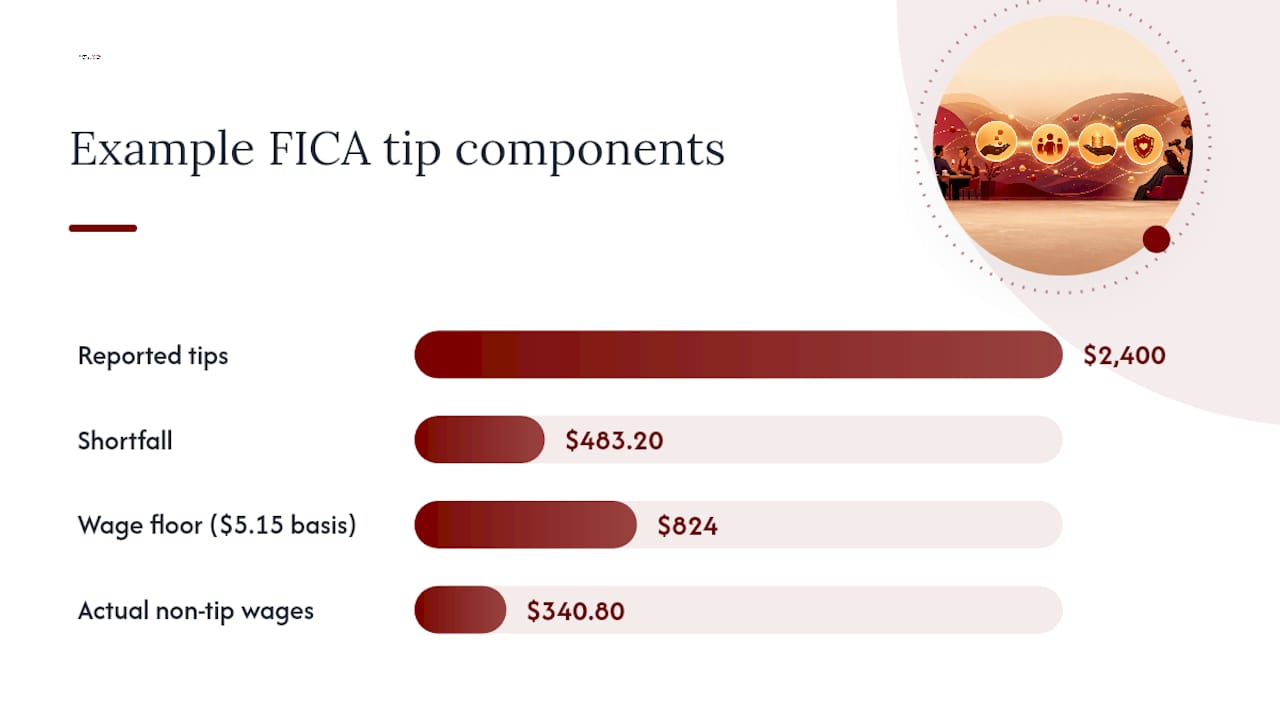
Take a server paid $2.13 an hour who works 160 hours in a month and reports $2,400 in tips. At the $5.15 basis, the wage floor for the month is $824. The server’s actual wages ($340.80) fall short by $483.20, so that amount comes out of reported tips first.
Two traps show up constantly: employers who accidentally treat auto-gratuities as tips inflate their credit incorrectly, and payroll systems that lock every employee to a single wage basis can misprice the credit when a business runs both food service and salon staff on the same payroll.
How Do You Claim the FICA Tip Credit on Form 8846?
Form 8846 is where the calculation becomes an actual tax benefit. You complete the form using your total creditable tips and employer FICA paid, then the resulting credit flows into your general business credit on Form 3800, which attaches to your business return.
A few filing mechanics matter more than owners expect:
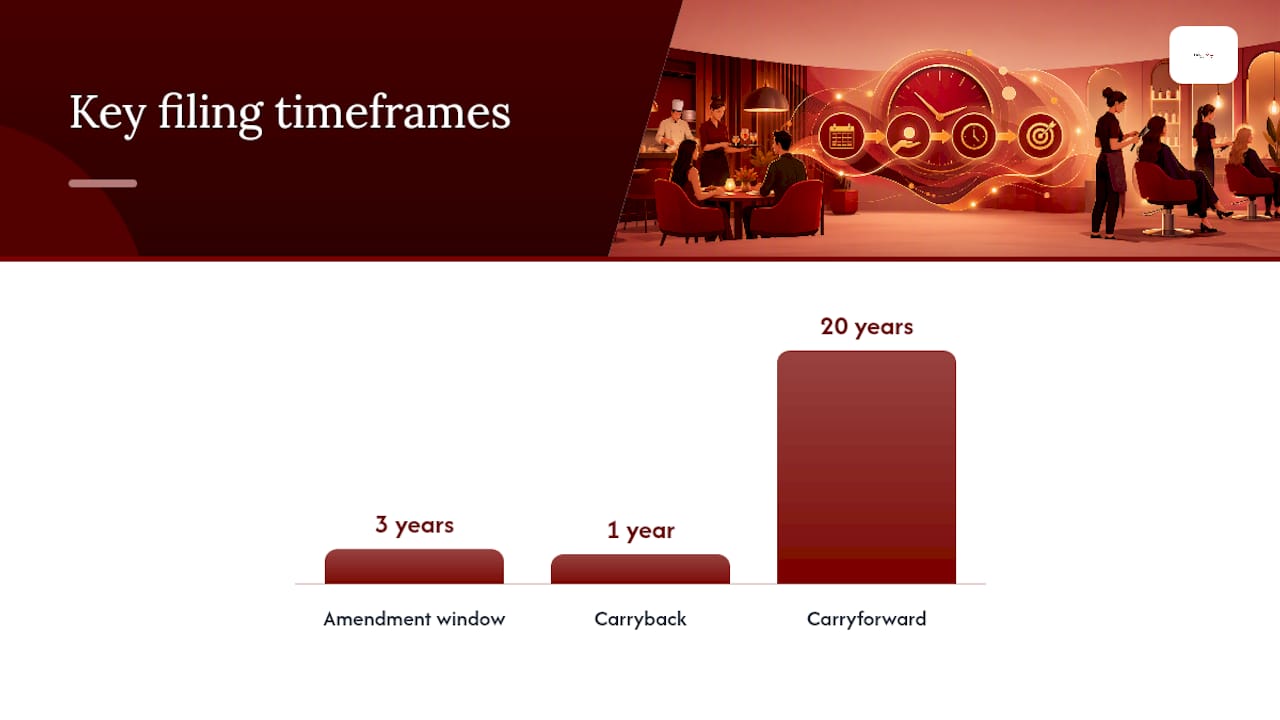
- The credit follows your business return’s normal filing deadline, but you can amend a prior-year return to claim a credit you missed, typically within three years of the original filing date; for assistance, see the IRS fax number lookup to contact the IRS directly.
- You must have met your quarterly employment tax deposit and reporting obligations for the periods you’re claiming.
- Unused credit carries back one year and forward up to 20 years, and you can elect out of the credit if it doesn’t serve your situation.
- Multi-state payroll, inconsistent tip records, or the need to project future carryforward use are strong signals to bring in a CPA rather than handle the filing solo.
Amended returns recovering multiple prior years can add up fast, but only if your records support the numbers.
Recordkeeping That Survives an IRS Audit
Documentation makes or breaks a FICA Tip Credit claim. Keep daily tip reports, W-2s showing tip income in the correct boxes, payroll registers that isolate employer FICA paid specifically on tips, and time records for every tipped employee.
Watch for these red flags before an examiner finds them:
- W-2 tip totals that don’t match your daily tip reports or point-of-sale tip data.
- Auto-gratuities or mandatory service charges booked as tips instead of wages.
- Wage deductions that were never adjusted to reflect the correct hourly basis.
- Tip pool allocations with no documentation showing how amounts were divided.
The Treasury’s own analysis points to mandatory service charges and missing daily tip records as the two biggest sources of audit exposure. Keep records for at least the standard three-year statute of limitations, longer if you’re claiming carryforward credits from multiple years.
Pro Tip: Reconcile your point-of-sale tip data against payroll every pay period, not just at tax time. Catching a mismatch in March beats explaining it to an auditor in October.
Solid payroll recordkeeping upfront saves hours of reconstruction work later.
Tax Planning Around the Credit’s Nonrefundable Nature
Because the credit is nonrefundable, it only reduces tax you actually owe in a given year, which is why the carryback and carryforward rules matter so much for businesses with uneven profitability. A slow year with little tax liability doesn’t waste the credit. It just pushes the benefit into a year when you can use it.
One rule catches owners off guard every filing season: you must reduce your deduction for employer FICA taxes by the exact amount of the credit you claim. Deducting the full FICA expense and claiming the credit on the same dollars amounts to double dipping, and the IRS guidance is explicit on this point. Coordinating this with your broader tax planning calendar, rather than treating it as a year-end afterthought, usually produces a cleaner filing and fewer surprises.
How Parr & Ibarra CPA Approaches FICA Tip Credit Claims
Calculating this credit accurately means combining payroll data, tip records, and tax filing into one clean process. Parr & Ibarra CPA’s team handles that through payroll services, bookkeeping, tax planning, and amended return preparation, plus audit representation if a claim gets questioned. A typical engagement moves from data intake, to the wage-basis calculation, to Form 8846 preparation, to filing and ongoing support. Recent case studies show how this kind of hands-on process plays out for local business clients.
What Owners Should Do Right Now
Start with three things: pull last month’s tip records and hours for one employee, run the calculation by hand to see what the credit is actually worth, and confirm your W-2 tip reporting matches your point-of-sale data. If that sample calculation reveals multiple years of missed credit, gaps in your payroll system, or audit risk from service-charge misclassification, that’s your signal to bring in a CPA rather than reconstruct years of records alone. Calculated correctly, this credit recovers real money most restaurants and salons already earned.
— Adan
Get Help Claiming the FICA Tip Credit
Running this calculation across a full staff roster, correcting past years, and defending it under audit is exactly the kind of work that eats an owner’s week. Parr & Ibarra CPA reviews your payroll setup, prepares Form 8846, files amended returns to recover credit you may have missed in prior years, and provides audit representation if the IRS asks questions. That’s the advantage of working with a firm built around proactive planning rather than once-a-year filing: the calculation gets checked before it becomes a problem, not after. Clients have used this process both to recover credit from missed prior years and to tighten up tip reporting so the numbers hold up on their own. If you want your payroll data reviewed and your credit calculated correctly, start with a payroll services review or reach out through tax planning services to schedule a consultation.
Sources
- FICA Tip Credit for employers | Internal Revenue Service
- Federal Insurance Contributions Act (FICA) Tip Credit
- Fact Sheet #15: Tipped Employees under the Fair Labor Standards Act (FLSA) | U.S. Department of Labor
- FICA Tip Credit for Employers: Everything You Need to Know | OnPay
FAQ
How Do You Calculate the FICA Tip Credit?
Multiply hours worked by your industry’s wage basis, subtract any shortfall between actual wages and that basis from reported tips, then multiply the remaining creditable tips by 7.65%.
What Is the FICA Tip Credit for Employers?
It’s a nonrefundable general business credit that reimburses eligible employers for the employer share of Social Security and Medicare taxes paid on qualifying employee tips, claimed using Form 8846.
When Did the FICA Tip Credit Start?
The credit was enacted in 1993 under Section 45B, according to Treasury’s historical analysis, and its eligibility expanded to certain beauty service employers for tax years after December 31, 2024.
Is There Still FICA Tax on Tips?
Yes. Employees and employers both continue paying FICA tax on reported tips; the credit simply lets qualifying employers recover their 7.65% share through their business tax return rather than eliminating the tax itself.
Can Parr & Ibarra CPA Help File an Amended Return for Missed Credits?
Yes, Expert accounting firms prepare amended returns to recover FICA Tip Credit amounts missed in prior years, typically within the standard three-year filing window, alongside payroll and bookkeeping support to keep records audit ready.

