
If you were born between 1951 and 1959, you generally must start taking required minimum distributions in 2026 at age 73, and your single most important deadline is December 31, 2026, unless 2026 is your first RMD year, in which case you can delay to April 1, 2027. Waiting creates a two-RMD year that can push you into a higher tax bracket. Your RMD equals your prior December 31 balance divided by the IRS Uniform Lifetime Table divisor, 26.5 at age 73.
TL;DR:
- If you turn 73 in 2026, your first RMD is due by April 1, 2027, but delaying may result in higher taxes from two distributions in one year.
- For 2026, your RMD equals your December 31, 2025, IRA balance divided by 26.5, the IRS divisor for age 73.
- You can delay a plan’s first RMD if still employed, owning less than 5% of the company, but only for workplace plans, not IRAs.
- Inherited IRAs generally require full withdrawal within 10 years, unless you’re an eligible beneficiary, in which case distributions can be stretched over your lifetime.
- Missing an RMD incurs penalties up to 25%, but prompt correction and proper documentation can typically reduce penalties to 10%.
Who Must Take an RMD in 2026 and When
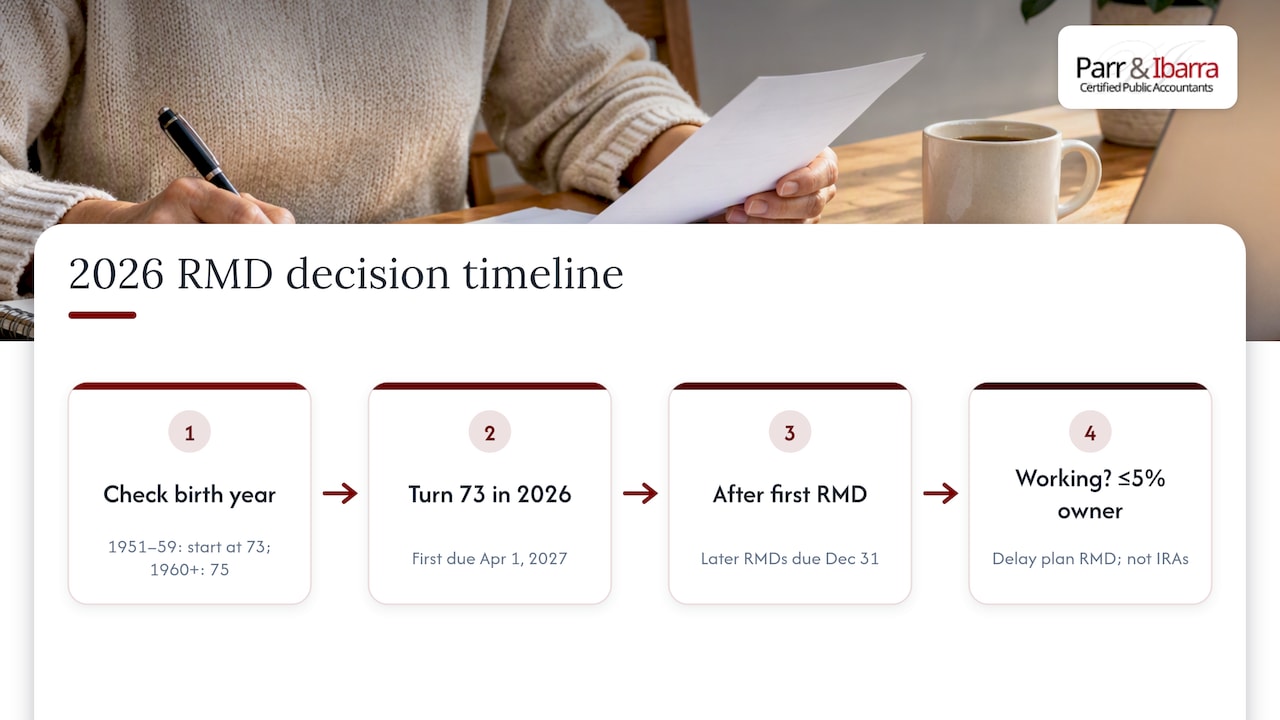
Your required beginning date depends on your birth year. If you were born between 1951 and 1959, you generally start RMDs at age 73, a threshold that applies through 2026 under rules the IRS confirms for retirement plan and IRA distributions. If you were born in 1960 or later, your starting age moves to 75 once that later phase of SECURE 2.0 takes effect.
Say you turn 73 sometime in 2026. Your required beginning date is April 1 of the following year for that first distribution only, April 1, 2027. Every RMD after that first one is due by December 31 of each year, with no April grace period.
Workplace retirement plans carry one notable exception: if you are still employed and own 5% or less of the company sponsoring your plan, you can usually delay your first RMD from that specific plan until the year you retire. That delay does not apply to IRAs, and it does not apply if you own more than 5% of the business.
How to Calculate Your 2026 RMD
The formula is straightforward: take your account balance as of December 31 of the prior year and divide it by the distribution period listed in the Uniform Lifetime Table in IRS Publication 590-B. That table updated in 2022 and those divisors still govern 2026 calculations.
At age 75, the divisor drops to 24.6, closer to 4.1%. The divisor shrinks each year as you age, which gradually raises your required withdrawal percentage.
Say your traditional IRA held $500,000 on December 31, 2025, and you turn 73 in 2026. Divide $500,000 by 26.5, and your 2026 RMD comes to the amount calculated by dividing your account balance by the IRS age 73 divisor.
- Confirm your prior year-end balance with each custodian before calculating.
- Use the divisor tied to your age on your birthday in the distribution year.
- Married owners whose spouse is more than 10 years younger use the Joint Life and Last Survivor Table instead, which produces a smaller required percentage.
Should You Take Your First RMD in 2026 or Wait Until April 2027?
Delaying your first RMD to April 1, 2027 means you will take two RMDs in 2027: the delayed 2026 distribution and the regular 2027 one. Both count as ordinary income in the same tax year, which can bump you into a higher bracket and, two years later, affect your Medicare Part B and Part D premiums through IRMAA surcharges.
- Delaying tends to help when 2026 income is unusually high, say from a business sale or large bonus, and you expect materially lower income in 2027.
- Taking the 2026 RMD on schedule usually works better when your income is fairly steady year to year, since it avoids stacking two distributions into one tax year.
- Either way, run the numbers for both years together, not just the delayed year in isolation, before deciding.
Pro Tip: If you’re weighing a Roth conversion or a qualified charitable distribution, time it to smooth out the income spike from a two-RMD year rather than adding to it.
Which Accounts Count and How to Sequence Withdrawals
Traditional IRAs, SEP IRAs, and SIMPLE IRAs can be aggregated, meaning you calculate the RMD for each one separately but can withdraw the total from any single IRA or combination of them. Workplace plans work differently, as the IRS RMD comparison chart explains: each 401(k), 457, or similar plan generally must satisfy its own RMD, and you cannot use an IRA withdrawal to cover a 401(k) requirement, or vice versa.
- Aggregate all your IRA RMDs and withdraw the total from whichever IRA makes sense for your cash needs.
- Calculate and satisfy each workplace plan’s RMD separately, since those generally cannot be combined with IRA totals.
- Draw from taxable accounts first when flexible, preserving Roth balances for later tax-free growth.
- Treat inherited accounts as entirely separate RMD calculations, since they follow their own rules regardless of your other balances.
Inherited IRA Rules in 2026: The 10-Year Rule
Most non-spouse beneficiaries who inherited an IRA after 2019 must empty the account within 10 years of the owner’s death, a rule the IRS outlines for retirement plan beneficiaries. A smaller group, including spouses, minor children, disabled or chronically ill beneficiaries, and beneficiaries less than 10 years younger than the owner, qualify as eligible designated beneficiaries and can still stretch distributions over their own life expectancy.
Whether you owe annual RMDs during that 10-year window depends on whether the original owner had already started their own RMDs before death. If they had, you generally must take annual distributions throughout the 10 years, not just a lump sum at the end. If they had not yet reached their required beginning date, you have more flexibility on timing within the window.
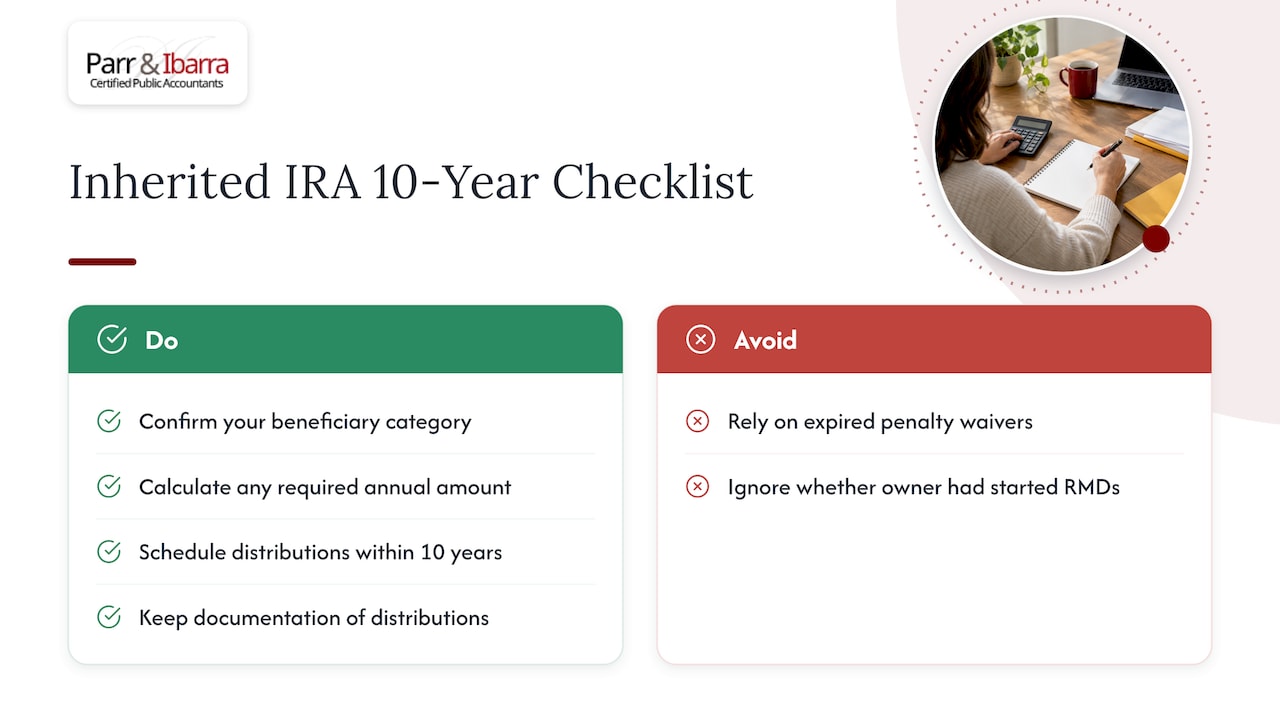
Prior penalty waivers tied to the 10-year rule’s rollout have ended, so enforcement is active in 2026. A compliance checklist helps: confirm which category you fall into, calculate any required annual amount, schedule the distribution, and keep documentation. If you are also updating other paperwork around an inheritance, this estate plan review guide covers when beneficiary designations need a second look.
Tax Consequences and Planning Tools for 2026
RMDs count as ordinary income, which can raise your adjusted gross income enough to make more of your Social Security benefit taxable and to trigger Medicare IRMAA surcharges. Because IRMAA is based on income from two years earlier, a large RMD in 2026 can affect your Medicare premiums in 2028.
- Qualified charitable distributions let you send IRA funds directly to a qualifying charity, and the amount counts toward your RMD without adding to your taxable income, a mechanic described in IRS Publication 590-B.
- Roth conversions can reduce future RMDs, but you cannot convert the portion of your distribution that satisfies your current year’s RMD. You must take the RMD first, then convert additional amounts separately.
- Spreading a large one-time distribution across a two-RMD year with a partial QCD can keep your AGI closer to your usual bracket.
A qualified charitable distribution (QCD) removed from an otherwise taxable RMD keeps that amount out of adjusted gross income, which can matter directly for where you land on the Medicare IRMAA income thresholds two years later.
Missed RMDs: Penalties, Corrections, and Prevention
Missing an RMD triggers an excise tax of 25% of the shortfall, reduced to 10% if you correct it within the IRS correction window, under rules tied to Form 5329.
- Withdraw the missed amount as soon as you discover the error.
- File Form 5329 for the tax year the RMD was missed, reporting the shortfall.
- Attach a brief explanation requesting a waiver if the miss resulted from reasonable cause, such as a custodian error.
- Keep statements and correspondence showing when you corrected the mistake, since documentation supports a waiver request.
Setting up automatic annual distributions with your custodian and confirming the transaction each December are simple habits that prevent most missed RMDs.
A Practical 2026 RMD Checklist From Our Team
Working through RMDs methodically avoids both penalties and unnecessary tax exposure. Our checklist: confirm which accounts are subject to RMDs this year, pull each account’s December 31, 2025 balance, apply the correct Uniform Lifetime Table divisor, and model a two-RMD scenario against a single-year scenario before deciding on timing.
From there, decide whether a qualified charitable distribution fits your giving plans, and confirm with each custodian that distributions were processed and documented correctly.
We handle this kind of modeling regularly as part of our tax planning work, including filing Form 5329 corrections when a client discovers a missed distribution, projecting IRMAA exposure before a client finalizes a withdrawal date, and structuring QCDs within a broader giving and income strategy. Retirees managing inherited accounts alongside their own RMDs also often need elder and estate planning support to keep beneficiary paperwork aligned with current rules.
Our Take: What Actually Matters for 2026 RMDs
The single biggest mistake we see is treating the first-RMD deadline choice as a formality instead of a tax decision. Most retirees default to taking the distribution on schedule without ever modeling the alternative, and most of the time that default is fine, but not always.
Start with three checks: your birth year and starting age, your actual account balances as of December 31, and whether a two-RMD year would meaningfully change your bracket. If you give to charity anyway, a qualified charitable distribution is close to a free tax reduction that too few people use. When the numbers get close, a CPA conversation is worth more than guessing.
— Adan
Get Help Modeling Your 2026 RMD With Parr & Ibarra CPA
Calculating a divisor is simple. Knowing whether to delay your first distribution, how a QCD changes your Medicare premium two years out, or how to correct a missed RMD without overpaying penalties takes more than a formula, and that is where we come in.
- We model two-RMD scenarios against single-year timing so you see the actual tax difference before you decide.
- We prepare and file Form 5329 corrections when a distribution was missed or miscalculated.
- We structure qualified charitable distributions and Roth conversion timing around your broader tax planning strategy.
- We handle IRS representation if a correction requires direct communication with the agency.
If your 2026 RMD decisions are more complicated than a single number, reach out through our tax planning services page to set up a conversation.
This article is general information, not a substitute for advice from a qualified financial advisor. Consult a qualified financial professional about your own circumstances before acting on anything here.
FAQ
What is the RMD table for 2026?
The table that applies for most retirees is the IRS Uniform Lifetime Table in Publication 590-B, which pairs your age with a distribution period divisor, 26.5 at age 73 and 24.6 at age 75. Married owners with a spouse more than 10 years younger use the Joint Life and Last Survivor Table instead.
What is the biggest RMD mistake?
The most common error is missing a distribution entirely or miscalculating it by mixing up aggregation rules between IRAs and workplace plans, a mistake the IRS flags frequently. The second most common mistake is delaying the first RMD without modeling the resulting two-RMD tax year.
What are the new rules for RMD?
For 2026, the RMD starting age remains 73 for people born between 1951 and 1959, with the age rising to 75 for those born in 1960 or later once that SECURE 2.0 provision takes effect. Inherited IRA rules also continue enforcing the 10-year distribution window for most non-spouse beneficiaries, with prior transition waivers no longer in place.
What is the required minimum distribution for an IRA in 2026?
Your RMD is your IRA balance as of December 31, 2025, divided by your age-based divisor from the Uniform Lifetime Table. For example, a $500,000 balance at age 73 produces a required distribution calculated by dividing by the divisor of 26.5.
Sources
- Retirement plan and IRA required minimum distributions FAQs | Internal Revenue Service
- About Form 5329 | Internal Revenue Service

