
If your 2024 Modified Adjusted Gross Income exceeded $109,000 as a single filer or $218,000 as a married couple filing jointly, you will pay Medicare IRMAA surcharges in 2026 on top of your standard Part B and Part D premiums. IRMAA (Income-Related Monthly Adjustment Amount) is not a penalty. It is a sliding-scale surcharge the Social Security Administration adds to your Medicare premiums based strictly on your income from two years prior.
A few things to know right now:
- If your 2024 MAGI was at or below $109,000 (single) or $218,000 (joint), you owe no IRMAA in 2026.
- If you exceeded those thresholds, your surcharge kicks in at the first dollar over the limit and applies for the full calendar year.
- MAGI for IRMAA purposes includes your Adjusted Gross Income (Form 1040, line 11) plus any tax-exempt interest (line 2a). Municipal bond income counts.
- The two-year lookback is the rule that catches most people off guard: your 2026 premiums are based on your 2024 tax return, not your current income.
About 5.1 million beneficiaries paid Part B IRMAA in 2025, a number that grows each year as more retirees cross the income thresholds through Roth conversions, required minimum distributions, and investment income.
Key Takeaways
IRMAA surcharges are determined by your MAGI from two years prior, making proactive income planning the most reliable way to manage or avoid them.
| Point | Details |
|---|---|
| Two-year lookback rule | Your 2026 IRMAA is based on your 2024 MAGI, including tax-exempt interest. |
| 2026 base threshold | Single filers above $109,000 and joint filers above $218,000 owe IRMAA in 2026. |
| Cliff effect risk | One dollar over a bracket threshold triggers the full surcharge for the entire year. |
| Appeal via SSA-44 | File Form SSA-44 within 60 days of your notice if a qualifying life-changing event reduced your income. |
| Parr & Ibarra CPA | Provides IRMAA scenario modeling and income-timing planning for retirees and business owners in DFW. |
How do Medicare IRMAA surcharges actually work?
IRMAA applies to Medicare Part B (medical coverage) and Part D (prescription drug coverage). It does not affect Part A for most beneficiaries, who pay no Part A premium at all.
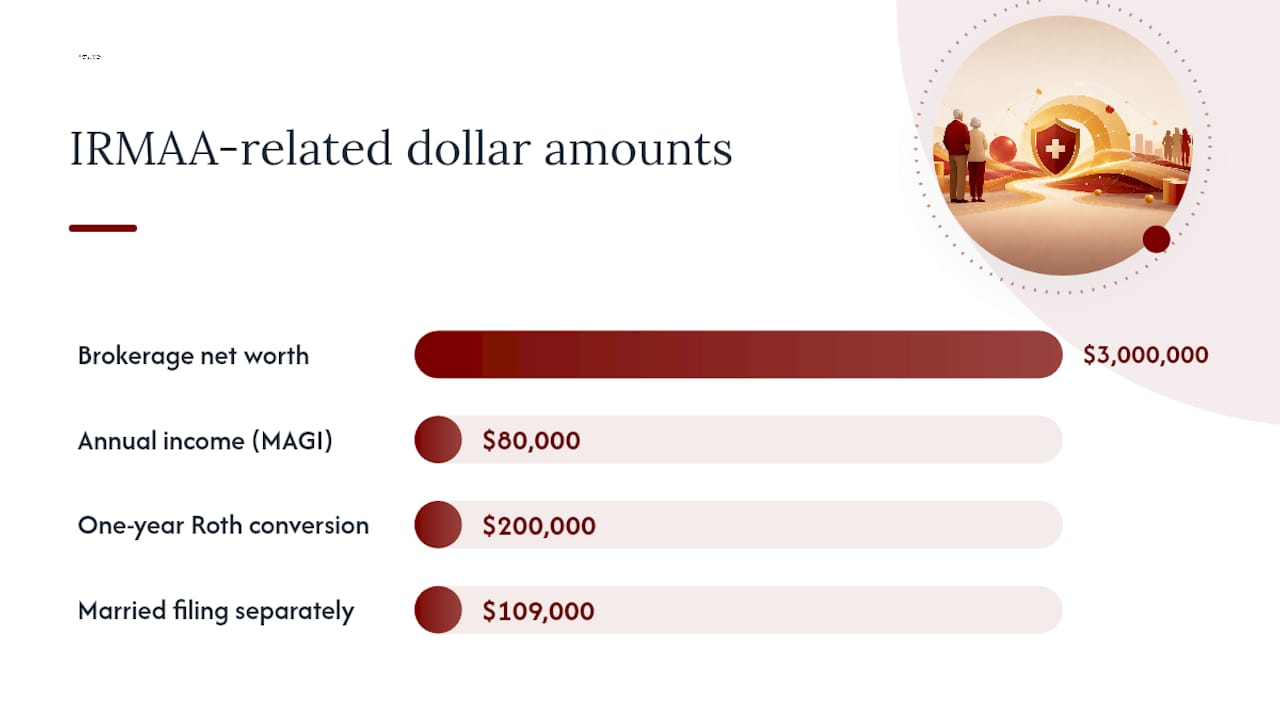
The MAGI definition matters here. For IRMAA, MAGI equals your AGI from Form 1040 line 11 plus tax-exempt interest from line 2a. That is it. Capital gains, Social Security income included in AGI, IRA distributions, and municipal bond interest all count. Net worth does not. A retiree sitting on $3 million in a brokerage account but drawing only $80,000 per year in income owes no IRMAA. A retiree who converts $200,000 from a traditional IRA to a Roth in a single year may owe IRMAA two years later even if that was a one-time event.
The administrative sequence runs like this: the IRS shares your MAGI data with the SSA, which places you into a bracket using the IRMAA sliding-scale tables. CMS then publishes the official premium amounts, and the SSA sends you a notice. Per SSA POMS guidance, IRMAA beneficiaries also lose the variable SMI premium protection that keeps standard premium increases tied to Social Security COLA increases, so your total Part B cost can rise faster than your benefit check.
Filing status creates meaningfully different thresholds:
- Single filers and married filing jointly filers use the standard brackets.
- Married filing separately filers face dramatically narrower brackets. In 2026, a married-filing-separately filer with MAGI above $109,000 jumps directly to the second-highest surcharge tier.
- There is a living-apart exception: if you lived apart from your spouse for the entire calendar year and file separately, you may qualify for the standard single-filer brackets rather than the punishing MFS schedule.
The two-year lookback is the most misunderstood rule in Medicare premium planning. Your 2026 IRMAA is set by your 2024 tax return. If you retired in 2025 and your income dropped sharply, that lower income will not reduce your 2026 premiums automatically. You would need to file Form SSA-44 to request a reduction based on a qualifying life-changing event.
What are the 2026 IRMAA brackets and surcharge amounts?
CMS published the official 2026 Part B and Part D IRMAA surcharge amounts in its November 14, 2025 fact sheet. The standard 2026 Part B monthly premium is the official CMS published amount. IRMAA adds a surcharge on top of that figure.
2026 Part B IRMAA tiers
2026 Part D IRMAA tiers (monthly surcharge added to plan premium)
The cliff effect is real. Earning one dollar over a threshold triggers the full surcharge for the entire year. A single filer at $137,001 MAGI pays $187.00 per month in Part B IRMAA instead of $74.00, a jump of $113 per month for that single dollar.
Worked examples
Single filer, $140,000 MAGI: Falls in the $137,001–$173,000 bracket. Monthly Part B surcharge: $187.00. Monthly Part D surcharge: $35.30. Combined monthly IRMAA: $222.30. Annual IRMAA cost: $2,667.60.
Married couple filing jointly, $300,000 MAGI: Falls in the $274,001–$346,000 bracket. Each spouse pays $187.00 per month in Part B IRMAA and $35.30 in Part D IRMAA. Combined household monthly IRMAA: $444.60. Annual household IRMAA cost: $5,335.20.
These numbers make the case for year-end planning. A Roth conversion that pushes a single filer from $136,500 to $137,100 costs an extra $1,356 in IRMAA alone over the following year.
How does the SSA determine and notify you of IRMAA?
The process is largely automatic and runs on a fixed annual cycle. Here is how it flows:
- The IRS provides MAGI data from your most recently filed tax return to the SSA, typically from returns filed in the prior year.
- The SSA uses that data to place you into the appropriate IRMAA sliding-scale bracket.
- CMS publishes the official premium and surcharge amounts (the 2026 amounts came out November 14, 2025).
- The SSA sends you a written notice, usually in late fall or early winter before the premium year begins, stating your IRMAA tier and the monthly dollar amount.
- If you are already receiving Social Security benefits, the IRMAA surcharge is deducted directly from your monthly benefit check. If you are not yet collecting Social Security, you receive a direct bill.
Part D IRMAA works differently from Part B. Medicare, the Part D surcharge is billed separately from your Part D plan premium. You pay the plan premium to your insurer and the IRMAA surcharge directly to Medicare, typically through Social Security deduction or direct billing.
Payment options for beneficiaries not on Social Security:
- Automatic bank deduction (Medicare Easy Pay)
- Online payment through Pay.gov
- Check or money order by mail
- In-person payment at certain Social Security offices
One practical note: if the SSA does not have your most recent tax return on file (for example, you filed late or recently amended), it may use an older return. That can work in your favor or against you. Checking your SSA record before the premium year begins is worth the few minutes it takes.
How to appeal or request a reduction using Form SSA-44
Appeals succeed most reliably when a documented life-changing event genuinely reduced your income. General financial hardship, a one-time high tax bill, or a feeling that the surcharge is unfair are not grounds for reduction.
Qualifying life-changing events under Form SSA-44:
- Marriage, divorce, or annulment
- Death of a spouse
- Work stoppage or reduction (including retirement)
- Loss of income-producing property (involuntary, such as a natural disaster)
- Loss or reduction of pension income
- Employer settlement payment (such as a one-time employer payment in lieu of pension)
Step-by-step process:
- Download Form SSA-44 from SSA.gov.
- Identify the qualifying life-changing event and the tax year you want SSA to use instead of the two-year-old return.
- Complete Step 2 (life-changing event details) and Step 3 (your more recent MAGI estimate or actual figures).
- Attach supporting documentation: a signed copy of your most recent tax return, a letter of retirement or termination, a death certificate if applicable, or a written MAGI estimate with explanation if the tax year is not yet filed.
- Submit by mail to your local SSA office or in person. There is no online submission for SSA-44.
- For a reconsideration request (if you disagree with an SSA determination), the standard window is 60 days from the date of the notice.
Pro Tip: Document the exact date of the life-changing event and keep copies of everything you submit. SSA will verify your MAGI estimate against your actual IRS return once it is filed. If your estimate was too low, SSA may retroactively correct your premiums, which can result in a balance due.
Filing SSA-44 does not automatically remove IRMAA. SSA reviews the documentation and issues a new determination. If the documentation is thin or the event does not clearly qualify, the request will be denied. That is why proactive year-end tax-planning strategies are a higher-probability lever than appeals after the fact.
What strategies can reduce your IRMAA exposure?
The two-year lookback means the window to act is the tax year two years before the premium year. For 2026 premiums, that window was 2024. For 2027 premiums, the window is 2025, and so on. Planning ahead is the only reliable approach.
Income-timing strategies:
- Defer discretionary IRA distributions to years when your MAGI is already near a bracket ceiling, rather than taking large distributions in a single year.
- Time Roth conversions carefully. A conversion that pushes you over a bracket threshold costs more than just the income tax on the converted amount. Model the IRMAA impact before executing.
- Harvest capital losses to offset realized gains and keep MAGI below a threshold.
- If you own a business and are approaching retirement, consider the timing of a sale or large distribution relative to your Medicare enrollment year.
Income-shaping tactics:
- Qualified Charitable Distributions (QCDs) allow beneficiaries age 70½ or older to transfer up to $108,000 per year (2026 limit, indexed for inflation) directly from an IRA to a qualified charity. The distribution satisfies your required minimum distribution but does not count as income in your AGI, which means it does not raise your MAGI. For someone sitting just below a bracket ceiling, a QCD can be the cleanest tool available.
- Maximize pre-tax retirement contributions if you are still working. Every dollar into a 401(k) or traditional IRA reduces your AGI and therefore your MAGI.
- Review capital gains tax treatment options before year-end. Long-term gains are taxed at lower rates, but they still count toward MAGI.
Filing status considerations:
Married filing separately almost never helps with IRMAA. The MFS brackets are far narrower than single or joint brackets, so most MFS filers with any meaningful income land in a higher tier than they would filing jointly. Consult a CPA before changing your filing status specifically to manage IRMAA. The interaction with other tax rules (itemized deductions, Social Security taxation, capital gains rates) usually makes MFS a net negative.
Checklist to bring to a CPA meeting:
- Your 2024 Form 1040 (lines 11 and 2a at minimum)
- Projected 2025 income sources: RMDs, Social Security, investment income, business distributions
- Any planned large transactions: property sales, business sales, stock option exercises
- Current Medicare enrollment status and whether you are already paying IRMAA
- Marital status and whether both spouses are on Medicare
Pro Tip: One-time income spikes, such as a business sale or a large Roth conversion, can lock you into a higher IRMAA tier for a full year even if your income returns to normal the following year. Modeling the two-year impact before executing a large transaction is far cheaper than paying the surcharge after the fact.
This article provides general information only and does not constitute individualized tax advice. Consult a qualified CPA or tax advisor for guidance specific to your situation.
Special situations and edge cases worth knowing
Married filing separately: The MFS brackets are punishing. In 2026, any MFS filer with MAGI above $109,000 jumps immediately to the second-highest surcharge tier, skipping the lower tiers entirely. The only exception is the living-apart rule: if you lived completely apart from your spouse for the entire tax year and file separately, you use the standard single-filer brackets instead.
Both spouses on Medicare: IRMAA is assessed per person, not per household. If both spouses are enrolled in Part B and Part D, each pays their own surcharge based on the household’s joint MAGI mapped to the joint-filer brackets. A couple with $300,000 MAGI pays the surcharge twice, once for each spouse, as shown in the worked example above.
Medicare Advantage and IRMAA: Enrolling in a Medicare Advantage (MA) plan does not eliminate IRMAA. You still owe the Part B IRMAA surcharge. Some MA plans have $0 plan premiums, but the IRMAA surcharge on Part B remains. Some MA plans also include Part D coverage, in which case the Part D IRMAA surcharge applies to that embedded drug coverage as well.
Tax-exempt interest and Social Security: Municipal bond interest does not appear in your AGI, but it is added back for IRMAA MAGI. A retiree with $95,000 in AGI and $20,000 in muni bond interest has a MAGI of $115,000 and owes IRMAA. Similarly, the portion of Social Security benefits included in your taxable income counts toward AGI and therefore MAGI. These two items together can push retirees over thresholds they did not expect to cross.
Dual eligibility (Medicare and Medicaid): Beneficiaries who qualify for both Medicare and Medicaid (dual eligibles) may have their Part B and Part D premiums covered by their state Medicaid program. If the state pays the premium, IRMAA surcharges may also be covered depending on the state’s program rules. Contact your state Medicaid office for specifics.
Why IRMAA planning deserves more attention than it gets
Most retirees treat Medicare premiums as a fixed cost. They are not. The difference between the lowest IRMAA tier and the highest is more than $500 per month per person in Part B alone. For a couple, that gap can exceed $12,000 per year. Over a decade of retirement, the cumulative difference is material enough to affect withdrawal sequencing, estate planning, and overall retirement sustainability.

What makes IRMAA particularly tricky is the two-year lag. By the time you receive the SSA notice telling you what you owe, the income decision that triggered it is already two years in the past. That is not a system designed for reactive management. It rewards people who model scenarios before they execute large transactions, not after.
The other thing most articles miss: IRMAA beneficiaries lose variable SMI premium protection. Standard Medicare beneficiaries have a statutory protection that limits how much their Part B premium can increase in a given year relative to their Social Security COLA. IRMAA beneficiaries do not get that protection. Their premiums can rise faster than their benefit checks, compounding the budget pressure over time.
The beneficiaries who manage IRMAA best are not necessarily the ones with the lowest incomes. They are the ones who plan two years out, model the bracket cliffs before executing Roth conversions or asset sales, and use tools like QCDs and pre-tax contributions deliberately. A single well-timed planning conversation can save more than its cost in IRMAA alone.
Parr & Ibarra CPA can model your IRMAA exposure before it costs you
For retirees and business owners in the Dallas-Fort Worth area, the gap between knowing about IRMAA and actually running the numbers is where money gets left on the table. Parr & Ibarra CPA works with individuals and business owners on proactive income-timing and tax-planning strategies that account for IRMAA bracket cliffs, Roth conversion timing, QCD eligibility, and the two-year lookback. The team includes multiple CPAs with deep experience in retirement income planning, and engagements are structured around your specific situation, not generic advice.
Personalized IRMAA scenario modeling requires a client engagement. If you are approaching a large income event or want to review your 2025 MAGI before it sets your 2027 premiums, schedule a consultation with Parr & Ibarra CPA now.
Sources
The figures and rules in this article come from the following primary sources. Use these to verify amounts, download forms, and get live help.
- 2026 Medicare Parts B premiums, deductibles, and coinsurance amounts (CMS fact sheet)
- Medicare Income-Related Monthly Adjustment Amount – Life-Changing Event (Form SSA-44)
- POMS: HI 01101.020 – IRMAA Sliding Scale Tables
- Medicare
Live help:
This article is general information, not a substitute for advice from a qualified financial advisor. Consult a qualified financial professional about your own circumstances before acting on anything here.
FAQ
Who will owe IRMAA surcharges in 2026?
Any Medicare beneficiary whose 2024 MAGI exceeded $109,000 (single filer) or $218,000 (married filing jointly) will owe IRMAA surcharges in 2026 on their Part B and Part D premiums.
What income level triggers IRMAA surcharges?
The 2026 IRMAA threshold starts at $109,001 for single filers and $218,001 for joint filers, based on 2024 MAGI. Married filing separately filers face a narrower schedule, with surcharges beginning at the same $109,001 floor but jumping to a higher tier immediately.
How can you avoid or reduce Medicare IRMAA surcharges?
The most reliable approach is managing your MAGI in the tax year two years before the premium year. Strategies include timing Roth conversions to stay below bracket thresholds, using Qualified Charitable Distributions to reduce taxable income, and deferring or accelerating discretionary distributions. If a qualifying life-changing event reduced your income, file Form SSA-44 to request use of a more recent tax year.
What percentage of Medicare beneficiaries pay IRMAA?
Approximately 5.1 million beneficiaries paid Part B IRMAA in 2025, representing a minority of total Medicare enrollees, though that number grows annually as more retirees cross the income thresholds through RMDs and investment income.
Does IRMAA apply to Medicare Advantage plans?
Yes. Enrolling in a Medicare Advantage plan does not eliminate IRMAA. You still owe the Part B IRMAA surcharge regardless of your plan type, and if your MA plan includes Part D drug coverage, the Part D IRMAA surcharge applies as well.

