
If you claimed the Employee Retention Credit (ERC), your audit risk depends less on luck than on how well the claim holds up quarter by quarter. The IRS says it is closely reviewing returns that claim the credit because of the number of improper claims. A claim backed by clear eligibility records is a different matter from one a promoter built from a template. This guide covers what raises the risk, what an examination looks like, how long the IRS can look back, and what to do now.
TL;DR
- As of early October 2026, the IRS reported about 13,000 ERC claims still in processing, including about 3,000 under audit. Most claimants have not been audited, but the agency is still working this inventory.
- Risk rises with claims for too many quarters, vague government-order support, overstated employee counts, and claims pushed by promoters who said there was nothing to lose.
- The IRS will ask for Forms 941, payroll records and proof of eligibility for each quarter. If you cannot produce them, fix that before a notice arrives.
- Interest on an erroneous ERC refund can run from the refund date. Withdrawing or correcting a claim early can limit the damage.
- If a notice arrives, read the deadline, gather records and bring in a CPA or tax representative before you reply.
What are your real chances of an ERC audit?
Nobody can give you a personal probability, and any site that does is guessing. What the IRS publishes is inventory. As of the week ending October 3, 2026, it reported roughly 13,000 ERC claims in various stages of processing, about 3,000 of them under audit.
That is a small share of the businesses that claimed the credit. It is also not a comfort. The IRS does not pick ERC examinations at random. Claims that match known warning signs are routed to Compliance. The Taxpayer Advocate Service says the IRS plans to work claims first-in, first-out while prioritizing hardship cases, and that claims meeting examination referral criteria go to Compliance.
So the useful question is not “will I be picked?” but “does my claim look like the ones that get referred?” The next section answers that.
What raises the risk of an ERC audit
The IRS has published its own list of warning signs. According to its guidance, red flags include claiming too many quarters, relying on nonqualifying government orders, overstating employee counts or miscalculating the credit, citing supply-chain problems, claiming too much of a period, claiming periods with no wages or before the business existed, and promoters who say you have nothing to lose. A second IRS release repeats these signs and adds that a promoter’s pitch is itself a signal.
Here is how those show up in real files.
Claiming every quarter available
Few businesses qualified for every eligible quarter. A claim covering all of them, with the same reasoning copied across periods, draws attention. Each quarter has to stand on its own facts.
A government order that did not really limit your operations
The common weak spot is a general order that did not actually suspend more than a nominal part of your business. Revenue agents treat each ERC requirement as one of many hurdles you must clear. A supply-chain delay or a customer who canceled is not automatically a suspension.
Employee and wage numbers that do not reconcile
The credit depends on counting employees, separating wages that were already used for PPP forgiveness, and handling owner and family wages correctly. If your ERC worksheet and your Forms 941 do not tie to the payroll register, an examiner will see it quickly. Clean payroll records are the best defense here, which is why we often start these reviews in the payroll and books, not the credit calculation.
Gross-receipts claims with thin support
If you qualified through a decline in gross receipts, the comparison quarter, your accounting method and any PPP interaction all need to be documented. A spreadsheet that nobody can trace back to the general ledger is a weak file.
A promoter story
If a marketing firm approached you, charged a contingency fee and filed the amended returns, the IRS views that pattern as higher risk. The issue is not that you used help. The issue is whether anyone checked eligibility and whether you have the work papers.
What the IRS reviews in an ERC examination
ERC examinations usually start with an information document request (IDR), not a visit. IRS material on ERC audits says IDRs request Forms 941, ERC worksheets, payroll journals, employee and wage details, evidence of a suspension or gross-receipts decline, and PPP documentation.
In practice, the stages feel different:
| Stage | What it usually involves | What helps you |
|---|---|---|
| Notice or letter | The IRS asks for information or tells you about a change to the claim | Reading the response date and keeping a copy of everything |
| Document request or desk review | An examiner works from the records you send, usually by mail | Organized, indexed records that answer each quarter’s eligibility |
| Field examination | A more detailed review, which can include interviews and broader record requests | A representative who handles all contact |
| Fraud referral | Reserved for cases involving suspected false statements | Qualified legal counsel, not only a CPA |
The first three are civil. Most honest claimants who face a review stay in the first two.
Records worth pulling together now
The Tax Adviser recommends that taxpayers save the relevant government orders and document eligibility, gross-receipts declines, and PPP loan and forgiveness records. Build a binder, digital or paper, for each claimed quarter:
- The government orders you relied on, with dates, and a short memo on how each one affected your operations.
- Forms 941 and the amended Forms 941-X filed for the credit.
- The ERC calculation worksheet, tied to payroll registers.
- PPP loan, forgiveness application and the wages used for forgiveness.
- Quarterly gross receipts compared with the base period, tied to the general ledger.
- Any engagement letter, eligibility analysis or work papers from whoever prepared the claim.
If your books were behind when you claimed the credit, a bookkeeping cleanup comes first. Our guide on keeping LLC bookkeeping IRS ready shows the habits that make this kind of file easy to rebuild.
How long can the IRS audit an ERC claim?
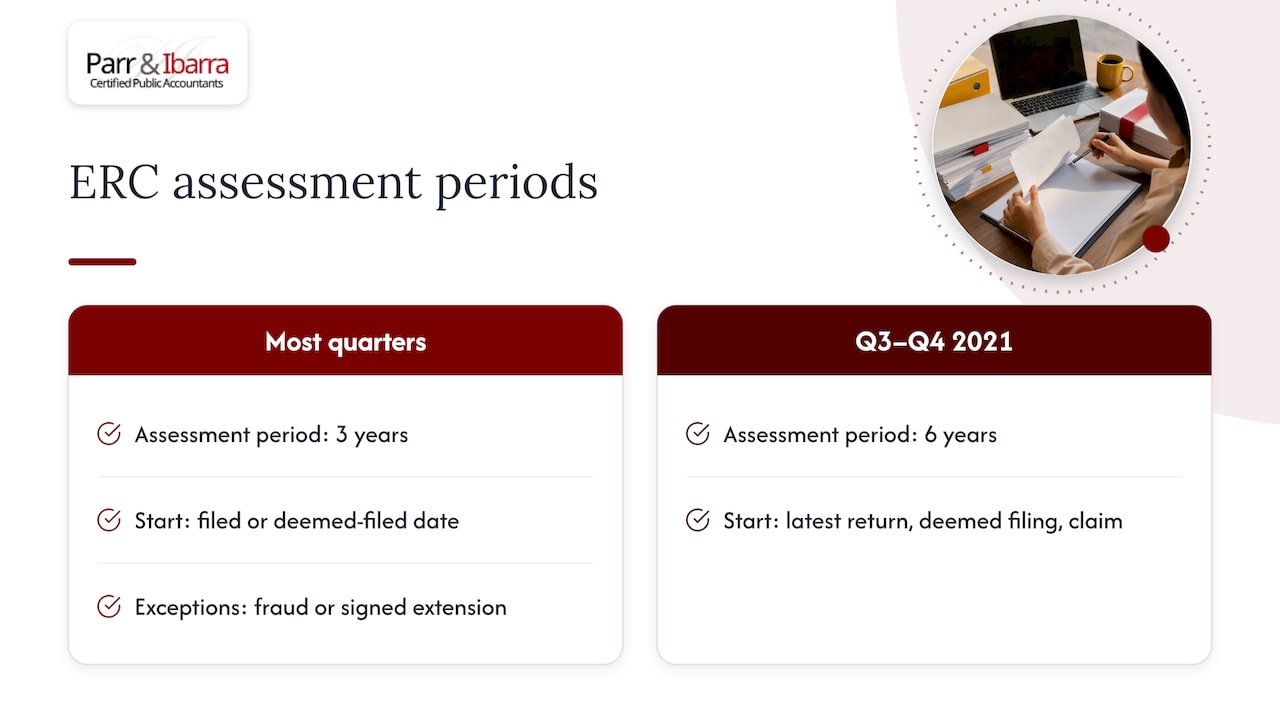
The answer depends on the quarter. The normal assessment period is three years from the date the return is filed or deemed filed. Quarterly payroll returns are generally treated as filed on April 15 of the following year, so for many 2020 and early 2021 claims that window has largely closed, unless there is fraud or a signed extension.
The third and fourth quarters of 2021 are different. The 2025 budget law (OBBBA) extended the assessment period to six years for those quarters and changed when the clock starts: the latest of the original return date, the deemed filing date or the date the ERC claim was filed. For a claim filed late, that can push the end date years out.
Two practical points follow. First, do not assume an older quarter is safe without checking your own filing dates, because late-filed amended returns and extensions change the math. Second, the clock does not apply if the return was fraudulent. A CPA or tax attorney should confirm the date for each quarter you claimed.
What happens if the IRS finds the claim was wrong
The exposure has three parts: the credit itself, interest and possible penalties.
Repayment. If the IRS decides a refund was issued in error, it will ask for the money back. For erroneous refunds of $100,000 or more, the IRS Internal Revenue Manual says taxpayers are typically given 10 business days to repay before additional interest accrues. Do not let a letter sit while you gather records. Call the number on it and ask for time in writing.
Interest. The same manual section says interest on an erroneous refund runs from the date of the refund if you caused the error, or if the refund is over $50,000 even when the IRS caused it. On a large claim, a year of interest is real money.
Penalties. Accuracy-related and other penalties can apply when the claim lacked a reasonable basis. Reliance on a competent professional and good records matter in that discussion. Fraud is a separate matter and carries much harsher consequences.
Withdrawing or correcting a claim
If you doubt a claim that has not been paid, the IRS has a withdrawal process. The Taxpayer Advocate describes it as a way to avoid future penalties and interest, though it does not protect anyone from criminal investigation if the original claim was fraudulent. It also says the IRS treats accepted withdrawn claims as if they were never filed. Programs for claims that were already paid have changed over time, so check the IRS ERC page for what is open now before you decide.
The decision to withdraw, amend or defend is a legal and tax judgment. Talk to a CPA or tax attorney who has seen your records before you file anything.
If you receive an ERC notice
A notice is a deadline, not a verdict. Work through it in this order:
- Read the notice type and the response date. Put the date on a calendar today.
- Do not call the IRS without a plan. Informal phone answers can become statements in your file.
- Collect the records listed above for the quarter named in the letter.
- Get representation early. A CPA, enrolled agent or attorney with power of attorney can speak for you and keep the exchange in writing. Our overview of IRS audit representation explains your rights and the usual next steps.
- Respond on time, even if only to ask for more time. Ignoring a letter turns a document request into a bigger problem. Our DFW notice roadmap covers what follows silence.
If the claim is disallowed
A disallowance is not the end. The Taxpayer Advocate explains that taxpayers generally have two years from the date on the disallowance notice to file a refund suit, reach an agreement with the IRS and receive a refund, or sign an extension. It also reports that the two-year period stated in Letter 105-C stays the same during IRS review. Mark that date separately from your response date. Missing it can end your right to sue.
How to lower your risk before anyone writes to you
If you claimed the credit, a self-review now costs far less than a response under deadline.
- Re-test each quarter. Ask whether the order, the revenue decline or the employee count really supports it, using the IRS red-flag list above.
- Reconcile payroll. Tie the 941s, ERC worksheet and payroll register together, and confirm wages used for PPP forgiveness were excluded.
- Get the preparer’s file. If a third party prepared the claim, ask for the eligibility analysis. If they cannot provide one, treat that as a risk factor.
- Check the limitations dates for each quarter with a professional.
- Decide with advice. If the review finds problems, a CPA and, where fraud is possible, an attorney can weigh withdrawal, correction and defense.
It also helps to look past the credit. The same weaknesses that sink an ERC claim, such as loose books, unreconciled payroll and undocumented decisions, tend to show up in other areas. Our tax planning team looks at the whole picture.
How Parr & Ibarra CPA can help
We are a Dallas-Fort Worth CPA firm with more than 20 professionals, including multiple CPAs, and we serve clients in English and Spanish. For ERC concerns, we can review your payroll and bookkeeping records, assess how well each quarter is documented, and represent you if the IRS writes. See our tax controversy and IRS representation work, or contact us to talk through your situation. We do not publish fixed fees for this work, because scope depends on how many quarters and records are involved.
FAQ
What are the biggest ERC audit risk factors?
The IRS names claiming too many quarters, weak government-order support, wrong employee counts or calculations, and periods with no wages or before the business existed. A promoter who said there was nothing to lose is also a flagged pattern. Any one of these is worth reviewing, and several together make a referral more likely.
How long can an ERC be audited?
It depends on the quarter. The usual assessment period is three years from the filing or deemed filing date, but for the third and fourth quarters of 2021, the 2025 law extended it to six years with a later start date. Fraud has no limit. Have a professional confirm the dates for each quarter you claimed.
Are ERC refunds still being processed?
Yes. As of early October 2026, the IRS reported about 13,000 claims still in processing, including about 3,000 under audit. Check the IRS ERC page for the latest figures, because they change.
Should I withdraw my ERC claim if I am unsure about it?
That is a decision to make with a CPA or tax attorney after a records review. The IRS withdrawal process can treat an accepted withdrawal as if the claim was never filed. It does not protect against a criminal investigation if the original claim was fraudulent.
What should I do first if I get an ERC letter?
Note the response date, do not ignore the letter, and gather the records for the quarter it names. Then have a CPA or other authorized representative handle the reply. If the claim is disallowed, track the two-year window on the notice.
Sources
- Employee Retention Credit | Internal Revenue Service
- Check business tax returns for signs of incorrect Employee Retention Credit claims | IRS
- IRS shares new warning signs of incorrect claims for Employee Retention Credit | IRS
- Employee Retention Credit positions and audits | IRS
- 21.4.5 Erroneous Refunds | IRS Internal Revenue Manual
- 2024 MSP #01: Employee Retention Credit | Taxpayer Advocate Service
- Resolving an Improper ERC Claim | Taxpayer Advocate Service
- Protect Your ERC Claim | Taxpayer Advocate Service
- Considerations for IRS examinations of ERC claims | The Tax Adviser
- Employee Retention Credit: 5 Years of IRS Answers | Forbes

