

If your business in Dallas owns equipment, furniture, computers or inventory, you owe property tax on it unless it falls under the exemption that began on January 1, 2026. That exemption is $125,000 of appraised value and is automatic. Even so, you may still have to file a rendition with the Dallas Central Appraisal District (DCAD) by April 15, and missing that filing carries a penalty. This guide covers what is taxable, how DCAD values it, what the bill looks like, and how to protest.
TL;DR
- Business personal property (BPP) is the tangible, movable property a business uses to earn income: equipment, furniture, fixtures, computers, inventory and supplies.
- Starting January 1, 2026, the first $125,000 of appraised value is exempt automatically. No application is needed.
- Renditions are due April 15 (May 15 with a timely written extension request). A late rendition triggers a 10% penalty on the tax.
- The Dallas combined local rate in the 2025 rate table is $2.226885 per $100, so a business with $200,000 of BPP would owe roughly $1,670 after the exemption.
- If you disagree with DCAD’s value, protest by May 15, usually online through uFile.
What Dallas business personal property tax covers
Texas taxes property by value (ad valorem). Real property is land and buildings. Business personal property is everything else a business owns or controls to produce income. DCAD’s valuation guide lists furniture, fixtures, machinery, equipment, computers, inventory, raw materials and finished goods as taxable. The same guide says intangibles such as cash, goodwill and application software do not need to be rendered.
In practice, here is how that sorts out for common Dallas businesses:
| Business | Typically taxable | Typically not on the rendition |
|---|---|---|
| Restaurant | Kitchen equipment, tables, POS hardware, food and beverage inventory | Cash in the register, goodwill |
| Dental or medical office | Chairs, imaging equipment, computers, supplies | Practice goodwill, patient lists |
| Retail shop | Shelving, fixtures, merchandise on hand | Brand value |
| Contractor | Tools, machinery, shop equipment | Your personal vehicle used only personally |
| Consulting firm | Office furniture, laptops, monitors | Software licenses, cash |
The key test is use. Property held or used to produce income is in. A laptop in your home office that you use only for your own consumption is not. A laptop you use for your business is.
Two cases surprise owners. First, you can owe BPP tax even if you rent your space, because the tax is on what you own inside it, not the building. Second, leased equipment can be reportable too, depending on the lease terms and who the property owner is for tax purposes. Ask your CPA how your leases should be reported.
How this differs from real property and vehicle taxes
The building and land are appraised separately as real property, and your landlord usually passes that cost through in a lease. Business vehicles are generally handled through registration rather than through your rendition, and Texas has no state tax on intangible property. If you are unsure whether an asset belongs on the rendition, that is a good question to settle before April, not after a penalty notice.
The $125,000 exemption that began in 2026
For decades, Texas exempted only property worth $2,500 or less. That changed. Per DCAD’s FAQ, effective January 1, 2026, under HB 9 from the 89th Legislative Session, businesses receive an automatic $125,000 exemption on the appraised value of tangible personal property used for income production. The enrolled bill summary describes the same change on the legislative side.
What that means for you:
- No application. The exemption is applied automatically.
- Related entities at one address are combined. DCAD states that related entities at the same address are aggregated, so splitting one operation into several LLCs in the same suite does not multiply the exemption.
- It is an exemption of value, not a flat credit. If your BPP is appraised at $90,000, taxable value is zero. If it is appraised at $200,000, taxable value is $75,000.
Most sole proprietors, small professional practices and home-based businesses will now owe nothing. Restaurants, medical practices, manufacturers, distributors and anyone carrying real inventory will still owe on the portion above $125,000.
Do you still have to file a rendition?
A rendition is the report that lists your property and its value. The exemption changes the math, but it does not remove the filing step for everyone.
Per DCAD, owners of tangible property used for income production generally must render by April 15 each year, and a written extension request filed by that date moves the deadline to May 15. The same FAQ says that a business whose property is worth $125,000 or less may elect not to render by filing a rendition statement or property report by April 15, certifying a reasonable belief that the value does not exceed that amount.
So the practical choices look like this:
- Clearly under $125,000. File the short certification by April 15. Keep your asset list on file to support it.
- Over $125,000, or close. File a full rendition with an accurate asset list and cost basis by April 15, or request the May 15 extension in writing before April 15.
- Not sure. Pull your fixed asset register and total up cost by category. If you do not have one, that is a bookkeeping gap worth closing. Our bookkeeping team can build one from your invoices and depreciation schedules.
Note the word “belief” in the certification. It is a sworn statement. Do not guess; total the numbers.
How DCAD finds businesses that do not file
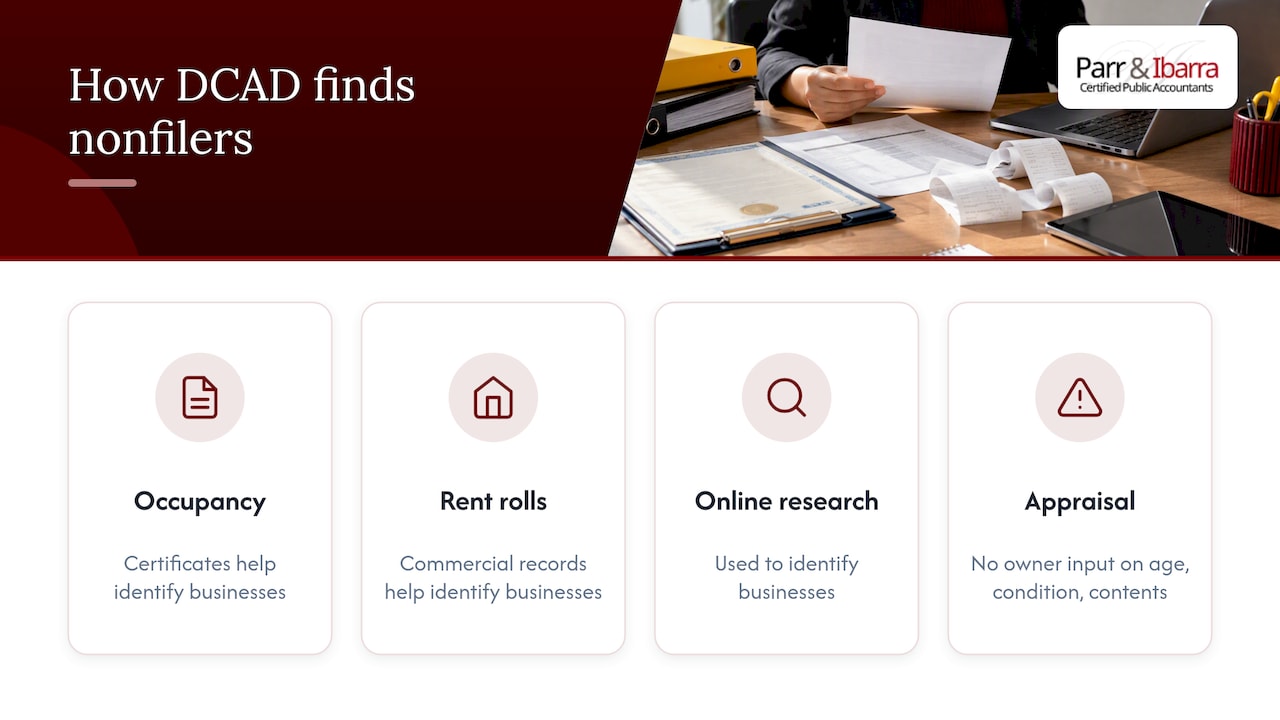
DCAD does not wait for you. Its BPP division identifies businesses through Certificates of Occupancy, commercial rent rolls and online research. If you open a new location in Dallas County and never file, the district may still appraise you, and it will do so without your input on age, condition or what you actually own.
How DCAD values your property
DCAD typically uses the cost approach: it starts from what comparable assets cost new, then adjusts for asset age, quality and condition to reach a market value estimate. The district calls this the most equitable and consistent method for mass appraisal of business property.
What this means for your filing:
- Report original cost and year acquired by category. A depreciated, ten-year-old kitchen line and a new one should not carry the same value.
- Tax depreciation is not the same as appraised value. Your federal return may have written an asset off in year one. DCAD’s value will still reflect age and condition rather than your tax basis. Your CPA should keep the two schedules separate.
- Inventory is valued as of January 1. Because Texas appraises as of that date, the stock you hold on January 1 drives the whole year’s bill. Owners with seasonal inventory sometimes benefit from the timing of year-end counts and purchases. How you account for inventory also matters for your return; our guide to inventory accounting methods covers the federal side.
What the bill looks like: a worked example
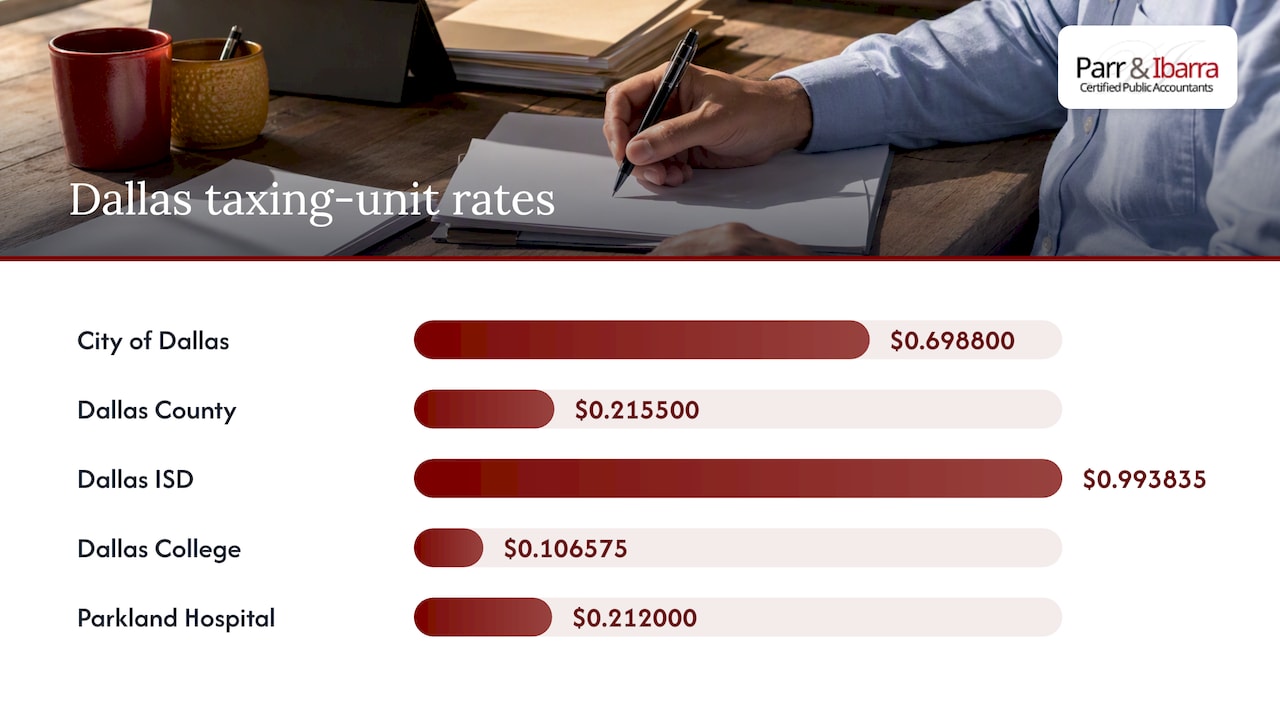
Your bill is the taxable value multiplied by each taxing unit’s rate, per $100 of value. In its 2025 rate table, the City of Dallas Office of Economic Development lists these rates for property inside the city: City of Dallas $0.698800, Dallas County $0.215500, Dallas ISD $0.993835, Dallas College $0.106575 and Parkland Hospital $0.212000, for a combined $2.226885 per $100. The city says these rates apply to real property and business personal property. Rates are set annually and differ by school district and city, so a business in Irving, Richardson or Plano will see a different mix.
Here is the arithmetic using the combined Dallas rate, for a restaurant with BPP appraised at $200,000:
| Step | Amount |
|---|---|
| Appraised value of BPP | $200,000 |
| Less automatic exemption | $125,000 |
| Taxable value | $75,000 |
| Combined rate | $2.226885 per $100 |
| Estimated tax | $75,000 ÷ 100 × 2.226885 = $1,670.16 |
Before the 2026 change, that same business would have been taxed on nearly the whole $200,000, which would have produced a bill of about $4,454 at the same rate. The exemption therefore saves this owner roughly $2,780 a year at current rates. A business appraised at $90,000 owes nothing.
This is an illustration, not a quote. Use your own appraisal notice and your actual taxing units’ rates. Also, the exemption’s interaction with each taxing unit can matter for businesses with property in more than one location, so have your CPA confirm how it applies to your locations.
Penalties for filing late or leaving property off
The penalty structure is simple and expensive. DCAD’s FAQ says failure to file a rendition by the deadline results in a mandatory 10% penalty on the total tax liability, and a 50% penalty may be added if a court determines fraud or intent to evade taxes.
A few ways owners get caught:
- Assuming the new exemption means “no filing, ever.”
- Filing for the original LLC but leaving off equipment owned by an affiliate at the same address, which is aggregated.
- Not noticing a second location or a storage unit holding inventory.
- Missing the extension request. It must be in writing and filed by April 15.
On a $1,670 bill the 10% penalty is about $167. On a manufacturer with a $60,000 bill, it is $6,000. The deadline matters more as your assets grow.
Protesting your appraisal
If DCAD’s value looks too high, you have a clear path. Businesses can file through DCAD’s uFile system, which typically opens in the second week of May, and protests must be postmarked by May 15 each year. DCAD says uFile is its preferred method and the only way to file a protest electronically, and you can upload evidence with your initial filing.
If you file and submit evidence, DCAD may hold an informal review, which can settle the dispute without a formal Appraisal Review Board hearing. Good evidence for a BPP protest includes:
- Your fixed asset register with purchase dates and invoices
- Proof of disposals, sales or equipment moved out of the county before January 1
- Photos or repair records showing condition
- Evidence that leased equipment belongs to the lessor
A protest filed in May of a given year covers that year’s appraisal notice. Check DCAD’s site each spring for the current process and any changes.
Abatements for larger projects
If you are planning a significant investment, such as a new facility, a manufacturing line or a major equipment purchase, ask whether a local abatement is possible. The Texas Comptroller explains that local governments use abatements to attract and retain businesses by abating all or part of increases in real or tangible personal property value. These are negotiated with specific taxing units and must be in place before the project begins, so they are a planning conversation, not something to chase after the fact.
A yearly BPP routine that keeps you out of trouble
A short routine beats a scramble in April:
- January: Count inventory as of January 1 and save the count.
- Q1: Update your fixed asset register: additions, disposals, locations.
- By April 15: File your rendition or certification, or send a written extension request.
- May: Review your appraisal notice. Protest by May 15 if the value is off.
- Fall: Compare the bill to the notice and pay by the date printed on it.
If you want these dates alongside your federal and state due dates, our guide to setting up a small business tax calendar shows how to lay them out. Property tax also belongs in your annual planning, since it is one more cost the right tax planning for Texas business owners should account for.
Getting help with your rendition
For a one-person consultancy under the exemption, filing a certification yourself may be enough. If you run a restaurant, a practice, a distribution business, or several entities at one address, the stakes are higher: the value you report, the aggregation rules and the protest evidence all affect your bill. Parr & Ibarra CPA works with Dallas-Fort Worth business owners on tax planning, preparation and IRS representation, and our team can also keep the asset records that make a rendition and a protest straightforward. We serve clients in English and Spanish.
FAQ
What is the business personal property tax exemption in Texas?
Effective January 1, 2026, Texas exempts the first $125,000 of appraised value of income-producing tangible personal property, up from $2,500. DCAD says the exemption is automatic and that related entities at the same address are aggregated. Property above that amount is taxed at your local rates.
When is the business personal property rendition due in Dallas County?
April 15 each year. A written extension request filed by April 15 moves the deadline to May 15. Businesses with property valued at $125,000 or less may elect not to render by filing a certification statement by April 15.
How much tax will my Dallas business owe on its personal property?
Subtract the $125,000 exemption from your appraised value, then multiply the remainder by your combined local rate per $100. At the 2025 combined City of Dallas rate of $2.226885 per $100, $200,000 of appraised property produces about $1,670. Your rate depends on your city, school district and other taxing units.
What happens if I do not file?
A late or missing rendition brings a mandatory 10% penalty on the tax liability, and a court-determined finding of fraud or intent to evade can add 50%. DCAD may also appraise the property without your input.
Can I dispute DCAD’s value?
Yes. File a protest through uFile, typically available from the second week of May, postmarked by May 15. Upload your asset records, and DCAD may resolve the matter in an informal review before any formal hearing.
Sources
- DCAD: Business Personal Property Valuation Process
- DCAD: Business Personal Property Frequently Asked Questions
- DCAD: uFile Online Protest and Settlement System
- DCAD: Informal Review Process
- Texas Legislature: HB 9 enrolled bill summary
- City of Dallas Office of Economic Development: Tax Rate
- Texas Comptroller: Chapter 312 Reinvestment Zones and Abatements

