An installment sale of real estate is a sale where you receive at least one payment after the tax year in which the sale closes. Under the installment method, you report your gain as the payments arrive, not all at once in the year of sale. That can spread the taxable gain across several years. It also makes you the lender, so the deal needs sound terms and a clear tax plan before you sign.
This guide covers who qualifies, how the math works, a worked example, what the IRS does not let you defer, how to elect out, and how to protect yourself as a seller.
TL;DR
- A sale qualifies as an installment sale when at least one payment comes after the close of the tax year of the sale (26 U.S.C. § 453).
- The installment method is the default. You must elect out by the return due date, extensions included, if you want all the gain taxed in the year of sale (IRS Topic 705).
- Each year you report interest, plus the gain share of your principal payments, using the gross profit percentage and Form 6252.
- Dealers and inventory sales are excluded, and the tax code has other limits, so a short review with a CPA before closing is worth the time.
- Because you become the lender, buyer default, insurance, and property taxes need written protections.
What an installment sale of real estate is
In a typical cash sale, the buyer pays in full at closing and you owe tax on the whole gain on that year’s return. In an installment sale, the buyer pays part at closing, often a down payment, and the rest over time under a promissory note. You usually hold a deed of trust or mortgage on the property as security.
The tax definition is narrow and simple. An installment sale is a disposition of property where at least one payment is received after the close of the tax year in which the disposition occurs (26 U.S.C. § 453). A sale that closes in December with the final check arriving in January qualifies on paper. Most planned installment sales run longer, anywhere from a few years to a decade or more, sometimes ending in a balloon payment.
Two terms you will see often:
- Seller financing: the commercial arrangement. You carry the note instead of the buyer borrowing from a bank.
- Installment method: the tax rule that lets you recognize gain as you collect payments.
Why sellers agree to take payments over time
The tax reason is timing. The IRS explains that under the installment method you report part of your gain as each payment arrives. Gain can be recognized over multiple years instead of landing in the year of sale (Publication 537). Spreading income can keep a large one-time gain from stacking on top of your other income in a single year. For a deeper look at how long-term and short-term rates work, see our investor’s guide to capital gains treatments and our overview of what capital gains tax is.
There are commercial reasons too:
- A wider pool of buyers. Buyers who cannot get a conventional loan, or who want to avoid one, can still purchase.
- Interest income. You earn interest on the note, which is taxed as ordinary income.
- A steadier income stream. Retirees and owners exiting a long-held property often like predictable monthly or annual payments.
- Negotiating room. Flexible terms can support a stronger price.
Keep the tax benefit in perspective: it is a deferral of timing, not an exemption. You still pay tax on the gain, just as you collect the money.
How the installment method calculates your gain
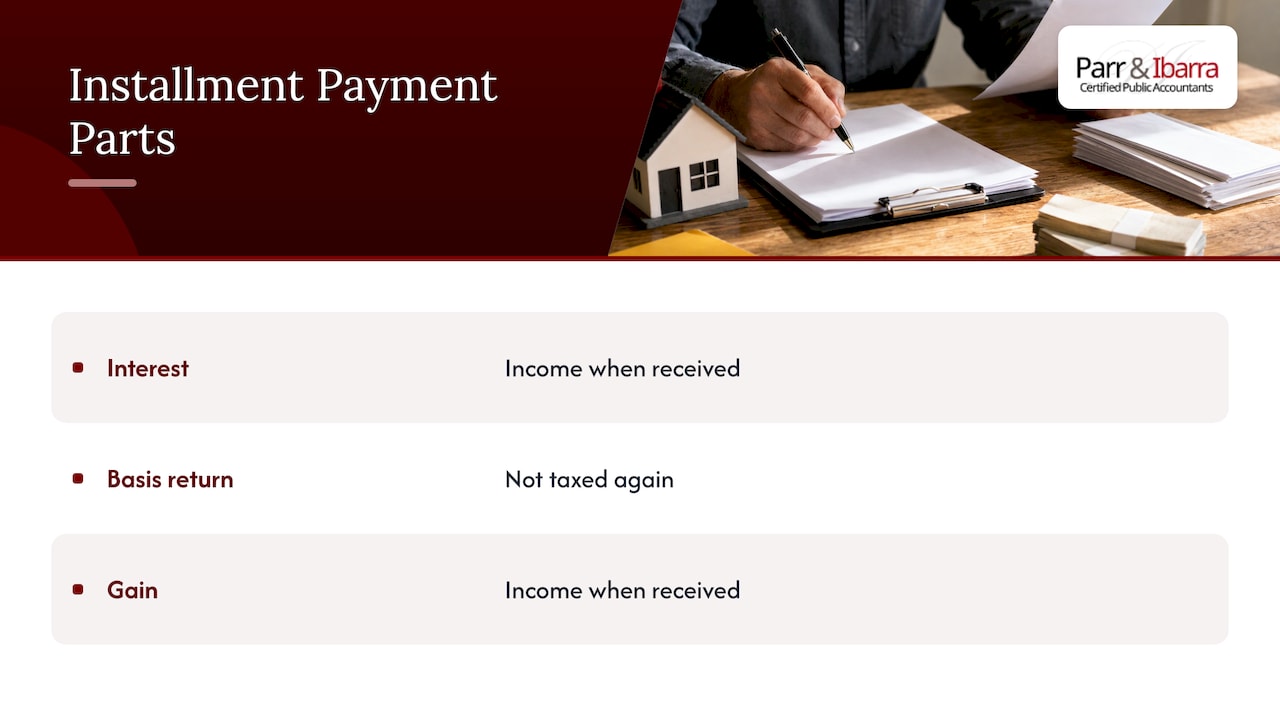
The IRS method works from the payments you receive each year. You generally multiply the payments received that year, less interest, by the gross profit percentage (Publication 537). Each payment is made up of three pieces: interest, return of your adjusted basis, and gain. You include the interest and the gain in income when received. The return of basis is not taxed again.
Step 1: Find your gross profit
Gross profit is generally the selling price minus your adjusted basis, with selling expenses taken into account. Adjusted basis is what you paid, plus improvements, minus depreciation you claimed or were allowed.
Step 2: Find the contract price
Publication 537 defines the contract price, for gross profit percentage purposes, as the selling price minus mortgages, debts, or other liabilities the buyer assumes or takes the property subject to, plus the amount by which those liabilities exceed your adjusted basis (Publication 537). If the buyer pays you entirely in cash and a note, with no assumed debt, the contract price is simply the selling price.
Step 3: Divide to get the gross profit percentage
Gross profit divided by contract price gives the percentage of each principal payment that is taxable gain.
Step 4: Apply it each year
Each year, multiply the principal you collect by that percentage. Add the interest you received as separate ordinary income.
A worked example
Say you sell a rental property for $500,000. Your adjusted basis, after selling costs, is $300,000. The buyer pays $100,000 at closing and signs a note for $400,000, payable in four annual principal payments of $100,000, plus interest. For simplicity, assume there is no existing mortgage and no depreciation recapture.
| Item | Amount |
|---|---|
| Selling price (also the contract price) | $500,000 |
| Adjusted basis | $300,000 |
| Gross profit | $200,000 |
| Gross profit percentage | 40% |
Each $100,000 of principal collected produces $40,000 of taxable gain and $60,000 of tax-free return of basis.
| Tax year | Principal received | Taxable gain (40%) | Interest |
|---|---|---|---|
| Year of sale | $100,000 | $40,000 | Reported as ordinary income |
| Year 2 | $100,000 | $40,000 | Reported as ordinary income |
| Year 3 | $100,000 | $40,000 | Reported as ordinary income |
| Year 4 | $100,000 | $40,000 | Reported as ordinary income |
| Year 5 | $100,000 | $40,000 | Reported as ordinary income |
The total gain is still $200,000. Instead of recognizing it all in the year of sale, you recognize $40,000 a year across five years. Whether that saves tax depends on your other income each year and on the rates that apply, which is where a tax projection helps.
Depreciation recapture and other real-estate wrinkles
Real estate is rarely as clean as the example. If you took depreciation on a rental or commercial building, part of your gain is tied to that depreciation. Publication 537 explains that depreciation recapture income is generally reported in the year of the sale, even if you receive no payment that year (Publication 537). That can create a tax bill larger than the cash you collected at closing. Plan for it before you set the down payment.
Other items worth reviewing with your CPA:
- Mortgages the buyer assumes. They affect the contract price, and when they exceed your basis, part of the excess can be treated as a payment in the year of sale.
- Interest on the note. The note should carry a reasonable stated interest rate. Publication 537 covers how the IRS treats unstated or too-low interest on installment obligations.
- Sales to relatives or related entities. Special rules can apply if the buyer resells soon after. Review them before you sell to family or a related business.
- Passive losses. If you have suspended losses on the property, a sale can change how they are used. Our guide to passive activity loss rules explains the basics.
- Inherited property. If you received the property at death, your basis may have been adjusted. See how a step-up in basis works, since it changes the gain you are spreading.
If the property sits inside a business you are selling, the structure of the deal matters as much as the payment schedule. Our article on the asset sale versus stock sale decision shows how that choice changes the tax result.
What does not qualify for installment treatment
The IRS states that the installment method cannot be used for sales of inventory, dealer sales, including real property held for sale to customers in the ordinary course of a trade or business, or stock and securities traded on an established securities market (Publication 537). The code likewise excludes dealer dispositions (26 U.S.C. § 453).
In practice, that matters most to people who buy, improve, and sell properties regularly. If you hold lots or homes as inventory, the sale is likely a dealer sale, and the installment method will not apply. A single sale of a long-held rental, a vacant parcel, or farmland generally looks different, but the facts decide it. Have a CPA confirm how you are classified before you build a deal around deferral.
Reporting the sale: Form 6252 and your return
The IRS generally requires you to file Form 6252 and to report installment sale income on Schedule D (Form 1040), Form 4797, or both (Publication 537). Which form applies depends on the property. Property held for investment typically flows through Schedule D. Property used in a business, such as a rental building or commercial property, often involves Form 4797.
You file Form 6252 for the year of sale and again in each later year you receive a payment. Keep the closing statement, the signed note, an amortization schedule, and records of your basis and depreciation. When you reach the final payment years, those records are what let you compute the correct figures.
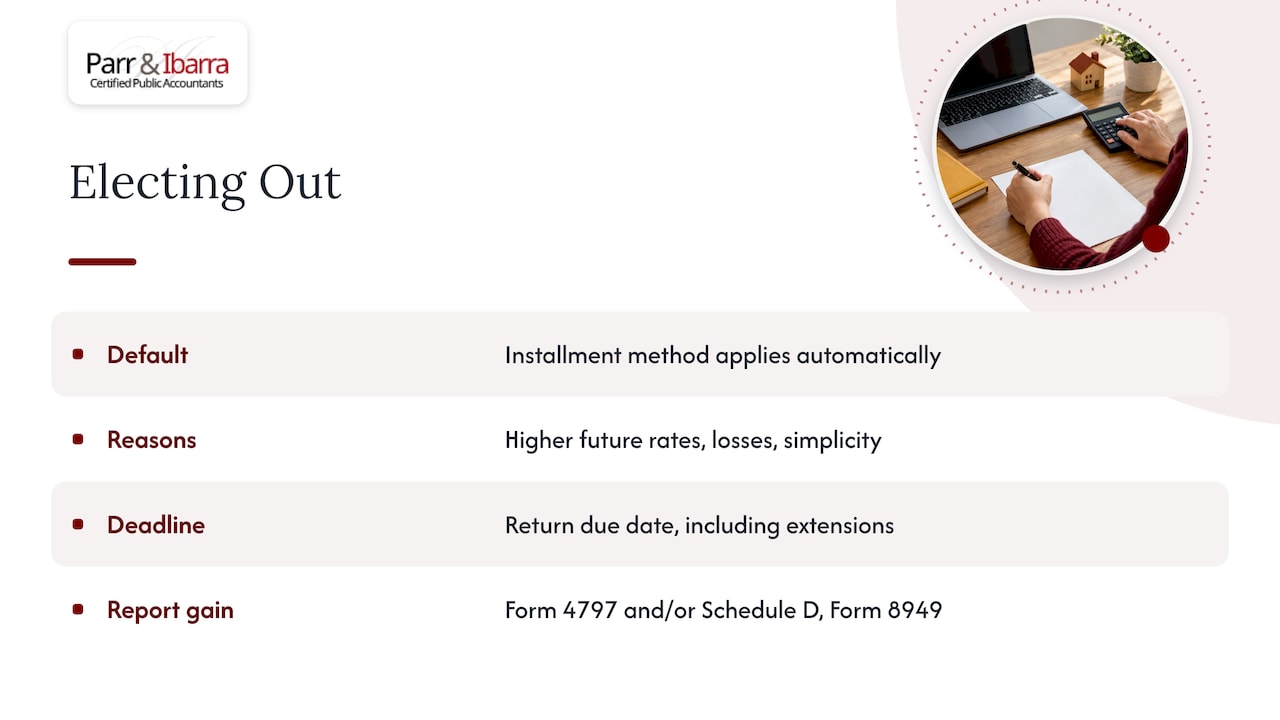
Electing out of the installment method
The installment method is automatic. If your sale qualifies, the IRS says you must report the gain under the installment method unless you elect out (installment sales tax tips for real estate).
Why would anyone elect out? Some sellers expect higher tax rates later. Others have losses or deductions this year that can absorb the gain, or they want the full proceeds taxed now for simplicity.
The timing rule is firm. The election must be made on or before the due date, including extensions, for the return covering the year of sale (IRS Topic 705). The IRS indicates you can elect out by reporting all the gain in the year of sale on Form 4797 and/or Schedule D (Form 1040) and Form 8949. Run the numbers both ways before you file, because this decision is hard to reverse.
Protecting yourself as the seller-lender
A tax deferral is only worth something if the buyer pays. Seller financing shifts the lending risk to you. Practitioner guidance for sellers points to several protections:
- Underwrite the buyer. Check credit, income, and the source of the down payment as a lender would.
- Secure the note. A recorded deed of trust, with attention to lien priority, protects your position (Seller Financing: Advantages From a Seller’s Perspective).
- Ask for a meaningful down payment. A buyer with real money in the deal has more reason to perform.
- Write protective loan terms. The same guidance recommends clauses covering default and making sure taxes and insurance are paid, for example through an impounded escrow.
- Spell out default and cure terms. A legal checklist for sellers stresses default, cure periods, and acceleration. It also notes that unpaid property taxes or an uninsured loss can damage your collateral faster than one missed monthly payment (Seller Financing Real Estate Contract: Key Clauses).
If the buyer defaults and you take the property back, there are tax consequences too. A tax-practice article discusses repossessions after installment sales, including the mandatory Section 1038 treatment for certain seller-financing repossessions (The Tax Adviser). Talk through the repossession scenario with your attorney and CPA before closing, not after a missed payment.
Questions to settle before you sign
- What is my adjusted basis, including depreciation taken?
- How much gain, including recapture, falls in the year of sale?
- What will my income look like in each year of the payment schedule?
- Is the interest rate reasonable, and is the note properly secured?
- Who pays taxes and insurance during the note, and how is it verified?
- Does the sale make sense as an installment sale, or would electing out be better?
If you own property through a business or plan to sell a company, add the exit questions: who is buying, how the deal is structured, and how it fits your estate plan. Our business succession and exit planning work covers that side.
How we help Dallas-Fort Worth sellers
At Parr & Ibarra CPA, we work with real estate investors, business owners, and individuals in Dallas-Fort Worth on the tax side of a property sale. That includes modeling an installment sale against a full-gain sale, projecting each year’s income, and planning the timing with your other tax picture. Our team of more than 20 professionals, including multiple CPAs, also offers services in English and Spanish.
If you are weighing seller financing on a property, our tax planning team can review your numbers before you commit to terms. If your sale is part of a larger transition, our strategic business advisory services, which include cost segregation and business consulting, can help you look at the whole picture.
FAQ
What is the main reason a seller agrees to an installment sale?
Usually it is tax timing. The installment method lets you report gain as you receive payments, so it can be spread over several years rather than landing in one (Publication 537). Many sellers also use it to reach buyers who cannot get a bank loan and to earn interest on the note.
How is capital gain taxed on an installment sale?
You multiply each year’s principal payments by the gross profit percentage and report that gain, plus the interest you received. The gain keeps the character it would have had in a cash sale, so long-term gain stays long-term. Some pieces, such as depreciation recapture, are reported in the year of sale regardless of when you are paid.
Can I use the installment method on every real estate sale?
No. Dealer sales, including property held for sale to customers in the ordinary course of business, and inventory do not qualify (Publication 537). Investors who regularly buy and resell properties should have their classification confirmed before relying on deferral.
How do I choose not to use the installment method?
You elect out by reporting all the gain in the year of sale. The election has to be made by the due date of that year’s return, including extensions (IRS Topic 705). Compare both approaches with your CPA before you file.
What forms do I file for an installment sale?
File Form 6252 for the year of sale and each year you receive a payment. The gain then flows to Schedule D (Form 1040), Form 4797, or both, depending on the property (Publication 537).
Sources
- 26 U.S.C. § 453: Installment method
- IRS Topic No. 705, Installment Sales
- IRS Publication 537, Installment Sales
- IRS: Installment sales, real estate tax tips
- Seller Financing: Advantages From a Seller’s Perspective
- Seller Financing Real Estate Contract: Key Clauses
- Seller beware: Repossessions in real estate installment transactions, The Tax Adviser