A charitable remainder trust (CRT) is taxed in three places. The donor gets a partial income tax deduction when funding it. The trust itself generally pays no federal income tax on what it earns. The person receiving the payouts pays tax on each distribution, in a fixed order set by the Internal Revenue Code. If you understand those three layers, you understand most of the tax picture.
This guide walks through each layer, shows a worked example with real numbers, and covers the planning points we see matter most when clients fund a CRT with appreciated assets.
TL;DR
- A CRT is an irrevocable trust. You (or another beneficiary) receive payments for life or a set term of up to 20 years, and what remains goes to a qualified charity.
- You may claim a partial charitable deduction equal to the present value of the charity’s remainder interest, not the full value of what you contribute.
- The trust is generally exempt from federal income tax, but any unrelated business taxable income triggers a 100% excise tax on that income.
- Payouts are taxed to the beneficiary through a four-tier system: ordinary income first, then capital gains, other income, and finally return of principal.
- Funding a CRT with low-basis appreciated assets is the classic use, because the trust can sell them without current tax at the trust level.
What a charitable remainder trust is
The IRS describes a CRT as an irrevocable split-interest trust. A non-charitable beneficiary receives payments for life or a set term (up to 20 years), and the assets left at the end pass to a qualified charity (IRS: Charitable remainder trusts). “Split interest” simply means two parties hold different pieces of the same asset: one holds the income stream, the other holds the remainder.
Because the trust is irrevocable, you cannot take the assets back once you fund it. That permanence is what makes the tax benefits available.
Annuity trust or unitrust
There are two flavors, and the tax results differ in how the payout is calculated:
| Feature | Charitable remainder annuity trust (CRAT) | Charitable remainder unitrust (CRUT) |
|---|---|---|
| Payout | Fixed dollar amount, set at creation | Fixed percentage of the trust’s value, revalued each year |
| Additional contributions | Not allowed after funding | Generally allowed |
| Effect of investment growth | Payout stays flat | Payout rises and falls with the trust’s value |
| Best suited to | Donors who want predictable income | Donors who want income that can keep pace with growth |
Within the unitrust family, a net income unitrust (NICRUT) or net income with makeup unitrust (NIMCRUT) limits each year’s distribution to the lesser of the trust’s net accounting income or the fixed percentage. That can help in years when the trust holds assets that produce little income, such as raw land (Estate of Schaefer, Tax Court).
The statutory ground rules
The governing statute is Internal Revenue Code section 664. Among its requirements, the annual payout must fall between 5% and 50% of the trust’s value, and the charity’s remainder must be worth at least 10% of the amount contributed (26 U.S.C. § 664). A trust that fails these tests does not qualify, and the tax benefits discussed below do not apply. This is one reason the trust document should be drafted by an estate planning attorney, with your CPA running the numbers first.
Layer one: the donor’s income tax deduction
When you fund a CRT, you do not deduct the full value of the property. You may claim a partial charitable deduction limited to the present value of the charity’s remainder interest. For an annuity trust, that is the value of the donated property minus the present value of the annuity you keep (IRS).
Several things move that number:
- Your age or the term. A longer expected payout period means a larger retained interest and a smaller deduction.
- The payout rate. A higher payout leaves less for charity and shrinks the deduction.
- The IRS Section 7520 rate. This is a monthly interest rate used in the valuation. You may elect the rate for the month of the transfer or either of the two preceding months, using whichever is highest (The Tax Adviser).
The deduction is claimed in the year you create and fund the trust. Like other charitable gifts, it is subject to percentage-of-income limits that depend on the type of property and the type of charity, and any excess can generally be carried forward. Your CPA should model that limit before you sign, because it determines how much of the deduction you can use right away.
Layer two: the trust’s own tax treatment
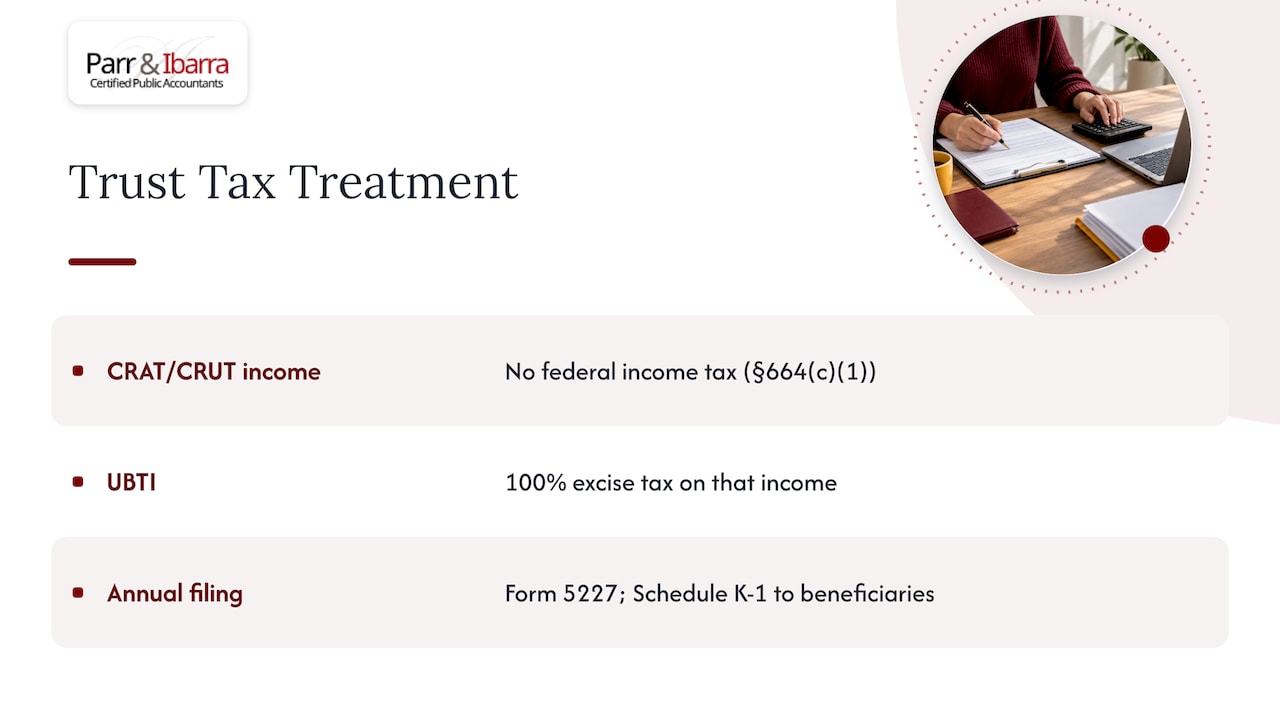
A CRAT or CRUT is not subject to federal income tax for the taxable year under section 664©(1). That is the engine of the strategy: the trust can hold and sell investments without paying income tax inside the trust (26 U.S.C. § 664).
There is one major exception. If the trust has unrelated business taxable income (UBTI), section 664©(2) imposes an excise tax equal to the amount of that income. The Tax Adviser notes that investments producing UBTI should generally be avoided, since the excise tax amounts to a 100% tax on that income (The Tax Adviser). Debt-financed property and certain operating business interests are the usual sources. If you are weighing a business interest or leveraged real estate as the funding asset, have your advisor review UBTI exposure first. Our guide to UBIT for nonprofit CFOs explains how that tax works in the charitable context.
The trust still has filing obligations. It reports on Form 5227 and issues a Schedule K-1 to each noncharitable beneficiary each year (IRS).
Layer three: how payouts are taxed to the beneficiary
Tax-free inside the trust does not mean tax-free forever. Distributions are taxable to the beneficiary and characterized under a four-tier system in section 664(b). The IRS lists the tiers in this order: ordinary income, capital gains, other income (including tax-exempt income), and return of corpus, meaning principal (IRS).
The highest-taxed categories come out first. The statute orders each distribution first as income includible in gross income (excluding capital-asset gains), then capital gain, other income, and corpus, and it measures undistributed capital gain on a cumulative net basis (26 U.S.C. § 664).
What that means in practice:
- Each year, the trust first treats a payout as coming from its ordinary income, such as interest and non-qualified dividends, up to the amount the trust has accumulated in that category.
- Once ordinary income is used up, the payout is treated as capital gain, including gain from selling the contributed assets.
- After that, other income, such as tax-exempt interest, is distributed.
- Only when all of those are exhausted does a payout count as a tax-free return of principal.
The tiers are tracked across the life of the trust, not year by year in isolation. A trust that sells a highly appreciated stock in year one may carry that gain out to the beneficiary over many years as payments are made. That is the deferral: instead of one large gain in the year of sale, the tax is spread across the payout period.
A worked example
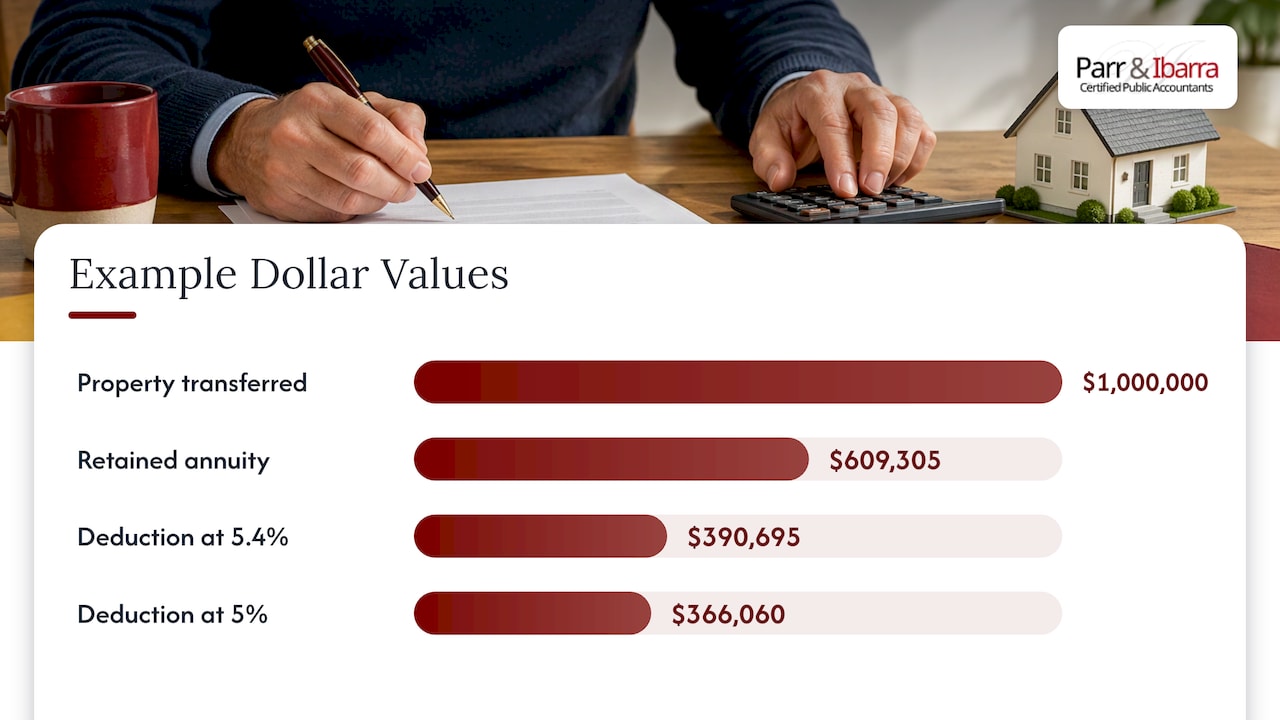
The Tax Adviser walks through a CRAT example that makes the deduction concrete. A 60-year-old donor transfers $1 million to a trust that pays $50,000 a year. Using a 5.4% Section 7520 rate (March 2025) and an annuity factor of 12.1861, the retained annuity is valued at $609,305. The charitable deduction is therefore $390,695. If the 5% rate had applied instead, the deduction would fall to $366,060 (The Tax Adviser).
The arithmetic is simple:
| Step | Amount |
|---|---|
| Property transferred | $1,000,000 |
| Annual payout (5%) | $50,000 |
| Annuity factor | 12.1861 |
| Present value of the donor’s annuity ($50,000 × 12.1861) | $609,305 |
| Charitable deduction ($1,000,000 − $609,305) | $390,695 |
Two lessons from this example:
- The rate matters. A lower Section 7520 rate cut the deduction by about $24,600 on the same facts. This is why the election to use the highest of three months is worth running.
- The deduction is not the whole benefit. The larger value usually comes from avoiding an immediate sale at the donor’s tax rate, plus the income stream and the eventual gift to charity.
The example uses a rate from a specific month. Your numbers will use the rate in effect when you fund the trust, so treat the figures above as an illustration of method, not a forecast.
Funding a CRT with appreciated assets
The most common reason people consider a CRT is a low-basis asset they want to sell: stock, real estate, or a closely held business interest. Appreciated securities can generally be sold inside the CRT without current federal income tax at the trust level, producing deferral. The gain is carried out to beneficiaries through the tier system as distributions are made (The Tax Adviser).
If you sold the same asset yourself, you would owe capital gains tax on the full gain in that year. If you want a refresher on how those rates and holding periods work, see our guide to what capital gains tax is and our overview of capital gains tax treatments for investors. Different assets are taxed differently, and holders of other appreciated holdings, such as precious metals subject to the collectibles tax rate, should confirm with their advisor which assets are suitable for a trust before any transfer.
Planning checklist before you fund
Before you move assets, work through these points with your CPA and attorney:
- Basis and holding period. The trust takes your basis in the asset. The lower your basis, the more deferral there is to gain.
- Payout design. Choose between annuity and unitrust, the payout percentage, and the term. These choices drive both your income and your deduction.
- Deduction limits. Model how much of the deduction you can use in the funding year and how much carries forward.
- UBTI risk. Avoid assets that could generate unrelated business income inside the trust.
- Reporting. Plan for Form 5227 at the trust level and K-1 reporting on your own return each year.
- Your wider picture. A large gift can affect your estate, your other income, and your family’s plans. Large estates also raise filing questions, covered in our note on Form 706 and portability.
If the asset is a business, timing and deal structure matter as much as the trust. Our piece on asset sales versus stock sales explains why the form of a sale changes the tax result, and you should settle that before the trust enters the picture.
Who a CRT tends to suit
A CRT can make sense when several things are true at once:
- You hold an appreciated asset with a low basis that you would otherwise sell and pay tax on.
- You want income for life or a set term, and you do not need access to the principal.
- You are charitably inclined and comfortable that a qualified charity receives what remains.
- You are working with advisors who will keep the trust compliant for its whole life.
Business owners preparing for an exit, real estate investors with highly appreciated property, and individuals with concentrated stock positions are the groups most often asking about it. For each, the CRT is one tool among several, and the right answer depends on your income, estate, and goals. Our tax planning strategies for business owners show where a charitable structure can fit into a wider plan.
Work with a CPA on the numbers
A CRT has moving parts: a valuation, a deduction limit, a tier-tracking system that runs for years, and annual filings. At Parr & Ibarra CPA, we help individuals, business owners, and real estate investors in Dallas-Fort Worth with tax planning and preparation and with estate and elder planning. We model the deduction and the payout tax before you commit, and we coordinate with your estate planning attorney, who drafts the trust. If you are weighing a CRT ahead of a sale, reach out to our team and we will walk through your situation.
FAQ
Is a charitable remainder trust taxable?
The trust itself is generally not subject to federal income tax, but the beneficiary is taxed on payouts. The one exception at the trust level is an excise tax equal to any unrelated business taxable income. Distributions to you are taxed through the four-tier system.
How much can I deduct when I fund a CRT?
You may deduct the present value of the charity’s remainder interest, which is the property’s value minus the present value of the payments you keep. In the Tax Adviser example above, that was $390,695 on a $1 million transfer. Your own figure depends on your age or the term, the payout rate, and the Section 7520 rate.
Do I avoid capital gains tax by selling inside a CRT?
You avoid current tax at the trust level, which defers the gain. The gain is not erased: it flows out to you as part of the payouts under the tier system. The benefit is spreading the tax over the payout period.
How do I report CRT income?
The trustee files Form 5227 for the trust and issues you a Schedule K-1 each year showing how your payouts are characterized. You carry those amounts to your own return. Your CPA should reconcile the K-1 each year against the trust’s tier records.
How long can a CRT last?
Payments can run for the life of the beneficiary or for a set term of up to 20 years. When the term ends, the remaining assets pass to the qualified charity named in the trust.
Sources
- IRS: Charitable remainder trusts
- 26 U.S.C. § 664: Charitable remainder trusts
- The Tax Adviser: Planning with charitable remainder trusts
- Estate of Arthur E. Schaefer, Tax Court