Form 1041 is the income tax return for a decedent’s estate or a trust. The person in charge, called the fiduciary (an executor, administrator or trustee), files it when the estate or trust crosses certain income thresholds. The return reports what the estate or trust earned and spent, and it splits the taxable income between the entity and its beneficiaries. The beneficiaries’ share travels on Schedule K-1. If you are an executor or trustee in Dallas-Fort Worth, a CPA who prepares fiduciary returns can keep the filing, the deadlines and the beneficiary reporting in one coordinated process. Our tax team does this work for local families, business owners and real estate investors.
This guide covers the basics: what the form is, who must file, the due date, how the income distribution deduction works, and what a K-1 means for the person who receives one.
TL;DR
- Form 1041 is the U.S. Income Tax Return for Estates and Trusts, filed by the fiduciary of a domestic estate, trust or bankruptcy estate.
- A domestic estate generally files at $600 or more of gross income. A domestic trust files if it has any taxable income, $600 or more of gross income, or a nonresident alien beneficiary.
- Calendar-year estates and trusts file by April 15 of the following year. Form 7004 gives an automatic 5½-month extension to file, not to pay.
- The income distribution deduction, limited by distributable net income (DNI), moves taxable income from the estate or trust to the beneficiaries.
- A Schedule K-1 tells each beneficiary what to report on their own Form 1040. Keep it with your records. Do not attach it to the return unless box 13, code B shows backup withholding.
What Form 1041 is and why it exists
When someone dies, their estate becomes a separate taxpayer. Trusts are separate taxpayers too. Once assets start producing interest, dividends, rent or capital gains, someone has to report that income. According to the IRS, Form 1041 is used to report an estate’s or trust’s income, deductions, gains and losses, income accumulated or distributed to beneficiaries, income tax liability, and employment taxes on household-employee wages.
The goal of the system is single taxation. A National Society of Tax Professionals guide on fiduciary returns explains that total taxable income is always taxed either to the entity on Form 1041 or to beneficiaries on their Form 1040 or 1040-SR, and distributed income keeps its character. Interest stays interest and capital gain stays capital gain.
A few related terms help:
- Fiduciary: the person legally responsible for the estate or trust. For an estate that is the executor or administrator. For a trust it is the trustee.
- Simple trust: a trust that must distribute all of its accounting income currently, makes no charitable contributions and distributes no principal, as the NSTP guide describes it. Any trust that does not meet that test is treated as a complex trust. All trusts are treated as complex in their final year, when remaining principal must be distributed.
- Decedent’s final Form 1040: the person’s own last personal return. It is separate from the estate’s Form 1041. The IRS says the estate administrator files the final personal return on its own.
The form has three pages of core information, and schedules attach as needed. The IRS lists Schedule D for capital gains and losses, Schedule I for the alternative minimum tax for estates, Schedule J for accumulation distributions of certain complex trusts, and Schedule K-1 for each beneficiary’s share. Schedule B, which computes the income distribution deduction, is the one that matters most in practice.
Who must file Form 1041
The thresholds below come from the 2025 Form 1041 instructions and apply to domestic entities.
| Entity | Must file if |
|---|---|
| Domestic estate | Gross income of $600 or more for the year, a nonresident alien beneficiary, or a qualified investment in a qualified opportunity fund (Form 8997 attached) |
| Domestic trust | Any taxable income, gross income of $600 or more, a nonresident alien beneficiary, or a qualified opportunity fund investment |
| Bankruptcy estate | Gross income of $15,750 or more for 2025 |
| Foreign estate or trust | Files Form 1040-NR instead |
Gross income means total income before deductions. A trust can owe a return at low income levels. A trust with taxable income of even a dollar must file, and one with $600 of gross income must file even if deductions wipe out the taxable income. Federal regulation 26 CFR 1.6012-3 sets the same $600 gross income and nonresident alien rules for fiduciary returns.
Two practical notes:
- Estates need their own tax ID. The IRS says an estate needs its own EIN (employer identification number, formatted 12-345678X), which can be applied for online, by fax or by mail. Use it on Form 1041 instead of the decedent’s Social Security number.
- Look at what the assets earn. Income-producing estate assets include CDs, bonds, mutual funds, rental property, savings accounts and stocks. A Texas estate that holds a rental house or a brokerage account can pass $600 quickly, even if the estate is small.
Texas has no state income tax, so the federal return is the main income tax filing for most DFW estates and trusts. Whether a Texas estate needs probate at all is a separate question, covered in our guide to Texas intestacy and the small estate affidavit.
Form 1041 due date
The due date depends on the estate’s or trust’s tax year. Under the 2025 instructions:
- Calendar-year trusts and estates file Form 1041 and the K-1s by April 15 after year-end. For tax year 2025 that was April 15, 2026. A 2026 calendar-year return follows the same pattern, so it is due in April 2027, moving to the next business day if the 15th falls on a weekend or holiday.
- Fiscal-year estates and trusts file by the 15th day of the fourth month after year-end. A June 30 year-end, for example, makes the return due October 15.
- Extensions: Form 7004 gives an automatic 5½-month extension to file. It does not extend the time to pay, so any tax owed still needs to be paid by the original date.
Estates have an option that trusts mostly lack: the executor can choose a fiscal year ending on the last day of any month within the first twelve months after death. That choice shapes every deadline afterward, so it deserves a decision at the start of administration, not at filing time. Check the IRS Form 1041 instructions page for the current year’s forms and dates.
Estates and trusts may also owe quarterly estimated tax. The IRS notes that an estate with income over the threshold may need to make quarterly payments, and Form 1041-ES is the voucher for that.
What the return reports, and the rates
An estate or trust figures its gross income much like an individual does. Most individual deductions and credits are allowed, plus one unique deduction: the income distribution deduction, figured on Schedule B. The return also covers the 3.8% Net Investment Income Tax where it applies.
The rate brackets for estates and trusts are compressed, which is the main reason the distribution decision matters. For tax years beginning after 2025, the IRS Form 1041-ES states:
- The highest bracket applies to income over $16,000, and the 2026 top rate is 37%.
- The 20% long-term capital gains and qualified dividend rate applies above $16,250. The 0% rate applies up to $3,300 and 15% falls in between.
- The 3.8% NIIT applies to the lesser of undistributed net investment income or adjusted gross income over $16,000. It does not apply to trusts devoted entirely to charitable purposes.
Compare that with an individual filer, who needs far more income to reach the top bracket. A trust that keeps its income can reach the 37% rate at $16,000, which is why many fiduciaries look at whether distributing income to beneficiaries produces a lower combined tax. Those thresholds are set by the IRS each year, so confirm the figures for the year you are filing.
The income distribution deduction and DNI
This is the concept that confuses most first-time fiduciaries, and it is simpler than it sounds.
When an estate or trust pays, credits or is required to distribute income to a beneficiary, it gets a deduction for it, and the beneficiary reports that income instead. The deduction is limited to distributable net income (DNI), figured on Schedule B. The 2025 instructions also say DNI determines how much of a distribution is included in the beneficiaries’ gross income.
The draft 2026 form lays out the mechanics. DNI is built from lines 1 through 6 of Schedule B, and the deduction on line 15 is the smaller of two numbers: the tentative deduction based on total distributions, or DNI less tax-exempt income. That amount lands on page 1, line 18, with the K-1s attached.
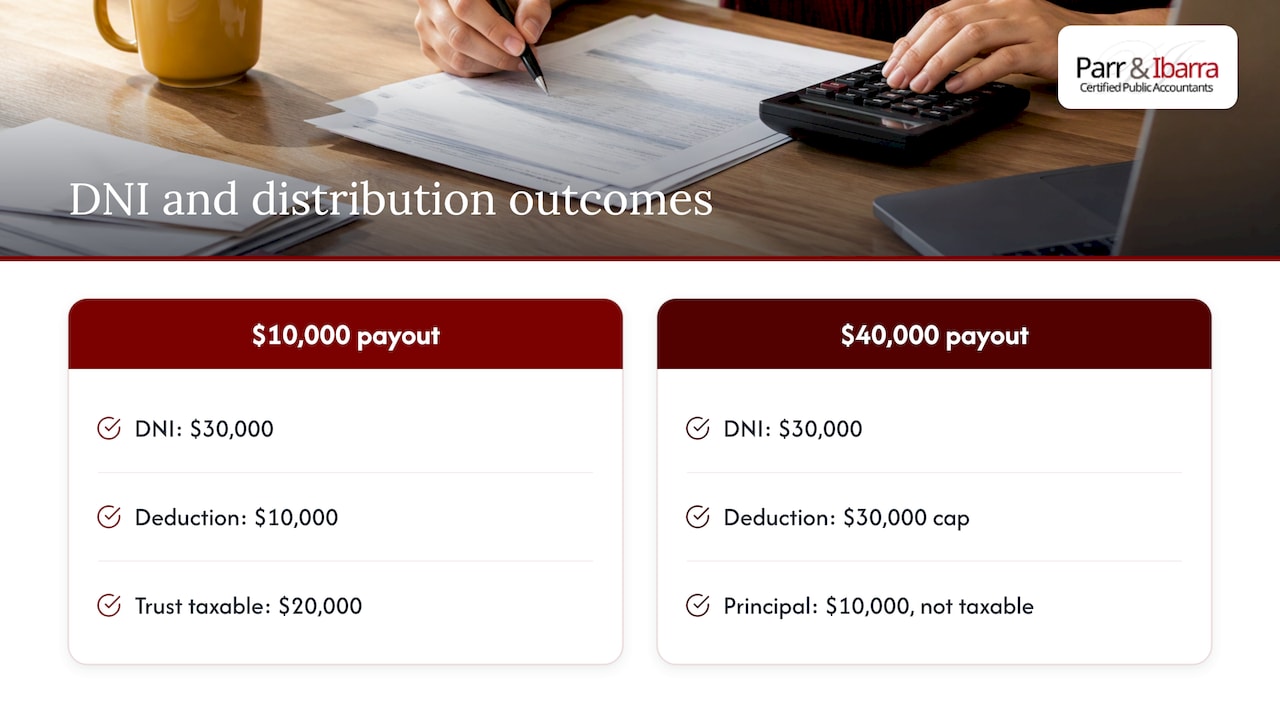
A simplified example (illustrative numbers, not tax advice): A complex trust earns $30,000 of taxable interest and has no expenses, so DNI is $30,000. The trustee distributes $10,000 to a beneficiary. The trust takes a $10,000 income distribution deduction and reports $20,000 as taxable income to the trust, less any exemption. The beneficiary receives a K-1 showing $10,000 of interest and reports it on their own Form 1040. If the trustee distributed $40,000 instead, the deduction would be capped at DNI, $30,000, and the extra $10,000 would be a distribution of principal that is not taxable income to the beneficiary.
Because the entity’s deduction and the beneficiary’s income are two sides of one number, an error on Schedule B shows up on several returns at once. The NSTP guide stresses that the entity-level deduction determines how much income is taxed to beneficiaries, so total taxable income equals what the beneficiaries report plus what the entity reports.
Some connected topics change what goes into the return. Assets that pass through an estate may receive a step-up in basis, which affects the gain reported on Schedule D when the estate sells. Gains also come in different types, covered in our guide to capital gains treatments. A charitable remainder trust has its own rules, explained in our piece on charitable remainder trust taxes.
What is a K-1 and what do you do with it
Schedule K-1 (Form 1041) is the beneficiary’s statement of their share of the estate’s or trust’s income, deductions and credits. The fiduciary prepares one for each beneficiary who received or was entitled to a distribution, files copies with the Form 1041 and gives each beneficiary their own.
If you are the beneficiary, the IRS instructions for Schedule K-1 say:
- Use it to report your share on Form 1040 or 1040-SR.
- Keep it for your records. Do not file it with your return unless box 13, code B, reports backup withholding.
- Box 1 interest goes to Form 1040 line 2b, box 2a ordinary dividends to line 3b, and box 2b qualified dividends to line 3a.
Beneficiaries often receive the K-1 late, sometimes after they have already filed. A K-1 follows the entity’s filing date, not the beneficiary’s, so a calendar-year K-1 is typically due to arrive by April 15. If you expect one, ask the fiduciary early, and file an extension rather than guess at the numbers.
A K-1 from a Form 1041 is different from the K-1 issued by a partnership or S corporation. It comes from an estate or trust and follows the DNI rules above. Do not mix up the two when you enter numbers.
If the estate includes retirement accounts, the beneficiary’s timing rules are a separate track. This overview of IRA beneficiary rules covers the 10-year rule, which governs when inherited retirement money has to come out.
Where first-time filers go wrong
The same few problems come up on fiduciary returns:
- Missing the EIN. Using the decedent’s SSN on estate income creates mismatches at the IRS. Get the EIN before the first interest payment is reissued.
- Forgetting the final Form 1040. The decedent’s last personal return and the estate’s Form 1041 are two different filings.
- Treating DNI as bank-statement income. DNI is a tax computation, not the same as fiduciary accounting income. Expenses, capital gains and tax-exempt income all move it.
- Late or missing K-1s. Beneficiaries cannot complete their own returns without them, and the IRS instructions require the fiduciary to provide them.
- Ignoring estimated tax. The compressed brackets mean undistributed income can produce a meaningful bill. Quarterly payments are worth planning for.
- Skipping the larger estate picture. Form 1041 is an income tax return. Whether a federal estate tax filing is needed is a different question, covered in our guide to Form 706 and portability, and the difference between estate and inheritance taxes is explained in Estate Tax vs. Inheritance Tax.
Getting the return done right
A fiduciary return pulls together the decedent’s final return, the estate’s EIN and tax year, the distribution schedule, estimated payments and the K-1s that feed every beneficiary’s own return. Parr & Ibarra CPA is a Dallas-Fort Worth firm with a team of more than 20 professionals, including multiple CPAs, and our tax services cover personal and corporate returns, tax planning, and estate and elder planning. We also offer services in English and Spanish, which helps when a family’s beneficiaries and executors are working across both languages. If you are an executor or trustee, start with our tax services page and we will take it from there.
FAQ
Who must file Form 1041?
The fiduciary of a domestic estate with $600 or more of gross income must file. So must the fiduciary of a domestic trust with any taxable income or $600 or more of gross income. Either must also file if there is a nonresident alien beneficiary. Bankruptcy estates file at $15,750 or more of gross income for 2025.
When is Form 1041 due?
Calendar-year estates and trusts file by April 15 after year-end, so a 2026 return is due in April 2027, moving to the next business day if the date falls on a weekend or holiday. Fiscal-year filers are due on the 15th day of the fourth month after year-end. Form 7004 extends the filing date by 5½ months but not the payment date.
What is a K-1?
A Schedule K-1 (Form 1041) shows a beneficiary’s share of the estate’s or trust’s income, deductions and credits. The beneficiary uses it to complete Form 1040 or 1040-SR and keeps it for their records. It is attached to the return only if box 13, code B shows backup withholding.
What is the income distribution deduction?
It is the deduction an estate or trust takes for income paid, credited or required to be distributed to beneficiaries. It is limited to distributable net income, figured on Schedule B. The same amount becomes taxable income to the beneficiaries through their K-1s.
Sources
- About Form 1041, U.S. Income Tax Return for Estates and Trusts (IRS)
- 2025 Instructions for Form 1041 and Schedules (IRS)
- 26 CFR 1.6012-3, Returns by fiduciaries (eCFR)
- File an estate tax income tax return (IRS)
- 2026 Form 1041-ES (IRS)
- 2026 Form 1041 draft (IRS)
- Instructions for Schedule K-1 (Form 1041) for a Beneficiary (IRS)
- Filing the Fiduciary Form 1041, National Society of Tax Professionals (January 2026)
- IRA beneficiary rules and the 10-year rule