Yes, fringe benefits are taxable by default. Under federal tax law, anything an employer provides in exchange for work counts as pay unless a specific Code section excludes it. The benefits that escape tax are the ones on the IRS’s exclusion list, and only when they meet that rule’s conditions. Everything else is wages, valued at fair market value, withheld on and reported on the employee’s Form W-2.
That default is where owners get into trouble. A company car, a gym membership, a gift card or a spouse’s travel can each be tax-free, partly taxable or fully taxable depending on how it is provided and documented. Getting it wrong means payroll tax errors on your side and an unexpected W-2 surprise on the employee’s.
TL;DR
- A fringe benefit is taxable income to the employee unless a specific rule excludes it, per Publication 15-B (2026).
- The taxable amount is the benefit’s fair market value, minus what the employee paid and any amount the law excludes.
- Excludable categories include de minimis benefits, working condition benefits, group-term life insurance up to $50,000, educational assistance up to $5,250 a year and transit or parking up to $340 a month.
- Taxable benefits are wages: withhold income, Social Security and Medicare tax, and report them on the W-2.
- Reimbursements are tax-free only under an accountable plan with timely substantiation.
The rule: taxable unless excluded
The starting point is Internal Revenue Code section 61, which treats compensation for services as gross income. The regulations at 26 CFR § 1.61-21 apply that to fringe benefits: a benefit given as compensation is included in the employee’s income unless another Code section excludes it. It does not matter that the benefit went to someone else. A perk given to an employee’s spouse is still taxable to the employee who performed the services.
The IRS’s employer guide, Publication 15-B, puts the same idea in practical terms. Any fringe benefit you provide is taxable and must be included in the recipient’s pay, except to the extent the law specifically excludes it. The exclusions are spread across 19 categories in the 2026 edition, from accident and health benefits to adoption assistance and meals.
That is why “is it taxable?” never has a one-word answer. You ask two questions: does an exclusion exist for this benefit, and did we meet its conditions?
How the taxable value is calculated
When a benefit is taxable, the amount that goes on the paycheck is its fair market value. The IRS describes that in Publication 5137 as what a willing buyer would pay an unrelated willing seller. The taxable amount is then reduced by anything the employee paid for the benefit.
A simple example from that guidance: a benefit worth $300 on the open market, for which the employee paid $100, creates $200 of taxable wages.
Two points catch owners out:
- Your cost is not the measure. The University of Alabama’s tax office, summarizing the regulation, notes that neither the employee’s own view of the benefit nor the employer’s cost sets the value; fair market value is what the employee would pay a third party at arm’s length. A discounted block of tickets you bought still gets valued at what the employee would have paid.
- Partial exclusions are common. Group-term life insurance is a good case. Coverage up to $50,000 is excluded, and the cost of coverage above that is taxable, per Publication 15-B.
What is tax-free: the main exclusions
Section 132 of the Internal Revenue Code is the core of the exclusion list. Under 26 U.S.C. § 132, gross income does not include a no-additional-cost service, a qualified employee discount, a working condition fringe, a de minimis fringe, a qualified transportation fringe, qualified moving expense reimbursement (for the narrow group the statute covers), or qualified retirement planning services. Other sections cover separate categories.
Here is how the most-used exclusions look in practice, based on Publication 15-B (2026):
| Benefit | Tax-free limit or condition |
|---|---|
| Accident and health coverage | Employer-paid coverage generally excluded from wages |
| Group-term life insurance | Up to $50,000 of coverage |
| Educational assistance | Up to $5,250 per year |
| Dependent care assistance | Up to $7,500 ($3,750 if married filing separately) |
| Transit or parking | Up to $340 per month |
| Achievement awards, adoption assistance, meals, employee discounts | Excluded when the specific rule is met |
| De minimis and working condition benefits | Excluded when they meet the definitions below |
The dollar limits are adjusted by the IRS from year to year, so confirm them against the current edition of Publication 15-B before you set policy for a new year.
De minimis fringe benefits
A de minimis benefit is one so small that tracking it would be unreasonable. The IRS definition turns on value and frequency: the property or service must be worth so little, considering how often you provide it, that accounting for it is impractical. It should be occasional or unusual and must not be disguised pay.
Three rules matter most:
- Cash is never de minimis. Cash and cash equivalents cannot be excluded this way, no matter how small. A gift card that works like cash is treated as cash.
- No partial credit. If a benefit is too large to qualify, its entire value is taxable, not just the excess. The IRS has ruled that items above $100 could not qualify even in unusual circumstances.
- Frequency counts. Something harmless once a year can fail when it becomes a regular benefit.
Examples listed in Publication 15-B include low-value holiday or birthday gifts, occasional parties or picnics, occasional theater or sporting event tickets, personal use of an employer-provided cell phone provided primarily for business reasons, and group-term life insurance for a spouse or dependent with a face amount of $2,000 or less.
There is no safe dollar figure for “small.” The test is reasonableness, so write down your policy and stick to it.
Working condition fringe benefits
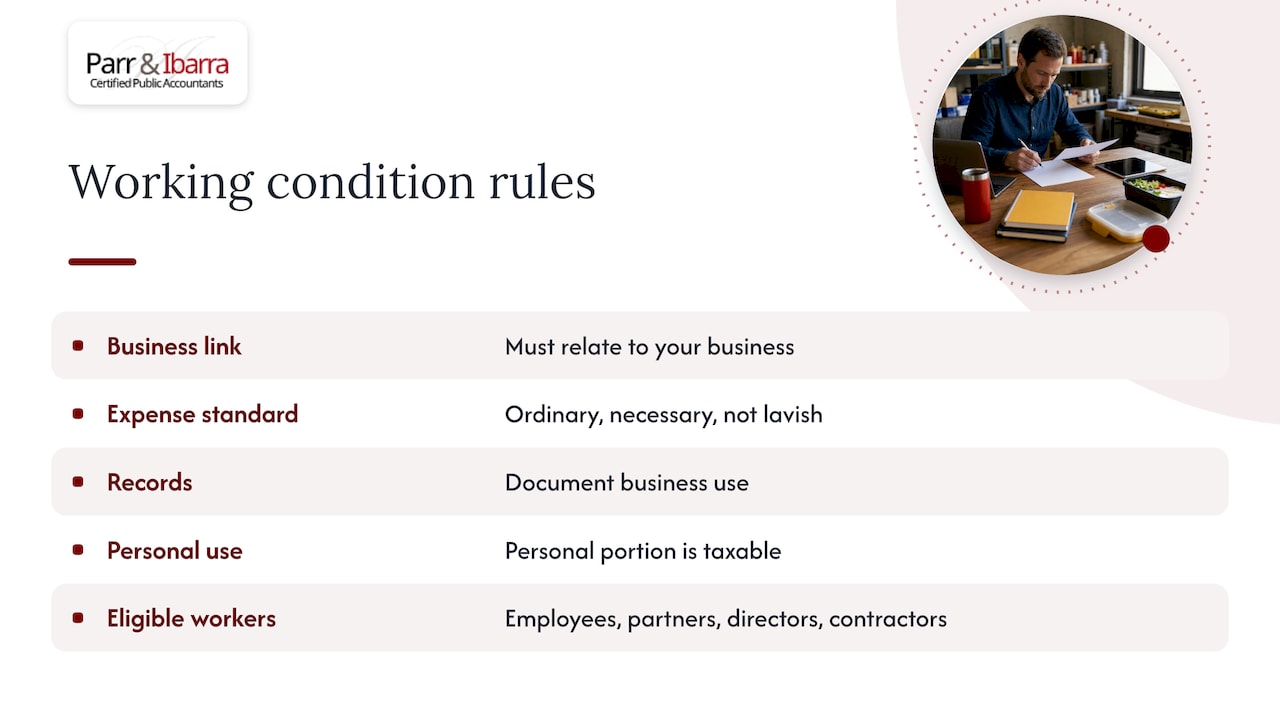
A working condition fringe is something the employee would have been able to deduct as a business expense had they paid for it personally. The Tax Adviser explains that the benefit must relate to your business, be an ordinary and necessary expense rather than a lavish one, and be backed by records showing the business use. The exclusion applies to employees, partners, directors and independent contractors who perform services for you.
The same article points out that the 2018 to 2025 suspension of miscellaneous itemized deductions did not end this exclusion. Employer-paid or reimbursed expenses that meet the business-expense standard remain excludable, which is why records are what hold the exclusion up.
Typical examples are business travel, professional licenses and dues, work tools and job-related training. A personal-use component changes the result. If the employee uses a work vehicle partly for personal trips, the personal portion is a taxable fringe benefit. Mileage and use logs are what separate the two; our guide to business mileage logs covers what a defensible record looks like.
Reimbursements: accountable versus non-accountable plans
Reimbursements are the most frequent source of accidental wages. Publication 5137 explains that payments under an accountable plan are excluded from income and not reported on the W-2. A plan is accountable when:
- the expense has a business connection;
- the employee substantiates it within a reasonable time, which is 60 days under the fixed-date method in IRS Publication 463;
- any excess advance is returned within 120 days.
Miss those conditions and the payment becomes wages subject to withholding. The same applies to flat allowances that are not tied to substantiated expenses. If a per diem or mileage allowance exceeds the substantiated amount, the excess is wages, and the substantiated portion is reported in box 12 of the W-2 with code L.
The 60-day window is stricter in practice than many policies assume. Ohio University’s finance office notes that reimbursements substantiated after 60 days are reported as taxable income with taxes withheld. A written accountable plan with a clear submission deadline is the simplest protection.
Payroll tax and W-2 reporting
A taxable fringe benefit is treated like any other pay. Per Publication 5137, it is generally subject to federal income tax withholding, Social Security tax and Medicare tax, and it is reported as wages on the W-2 for the year the employee received it. You may elect to treat noncash benefits as paid per pay period, or quarterly, semiannually or annually, but no less often than annually. Choosing a regular schedule keeps withholding from landing in one lump in December.
It helps to keep this separate from investment income, which follows different rules; for a sense of how those differ, see this explainer on Treasury ETF taxes. Wages from fringe benefits are taxed the same as salary.
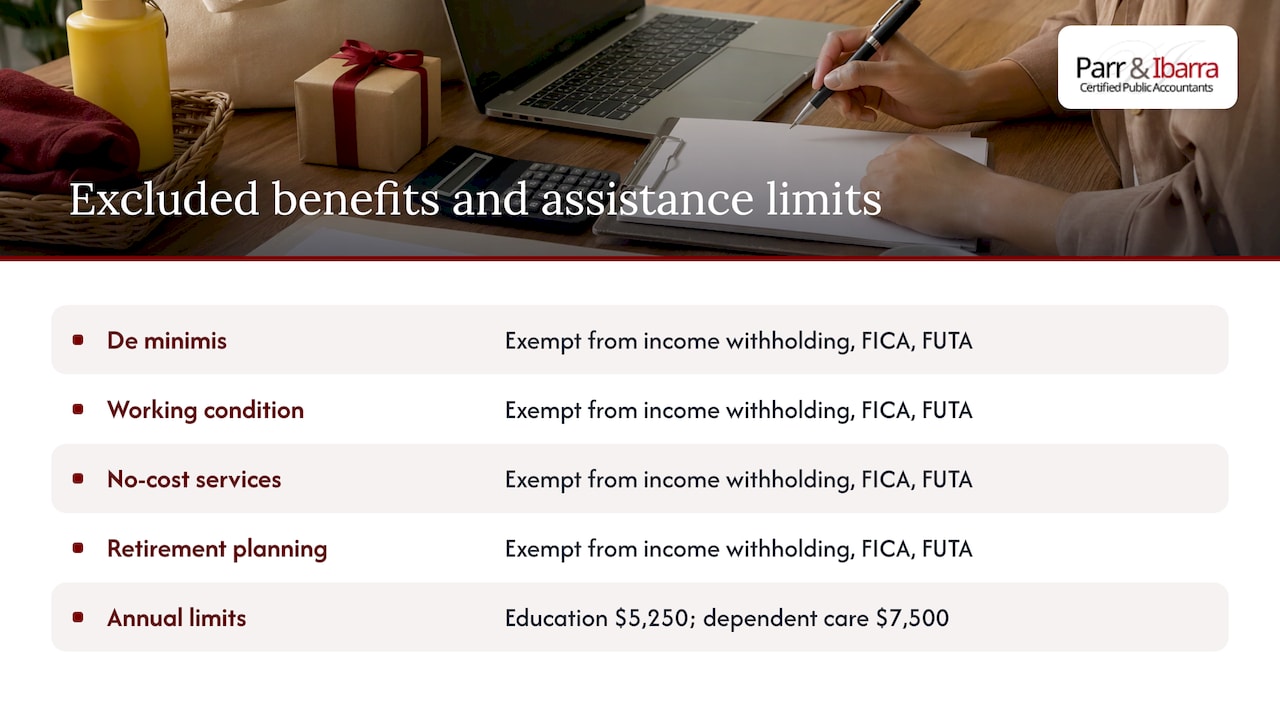
Excluded benefits are the opposite. Table 2-1 of Publication 15-B shows that de minimis benefits, working condition benefits, no-additional-cost services and qualified retirement planning services are exempt from income tax withholding, Social Security and Medicare tax and federal unemployment tax. Educational assistance is exempt up to $5,250 a year, and dependent care assistance up to $7,500.
For how withholding and deposits fit into your wider payroll obligations, see our overview of payroll tax obligations for small business owners. If your team spans states, multi-state payroll tax rules add another layer.
A worked example
Say a Dallas contractor with 12 employees does the following in one year:
- gives each employee a $40 holiday gift basket, and a $50 cash bonus on top;
- pays $6,000 toward one employee’s graduate coursework;
- lets a project manager use a company truck for work and weekend trips;
- reimburses travel receipts that staff submit three months late.
Here is how each lands:
- Gift basket: low-value and occasional, likely de minimis and not taxable.
- Cash bonus: cash is never de minimis, so $50 is wages, no matter how small.
- Coursework: $5,250 can be excluded, and the remaining $750 is generally taxable, subject to the educational assistance conditions in Publication 15-B.
- Company truck: the business miles are a working condition benefit if logged; the weekend use is a taxable fringe benefit at fair market value.
- Late receipts: beyond the 60-day reasonable period, the reimbursements are wages.
None of these are exotic. Most small businesses have at least two of them in a given year.
Where owners and their families run into trouble
Owner-employees sit in a gray area. The same rules decide whether a benefit the business provides to an owner is excluded or counts as compensation, and how it is reported depends on your entity type. Meals, vehicles, health coverage and travel for an owner need to be handled with the entity structure in mind. Our guide to tax-efficient owner compensation explains how those choices fit together, and our post on employer meals in 2026 covers the deduction side of meals, which is separate from whether the employee is taxed.
There are two sides to every fringe benefit: whether the employee has income, and whether the business gets a deduction. A benefit can be tax-free to the employee and still limited as a deduction, or the reverse.
A practical policy checklist
- List every perk you provide, including informal ones like gift cards, tickets, phone use and vehicle use.
- Match each to an exclusion in Publication 15-B and note its conditions and any dollar cap.
- Put your accountable plan in writing, with a 60-day submission rule.
- Keep use logs and receipts for working condition benefits.
- Value taxable benefits at fair market value, subtract what the employee paid, and add them to wages on a set schedule.
- Review the list each January against the current IRS limits.
How we help
Parr & Ibarra CPA is a Dallas-Fort Worth firm with a team of more than 20 professionals, including multiple CPAs. We offer payroll services and tax planning for local business owners, nonprofits and individuals, and we serve clients in English and Spanish. If you are unsure whether a benefit is being treated correctly on your payroll, that is the review we are set up to do, and you can start at aibarra.cpa.
FAQ
What are de minimis fringe benefits?
They are items of such low value, considering how often they are given, that accounting for them is impractical. Examples include occasional parties, low-value holiday gifts and occasional event tickets. Cash and cash equivalents never qualify, and if an item is too large, the whole value is taxable.
What are working condition fringe benefits?
They are employer-provided property or services that the employee could have deducted as a business expense if they had paid personally. They must be ordinary, necessary and supported by records of business use. When they qualify, they are not wages.
Are reimbursements taxable?
Not under an accountable plan. The expense must have a business connection, be substantiated within a reasonable time (60 days under the fixed-date method) and any excess advance returned within 120 days. Payments that miss those conditions are taxable wages.
Where are taxable fringe benefits reported?
On the employee’s Form W-2 as wages for the year the benefit was received. They are generally subject to income tax withholding, Social Security and Medicare tax.
Is there one tax rate for fringe benefits?
No. A taxable fringe benefit is added to wages and taxed at the employee’s own rates. For the flat supplemental withholding rate that applies in a given year, check the current IRS guidance, since the rate has been set by law for specific tax years.
Sources
- 26 CFR § 1.61-21, Taxation of fringe benefits
- IRS Publication 15-B (2026), Employer’s Tax Guide to Fringe Benefits
- IRS Publication 5137, Fringe Benefit Guide
- 26 U.S.C. § 132, Certain fringe benefits
- IRS: De minimis fringe benefits
- The Tax Adviser: Taxation of employees’ use of corporate apartments
- University of Alabama Tax Office: Fringe Benefit Taxation
- Ohio University Finance: 60 Day Rule for Expense Reimbursement