
Texas Estates Code Chapter 201 controls who inherits when someone dies without a will, and the order runs through the surviving spouse, children, parents, and siblings depending on the family structure and property type. Before filing anything with a court, heirs should locate beneficiary designations and account titles, since those assets often pass outside probate entirely, and check whether the estate qualifies for a Small Estate Affidavit.
TL;DR:
- Heirs must understand the distinction between community and separate property, as inheritance shares and asset splits vary significantly based on property type.
- Accurate identification of heirs relies on proper documentation such as birth, adoption, and marriage records, with incomplete or incorrect info causing delays or disputes.
- The estate’s value must be carefully calculated, especially homestead and exempt properties, to determine eligibility for Small Estate Affidavits, which are limited to estates under $75,000.
- Most assets with designated beneficiaries or joint ownership bypass probate entirely, reducing costs and timeline, but probate is necessary for assets solely titled in the decedent’s name.
- Early organization and proper legal counsel can prevent common mistakes, like miscounting assets or missing creditor claims, that often prolong or complicate intestate succession procedures.
Who inherits under Texas intestacy laws: order of succession and property types that matter
Texas splits intestate inheritance by property type, and getting this distinction right determines who actually receives what. Texas Estates Code Chapter 201 sets the order: spouse, then children or descendants, then parents, then siblings, and further kindred if none of those survive.
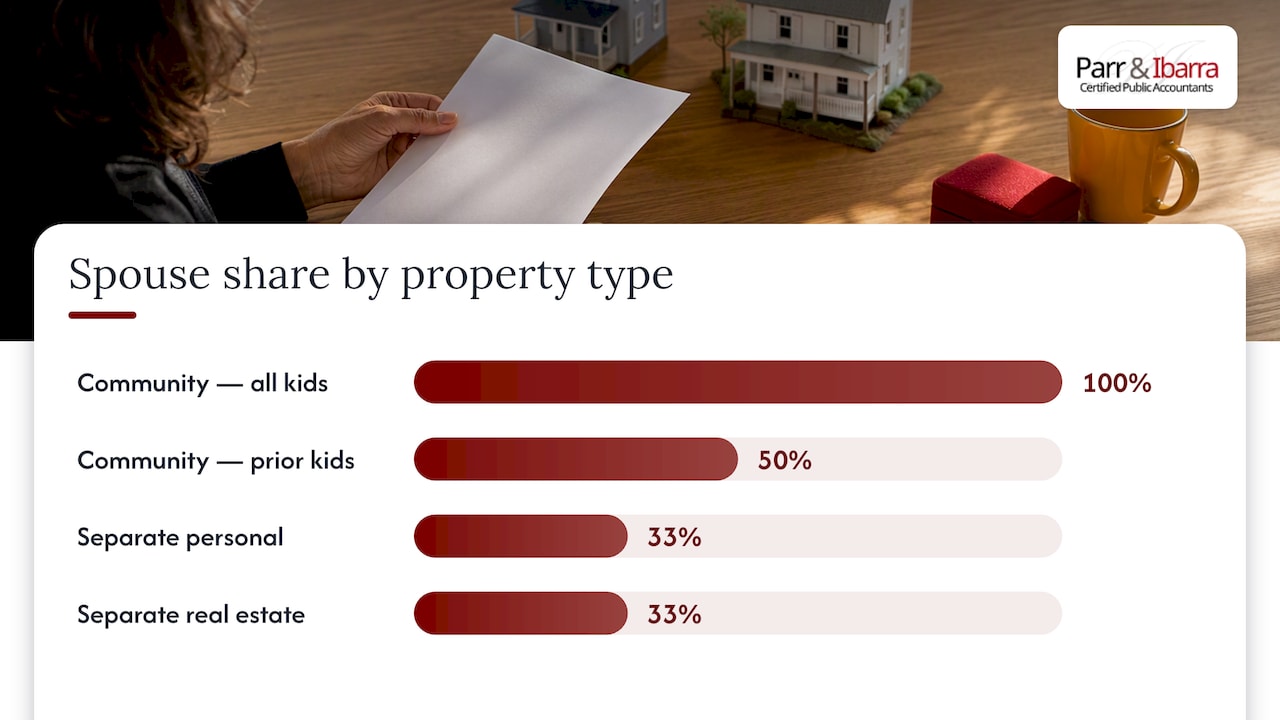
Children and grandchildren inherit per capita with representation, meaning a deceased child’s share splits evenly among that child’s own children rather than passing up to siblings. Community property, the assets built during a marriage, generally goes entirely to the surviving spouse if all the couple’s children are also that spouse’s children. When one spouse has children from a prior relationship, the community property split changes: the surviving spouse keeps their half, and the deceased spouse’s half goes to their children.
Separate property follows a different formula. A surviving spouse typically receives one-third of separate personal property, with children taking the remaining two-thirds, while separate real estate gives the spouse a life estate in one-third with the rest going to children outright.
- Statutory survival requires an heir to outlive the decedent by 120 hours, or that heir is treated as having predeceased.
- Adopted children inherit the same as biological children under Texas law, and stepchildren generally do not inherit unless legally adopted.
- Half-blood siblings inherit half the share a full-blood sibling would receive when no closer heirs exist.
Getting these categories wrong is one of the most common reasons intestate succession disputes drag on.
How intestate probate works in Texas: filings, administrator appointment, and administration types
Not every asset needs to go through probate. Life insurance, retirement accounts with named beneficiaries, and payable-on-death bank accounts transfer outside the court process entirely because they pass by contract or title. Probate becomes necessary when the estate holds assets like real property, vehicles, or bank accounts titled solely in the decedent’s name with no listed beneficiary.
- File an application for administration or a determination of heirship with the county clerk or the local statutory probate court.
- The court appoints an administrator, who may be a spouse, adult child, or another qualified party.
- The administrator sends notice to creditors, prepares an inventory and appraisement, pays valid debts, and distributes what remains.
The court decides between independent and dependent administration, and this choice shapes both cost and timeline. Independent administration, which reduces court oversight when heirs consent, lets the administrator handle sales and disbursements without returning to court for approval each time. Dependent administration requires court sign-off for most transactions, which raises legal fees and stretches out the process considerably.
Texas courts commonly see filings for inventories, applications for sale, partition and distribution, and notice to creditors as standard steps in an intestate case. Recognizing this checklist early helps heirs anticipate what paperwork is coming rather than reacting to each filing as a surprise.
Small Estate Affidavit: strict eligibility rules and how it avoids full probate
A Small Estate Affidavit lets qualifying heirs skip formal administration entirely, but the requirements are narrow. The estate’s value, excluding homestead and exempt property, must total $75,000 or less, and the decedent must have left no will.
- The affidavit can only be filed at least 30 days after the date of death.
- All heirs, or an authorized signatory acting for a minor or incapacitated heir, must sign.
- Two disinterested witnesses must also sign, and the affidavit must include a sworn statement that the estate’s debts do not exceed its assets.
Real property transfers through an SEA only in narrow circumstances, generally limited to a homestead passing to a surviving spouse or minor children who lived there with the decedent. Miscounting homestead or exempt personal property when calculating the $75,000 threshold is a common mistake that gets affidavits rejected outright, and signers can face liability if the sworn statement turns out to be false.
Pro Tip: Pull a recent appraisal district value and account statements before filing an SEA, so the $75,000 calculation holds up if a court or title company questions it.
Common complications and red flags that can delay or change outcomes
Blended families create the most frequent disputes, since the community and separate property split changes depending on whose children are involved. Missing heirs or disputed parentage often force a formal heirship hearing, which adds months to the timeline.
- Creditor claims must be resolved before distribution, and homestead or exempt personal property generally sits outside the reach of most unsecured creditors.
- Title companies often refuse to insure property transfers until a court’s determination of heirship is entered, since that ruling is treated as final proof of ownership.
- Disputes over lineage, adoption, or a decedent’s marital history tend to surface only after a sale or refinance is attempted, so resolving them early avoids costly delays later.
Practical checklist: exact documents to gather, first filings, and expected timeline and costs
Getting organized early saves weeks of back-and-forth with the court and any CPA or attorney involved. Start by gathering the paperwork that proves identity, family relationships, and asset ownership.
- Collect the death certificate, marriage certificate, birth and adoption records for all children, property deeds, vehicle titles, and account statements.
- Check every account and policy for named beneficiaries before assuming an asset needs to go through probate.
- Confirm Small Estate Affidavit eligibility, or file an application for administration or determination of heirship if the estate exceeds the threshold or holds real property outside a qualifying homestead situation.
Costs vary based on complexity: attorney fees, court filing costs, and appraisal fees are the baseline, while dependent administration adds recurring court-approval expenses that independent administration avoids. Estates using independent administration with heir consent typically move faster and cost less than those requiring dependent administration and repeated court approvals, since every sale or disbursement under dependent administration needs a judge’s sign-off.
When to involve a CPA for valuation, tax filings, and trust accounting
A CPA becomes essential when an estate holds a business interest, requires a fiduciary income tax return, or needs formal inventory and appraisement work. CPAs also handle IOLTA or court registry accounting, calculate tax basis for inherited assets, and coordinate with the probate attorney so filings and financial records match at every step of administration.
Rights of the surviving spouse, including the homestead and allowances
A surviving spouse’s rights in Texas intestacy go beyond the basic community and separate property split. The surviving spouse generally has the right to occupy the homestead for life, regardless of who technically inherits the underlying title, and this right exists separately from the inheritance shares set out in Chapter 201.
Texas does not use the “elective share” concept found in some other states, largely because community property law already guarantees a spouse half of everything earned during the marriage. Instead of electing against a will, a Texas surviving spouse’s protection comes from the automatic community property split and from statutory allowances, such as a family allowance for support during administration and the right to certain exempt personal property regardless of what the will or intestacy rules would otherwise assign.
Separate property is where a spouse’s position is weaker: as noted earlier, a surviving spouse receives only one-third of separate personal property and a life estate in one-third of separate real property when children survive, with the rest going to those children. Spouses in second marriages or blended families should pay particular attention to this distinction, since it often produces outcomes people do not expect, especially when most of the couple’s wealth sits in one spouse’s separate name rather than in community accounts.
How to identify and locate heirs
Identifying every legal heir is often harder than it sounds, especially in families with adoptions, estrangements, or children born outside marriage. Start with the immediate family: spouse, children, and any predeceased children’s own descendants, since they inherit by representation.
Birth certificates, adoption decrees, and marriage records are the primary proof documents a court will want to see at a determination of heirship hearing. When a potential heir cannot be located, courts can appoint an attorney ad litem to represent that unknown or missing heir’s interests, which keeps the case moving without skipping anyone’s legal share.

Half-siblings and more distant relatives only inherit when no closer heirs survive, so tracing the family tree that far is only necessary in those cases. Because a court’s heirship determination is treated as final and is difficult to reopen later, thorough documentation at this stage protects against title disputes years down the road.
How debts and liabilities are handled in intestate estates
Debts do not disappear just because someone died without a will. The estate’s administrator must send notice to creditors and pay valid claims before any distribution to heirs, using estate assets in a priority order set by law, with funeral expenses and administration costs typically paid first.
Homestead property and certain exempt personal property, like a portion of household goods and a vehicle, generally sit outside the reach of most unsecured creditors, which is why correctly classifying these assets matters as much for creditor protection as for inheritance shares. Heirs are not personally responsible for the decedent’s debts beyond the value of what they inherit, except in specific situations like a jointly held debt or a mortgage tied to inherited property.
Small Estate Affidavits require a sworn statement that the estate’s assets exceed its debts, so an estate that is insolvent, meaning debts outweigh assets, cannot use that shortcut and instead needs formal administration to sort out competing claims.
Tax implications of intestate succession in Texas
Texas has no state inheritance tax and no state estate tax, so heirs receiving property through intestate succession do not owe Texas tax on the inheritance itself. The federal estate tax only applies to estates above the federal exemption threshold, which affects a small share of estates, and most families dealing with intestacy will not cross that line.
Income tax issues are more common in practice. Assets like retirement accounts can carry income tax consequences for the beneficiary, and any income the estate earns during administration, such as interest or rental income, may require a fiduciary income tax return. Inherited property generally receives a stepped-up basis to its value at the date of death, which affects capital gains if an heir later sells that property. Sorting out basis calculations and any required filings is exactly the kind of detail worth confirming with a tax professional before assuming no return is needed.
Author’s note: what I see go wrong most often
The single biggest mistake I see is heirs filing for probate before checking beneficiary designations, which often means unnecessary court costs for assets that never needed to touch probate. Other recurring errors: miscounting Small Estate Affidavit assets, missing proof of adoption or parentage, and waiting too long to send creditor notices.
— Adan
If you need help with intestate succession, tax filings, or estate accounting
Sorting through property classifications, creditor claims, and fiduciary tax filings takes real time, and most families doing it once want a professional who has done it many times. Parr & Ibarra CPA works with Dallas-Fort Worth families and heirs on estate accounting, valuation, and tax filings tied to intestate succession, alongside broader elder planning and estate planning services. If your family is navigating an intestate estate and needs help with the accounting or tax side, reach out to schedule a consult.
This article is general information, not a substitute for advice from a qualified lawyer. Consult a qualified legal professional about your own circumstances before acting on anything here.
Sources
- Texas Estates Code Chapter 201 — Descent and distribution
- Probating an estate without a will — TexasLawHelp
FAQ
What is the order of heirship in Texas?
Texas law prioritizes the surviving spouse, then children or their descendants, then parents, then siblings, with the exact split depending on whether property is community or separate. Chapter 201 sets out each scenario in detail, including rules for half-siblings and more distant relatives when no closer heirs survive.
What are the rules of intestacy?
Intestacy rules apply when someone dies without a valid will, and in Texas they assign property based on marital status, whether children exist, and whether the property is community or separate. The governing statute also sets a 120-hour survival requirement and treats legally adopted children the same as biological children.
How long after death do you have to probate a will in Texas?
For an intestate estate, there is no strict deadline to open an administration, though delays can complicate creditor claims and title transfers. A separate four-year rule applies to admitting an actual will, but that limitation does not create a filing deadline for appointing an administrator in an intestate case.
What assets are exempt from probate in Texas?
Assets with named beneficiaries or automatic transfer features, such as life insurance, retirement accounts, and payable-on-death bank accounts, pass outside probate because they transfer by contract or account title rather than through the court. Property held in joint tenancy with right of survivorship also transfers directly to the surviving owner without probate involvement.

