
Starting with amounts paid or incurred after December 31, 2025, the baseline rule stays simple: most business meals remain 50% deductible, but entertainment costs stay fully disallowed, and employer-provided meals for convenience or through an employer-operated eating facility lose their deduction entirely. Check IRS Publication 463 and Notice 2026-60 before you file.
TL;DR:
- The deduction for employer-provided meals and employer-operated eating facilities will be eliminated for amounts paid after December 31, 2025, but employee tax exclusions remain unchanged.
- Business meals with a clear business purpose, such as client dinners and travel meals, continue to qualify for a 50% deduction if properly documented, with itemized bills being crucial for deduction claims.
- Meals bundled with entertainment or offered at recreational events are nondeductible unless the food cost is separately stated on the invoice; combined charges without itemization are a common audit trigger.
- Businesses should reclassify or adjust policies for on-site cafeterias and staff meals, as these will no longer be deductible, despite remaining tax-free for employees.
- Accurate, contemporaneous documentation covering amount, date, purpose, and attendees is essential to claim meal deductions and avoid penalties during audits.
What changed in 2026: statutes and IRS updates
The core structure of 26 U.S. Code § 274 has not moved. Entertainment expenses stay disallowed, and most food and beverage costs tied to business remain capped at 50%. What changed is narrower but consequential: the statutory amendment to §274(o) eliminates the deduction for certain employer-provided meals and employer-operated eating facility costs for amounts paid or incurred after December 31, 2025.
The 2026 amendment shuts that down on the employer side The deduction disappears even though the employee-side tax treatment under a separate code section has not changed in parallel, which creates a mismatch worth understanding before your accountant closes the books.
The final regulations under §274 also sharpen the line between entertainment and food. When a business buys tickets to a game, a show or a similar activity and food is served as part of that package, the food is treated as part of the entertainment cost, and the whole thing is nondeductible unless the invoice separately states the food charge. That separation rule is not new for 2026, but it becomes more important now that fewer categories of meal cost survive the entertainment trap. A caterer’s itemized bill that breaks out food and beverage from venue rental or activity fees can be the difference between a $0 deduction and a 50% deduction on that portion.
For business owners, the practical takeaway is that the 2026 changes are a subtraction, not a rewrite. Client meals, employee travel meals and most ordinary business dining stay where they were. Break room snacks, on-site cafeterias and meals provided purely for the employer’s operational convenience move from a limited deduction to no deduction at all. That single shift is what drives most of the bookkeeping and policy work covered later in this guide.
Which business meals remain deductible in 2026
The 50% rule still governs the majority of ordinary business meal spending, and the conditions have not changed. To claim the 50% deduction, the meal has to happen while the taxpayer or an employee is present, it has to serve a genuine business purpose, and the cost cannot be lavish or extravagant given the circumstances. A client dinner where business is discussed, a working lunch with a prospective vendor and meals purchased during business travel generally fit this partial deduction category.
A short list of common transactions and their treatment helps when you are coding expenses:
- Client or prospect meals with a documented business discussion: 50% deductible.
- Meals during business travel away from home: 50% deductible, subject to per-diem or actual-cost substantiation.
- Meals provided at recreational or social events for the general benefit of employees, such as a holiday party: fully deductible when certain conditions are met, since these fall outside the ordinary 50% limitation.
- Meals for the employer’s convenience, including on-site cafeteria subsidies: nondeductible for amounts paid or incurred after 2025 under the §274(o) change.
- Food served as part of an entertainment package with no separately stated charge: nondeductible as entertainment.
That last item deserves attention because it is where audits tend to land. Publication 463 is explicit that separately stated charges and itemized vendor bills are the most reliable way to preserve a meal deduction when food shows up alongside entertainment. If a client takes a group to a ballgame and the tickets include a hospitality package with food bundled in, the entire cost is treated as entertainment and disallowed unless the venue’s invoice separates the food cost on its own line. On audit, a combined charge with no itemization is hard to unwind after the fact, so getting the itemized invoice at the time of purchase matters more than trying to reconstruct it later.
Employer-provided meals and employer-operated eating facilities
Section 119 and §274(o) now pull in different directions, and understanding that gap is central to 2026 planning. Under Publication 15-B, an employee can still exclude the value of meals provided on the employer’s premises for the employer’s convenience from their own taxable income. That exclusion sits in a different part of the code than the employer’s deduction, and the 2026 amendment to §274(o) disallows the employer’s deduction for those same meals without touching the employee’s exclusion.
The result is a genuine asymmetry. The business pays for the meal, gets no deduction, and the employee still receives it tax-free. That combination changes the math on whether continuing the benefit makes financial sense once the deduction disappears.
Employer-operated eating facilities, cafeterias, subsidized lunch programs and similar arrangements fall squarely into this category.

Businesses that still want to offer the benefit have a few paths forward. Some will keep the meal program as a nondeductible cost because retention or operational continuity outweighs the lost tax benefit. Others will convert the benefit to a taxable cash stipend added to payroll, which restores deductibility as compensation expense but shifts the tax burden onto the employee’s paycheck. A third option is scaling back the benefit to occasional use rather than a daily subsidy, which can reduce the nondeductible spend without eliminating the perk entirely. Each path has payroll and policy implications that should be worked out with your accounting team before the next plan year starts.
Substantiation and per-diem rules you need on file
None of the category rules above matter if the paperwork cannot support them. 26 USC 274(d) requires four elements before a meal or travel expense can be deducted, and missing any one of them can cost you the deduction even when the meal itself clearly qualifies.
- The amount of the expense, tied to an itemized receipt rather than a card statement summary.
- The time and place of the meal, including the date and the establishment.
- The business purpose, stated specifically enough to show it was not personal.
- The business relationship of the people present, meaning names and their connection to the business.
Businesses that use per diem rather than actual-cost substantiation for travel meals have a separate set of rates to track. Notice 2026-60 sets the special per diem rates effective October 1, 2026, along with the meal and incidental expense portions used for substantiation under Rev. Proc. 2019-48. Reporting from the Journal of Accountancy on the September 2026 update confirms the per-diem rate increases and notes that the meal portions used for the §274(n) calculation carry through unchanged from the prior notice.
| Substantiation method | What it requires | Where the rate comes from |
|---|---|---|
| Actual-cost | Itemized receipt, date, purpose, attendees | Vendor invoice at time of purchase |
| Per diem (CONUS high/low) | Locality-based daily rate, no itemized receipt required for the per diem itself | Notice 2026-60, effective October 1, 2026 |
The operational fix that prevents most substantiation failures is building the four required fields into the expense capture process itself, rather than trying to reconstruct them at year end. An expense form or app that asks for business purpose and attendee names at the moment the receipt is uploaded closes most of the gap that shows up in an IRS receipt review for self-employed filers.
Tax-planning checklist: steps to take in 2026
The category changes only help you if your books reflect them. A handful of concrete moves will get most businesses current before year-end close.
- Split your chart of accounts into distinct meal buckets: client meals, travel meals, employer-convenience meals and entertainment, rather than lumping everything into one “meals and entertainment” line.
- Tag every transaction at the time it is coded, not during tax prep, so the 50% and 0% categories never get mixed in the same account.
- Rewrite your expense reimbursement policy to require business purpose and attendee names on every submission, matching the §274(d) fields directly.
- Decide, with payroll, whether any employer-provided meal program should convert to a taxable fringe benefit now that the employer deduction is gone.
- Bring in outside help for the chart-of-accounts rebuild if your bookkeeping team is already stretched thin during the transition. This kind of reclassification is exactly the sort of project an outsourced bookkeeping or CFO engagement is built to handle.
Pro Tip: Set up a separate general ledger account called “employer-convenience meals, nondeductible” so your bookkeeper never has to guess which bucket a transaction belongs in at tax time.
Practical examples and a quick-reference table
A client dinner is the easiest case to get right. Say a partner takes a prospective client to dinner and the conversation covers a pending contract. The itemized receipt shows the meal cost separately from any bar tab, the invitation and calendar entry document the business purpose, and the expense report lists both attendees.
A staff cafeteria is the harder case. A manufacturing company that has run an on-site subsidized cafeteria for years now finds that cost nondeductible for amounts paid after 2025, regardless of how the arrangement was treated in prior tax years. The employees still receive the meal tax-free under the fringe benefit exclusion, but the business no longer gets any deduction for the cost, which is the asymmetry described earlier in this guide.
| Scenario | Likely deduction | Evidence required |
|---|---|---|
| Client dinner with business discussion | 50% deductible | Itemized receipt, purpose, attendees |
| Travel meal on a business trip | 50% deductible or per diem | Itemized receipt or per diem log |
| Subsidized staff cafeteria | Nondeductible after 2025 | Not applicable, no deduction available |
| Entertainment tickets with bundled food, no itemization | Nondeductible | Not applicable, food not separately stated |
| Entertainment tickets with separately stated food charge | Food portion 50% deductible | Itemized venue invoice |
- The most common audit trigger in this area is a combined entertainment and food charge with no separate line item on the invoice.
- Requesting itemized billing from venues and caterers at the time of the event protects the deduction far more reliably than trying to allocate costs after the fact.
How Parr & Ibarra CPA helps clients implement 2026 changes
Reclassifying meal expenses, updating reimbursement policy and deciding whether an employer meal program should become a taxable benefit all touch tax, bookkeeping and payroll at once. Parr & Ibarra CPA’s team of over 20 professionals, including multiple CPAs, works across tax planning, bookkeeping and payroll so the chart-of-accounts rebuild and the payroll decision happen in the same conversation rather than as separate projects handled by different people.
Inflation adjustments and how they affect this deduction
Inflation adjustments in this area apply narrowly. What does move each year is the per diem substantiation rate, which Notice 2026-60 updates effective October 1, 2026, and which the Journal of Accountancy confirmed reflects an increase in the overall per diem rate while the meal and incidental expense portion used for the §274(n) calculation carries forward unchanged.
That distinction matters for planning. A business using actual-cost substantiation for travel meals sees no change in the deduction percentage from year to year, only in the underlying cost of the meal itself. A business using per diem substantiation needs to track the new October 1 rates and apply the correct meal portion figure for expenses incurred on or after that date, since using a stale rate can misstate the deductible amount on both the expense report and the return. Coordinating this with whoever processes travel expense reports before the fourth quarter avoids a scramble when the new rates take effect mid-year.
Meals, entertainment, and lingering COVID-19 relief provisions
That provision was a time-limited exception tied to specific tax years, and no current guidance extends or revives it for amounts paid or incurred in 2026.
No other COVID-era meal or entertainment relief provision carries forward into the 2026 rules described in this guide. The current framework rests entirely on the standard §274 structure and the §274(o) amendment covering employer-provided meals and eating facilities, not on any pandemic-era exception.
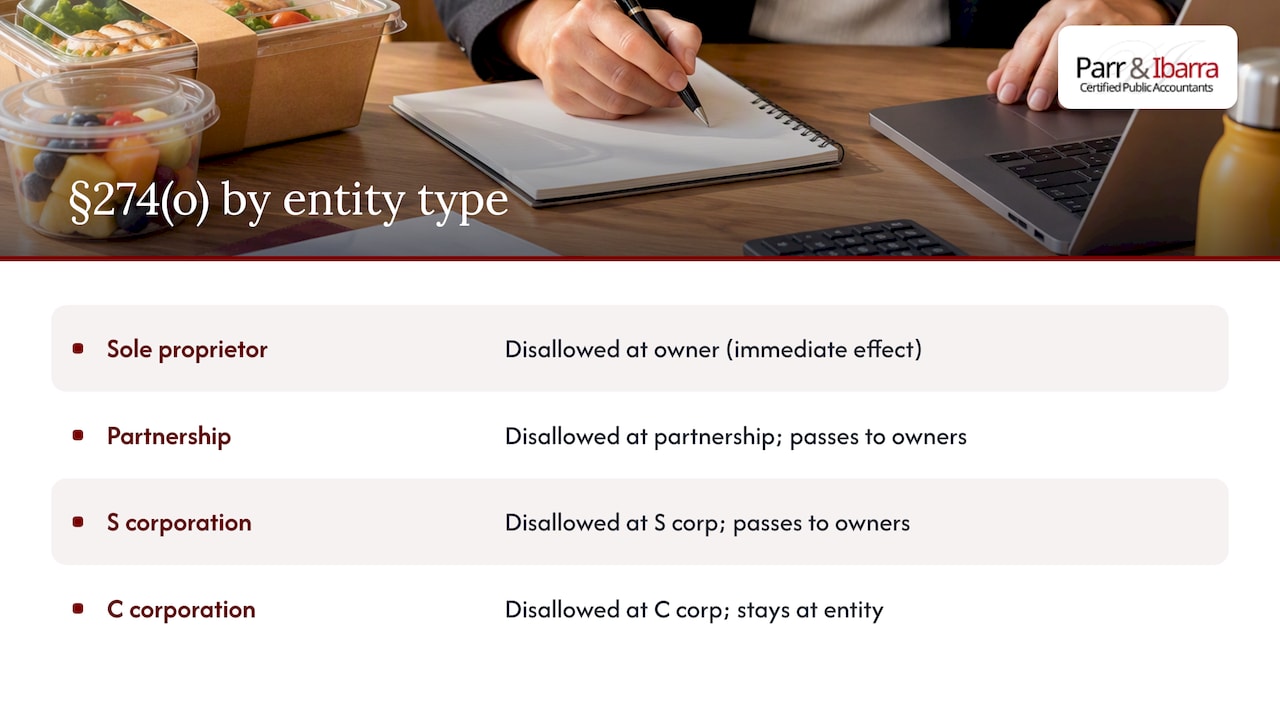
How entity type changes the deduction mechanics
The substantive rules under §274 apply the same way regardless of business structure, but where the deduction lands and who benefits from it differs by entity type.
Owners in these structures need to watch how their tax software or preparer handles the pass-through of a partially disallowed expense, since an error at the entity level shows up on every owner’s individual return.
The practical difference for a sole proprietor is that recordkeeping failures have an immediate, direct effect on personal tax liability rather than being diluted across multiple owners.
Across all four structures, the employer-convenience meal and eating-facility disallowance under §274(o) applies to whichever entity actually pays for and provides the meal. A partnership running a subsidized lunch program loses the deduction at the partnership level before any pass-through happens, just as a C-corporation loses it directly. Entity choice does not change whether the 2026 rules apply, only how the resulting tax effect is distributed to the people who own the business.
Penalties and audit risks tied to these deductions
Both mistakes are easy to make with a generic “meals and entertainment” account and easy to catch on review, since the invoice itself usually reveals whether the food charge was ever broken out.
The consequences follow the general rules for underpayment: additional tax owed on the disallowed portion, interest from the original due date, and potential accuracy-related penalties if the position lacked reasonable support at the time it was taken. A business that can produce contemporaneous documentation meeting the §274(d) requirements, purpose, attendees, time, place and amount, is in a far stronger position during an examination than one reconstructing records after the fact.
The eating-facility and employer-convenience disallowance under §274(o) adds a new audit angle for 2026 specifically. Examiners reviewing a return for the first post-2025 tax year are likely to look closely at any meal-related deduction that was previously claimed under the old convenience-of-employer standard, since that is precisely the category the amendment eliminated. Businesses that continue deducting cafeteria or on-site meal subsidies out of habit, without updating their bookkeeping to reflect the change, are the ones most likely to see that deduction disallowed on exam.
Balancing cost, culture, and compliance
Losing the deduction on employer-provided meals does not automatically mean cutting the program. When a subsidized cafeteria keeps shift workers on-site or supports retention, the nondeductible cost can still be worth paying. The harder call is deciding when to convert it to a taxable benefit instead, and that decision belongs to your tax advisor and payroll team together, not to a single department guessing at the tradeoff.
— Adan
Parr & Ibarra CPA: services and how to engage for 2026 planning
Reworking your meal and entertainment classifications touches tax strategy, bookkeeping structure and payroll decisions at the same time, which is exactly the mix Parr & Ibarra CPA is built to handle for Dallas-Fort Worth business owners. Our team combines tax planning with hands-on bookkeeping and payroll support, so the chart-of-accounts rebuild, the reimbursement policy update and the fringe benefit decision get solved in one engagement instead of three separate conversations.
If you want a policy review before your next filing deadline, visit our tax services page to get started.
This article is general information, not a substitute for advice from a qualified financial advisor. Consult a qualified financial professional about your own circumstances before acting on anything here.
Sources
- 26 U.S. Code § 274 – Disallowance of certain entertainment, etc., expenses | LII / Legal Information Institute
- 2026-2027 Special per diem rates (Notice 2026-60) | IRS
- IRS raises per diem rates for business travel effective Oct. 1 | Journal of Accountancy
FAQ
What is the IRS meal allowance for 2026?
There is no single flat “meal allowance.” Businesses either deduct 50% of actual substantiated meal costs under §274(n) or use per diem rates for travel meals, and the per diem meal and incidental expense portions were updated under Notice 2026-60 effective October 1, 2026.
How does the new employer meal deduction change work?
Under the §274(o) amendment to 26 U.S. Code § 274, employer-provided meals for the employer’s convenience and costs tied to employer-operated eating facilities are no longer deductible for amounts paid or incurred after December 31, 2025. Employees may still exclude the value of these meals from their own income under the fringe benefit rules in Publication 15-B, even though the employer gets no deduction.
How much can you claim for meals and entertainment?
Food served alongside entertainment can still get the 50% treatment on its own if the vendor separately states the food charge on the invoice, as described in IRS Publication 463.
What meals and entertainment expenses are 100% deductible?
Most other business meals fall under the 50% rule, and entertainment costs themselves are not deductible at all under §274.

