
RSUs are typically taxable as ordinary income when they vest at the fair market value of the shares, and that vesting value becomes your cost basis for any later sale. The vesting event triggers federal income tax withholding and payroll taxes, so your W-2 will reflect that income the year it happens. For employees at DFW-area companies, including those working at major employers along the Keller, Southlake, and Las Colinas corridors, RSU grants have become a significant and often misunderstood part of total compensation. Check your withholding method now because many employees end up owing more than what their employer withheld, and the gap can be substantial when you are already in a higher bracket from base salary alone.
TL;DR:
- RSUs are taxed as ordinary income at vesting based on the fair market value, which becomes your cost basis for future sale calculations.
- Many employees face a withholding rate of 22% on RSU vestings, but their actual tax rate can be higher, leading to potential underpayment unless they make estimated payments.
- The value at vesting is included in W-2 wages and FICA taxes, but the timing of FICA taxes may not align exactly with income tax timing, requiring attention.
- When selling shares, the difference between sale price and vest-date basis determines capital gains or losses, which must be correctly reported to avoid double taxation.
- Alternative withholding methods like sell-to-cover or share withholding impact cash flow and share amounts, and understanding these helps minimize surprises during tax filing.
How RSUs work and why vesting is the tax trigger
A restricted stock unit is a promise from your employer to give you shares once certain conditions are met. Nothing changes hands at the grant date. You do not own stock, you own a contractual right to receive stock later, and that distinction is the entire reason RSUs are taxed differently from stock you buy outright.
The vesting date is when the conditions attached to your RSUs are satisfied, usually a service period, a performance target, or both. Settlement is the moment the company actually delivers the shares to you, which in most plans happens on or close to the vest date itself. Some plans separate vesting and settlement by design, delaying delivery for tax or administrative reasons, so it is worth checking your grant agreement rather than assuming the two dates are identical.
Vesting schedules vary by company. A common structure grants a quarter of the award each year over four years, while other companies use monthly or cliff vesting after an initial waiting period. Public companies typically use “single trigger” vesting, meaning time alone satisfies the condition. Many pre-IPO companies use “double trigger” vesting, requiring both a time-based service period and a liquidity event such as an IPO or acquisition before shares actually settle. If you work at a private company, this second trigger matters enormously: your RSUs can vest on paper for years without ever settling, and no tax is owed until settlement actually occurs.
RSUs are treated as a form of deferred compensation under the tax code. According to IRS guidance on stock-settled RSUs, restricted stock units settled in stock are generally not taxed at grant. The value of the stock is included in income when it is actually transferred, typically at vesting, and the employer receives a corresponding deduction at that time.
This is also why the Section 83(b) election, familiar to anyone who has researched restricted stock, generally does not apply to RSUs. An 83(b) election lets a recipient of actual restricted stock pay tax at grant based on the (usually low) value at that time, locking in favorable treatment if the stock appreciates. RSUs do not qualify because you receive no actual property at grant, only an unfunded promise. There is nothing to elect into because there is no transfer of property yet. A narrow exception exists for certain private-company employees under Section 83(i), covered later in this guide.
Taxation at vesting: ordinary income, payroll taxes, and FICA treatment
The moment your RSUs vest and settle, the fair market value of those shares on that date becomes ordinary wage income, taxed at your regular income tax rates rather than capital gains rates. This is the single most important mechanic to understand about RSU tax, because it determines both how much you owe and when you owe it.
Under Internal Revenue Code Section 83 and related IRS guidance, once an employee acquires beneficial ownership of stock and there is no longer a substantial risk of forfeiture, the value received is includible in gross income. An IRS memorandum on stock-settled RSU treatment walks through situation examples showing that when an employer initiates payment under an RSU, the employee acquires beneficial ownership, and the fair market value at that point is includible in income. The memorandum also notes that RSU settlement can be subject to FICA taxes as of the later of the date services were performed or the date no substantial risk of forfeiture remains, so the FICA timing does not always match the income tax timing precisely.
That FICA detail matters more than most employees realize.
RSU income is also classified as a supplemental wage for federal withholding purposes, distinct from your regular salary. According to Publication 15, the Employer’s Tax Guide, supplemental wages such as RSU vesting income are generally withheld at a flat 22%, or 37% for amounts over $1 million in supplemental wages during the year, rather than at the graduated rate your W-4 would otherwise produce. This flat-rate withholding is the root of most RSU tax surprises.
Employer deposit timing adds another layer. Publication 15 also describes accelerated deposit rules, sometimes called the one-day rule, that require employers to deposit withheld taxes the next business day once accumulated employment taxes cross a certain threshold. This affects how quickly the IRS receives your withheld funds, but it does not change what you personally owe. The employer’s compliance obligation is separate from your own liability, and that separation is exactly why a shortfall in withholding becomes your problem, not your employer’s.
Two things happen simultaneously at vesting: the fair market value of the shares becomes taxable wage income reported on your W-2, and the flat supplemental withholding rate almost never equals your actual marginal rate. Understanding that gap is the first step toward avoiding a surprise bill in April.
Withholding methods and common practical outcomes
Employers use one of a few standard methods to cover the tax bill generated when your RSUs vest, and the method chosen affects both your cash flow and how many shares you actually keep.
- Sell-to-cover: your broker automatically sells a portion of the newly vested shares immediately after settlement, using the proceeds to pay withholding taxes, and deposits the remaining shares in your account.
- Net settlement (share withholding): the company withholds a number of shares equal in value to the tax obligation and never issues them to you at all, so you receive fewer shares outright rather than receiving all shares and then selling some.
- Cash withholding: you pay the withholding amount directly from your own funds, allowing you to keep all vested shares, though this requires having cash available on short notice.
- Flat supplemental withholding by default: absent any election, payroll typically applies the standard supplemental wage rate automatically through whichever method the plan specifies, most commonly sell-to-cover.
The mechanics behind sell-to-cover matter because the sale happens within a narrow window right after vesting, often the same day, and the price at which shares are sold can differ slightly from the price used to value your income for W-2 purposes. That small timing gap can create a minor capital gain or loss on the shares sold to cover taxes, separate from the income tax owed on the vested value itself.
Net-share settlement is administratively simpler for the employer but has an important side effect: because the shares withheld are never issued, they cannot later be sold to raise cash. If you have a specific need for liquidity right after vesting, this method may leave you without enough freely tradable shares to meet it.
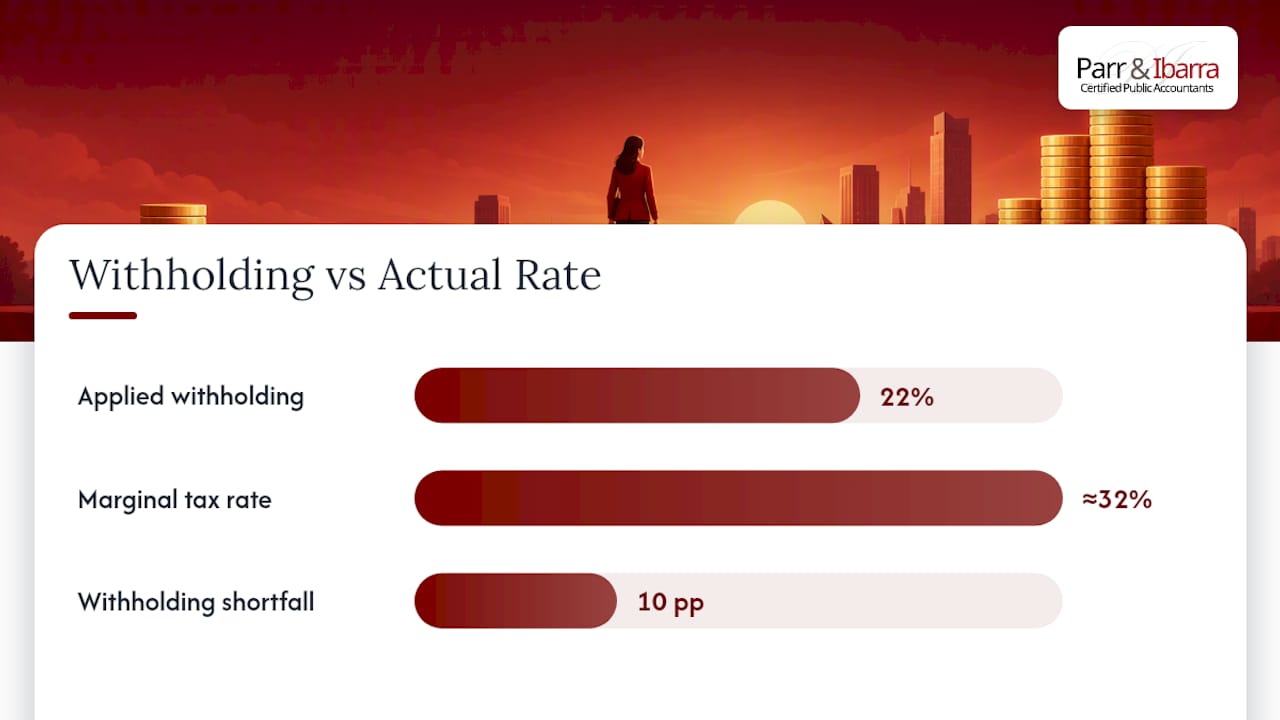
Here is where many employees get caught. Say an employee’s RSUs vest with a value that pushes their combined marginal federal and state rate to roughly 32%, but the employer withholds at the standard 22% federal supplemental rate described in Publication 15. That 10-point gap accumulates silently across every vesting event during the year, and it only becomes visible when the tax return is prepared. For someone with several vesting events and a six-figure base salary, that gap can add up to a real four-figure balance due, plus potential underpayment penalties if estimated payments were not adjusted along the way.
Pro Tip: Pull your most recent pay stub right after a vesting event and compare the withholding rate actually applied to your marginal tax bracket; if there’s a gap, address it with an estimated payment before quarter-end rather than waiting until you file.
Cost basis and selling later: gains, losses, and reconciling broker reports
The fair market value included in your income at vesting is not just a tax bill, it is also your starting cost basis for the shares. When you eventually sell, gain or loss is calculated as the difference between your sale price and that basis, and getting this number right is what keeps you from paying tax twice on the same income.
According to Carta’s overview of RSU taxation, when you later sell shares acquired through RSU settlement, you report the capital gain or loss based on your cost basis, which equals the amount already included in your gross income at settlement. You will receive a Form 1099-B from your broker reporting the sale, but you are responsible for reporting the transaction on Form 8949 and Schedule D, adjusting for any discrepancy between what the broker reports as basis and your actual basis.
That discrepancy is common and predictable. Brokers frequently report a cost basis of $0, or a basis that only reflects what you paid out of pocket (often nothing), because they are not always tracking the compensation income your employer already added to your W-2. If you do not correct this, you risk reporting the full sale price as taxable gain a second time, on top of the tax you already paid through payroll at vesting.
- Confirm your per-share vest-date value from your W-2 supplemental documentation, your employer’s stock plan portal, or your grant statement.
- Compare that value to the basis your broker reports on Form 1099-B for any shares sold.
- If the reported basis is understated, use Form 8949 to enter an adjustment code and the correct basis, then carry the corrected total to Schedule D.
- Track your holding period separately from your vesting date, since the clock for long-term capital gains starts at settlement, not at grant.
Holding period determines your tax rate on any additional gain or loss beyond the amount already taxed as wages. If you hold vested shares for more than a year past the settlement date before selling, any appreciation above your basis qualifies for long-term capital gains rates. Sell within a year, and that appreciation is taxed as short-term gain at your ordinary income rates, which for many RSU recipients is already a high bracket.
The practical fix for most of this is recordkeeping discipline. Keep your grant agreement, every vesting confirmation from your stock plan administrator, and each year’s W-2 in one folder, and reconcile them against your 1099-B as soon as it arrives rather than waiting until the filing deadline. A mismatch caught in February is a five-minute fix. The same mismatch caught in April, after you have already filed, means an amended return.
Tax forms and reporting workflow before you file
Three forms carry the weight of RSU reporting, and each one plays a distinct role that is easy to confuse if you have never walked through the sequence before.
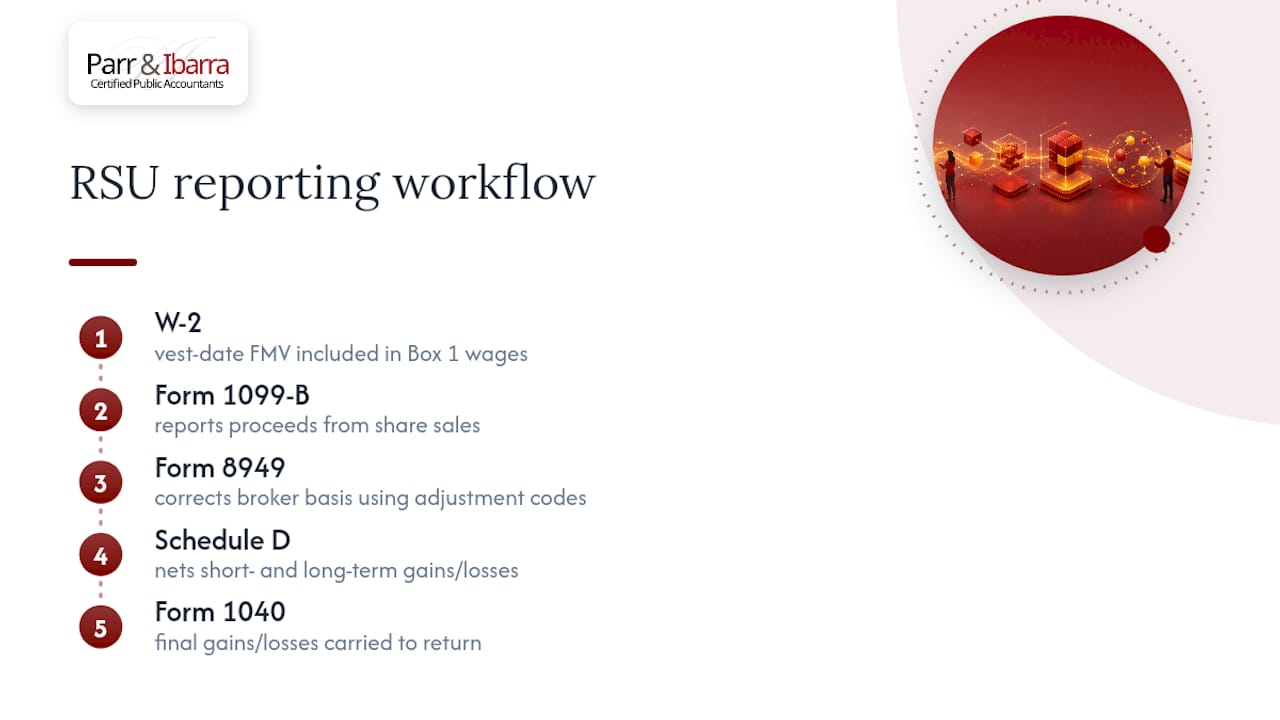
Your W-2 should already include the vest-date fair market value of your RSUs as part of Box 1 wages, along with the associated federal, Social Security, and Medicare withholding in the corresponding boxes. This income is baked into your total wages, it is not broken out as a separate line unless your employer chooses to note it in Box 14 for informational purposes. If several vesting events happened during the year, the W-2 reflects the sum of all of them.
Your broker’s Form 1099-B reports the proceeds from any sale of vested shares, whether that sale happened automatically through sell-to-cover or later when you decided to sell on your own. The basis reported on this form is the point of friction described earlier: brokers sometimes report an inaccurate or incomplete basis for RSU-acquired shares, particularly for sales that happened years after vesting once the original vesting data has aged out of the broker’s easy-access records.
Form 8949 is where you make the correction. Each sale gets its own line, and if the basis reported by the broker does not match your actual basis, you use the adjustment column and an appropriate code to show the correct figure. The instructions for Form 8949 explain how brokers report proceeds and basis on Form 1099-B, and why taxpayers must use Form 8949 to reconcile any difference between the reported figure and the actual basis.
Once Form 8949 is complete, the totals flow to Schedule D, which nets your short-term and long-term gains and losses and carries the final number to your Form 1040.
Timing is worth planning around. W-2s typically arrive by the end of January, but 1099-B forms from brokerage firms often arrive later, sometimes not until mid-February, and can occasionally be corrected and reissued if the broker updates cost basis information after the original mailing. Waiting to file until you have both documents in hand, and comparing them against your own vesting records before submission, avoids the need for an amended return later.
Special situations that change the usual RSU timeline
Several circumstances shift the standard vesting-equals-taxable-event rule, and each one deserves attention before it catches you off guard.
Private-company RSUs frequently use double-trigger vesting, meaning shares do not settle, and no tax is owed, until a liquidity event such as an IPO or acquisition occurs, even if the time-based portion of vesting finished years earlier. According to IRS guidance for privately held companies, employees should document how the employer determined fair market value and keep contemporaneous records of any share withholding or sell-to-cover transactions to support basis calculations later. When liquidity is absent at settlement, meaning there is no public market to sell shares into, pre-funding the tax bill from other savings becomes a real planning consideration rather than a theoretical one.
Leaving your employer before vesting typically forfeits unvested RSUs entirely, though severance agreements and change-in-control provisions sometimes accelerate vesting, pulling forward a tax event you had not planned for in that calendar year. Review your plan documents and any separation agreement carefully rather than assuming standard treatment applies.
As established earlier, 83(b) elections generally do not apply to RSUs because no property transfers at grant, so there is nothing to elect into. A narrower provision, Section 83(i), allows certain employees of eligible private corporations to elect to defer income recognition on qualified stock for up to five years, but the eligibility rules are strict, excluding many executives and requiring broad-based employee participation in the equity plan, so it applies to a limited group.
Nonresident aliens face sourcing rules that allocate RSU income between work performed inside versus outside the country, based on days worked in each location during the vesting period. An IRS practice unit on deferred compensation for nonresident aliens explains that this day-count sourcing can materially change how much income is subject to withholding, making cross-border vesting one of the more complicated scenarios to handle without specialist guidance.
Practical planning steps to manage tax due at vesting
Getting ahead of RSU tax means estimating your real liability before the vesting date arrives, not after your W-2 shows up in January.
RSU income itself does not typically trigger AMT the way incentive stock option exercises can, but a large RSU vesting year that pushes your total income higher can still affect AMT calculations indirectly by changing your exemption phaseout, so it is worth checking in years with unusually large equity income.
- Compare your combined marginal rate to the 22% flat withholding rate your employer likely applies, and treat any gap as a bill you will owe later.
- Make an estimated tax payment for the quarter in which vesting occurred if the shortfall is significant, rather than waiting for your employer to true it up.
- Decide sell or hold based on your own liquidity needs and concentration risk, not on trying to time the stock price.
- Revisit your W-4 if you have several vesting events scheduled during the year, to increase regular withholding and smooth out the gap automatically.
The sell versus hold decision deserves its own checklist. Ask whether you already hold too much of your net worth in a single company’s stock, whether you have an upcoming cash need such as a home purchase, and whether selling immediately at vesting (avoiding further price risk) makes more sense than holding for long-term capital gains treatment. There is no universally correct answer, only a tradeoff between concentration risk and potential tax savings from a lower long-term rate.
Pro Tip: If you have vesting events across multiple states in the same year because you relocated, flag it early: state sourcing rules for RSU income can differ sharply from your current state of residence.
Complex situations, multistate vesting, a single vesting event large enough to shift your tax bracket, or a private-company liquidity event with no public market for the shares, are the moments to bring in a CPA rather than work through spreadsheets alone. For deeper context on how RSU income interacts with broader compensation planning, see this guide to tax-efficient owner compensation, and for the mechanics of estimated payments themselves, this breakdown of estimated quarterly tax timing applies just as well to a large one-time vesting event as it does to a business owner’s quarterly obligations.
What a CPA reviews when you bring in RSU documents
A CPA working through an RSU tax situation typically starts with your plan documents and vesting ledger, then reconciles your W-2 against your 1099-B to confirm the wage income and cost basis line up correctly. For employees with multistate work history or private-company grants, that review also covers state sourcing allocation and FICA timing across vesting events.
Bring the following to a productive first meeting: your original grant agreement, brokerage statements covering every sale of vested shares, your W-2 for the relevant year, and recent pay stubs showing withholding at vesting. Useful questions to ask include whether your withholding method has created a shortfall, whether your cost basis has been correctly reported on your 1099-B, and whether a multistate work history affects how your RSU income should be sourced.
The firm combines big-firm technical expertise with a community-focused, responsive team, drawing on a staff of professionals including multiple CPAs, and offers bilingual English and Spanish service for local clients. For readers whose RSU situation involves a private-company liquidity event tied to a broader corporate transaction, the firm’s experience with detailed tax due diligence work reflects the same document-level review process an RSU reconciliation requires.
When your RSU tax situation involves more than a single, straightforward vesting event, proactive tax planning and payroll coordination through a firm familiar with equity compensation is usually the faster path to getting it right the first time.
A conservative approach to RSU tax planning
Employees who plan conservatively around RSU vesting rarely get surprised. Assuming your employer’s flat withholding will fall short, and setting cash aside for the gap, protects you from a scramble at filing time and from underpayment penalties that stack up quietly across a year with several vesting events.
Reconcile your W-2 and 1099-B early, ideally the week each arrives, rather than after your return is otherwise finished. If your situation involves cross-border work, a private-company grant with no current liquidity, or a year with an unusually large vesting event, get a second set of eyes on it before you file rather than after.
— Adan
Getting hands-on help with RSU reporting and tax planning
Reconciling W-2 wages against 1099-B basis, correcting Form 8949 entries, and estimating what you owe before a vesting event hits are exactly the kind of detail work that turns a stressful filing season into a routine one. A local CPA firm works with individuals and business owners on exactly this kind of proactive planning, rather than just filing returns after the fact.
- Tax Planning: forward-looking review of upcoming vesting events, withholding gaps, and estimated payment timing.
- Taxes – Personal & Corporate: full preparation and filing, including RSU basis corrections on Form 8949 and Schedule D.
- Payroll Services: coordination for business owners managing equity compensation for their own employees.
An engagement typically starts with a document review of your grant agreements, pay stubs, and brokerage statements, followed by a plan to adjust withholding or estimated payments before your next vesting date. If you had a large RSU event this year or expect one soon, visit the Tax Services page to schedule a consultation before your next vesting date arrives.
Sources
These government and primary sources cover the rules cited throughout this guide, and are worth reading directly if you want the underlying language rather than a summary.
- Publication 5992 (IRS guidance excerpt)
- Restricted stock units (RSU): How they work, benefits, and taxes — Carta
This article is general information, not a substitute for advice from a qualified financial advisor. Consult a qualified financial professional about your own circumstances before acting on anything here.
FAQ
Do RSUs get taxed twice?
No, when reported correctly RSUs are not taxed twice: the fair market value at vesting is taxed once as ordinary income, and any further gain or loss after that point is taxed separately as a capital gain or loss on sale. Double taxation typically happens only when a broker reports an incorrect cost basis on Form 1099-B and the taxpayer fails to correct it on Form 8949.
How much tax will I pay on RSUs?
The vest-date value of your RSUs is added to your wages and taxed at your ordinary income rate, plus applicable state and payroll taxes, but your employer typically withholds only at a flat supplemental rate, which is 22%, or 37% above $1 million in supplemental wages for the year. If your actual marginal rate is higher than the withholding rate applied, you will owe the difference when you file.
Are RSUs taxed at 40%?
High earners in high-tax states can see a combined effective rate that approaches that range, but it comes from stacking several separate rates rather than one fixed percentage.
Do I need to pay income tax on RSUs?
Yes, the fair market value of your RSU shares is included in your taxable wages in the year they vest and settle, under IRS rules for stock-settled RSUs. This income appears on your W-2 and is subject to ordinary federal income tax along with applicable state and payroll taxes.

