
Non-corporate shareholders who hold original-issuance stock from a qualifying C corporation can exclude a large share of their federal capital gains under IRC §1202, known as qualified small business stock, or QSBS. The exact benefit depends on when the stock was issued: shares issued before July 4, 2025 follow older caps and holding rules, while shares issued after that date fall under new tiered rules from the One Big Beautiful Bill Act. State taxes can cut into the federal savings, so confirm your documentation and talk to a CPA before assuming you qualify.
TL;DR:
- The new rules from July 4, 2025, increase the gross-assets ceiling and alter the per-issuer cap, making qualification easier for some high-basis founders.
- Original issuance from a U.S. domestic C corporation and operating a qualified trade are essential, with stricter tests for active business use and asset thresholds, especially after 2025.
- Holding periods now follow a tiered schedule, with five or more years of holding allowing full exclusion, but the benefits are limited by caps based on either $15 million or ten times basis.
- State taxes can significantly reduce QSBS benefits, notably in California that taxes the full gain, so taxpayers must consider state conformity when planning sales.
- Proper documentation of issuance and compliance measures taken at the time of issuance are critical to verify QSBS eligibility during audits or sales, preventing costly disqualification.
What Is Qualified Small Business Stock Under Section 1202?
Qualified small business stock is a category of C corporation shares that, when held long enough, lets individuals exclude some or all of their capital gain from federal tax under IRC §1202. The law benefits individual investors, partners who hold their shares through a partnership, and certain trusts and estates that received the stock through original issuance rather than a secondary purchase.
The exclusion works against a cap. You can exclude gain up to the greater of a flat dollar amount or 10 times your adjusted basis in the stock, whichever produces the bigger number for you. That dollar figure shifted with recent legislation, and so did the holding-period rules that determine what percentage of gain you can exclude at all, according to the SBA’s overview of QSBS.
The single most important date in this entire topic is the day your stock was issued. Shares issued before July 4, 2025 play by one set of rules. Shares issued on or after that date play by another, thanks to the OBBBA overhaul. Everything downstream, caps, holding periods, exclusion percentages, traces back to that issuance date.
Which Companies Qualify as a Small Business Under Section 1202?
Before you worry about your own holding period, the company itself has to clear four hurdles at the time the stock was issued and, for some tests, throughout your holding period.
Domestic C corporation status. The issuer must be a domestic C corporation when the stock is issued and for substantially all of the time you hold it. S corporations, LLCs taxed as partnerships, and foreign entities don’t qualify, though an LLC that converts to a C corp before issuing new shares can create QSBS-eligible stock going forward.
Gross-assets ceiling. The company’s gross assets can’t exceed a set threshold immediately after the stock is issued. Under the pre-OBBBA regime that ceiling was set at a specified limit; for stock issued under the post-2025 regime, the ceiling is higher, as established by recent law, per the Tax Foundation’s rollover analysis and related practitioner guidance. Assets are measured at cash value or adjusted basis, whichever is higher, which trips up founders who assume this is a valuation test tied to the last funding round.
Qualified trade or business. The company has to operate a qualified trade or business. Section 1202 explicitly excludes several categories: professional services (law, accounting, health, consulting), financial services and banking, farming, hotels and restaurants, and businesses whose principal asset is the reputation or skill of an employee. A software company, a manufacturer, or a biotech developing its own products typically qualifies; a law firm or investment advisory shop does not.
The 80% active-business test. At least 80% of the company’s assets, by value, must be used in the active conduct of that qualified trade or business throughout substantially all of your holding period. Track this in board minutes and balance sheets tied to each issuance date, not just at year-end.
- Confirm C-corp status on the cap table and articles of incorporation
- Calculate gross assets immediately before and after each stock issuance
- Document the company’s primary business activity against the excluded-industry list
- Keep asset-use records that show 80% or more tied to active operations
How Do Shareholder and Stock-Level Rules Work?
The company can check every box and you can still lose the exclusion if the stock itself, or how you acquired it, fails the test. Section 1202 requires original issuance: you must have received the stock directly from the corporation in exchange for money, property, or services, according to Carta’s explainer on QSBS mechanics. Buy shares from an existing shareholder on a secondary sale and those shares carry no QSBS benefit, no matter how long you hold them.
Eligible holders include individuals, partners who receive an allocated share of QSBS gain through a partnership, and certain trusts and estates. When a partnership holds QSBS, each partner’s exclusion is generally calculated based on their share of the gain and their own per-issuer cap, not the partnership’s.
For employees and advisors holding options or restricted stock, timing matters enormously:
- The holding period for exercised options starts on the exercise date, not the grant date, so early exercise generally starts the QSBS clock sooner
- RSUs typically start the holding period on the vesting or settlement date, when shares are actually issued
- Transfers by gift or at death can carry over, or “tack,” the original holder’s holding period to the new owner
- A stock split or conversion under the company’s own governing documents usually preserves QSBS status, but a redemption or recapitalization can jeopardize it
Pull your issuance documents, stock purchase agreements, and option exercise records now, before a sale forces you to reconstruct them under deadline pressure.
How Long Do You Have to Hold QSBS Before Selling?
Holding period determines everything, and this is exactly where the 2025 overhaul changed the math. Stock issued before July 4, 2025 follows the original rule: hold it more than five years and you can exclude up to 100% of the gain, capped at the greater of $10 million or 10 times your basis.
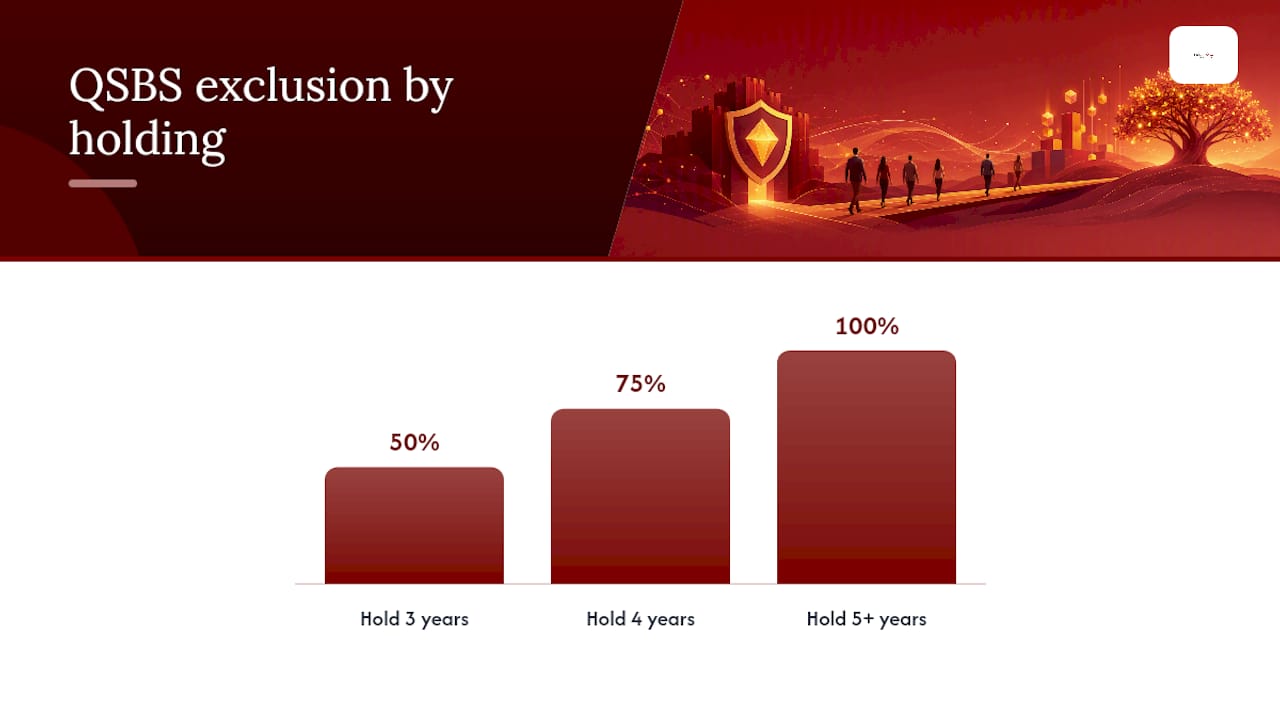
Stock issued on or after July 4, 2025 follows a tiered schedule under the OBBBA:
- Hold 3 years: exclude 50% of the gain
- Hold 4 years: exclude 75% of the gain
- Hold 5 years or more: exclude 100% of the gain
- Per-issuer cap rises to the greater of $15 million or 10 times basis, with the $15 million figure indexed for inflation starting in 2027, per the Acorn 9 founder’s guide to the 2025 overhaul
Here’s how the cap-versus-basis math plays out. Say you invested $500,000 in a startup and your post-2025 QSBS is worth $9 million at sale, a $8.5 million gain. Ten times your basis is $5 million, less than the flat $15 million cap, so the flat cap wins and you can exclude the entire $8.5 million gain if you’ve held five years.
The $15 million cap only helps once your basis is below $1.5 million. Founders with near-zero basis benefit most from the flat-dollar cap; investors who put in large checks often get more mileage from the 10x-basis formula.
Now flip the holding period. Sell at year 4 instead of year 5, and you exclude only 75% of that $8.5 million gain, or $6.375 million. The remaining $2.125 million is taxed as ordinary capital gain, subject to a special 28% rate on the taxable QSBS portion plus the 3.8% Net Investment Income Tax where it applies, under IRS Tax Topic 409. That’s a meaningfully higher bill than the capital gains rate most investors expect, so model the year-4 exit against the year-5 exit before you sign a term sheet.
Do NIIT, AMT, and State Taxes Reduce the QSBS Benefit?
The federal exclusion is generous, but it’s not the whole tax picture. Get the excluded portion right and you can still owe more than expected once NIIT, AMT, and your state weigh in.
The excluded portion of QSBS gain is generally not subject to the 3.8% Net Investment Income Tax, since NIIT applies to net investment income and excluded gain isn’t counted as income for that purpose. Alternative Minimum Tax exposure on QSBS has been reduced for stock acquired after September 27, 2010, but older acquisitions or unusual fact patterns can still trigger an AMT preference item, which is a detail worth flagging to your CPA rather than assuming away.
State conformity is the piece founders overlook most often. Several states don’t fully conform to the federal QSBS exclusion:
- California does not recognize the QSBS exclusion at all, taxing the full gain as ordinary income under state law
- Other states partially conform or apply their own asset and residency tests, and sourcing rules differ for residents versus nonresidents
- A federal exclusion of $8 million can still leave you with a six-figure state tax bill depending on where you live and where the company was headquartered
Run the federal QSBS model first, then layer your specific state’s treatment before you commit to a sale date or a rollover. A capital gains tax overview is a useful starting point for understanding how the taxable remainder interacts with your broader return.
What Records Do You Need to Prove QSBS Eligibility?
QSBS eligibility gets tested retrospectively, often years after issuance, at exactly the moment you’re trying to close a sale or respond to an audit notice. Waiting until then to assemble proof is a documented way to lose the exclusion even when the company genuinely qualified, according to Stripe’s guide for founders.
Keep these records tied to each issuance date, not just filed away at year-end:
- Board minutes authorizing the stock issuance
- The stock purchase agreement or option exercise paperwork
- Balance sheets showing gross assets immediately before and after issuance
- The capitalization table as it stood on the issuance date
- Stock ledger entries and physical or digital stock certificates
- Contemporaneous notes on the company’s primary trade or business activity
Pro Tip: Snapshot your cap table and balance sheet every time you issue new stock, not just at your annual close. A balance sheet from December won’t help you prove the gross-assets test for a round that closed in March.
The most common failure isn’t a company that doesn’t qualify. It’s a company that qualified but can’t prove it years later because nobody kept the paperwork. Some CPA firms build recordkeeping templates into ongoing engagements specifically so this documentation exists before it’s needed, not after.
What Are the Best QSBS Planning Strategies and Pitfalls?
Once you understand the baseline exclusion, a handful of planning moves can extend or protect it, and a handful of mistakes can quietly kill it.
- Use a Section 1045 rollover to defer gain without starting a new clock from zero. If you sell QSBS held more than six months and reinvest the proceeds in replacement QSBS within 60 days, you defer the gain. This doesn’t convert pre-OBBBA stock into the post-OBBBA regime, and it doesn’t extend your original per-issuer cap, per the Tax Foundation’s analysis of rollover mechanics.
- Consider gifting shares to multiply the per-issuer cap across family members. Gifting QSBS to a spouse or into a properly structured trust can give each recipient their own exclusion cap, but gift-tax rules, basis carryover, and generation-skipping transfer tax all need coordination between tax, estate, and corporate counsel.
- Time option exercises deliberately. Exercising early starts your holding-period clock sooner, but exercising stock for services can trigger payroll withholding and ordinary income recognition that has nothing to do with QSBS. Review the tax-efficient compensation strategies that apply when equity is issued for services.
- Watch for redemptions and conversions that break original issuance. A company redemption of other shareholders’ stock around the time of your purchase can disqualify your shares under anti-abuse rules, and any conversion that isn’t a straightforward statutory recapitalization can jeopardize QSBS status entirely.
How Do You Report QSBS on Your Tax Return?
Reporting QSBS correctly comes down to giving your preparer the right documents at the right time, not filling out an exotic form. The exclusion is generally reported on Form 8949 and carried to Schedule D, with the excluded portion coded separately from the taxable remainder.
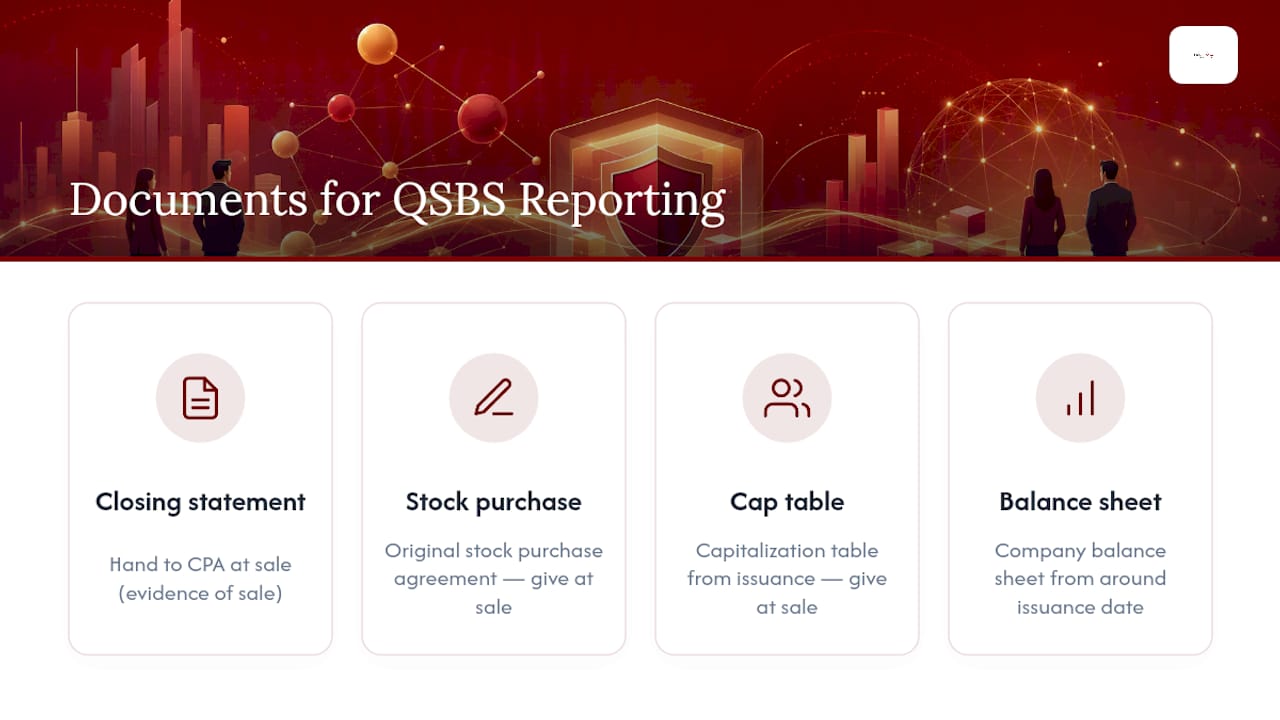
At sale time, hand your CPA the closing statement, the original stock purchase agreement, the capitalization table from issuance, and the company’s balance sheet from around the issuance date. Straightforward exclusion calculations are tax work; a legal opinion or securities review becomes worthwhile when the company’s qualification is genuinely close to a line, like the gross-assets ceiling or the active-business test.
You exclude the full $12 million and owe no federal capital gains tax on that sale, subject to state treatment.
Publisher Perspective: Early Documentation Beats Late Diagnosis
It is common for founders to discover QSBS matters only when a term sheet is already on the table, long after the paperwork that would prove eligibility should have been filed away. The exclusion rewards people who documented issuance correctly years earlier, not people who scramble at closing. Build the file now.
— Adan
How Parr & Ibarra CPA Helps You Get QSBS-Ready
Some CPA firms provide services that include reviewing issuance documents and cap table history before a sale, not after a demand letter arrives. This kind of proactive eligibility work can prevent issues that occur when reviews happen retroactively.
The firm’s proactive planning covers documentation review against the gross-assets and active-business tests, exit-tax modeling that layers federal exclusion against state exposure, trust and gifting structures for stacking exclusions across family members, and payroll and compensation review when equity is issued for services. If you’re a founder approaching a funding round, a liquidity event, or an acquisition offer, get your tax planning strategy reviewed before you sign anything, not after.
Sources
- 26 U.S.C. § 1202 — Qualified small business stock (US Code)
- IRS Tax Topic 409 — Capital gains and losses
- Qualified Small Business Stock: What Is It and How to Use It — SBA
- Qualified small business stock (QSBS) explained — Stripe
This article is general information, not a substitute for advice from a qualified financial advisor. Consult a qualified financial professional about your own circumstances before acting on anything here.
FAQ
How Do I Know If My Stock Is QSBS?
Check that the issuer was a domestic C corporation with gross assets under the applicable ceiling when your shares were issued directly to you, and confirm the company operated a qualifying trade or business, not one on the excluded list like finance or professional services.
How Do I Report Qualified Small Business Stock on Taxes?
Report the sale on Form 8949, carry it to Schedule D, and separate the excluded portion of the gain from any taxable remainder, which may be subject to the 28% Section 1202 rate plus NIIT.
What Are the QSBS Requirements for 2026?
Stock issued after July 4, 2025 falls under the OBBBA regime: a $75 million gross-assets ceiling at issuance, a per-issuer cap of the greater of $15 million or 10 times basis, and the tiered 3, 4, and 5-year exclusion schedule described above.
Does California Recognize the QSBS Exclusion?
No. California does not conform to the federal QSBS exclusion and taxes the full gain as ordinary income at the state level, which is why modeling state tax separately from the federal benefit matters.

