

Unrelated business income tax (UBIT) is the federal tax the IRS requires most tax-exempt organizations to pay on net income from trade or business activities that are regularly carried on and not substantially related to their exempt purpose. Your three immediate actions: (1) identify every revenue stream that might fall outside your mission, (2) document the facts and cost allocations for each one, and (3) report and pay using Form 990-T if gross unrelated income reaches $1,000 or more in a year. IRS Publication 598 is the authoritative reference that walks through every rule, exception, and calculation method.
UBIT is not rare. In 2017, more than 80,000 exempt organizations filed Form 990-T, reporting $15.4 billion in taxable income and $871.4 million in tax. Many organizations owe nothing after deductions, but the ones with commercial activities face real exposure. Treating UBIT as a manageable cost of earning unrelated revenue, rather than a penalty to dodge, is the mindset that keeps nonprofits both compliant and financially healthy.
What counts as unrelated business income?
The IRS applies a three-part test to every revenue stream. All three conditions must be true before income becomes subject to UBIT.

Part 1: Trade or business. The activity must be conducted for the production of income from selling goods or performing services, with an intent to make a profit. A hospital pharmacy selling supplies to the general public qualifies. A university selling advertising space in its alumni magazine qualifies too, even though the magazine itself is mission-related.
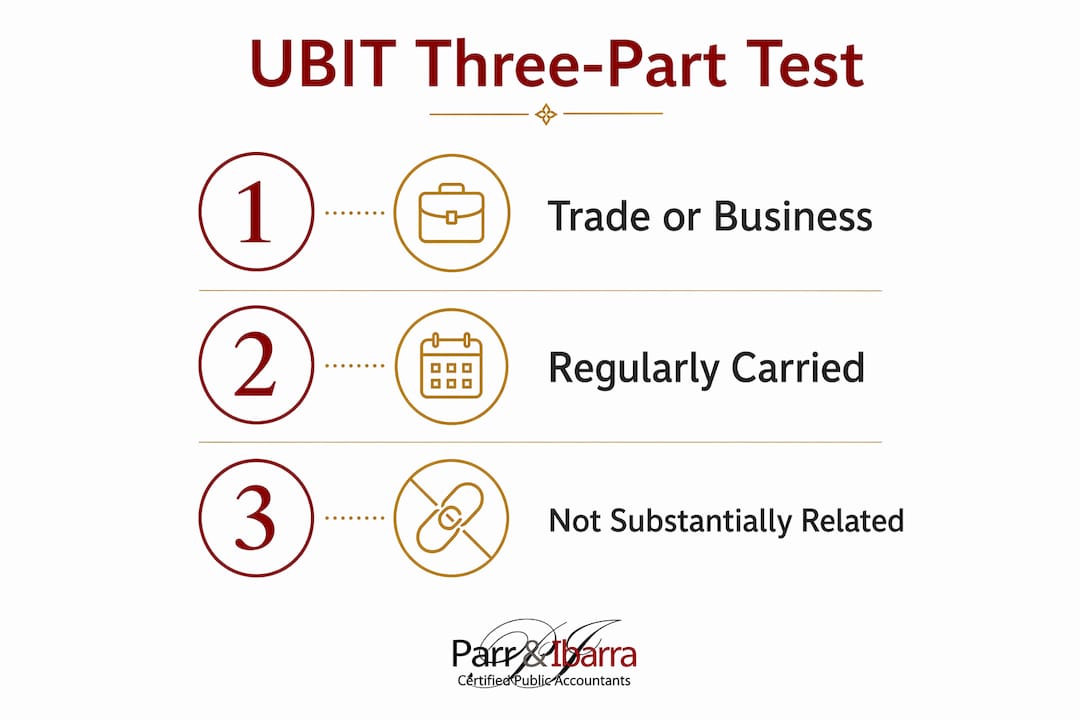
Part 2: Regularly carried on. The activity must show frequency and continuity similar to how a for-profit would run the same business. A one-time fundraising auction generally does not qualify. A coffee shop open five days a week inside a church building almost certainly does.
Part 3: Not substantially related. This is where most confusion lives. The IRS looks at whether the activity itself contributes importantly to accomplishing the exempt purpose, under Regulations Sec. 1.513-1(d)(2). Using the profits for mission work does not make the activity substantially related. The source of the income is what matters, not the destination.
Common scenarios that trigger UBIT:
- A museum gift shop selling general merchandise to the public
- A university renting its theater to commercial promoters during the summer
- A nonprofit hospital offering laboratory services to outside physicians
- Selling advertising in publications, operating a retail store open to the public, or providing services to the general public that resemble for-profit activity
Quick decision cues for finance teams:
- Would a for-profit competitor do the same thing? If yes, flag it.
- Is the activity happening on a regular schedule, not just occasionally?
- Does the activity serve the general public rather than primarily your members or beneficiaries?
- Is paid staff (not volunteers) running it?
Pro Tip: When an activity sits in a gray zone, document your reasoning in writing before filing season. A memo explaining why you concluded an activity is substantially related is far more defensible than silence if the IRS asks.
What income is excluded from UBIT?
Several categories of income are generally excluded from unrelated business taxable income (UBTI), even when they look commercial on the surface. Finance teams sometimes over-report because they do not know these exclusions well enough.
Common exclusions under Publication 598:
- Dividends, interest, and investment income. Passive investment returns from an organization’s ordinary portfolio are excluded. This covers bank interest, annuities, payments on securities loans, and income from notional principal contracts.
- Royalties. Payments for the use of intellectual property the organization owns are excluded, as long as the organization is not providing services in connection with the royalty arrangement.
- Rent from real property. Generally excluded, with important exceptions covered in the next section.
- Gains and losses from property sales. Excluded unless the property was inventory held primarily for sale in a regular trade or business.
- Volunteer-operated activities. If substantially all the work is performed by unpaid volunteers, the activity is excluded.
- Convenience activities. Sales of items primarily for the convenience of members, students, patients, or employees (a campus bookstore selling textbooks, for example).
- Qualified sponsorships. Payments where the sponsor receives nothing more than acknowledgment of their name, logo, or product line, per IRC Sec. 513(i).
- Donated merchandise sales. Selling goods that were donated to the organization.
The most common misconception: Many nonprofit managers assume that because they plow every dollar back into programs, none of their revenue is taxable. The IRS does not see it that way. Profit use is irrelevant to the UBIT analysis. What matters is whether the activity itself furthers the exempt purpose.
Pro Tip: When you rely on an exclusion, document it. Keep a one-page memo for each excluded revenue stream explaining which exclusion applies and why the facts support it. If the IRS later questions the position, that memo is your first line of defense.
Special UBIT rules that often catch nonprofits off guard
Debt-financed income
Rental income is generally excluded from UBTI, but that exclusion disappears when the property is debt-financed. Under the rules in Publication 598, if a nonprofit borrows money to acquire or improve property and then rents that property, a proportionate share of the rental income becomes UBTI. The calculation is based on the ratio of acquisition indebtedness to the property’s average adjusted basis.

Rental income can also be recharacterized as taxable when the payment is actually a share of the operator’s profits, or when a management company is running the property on the nonprofit’s behalf. The IRS uses an “all facts and circumstances” approach, so the label “rent” in a contract does not automatically protect the income.
Advertising vs. qualified sponsorship
Selling advertising space in a publication or on a website is a trade or business activity subject to UBIT. A qualified sponsorship payment under IRC Sec. 513(i) is not. The line between the two is whether the sponsor receives a “substantial return benefit.” Acknowledging a sponsor’s name and logo: excluded. Providing ad space with a call to action, pricing information, or comparative language: taxable advertising.
A practical example: a nonprofit newsletter that prints “Sponsored by ABC Company” next to the company logo is a qualified sponsorship. The same newsletter selling a quarter-page ad with “Call us at 555-1234 for a free quote” is selling advertising, and that revenue is subject to UBIT.
Joint ventures and passthrough income
When a nonprofit enters a partnership or LLC with a for-profit entity, income passed through from the entity’s unrelated activities is generally treated as UBTI at the nonprofit level. The nonprofit cannot shield itself from UBIT simply by holding an interest in a joint venture rather than running the activity directly.
Gaming and bingo
Certain bingo games conducted by nonprofits are excluded from the definition of unrelated trade or business under IRC Sec. 513, provided the game does not violate state or local law and commercial bingo operations were prohibited in the state at the time the relevant legislation was enacted. Other gaming activities, including pull-tabs and casino nights, do not automatically qualify for this exclusion and should be reviewed individually.
How to compute UBTI and file Form 990-T
Step-by-step UBTI calculation
- Identify gross receipts from each unrelated trade or business separately.
- Subtract cost of goods sold (COGS) to arrive at gross income per activity.
- Subtract directly connected expenses (wages, supplies, depreciation, allocated overhead) to arrive at UBTI per activity.
- Apply the $1,000 specific deduction available to all filers.
- Sum the results across all activities. Under IRC Sec. 512(a)(6), you compute UBTI separately for each unrelated trade or business. You cannot net a loss from one activity against income from another for current-year purposes.
- Apply the 21% federal corporate tax rate to the total UBTI.
| Filing element | Key rule |
|---|---|
| Filing threshold | $1,000 or more gross unrelated income triggers Form 990-T |
| Separate reporting | One Schedule A (Form 990-T) per unrelated trade or business |
| Federal tax rate | 21% flat corporate rate on UBTI |
| Estimated tax trigger | Expected tax of $500 or more requires quarterly estimated payments |
| Filing deadline | 15th day of the 5th month after the organization’s tax year ends |
Example: A 501©(3) that earns gross advertising revenue will calculate UBTI by deducting directly connected expenses and the specific deduction, then applying the 21% federal tax rate to the UBTI amount. Many states also impose their own UBIT-equivalent taxes, and combined rates can approach 30% in some jurisdictions, so state filings deserve equal attention.
Estimated tax payments are due quarterly using Form 990-W when the organization expects its total UBIT liability to reach $500 or more for the year. Missing these payments triggers underpayment penalties, separate from any late-filing penalty on Form 990-T itself.
Pro Tip: File Form 990-T even in years when deductions eliminate the tax liability. A filed return with zero tax owed is far cleaner than a missing return that invites IRS inquiry.
The CFO playbook for managing UBIT risk
Three-bucket revenue framework
The most practical starting point is sorting every revenue stream into one of three buckets: contributions and grants, program service revenue, and unrelated revenue. The three-bucket framework makes UBIT identification faster and board reporting cleaner. Anything landing in the third bucket gets a full three-part test review.
Bookkeeping controls
- Assign separate general ledger codes to each unrelated revenue stream and its directly connected expenses.
- Document your overhead allocation method (square footage, headcount, or time-tracking) in writing and apply it consistently year to year.
- Set a monthly monitoring trigger: if any unrelated revenue stream exceeds $500 in a month, flag it for quarterly review.
- Keep board minutes that reflect policy decisions about new revenue activities.
Decision tree for new revenue ideas
- Does the activity serve the general public or primarily your beneficiaries?
- Will paid staff run it, or volunteers?
- Is it planned to recur regularly throughout the year?
- Does it resemble something a for-profit competitor would do?
If the answers point toward public, paid, recurring, and commercial, run the three-part test before launching and budget for UBIT.
When to consider a taxable subsidiary
A taxable subsidiary (typically a C corporation wholly owned by the nonprofit) makes sense when unrelated activities are substantial, growing, and generating enough income to justify the administrative cost of a separate entity. The subsidiary pays corporate income tax on its own earnings, and dividends paid to the nonprofit parent are generally excluded from UBTI as passive investment income. The tradeoff: setup costs, separate bookkeeping, and ongoing compliance. For entity-level decisions of this kind, a CPA with nonprofit experience should be part of the conversation before any structure is put in place.
Pro Tip: Do not wait until an activity is generating six figures to have the subsidiary conversation. The time to structure it correctly is before the revenue scales, not after.
Recordkeeping, penalties, and audit red flags
Good records are the difference between a clean audit and a costly one. The IRS expects documentation that supports every revenue classification, every deduction, and every allocation method used on Form 990-T.
Records to keep (minimum five years):
- Revenue ledgers and bank statements for each unrelated activity
- Invoices and contracts supporting directly connected expenses
- Overhead allocation worksheets with the method clearly stated
- Board minutes approving new revenue activities or policy changes
- Prior-year Form 990-T returns and all Schedule A attachments
Common audit red flags:
- Mixing mission and commercial activities in the same cost center without clear allocation
- Inconsistent positions across years (e.g., treating the same activity as related one year and unrelated the next without explanation)
- Large deductions against unrelated income that are not clearly connected to that activity
- Rapid growth in unrelated revenue relative to program service revenue
Penalties and consequences: Failure to file Form 990-T when required triggers a late-filing penalty. Underpayment of estimated taxes adds interest and additional penalties. More seriously, if unrelated commercial activities become a primary purpose of the organization rather than a secondary one, the IRS can challenge the organization’s tax-exempt status entirely. That outcome is rare, but it is the reason UBIT compliance matters beyond the dollar amount of tax owed. For a broader look at nonprofit compliance obligations, the Form 990 filing requirements are closely related and worth reviewing alongside UBIT rules.
Key Takeaways
UBIT applies when income meets all three IRS criteria: trade or business, regularly carried on, and not substantially related to the exempt purpose, with UBTI taxed at the flat 21% federal corporate rate. Many states impose additional UBIT-equivalent taxes, and combined rates can approach 30% depending on the state.
| Point | Details |
|---|---|
| Three-part IRS test | All three conditions must be met: trade or business, regularly carried on, not substantially related. |
| Filing threshold | Gross unrelated income of $1,000 or more requires filing Form 990-T with a separate Schedule A per activity. |
| 21% federal rate | UBTI is taxed at the flat 21% federal corporate rate; state taxes can push combined rates toward 30%. |
| Separate activity accounting | IRC Sec. 512(a)(6) prohibits netting losses from one unrelated activity against income from another. |
| Parr & Ibarra CPA | Provides Form 990-T preparation, UBIT reviews, and outsourced CFO advisory for nonprofits in the Dallas-Fort Worth area. |
The UBIT rule most nonprofit boards get wrong
The conventional wisdom in nonprofit circles is that UBIT is a compliance problem to be minimized. Finance teams spend energy trying to argue activities into the “substantially related” bucket rather than asking the more useful question: is this activity profitable enough after tax to be worth running?
That reframe matters. A gift shop generating $80,000 in annual revenue with $20,000 in net UBTI owes $4,200 in federal tax. That is not a reason to shut the shop down. It is a reason to track it properly, allocate costs accurately, and make sure the board understands the net contribution to the organization’s finances. The organizations that get into trouble are the ones that either ignore UBIT entirely or over-engineer their revenue classifications to avoid it, then face an audit with no documentation to support their positions.
The subsidiary question is similarly misunderstood. Many nonprofit leaders treat it as a last resort or a sign that something went wrong. In practice, a well-structured taxable subsidiary can protect the parent’s exempt status, simplify reporting, and make the commercial activity more attractive to outside partners who want a conventional business relationship. The decision should be driven by scale and strategy, not by embarrassment about having unrelated revenue.
The nonprofit management challenge is not avoiding UBIT. It is building the internal controls to identify it accurately, price it into revenue decisions, and report it cleanly every year.
Parr & Ibarra CPA helps nonprofits stay ahead of UBIT
Nonprofit finance teams in the Dallas-Fort Worth area get a concrete advantage working with Parr & Ibarra CPA: a team of more than 20 professionals, including multiple CPAs, who handle UBIT reviews, Form 990-T preparation, and outsourced CFO advisory as integrated services, not add-ons.
The firm’s nonprofit compliance work covers the full picture: classifying revenue streams using the three-bucket framework, building defensible overhead allocation methods, preparing Schedule A for each unrelated trade or business, and advising on whether a taxable subsidiary makes financial sense for your organization’s situation. For nonprofits that need ongoing support rather than a once-a-year filing, Parr & Ibarra CPA offers bookkeeping and CFO advisory on a recurring basis so UBIT exposure is monitored throughout the year, not discovered in April.
To get started, prepare a summary of your organization’s revenue streams by category, note which activities involve paid staff and serve the general public, and bring your most recent Form 990-T (or explain why one has not been filed). Schedule a consultation at aibarra.cpa and come with your questions.
Useful sources
The IRS primary sources below are the authoritative references for every UBIT question. Save or bookmark them for your compliance file.
- IRS Publication 598: Tax on Unrelated Business Income of Exempt Organizations — the complete guide to UBTI computation, exclusions, special rules, and examples. Print or save a copy for your records.
- 2025 Instructions for Form 990-T — line-by-line filing guidance, Schedule A instructions, and who-must-file rules.
- IRS: Unrelated Business Income Tax overview — concise IRS summary of filing thresholds, estimated tax requirements, and links to related forms.
- IRS: Unrelated Business Income Defined — the three-part test explained in IRS language, with links to exceptions and exclusions.
- Journal of Accountancy: What not-for-profits need to know about UBIT — practitioner perspective on UBIT compliance, including the mindset shift from avoidance to compliant planning.
FAQ
What is the UBIT filing threshold for nonprofits?
A tax-exempt organization must file Form 990-T when it has $1,000 or more of gross income from one or more unrelated trades or businesses during the year.
Does using profits for charitable purposes eliminate UBIT?
No. The IRS focuses on the source of the income, not how the organization uses it. Funding programs with unrelated revenue does not make the activity substantially related to the exempt purpose.
Can a nonprofit offset losses from one unrelated activity against income from another?
Not for current-year UBTI. IRC Sec. 512(a)(6) requires separate calculation for each unrelated trade or business, and the UBTI from any single activity cannot be less than zero when summing across activities.
When does rental income become subject to UBIT?
Rental income loses its exclusion when the property is debt-financed, when the payment is actually a share of the operator’s profits, or when a management company is running the property on the nonprofit’s behalf.
What is the federal UBIT tax rate?
The flat federal corporate rate of 21% applies to UBTI for organizations taxed as corporations. Many states impose additional UBIT-equivalent taxes, and combined rates can approach 30% depending on the state.

