

Grant accounting is the fund-specific bookkeeping and reporting system nonprofits use to track, allocate, and prove proper use of grant dollars. Unlike regular income, grant funds come with strings attached: restrictions on purpose, time limits, documentation requirements, and often federal oversight. Get it wrong and you risk disallowed costs, audit findings, or losing access to future funding.
Three things separate organizations that sail through audits from those that scramble:
- Segregation: Every grant lives in its own project code or cost center from day one. Retroactive separation rarely satisfies auditors.
- Budget vs. actuals: Run this comparison at least monthly, not just at closeout. Surprises caught early are correctable; surprises at year-end often aren’t.
- Documentation: Every transaction needs a paper trail: invoices, timesheets, approval signatures, and the grant agreement itself.
This week’s first actions:
- Assign a unique project code to every active grant in your general ledger.
- Pull a budget-vs.-actual report for each grant and flag any line significantly over or under budget spent.
- Locate and centralize all grant agreements, award letters, and funder correspondence in one folder.
- Confirm who is responsible for time and effort reporting on each grant.
- Set calendar reminders for every Federal Financial Report (FFR) and funder report deadline.
What is grant accounting and how does it differ from standard accounting?
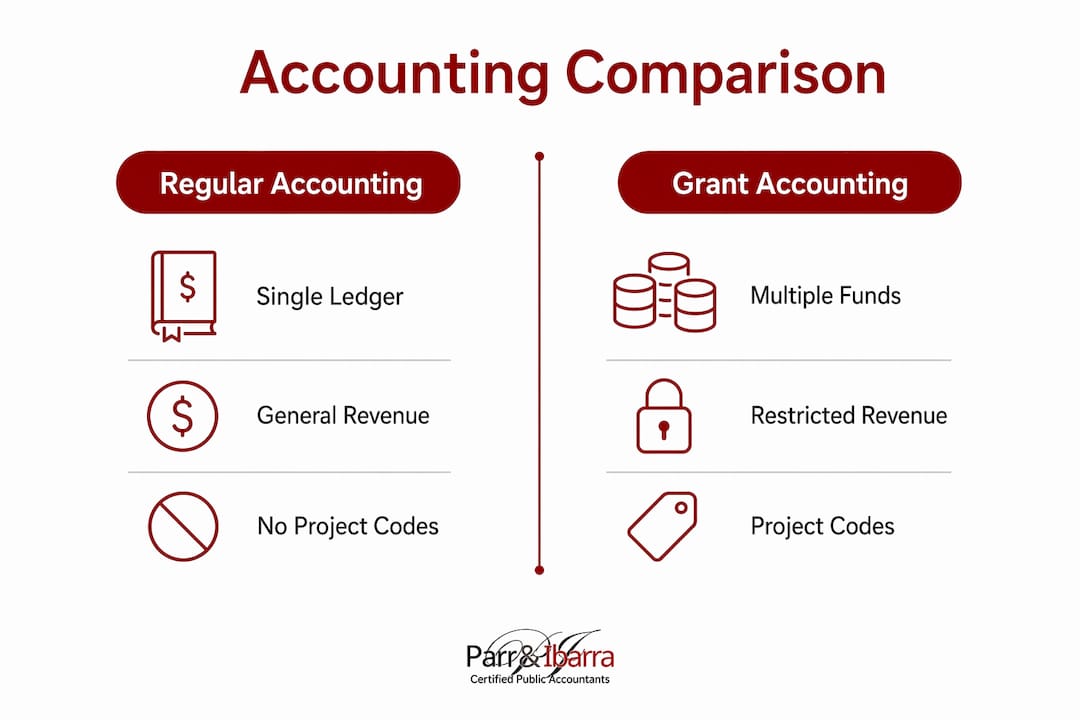
Grant accounting is a specialized subset of fund accounting, the broader framework nonprofits use to track financial activity across separate funding streams. Where standard accounting aggregates income and expenses into a single general ledger, grant accounting requires each funding source to be tracked independently, with its own revenue, expense, and balance records.
The conceptual split that trips up most organizations is restrictions. Donor and funder restrictions come in two forms under FASB ASC 958, the U.S. GAAP standard governing nonprofit financial statements:
- Purpose restrictions: Funds may only be used for a specified program or activity (e.g., after-school tutoring, equipment purchase).
- Time restrictions: Funds are available only during a defined period or upon a future event.
Revenue recognition follows the restriction. An unconditional grant (no performance barrier) is recognized as revenue when the award is made. A conditional grant defers revenue until the organization meets the funder’s conditions, such as matching funds raised or specific deliverables completed. This distinction matters enormously for the income statement: recording conditional grant revenue too early overstates revenue and can trigger audit findings.
Federal grants add another layer through the Uniform Guidance (2 CFR Part 200), the OMB-issued framework that governs allowable costs, internal controls, procurement standards, and audit requirements for federal award recipients. State and local pass-through awards typically flow down the same requirements to subrecipients.
How grant accounting differs from regular accounting on the axes that matter:
| Dimension | Regular accounting | Grant accounting |
|---|---|---|
| Fund structure | Single general ledger | Separate fund/project per grant |
| Revenue recognition | Earned when delivered | Conditional on meeting grant terms |
| Expense rules | Generally accepted costs | Allowable, allocable, and reasonable per 2 CFR Part 200 |
| Reporting cadence | Annual financial statements | Periodic funder reports, FFRs, and audit schedules |
| Audit trail | Standard documentation | Source docs tied to specific grant transactions |
| Commingling | Permitted across programs | Prohibited; funds must be separately identifiable |
What are the core components of an effective grant accounting system?
A solid grant accounting setup is not just about software. It is a combination of structural decisions, processes, and documentation habits that together make compliance manageable and audits predictable.

Core components and what each one does:
| Component | Purpose | One implementation tip |
|---|---|---|
| Chart of accounts with project codes | Ties every transaction to a specific grant | Assign a unique project code at award; never reuse codes across grants |
| Dedicated cost centers or bank accounts | Prevents commingling of funds | Use separate cost centers at minimum; separate bank accounts for high-risk or trust-fund requirements |
| Budget-vs.-actual process | Catches overspending and underspending early | Run monthly; flag any line more than 10% off budget |
| Time and effort reporting | Documents personnel costs charged to grants | Use signed timesheets or system-generated reports tied to project codes |
| Indirect cost rate and allocation | Fairly distributes overhead to grants | Document the methodology in writing; apply consistently |
| Subrecipient vs. contractor classification | Determines monitoring obligations | Subrecipients require monitoring; contractors do not |
| Documentation and retention | Supports audit findings and future funding | Retain records for the period required by the award (often 3–7 years) |
The project code structure deserves special attention. Best practice is to create a dedicated project code for every grant at the time of award and require that code on all revenue and expenditure documents. Retroactive segregation, where staff try to reconstruct which costs belonged to which grant after the fact, rarely satisfies auditors and wastes significant staff time.
Subrecipient classification is another area where organizations frequently stumble. If your organization passes federal funds to another entity that carries out part of the program, that entity is a subrecipient, not a contractor. Subrecipients must be monitored, must follow Uniform Guidance, and their expenditures appear on your Schedule of Expenditures of Federal Awards (SEFA). Misclassifying a subrecipient as a contractor is one of the most common audit findings under 2 CFR Part 200.
How do you record grant transactions from award through closeout?
The grant lifecycle has predictable accounting checkpoints. Knowing what to record at each stage, and why, keeps your ledger clean and your audit trail defensible.
Grant lifecycle accounting checkpoints:
- Award letter received — Record the grant receivable and deferred revenue (for conditional grants) or contribution revenue (for unconditional grants).
- Cash received — Debit cash, credit the grant receivable or deferred revenue account.
- Expenses incurred — Debit program expense accounts with the grant project code; credit accounts payable or cash.
- Payroll/time allocations — Allocate payroll based on signed timesheets; debit personnel expense under the grant project code.
- Indirect cost allocation — Apply the approved indirect cost rate to direct costs; debit indirect cost expense, credit the indirect cost pool.
- Release of restriction — When conditions are met, debit net assets with donor restrictions, credit net assets without donor restrictions.
- Closeout — Reconcile all expenditures to the final report, return any unspent funds, and close the project code.
Sample journal entries:
| Event | Debit | Credit |
|---|---|---|
| Award recorded (conditional grant) | Grants Receivable | Deferred Revenue — Grant |
| Cash received | Cash | Grants Receivable |
| Direct program expense | Program Expense [Project Code] | Accounts Payable / Cash |
| Payroll allocation | Personnel Expense [Project Code] | Payroll Clearing |
| Indirect cost allocation | Indirect Cost Expense [Project Code] | Indirect Cost Pool |
| Restriction released | Net Assets — With Restrictions | Net Assets — Without Restrictions |
| Unspent funds returned | Deferred Revenue — Grant | Cash |
On the financial statements, grant revenue flows through the statement of activities. Restricted net assets appear on the statement of financial position until restrictions are released. The SEFA, required for organizations subject to Single Audit, lists federal award expenditures by Assistance Listing number and is prepared directly from the project-code-level detail in your general ledger.
Pro Tip: Set up your timekeeping system to require a project code on every entry before a timesheet can be submitted. This one configuration change creates a defensible, real-time audit trail for personnel costs and eliminates the need to reconstruct allocations at year-end.
How should you structure your chart of accounts and choose grant tracking software?

The chart of accounts is the skeleton of your grant accounting system. Get it right and every report, reconciliation, and audit request becomes straightforward. Get it wrong and you spend hours manually reconstructing data that should be automatic.
Practical chart of accounts recommendations:
- Use a segment structure that includes fund, program, project, and natural account (e.g., 01-4100-GRANT001-5200 for personnel expense on a specific grant).
- Create separate revenue accounts for restricted and unrestricted grant income.
- Maintain a deferred revenue account for conditional grants not yet earned.
- Set up sub-ledger accounts for each active grant so budget-vs.-actual reports can be pulled at the project level without custom queries.
State-level grant guidance consistently requires project-level chartfields that enable traceability to the expenditure level and support preparation of the SEFA. That standard applies whether you are managing a federal pass-through or a direct federal award.
When spreadsheets become a liability:
Spreadsheets work for a single small grant. They stop working when you have more than two active grants, any federal funding, or a staff member who is the only person who understands the file. The signals that it is time to move to fund-aware software:
- You cannot produce a budget-vs.-actual report for a single grant in under five minutes.
- Payroll allocations are done manually at month-end rather than automatically by project code.
- You have had a close call with a reporting deadline because the data was not ready.
Key software features to prioritize:
- Grant/project tagging on every transaction at the point of entry
- Budget vs. actual dashboards at the project level, updated in real time
- Time and effort integration that pulls timesheet data directly into project cost reports
- Automated cost allocation for indirect costs based on a documented rate
- Report templates for Federal Financial Reports (FFRs) and funder-specific financial reports
- Audit trail logging that records who entered, modified, or approved each transaction
Fund-aware accounting software that automates real-time budget-vs.-actual comparisons and cost allocations reduces end-of-cycle surprises and gives program managers the visibility they need to manage spending without waiting for month-end close.
Software feature dimensions to evaluate (not vendors):
| Feature dimension | Why it matters | What to look for |
|---|---|---|
| Project/fund segmentation | Enables per-grant reporting | Unlimited project codes; segment-level P&L |
| Budget control | Prevents overspending | Real-time alerts when actuals approach budget |
| Time and effort | Documents personnel costs | Direct integration with payroll or timekeeping |
| Indirect cost automation | Reduces manual allocation errors | Configurable rate tables by grant or period |
| Reporting templates | Speeds up funder reports | Pre-built FFR and financial report formats |
| Audit trail | Supports audit requests | Immutable transaction log with user and timestamp |
For nonprofits exploring outsourced accounting capacity, remote accounting and controller staffing can fill gaps while permanent staff are hired or trained.
What do funder reporting and federal compliance actually require?
Compliance is where grant accounting moves from bookkeeping to risk management. Missing a deadline or misclassifying a cost can have consequences that go well beyond a correction entry.
Common funder reports and deadlines:
- Federal Financial Report (FFR / SF-425): Required for most federal awards; typically due 30 days after each quarter and 90 days after the award period ends.
- Progress/performance reports: Narrative and data reports on program outcomes; frequency varies by funder (quarterly, semi-annual, or annual).
- Drawdown requests: Cash requests submitted through systems like ASAP or G5; must be supported by actual expenditures.
- Final financial report: Due at closeout; must reconcile all expenditures to the approved budget and return unspent funds.
- Schedule of Expenditures of Federal Awards (SEFA): Required for Single Audit; lists all federal expenditures by award and Assistance Listing number.
The operational risk of missed reports is not abstract. Federal reporting systems often integrate directly with payment platforms, and a delinquent FFR can trigger automated payment freezes that interrupt drawdowns and require administrative remediation to clear. For organizations that depend on federal cash flow to meet payroll, that is a serious operational threat.
Uniform Guidance obligations most likely to trigger audit findings:
- Allowable costs: Costs must be permitted by 2 CFR Part 200 Subpart E, the award terms, and the organization’s own policies.
- Allocability: Costs must benefit the grant in proportion to how they are charged.
- Internal controls: Written policies for authorization, segregation of duties, and asset safeguarding are required.
- Procurement: Federal procurement standards apply to purchases made with federal funds, including competitive bidding thresholds.
- Documentation: Source documents (invoices, timesheets, contracts) must support every transaction.
- Subrecipient monitoring: Pass-through entities must monitor subrecipients and verify they meet federal requirements.
- Single Audit threshold: Organizations that expend $750,000 or more in federal awards in a fiscal year must have a Single Audit conducted under 2 CFR Part 200 Subpart F.
Audit-readiness checklist:
- [ ] Monthly reconciliations of all grant accounts to the general ledger
- [ ] Signed timesheets or system-generated time records for all personnel charged to grants
- [ ] Procurement documentation (bids, sole-source justifications, contracts) for all purchases over threshold
- [ ] Subrecipient monitoring files (risk assessments, site visit reports, financial report reviews)
- [ ] Indirect cost rate agreement or documented cost allocation methodology
- [ ] Copies of all award letters, amendments, and funder correspondence
- [ ] SEFA draft prepared at least 60 days before audit fieldwork begins
- [ ] Written policies for allowable costs, procurement, and conflict of interest
For organizations subject to Single Audit, financial statement audit services that include audit preparation support can significantly reduce the time and cost of the audit itself.
What internal controls and operating habits actually reduce audit risk?
Controls are only as good as the habits behind them. A policy manual that sits in a drawer does nothing. The organizations that consistently pass audits have made a few specific behaviors routine.
Internal controls that matter most:
- Segregation of duties: The person who approves an expense should not be the same person who processes the payment. For small teams, a board member can serve as a secondary approver.
- Approval matrix: Document who can authorize expenditures at each dollar threshold, and require grant project codes on all approvals.
- Expense pre-approval: Require written approval before incurring any expense that will be charged to a grant, especially for travel and equipment.
- Bank reconciliations: Reconcile every account monthly, with a second reviewer sign-off.
- Periodic internal grant audits: Quarterly self-reviews of each active grant against the approved budget and funder terms catch problems before external auditors do.
Operational habits funders notice:
Rigorous, transparent records increase the probability of repeat funding. Funders evaluate stewardship through the financial reports you submit, and an organization that consistently delivers clean, on-time reports with clear budget narratives signals low risk. That reputation compounds over time.
Designate a grant administrator (or assign that role explicitly to an existing staff member) who owns the calendar of reporting deadlines, monitors budget-vs.-actual monthly, and is the primary contact for funder questions. Without a named owner, deadlines slip.
Subrecipient monitoring checklist:
- [ ] Pre-award risk assessment completed for each subrecipient
- [ ] Subaward agreement includes all required federal flow-down provisions
- [ ] Subrecipient financial reports reviewed within 30 days of receipt
- [ ] Site visit or desk review completed at least annually for high-risk subrecipients
- [ ] Subrecipient audit reports reviewed and findings tracked
Pro Tip: Document your indirect cost methodology in a one-page memo that explains the base, the rate, and why the allocation is reasonable. Attach it to your cost allocation policy. When an auditor asks how you calculated indirect costs, hand them the memo. That one document can resolve a line of questioning in minutes instead of hours.
Key Takeaways
Effective grant accounting requires fund segregation, real-time budget monitoring, and airtight documentation from award through closeout.
| Point | Details |
|---|---|
| Assign project codes immediately | Create a dedicated project code at award; retroactive segregation rarely satisfies auditors. |
| Run budget-vs.-actual monthly | Catch overspending or underspending early, when corrections are still possible. |
| Document every transaction | Invoices, timesheets, and approvals tied to a project code form the audit trail funders and auditors require. |
| Know your federal thresholds | Organizations expending a significant amount in federal awards in a fiscal year must have a Single Audit under 2 CFR Part 200 Subpart F. |
| Parr & Ibarra CPA | Provides nonprofit bookkeeping, outsourced controller support, and audit preparation for grant-funded organizations in the Dallas-Fort Worth area. |
How a CPA approaches grant accounting decisions
The question I hear most often from nonprofit finance directors is not “how do I record this?” It is “how do I set this up so I am not rebuilding it six months from now?” Those are very different problems.
The setup question is almost always about the chart of accounts and the indirect cost methodology. Getting the project code structure right at the start costs maybe two hours. Getting it wrong costs weeks of reconciliation work and, in the worst cases, disallowed costs that the organization has to return. The indirect cost rate is the other decision that has long-term consequences. Many nonprofits accept a funder’s default rate without realizing they could negotiate a higher rate or pursue a negotiated indirect cost rate agreement (NICRA) with their cognizant federal agency. A NICRA locks in a rate that all federal funders must accept, which simplifies budgeting and reduces the risk of cost disallowances.
The harder judgment calls involve restricted grants with tight timelines. A grant that funds a specific deliverable in nine months sounds straightforward until you realize your organization does not have the operational capacity to execute it cleanly. Accepting that grant means either stretching staff thin or hiring, both of which create their own compliance risks. A CPA advising a nonprofit on this decision looks at the indirect cost coverage, the timeline against current workload, and whether the funder has a track record of approving no-cost extensions. Sometimes the right answer is to decline a grant, or to negotiate the scope before signing.
The organizations that manage grants well treat the accounting function as a strategic asset, not a compliance burden. Clean records, timely reports, and a well-documented indirect cost methodology make the next grant application easier and the audit shorter. That is the return on investment for doing this right.
Parr & Ibarra CPA supports nonprofits through every stage of grant management
Nonprofit grant accounting is one of the most technically demanding areas of nonprofit finance, and it is also one of the areas where the cost of a mistake is highest. Parr & Ibarra CPA works with nonprofits in the Dallas-Fort Worth area on the full range of grant accounting needs: chart-of-accounts setup, monthly grant bookkeeping, indirect cost rate documentation, outsourced controller and CFO services, and audit preparation including Single Audit support.
An engagement typically starts with an assessment of your current accounting structure, active grants, and reporting obligations. From there, the team builds or restructures the chart of accounts, documents cost allocation policies, and sets up the budget-vs.-actual reporting process your program managers and board need. For organizations approaching a Single Audit or responding to audit findings, Parr & Ibarra CPA provides direct support through fieldwork and corrective action planning.
If your nonprofit needs grant bookkeeping support or is preparing for an audit, contact Parr & Ibarra CPA to schedule a nonprofit accounting assessment and find out what a structured engagement looks like for your organization.
Authoritative resources and further reading
These primary sources underpin the guidance in this article. Each one is worth bookmarking if you manage federal or state grants.
| Resource | Why it matters | Relevant sections |
|---|---|---|
| DOJ Grants Financial Guide | Primary reference for DOJ award recipients; covers accounting system requirements, allowable costs, and drawdown procedures | Compliance, audit readiness, journal entries |
| Uniform Guidance (2 CFR Part 200) | OMB framework governing cost principles, internal controls, procurement, and Single Audit for all federal awards | Revenue recognition, allowable costs, Single Audit |
| CAPP Topic No. — (Virginia DOA) | State-level grant management manual demonstrating project chartfield and SEFA requirements | Chart of accounts, project codes, SEFA preparation |
| DOJ Justice Grants Financial Manager Reference | Practical guide for federal grant financial managers; covers FFR deadlines and payment system integration | FFR compliance, drawdown risk |
| Grant accounting overview (NetSuite) | Practitioner overview of grant accounting responsibilities and best practices | Definition, core components, best practices |
| Instrumentl grant financial management guide | Operational guide covering fund segregation, centralized records, and budget monitoring | Best practices, internal controls |
| Parr & Ibarra CPA | Dallas-Fort Worth CPA firm offering nonprofit bookkeeping, audit preparation, and outsourced controller services | Service inquiries, nonprofit accounting assessments |
Additional reading:
- Nonprofit Management Guide covers governance and financial stewardship in the broader nonprofit context.
- IRS Form 990 compliance guide explains how grant revenue and restricted net assets appear on the Form 990.
FAQ
What is grant accounting?
Grant accounting is the process of tracking, managing, and reporting all financial activity tied to grant funds, with separate records for each grant, restrictions on how funds may be used, and documentation requirements that go beyond standard bookkeeping.
How do you record a grant in accounting?
Conditional grants are recorded as deferred revenue when the award letter is received and recognized as revenue only when the organization meets the funder’s conditions; unconditional grants are recognized as revenue at the time of the award.
What is the difference between grant accounting and regular accounting?
Grant accounting requires fund segregation by grant, conditional revenue recognition under FASB ASC 958, allowable-cost rules under 2 CFR Part 200 for federal awards, and periodic funder reporting, none of which apply to standard general-purpose accounting.
Is grant accounting hard to learn?
The concepts are straightforward, but the compliance layer, particularly Uniform Guidance requirements for federal awards, adds complexity that most general accountants have not encountered; working with a CPA experienced in nonprofit grant compliance, such as Parr & Ibarra CPA, shortens the learning curve considerably.
What triggers a Single Audit for a nonprofit?
A nonprofit that expends $750,000 or more in federal awards in a single fiscal year is required to have a Single Audit conducted under 2 CFR Part 200 Subpart F, covering both the financial statements and compliance with federal program requirements.

