

An amended tax return is a corrected version of a previously filed federal return, submitted to the IRS using Form 1040-X to update income, deductions, credits, filing status, or dependent information. If you discovered a missed deduction after filing, received a corrected W-2, or claimed the wrong filing status, the tax return amendment process exists specifically to fix those errors. The IRS now supports electronic filing for 2024, 2025, and 2026 returns, making the process faster than it has ever been. This guide walks you through every file amended tax return step, from gathering documents to tracking your submission.
What you need before filing an amended tax return
Preparation determines whether your amendment moves through the IRS quickly or stalls for months. Gather every document before you open Form 1040-X.
Documents and records to collect:
- A copy of your original filed return, including all schedules and attachments
- Any corrected or new income statements such as a corrected W-2 or 1099-NEC
- Receipts, statements, or records that support the change you are claiming
- Relevant IRS schedules that will change as a result of the amendment (Schedule C, Schedule D, etc.)
- Your tax software login or a printable Form 1040-X from IRS.gov
Per IRS guidance, you must file separate amended returns for each tax year you intend to correct, attaching the supporting documents specific to that year. That means if you need to fix both your 2023 and 2024 returns, you submit two separate Form 1040-X filings, each with its own documentation. Mixing years on a single form is a guaranteed processing delay.
Timing matters more than most taxpayers realize. The deadline to claim a refund through an amended return is the later of 3 years after filing or 2 years after tax payment. If you filed your 2021 return on April 15, 2022, your refund claim window closes April 15, 2025. Miss that window and the IRS keeps the money regardless of how valid your claim is.

Pro Tip: Do not file your amendment the moment you spot an error. The IRS recommends waiting until your original return has fully processed before submitting a 1040-X. Filing too soon creates conflicting records and can delay both your original refund and the amendment.
For older tax years outside the current and two prior years, paper filing is required because IRS systems only accept e-filed amendments for recent returns. Plan accordingly if you are correcting a 2021 or earlier return.
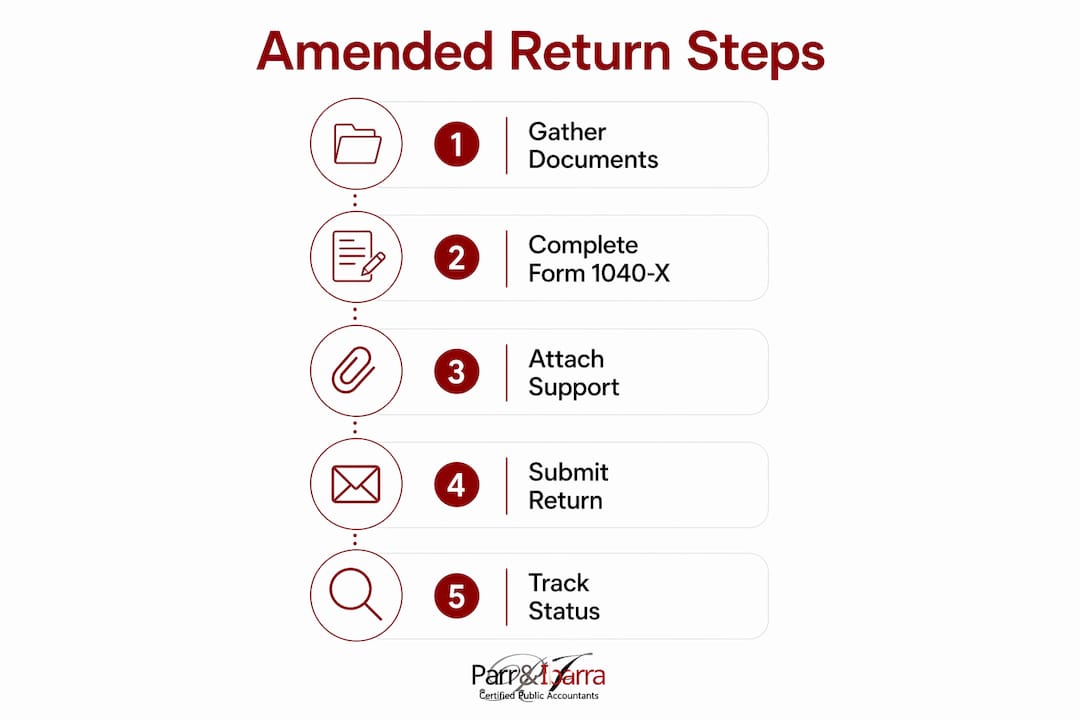
How to complete and submit Form 1040-X step by step
Form 1040-X is structured around three columns that tell the IRS exactly what changed and why. Understanding the column logic before you start saves significant time.
Enter your original figures in Column A. These numbers come directly from your originally filed return. Do not adjust for any IRS corrections already made to your account. Column A is your starting point, not the IRS’s current record of your account.
Enter the net change in Column B. This is the difference between what you originally reported and what the correct amount should be. Use a negative number if you are reducing an amount. The three-column format of Form 1040-X requires precise data entry, so cross-reference your supporting documents carefully before entering anything.
Enter the corrected totals in Column C. Column C equals Column A plus or minus Column B. These are the numbers the IRS will use to recalculate your tax liability.
Complete Part II: Explanation of Changes. This section is not optional. The IRS will not process Form 1040-X without a clear, specific explanation for each change. Write in plain language: “Received corrected 1099-NEC from ABC Company on March 10, 2026, increasing self-employment income by $4,200” is far more effective than “income correction.” Vague explanations invite follow-up letters and processing delays.
Attach supporting documents. Include only the documents directly related to the changes you are claiming. Attaching your entire original return or unrelated forms slows the review. A corrected W-2, a new 1099, or an updated Schedule C is sufficient when that is what drove the change.
Choose your filing method. For 2024, 2025, and 2026 returns, approved tax software and IRS Free File support e-filing of Form 1040-X. E-filing is the faster option. For older years, mail your paper Form 1040-X to the IRS address listed in the form’s instructions, which varies by state.
Sign and date the return. An unsigned Form 1040-X is invalid. If you are filing jointly, both spouses must sign.
Pay any additional tax owed. If your amendment increases your tax liability, pay by the original due date to minimize penalties and interest. Use IRS Direct Pay online or Form 1040-V if mailing a check.
Pro Tip: You can file up to 3 amended returns for the same tax year if you discover additional corrections after submitting your first 1040-X. Each subsequent amendment must include all prior corrections, not just the newest one.
Here is a quick comparison of e-filing versus paper filing for amended returns:
| Factor | E-filing | Paper filing |
|---|---|---|
| Eligible years | 2024, 2025, 2026 | All years |
| Processing time | 8 to 10 weeks typical | 10 to 12 weeks or longer |
| Tracking | Available immediately | Available after IRS receives form |
| Signature | Electronic | Handwritten required |
| Supporting docs | Uploaded with submission | Mailed with form |
What to expect after filing your amended return
Most taxpayers underestimate how long the amendment process takes. Setting accurate expectations prevents unnecessary stress and premature follow-up calls to the IRS.
The IRS processes amended returns in 8 to 12 weeks, and e-filing saves roughly one to two weeks compared to paper. During peak filing season, processing can stretch beyond 12 weeks. That timeline is normal and does not indicate a problem with your return.
Key milestones to watch for:
- Status tracking: Use the IRS “Where’s My Amended Return?” tool at IRS.gov or call 866-464-2050 to check status. The tool updates once daily and shows three stages: received, adjusted, and completed.
- IRS acceptance: The IRS may accept your amendment in full, partially accept it, or disallow it entirely. Full acceptance means your refund or adjusted balance is processed as filed.
- Partial or full disallowance: If the IRS disagrees with part or all of your amendment, you will receive a notice explaining the reason. You have the right to respond, request an appeal, or petition the U.S. Tax Court.
- State returns: Most states require a separate amended state return after a federal amendment. Many states require notification within 90 days of the federal change. Check your state’s department of revenue for specific deadlines and forms.
The amended return is the official claim for refund required to initiate a tax refund lawsuit, making accuracy and a detailed explanation critical for legal standing if a dispute escalates.
Do not call the IRS before the 12-week mark unless the “Where’s My Amended Return?” tool specifically instructs you to contact them. Early calls do not speed up processing and consume time you could spend elsewhere.
Common mistakes that delay or derail amended returns
Most amendment problems are preventable. These are the errors that consistently cause delays or outright rejections.
- Filing before the original return processes. The IRS advises waiting for original return processing before submitting an amendment. Filing too early creates conflicting records in IRS systems.
- Vague Part II explanations. “Error correction” tells the IRS nothing. Specify the form, the line number, the dollar amount, and the reason for the change.
- Attaching unnecessary documents. Sending your entire original return, unrelated schedules, or duplicate forms adds bulk without value and can trigger additional review.
- Amending for math errors. The IRS automatically corrects arithmetic mistakes on original returns. Filing a 1040-X for a math error wastes time and can confuse your account. Amend only when income, credits, deductions, or filing status actually change.
- Missing the refund deadline. The three-year window for refund claims is firm. There is no extension for forgetting.
- Forgetting state amendments. A federal amendment that changes your adjusted gross income almost always requires a corresponding state amendment.
Pro Tip: If your amendment involves multiple tax years, a complex business deduction, or a dispute with the IRS, consult a CPA before filing. The cost of professional help is almost always less than the cost of a rejected amendment or an audit triggered by an unclear explanation.
Key takeaways
Filing an amended tax return correctly requires Form 1040-X, precise three-column data entry, a specific written explanation of every change, and patience through an 8 to 12 week processing window.
| Point | Details |
|---|---|
| Use Form 1040-X | This is the only IRS-approved form for amending individual federal tax returns. |
| E-file for speed | Electronic filing is available for 2024, 2025, and 2026 returns and saves one to two weeks. |
| Explain every change | Part II requires a specific, detailed narrative or the IRS will not process the form. |
| Watch the refund deadline | You have three years from the filing date or two years from tax payment to claim a refund. |
| File state returns separately | Most states require their own amended return within 90 days of a federal change. |
What I’ve learned from years of amended return filings
After working through hundreds of amended returns with clients at Parr & Ibarra CPA, the single biggest mistake I see is impatience. A client spots an error in February, files a 1040-X the next day before the original return has even posted, and then spends three months untangling the confusion. Waiting feels counterintuitive when you know money is owed to you. But the IRS processes returns sequentially, and an amendment that arrives before the original is fully processed creates a conflict that requires manual intervention.
The second thing I have learned is that the quality of Part II explanations separates smooth amendments from problem ones. I have seen one-sentence explanations sail through in eight weeks and vague two-word entries sit in review for six months. The IRS reviewer reading your form is not a mind reader. Tell them exactly what changed, why it changed, and what document proves it.
I also push back on the idea that e-filing is always the right choice. For straightforward corrections on recent returns, yes, e-file every time. But for complex multi-year amendments involving business income, depreciation recapture, or carryforward losses, paper filing with a well-organized attachment package often produces a cleaner record. The ability to include a cover letter explaining the full context of the changes is underrated.
Finally, do not ignore the state side of this equation. I have seen clients receive their federal refund, celebrate, and then get hit with a state notice six months later because they forgot to file the state amendment. Most states give you 90 days from the federal change. That window moves fast.
— Adan
Let Parr & Ibarra CPA handle your amended return
Filing an amended return is straightforward when the changes are simple. When they involve business income, multiple years, or a disagreement with the IRS, the stakes are higher and the margin for error is smaller.

Parr & Ibarra CPA serves individuals and business owners across the Dallas-Fort Worth area with personalized tax and accounting services that go well beyond annual filing. Our team of over 20 professionals, including multiple CPAs, handles amended returns with the precision and documentation standards that keep IRS processing moving. Whether you missed a deduction, received a corrected income statement, or need to correct several prior years, we provide the hands-on guidance that turns a stressful correction into a resolved file. Contact Parr & Ibarra CPA in Hurst, TX to schedule a consultation.
FAQ
What is an amended tax return?
An amended tax return is a corrected federal return filed using Form 1040-X to update income, deductions, credits, filing status, or dependent information after the original return has been submitted to the IRS.
How long does the IRS take to process an amended return?
The IRS typically processes amended returns in 8 to 12 weeks. E-filed amendments process one to two weeks faster than paper submissions.
What is the deadline to file an amended return for a refund?
The deadline is the later of three years after the original filing date or two years after the tax was paid. Filing after this window forfeits any refund claim.
Can I e-file my amended tax return?
Yes, for tax years 2024, 2025, and 2026. Older tax years require a paper Form 1040-X mailed to the IRS address listed in the form’s instructions.
Do I need to file an amended state return after amending my federal return?
Most states require a separate amended state return after a federal amendment, typically within 90 days of the federal change. Check your state’s department of revenue for the specific form and deadline.

