

Choosing between an LLC and an S-Corp is one of the most consequential tax decisions a small business owner will make. Get it right and you can save thousands of dollars every year. Get it wrong, or wait too long, and you leave real money on the table. Money that could go back into your business, your retirement, or your family.
This guide covers everything you need to know about LLC vs S-Corp tax strategy for 2026. How each structure is taxed, when an S-Corp election makes financial sense, what the IRS expects from S-Corp owners, and the mistakes that trip up business owners who try to navigate this alone. We also cover the most significant recent tax law changes, including the provisions of the One Big Beautiful Bill Act signed July 4, 2025, that directly affect LLC and S-Corp owners.
Whether you are a freelancer crossing six figures for the first time, a service-based business owner with growing profits, or an entrepreneur in Keller, Texas evaluating your options before launch, this guide gives you the full picture.
2026 IRS Updates Every LLC and S-Corp Owner Needs to Know
The One Big Beautiful Bill Act, signed July 4, 2025, introduced substantial permanent changes to tax law affecting pass-through entities. The QBI deduction has been made permanent. Bonus depreciation is restored to 100%. R&D expenses are immediately deductible. The SALT cap has been raised. If you have not reviewed your entity structure and tax strategy since these changes took effect, that review is overdue. The full breakdown of the 2026 federal tax law updates covers how these provisions interact across different business types and income levels, and who actually benefits from the tax bill is worth reading alongside it.
QBI Deduction Is Now Permanent
The Section 199A Qualified Business Income deduction, which allows eligible pass-through business owners to deduct up to 20% of qualified business income, has been made permanent under the OBBBA. Previously set to expire after 2025, it now has no sunset date. For S-Corp owners and LLC members, this is one of the most valuable deductions available, and its permanence allows for genuine long-term planning rather than year-to-year uncertainty.
For 2026, the income thresholds before the phase-out begins have been adjusted upward to approximately $203,000 for single filers and $406,000 for joint filers. Service-based businesses in law, consulting, accounting, and financial services should monitor their income relative to these thresholds carefully, as the deduction begins to phase out above them.
100% Bonus Depreciation Is Back Permanently
One of the most significant provisions of the OBBBA restores 100% bonus depreciation on a permanent basis. Prior law had been phasing this down from 80% in 2023 toward zero by 2027. Under the new rules, S-Corp owners and LLC members can immediately write off the full cost of qualifying equipment, vehicles, technology, and furniture purchased for business use in the year the asset is placed in service. What 100% bonus depreciation means for business owners in practice is substantial, particularly for capital-intensive businesses that have been holding off on equipment purchases.
R&D Expenses Are Immediately Deductible Again
Domestic research and development expenses are now immediately deductible in the year incurred, reversing the 2022 requirement that R&D costs be amortized over five years. Software development costs are also eligible for immediate deduction. For technology companies and businesses that invest in developing new processes or products, this change produces meaningful current-year tax savings.
SALT Cap Raised to $40,400 for 2026
The state and local tax deduction cap has increased to approximately $40,400 for 2026, adjusted upward from $40,000 in 2025, and indexed through 2029. It phases out above roughly $505,000 in modified adjusted gross income in 2026. Without further legislative action, the cap reverts to $10,000 in 2030. Texas has no state income tax, which puts Keller-area business owners in an already favorable position, but those with significant property tax obligations or income from other states should coordinate this change carefully with their CPA.
Section 179 Limits Increased
The Section 179 expense limit has been raised to approximately $1.32 million for 2026, with the phase-out beginning after $3.29 million in qualifying purchases. This provision allows businesses to elect to expense qualifying property immediately rather than depreciating it over time. Maximizing business deductions through depreciation, amortization, and expensing strategies covers how Section 179 and bonus depreciation work together and where each one makes more sense depending on your income and asset situation.
2026 S-Corp Filing Deadlines
Form 1120-S is due March 16, 2026 for calendar-year S-Corps. The standard March 15 deadline shifts to the next business day because March 15 falls on a Sunday. If more time is needed, a six-month extension using Form 7004 moves the filing deadline to September 15, 2026. The extension applies to filing only, not to any taxes owed. Staying on top of essential tax deadlines is straightforward with the right systems in place, but missing S-Corp deadlines carries real consequences. The IRS imposes a penalty of $245 per shareholder per month the return is late, up to 12 months. A 10-shareholder S-Corp filing six months late could face $14,700 in penalties, entirely separate from any unpaid taxes. If you need to file an extension, the guide to filing a business tax extension walks through the process step by step.
How an LLC Is Actually Taxed
A Limited Liability Company separates your personal assets from your business liabilities. If your business is sued or accumulates debt, your personal finances are generally protected. That liability protection is the primary legal reason most entrepreneurs choose an LLC over operating as a sole proprietor.
How an LLC is taxed, though, depends entirely on how many members it has and whether any special elections have been made with the IRS.
Single-Member LLC
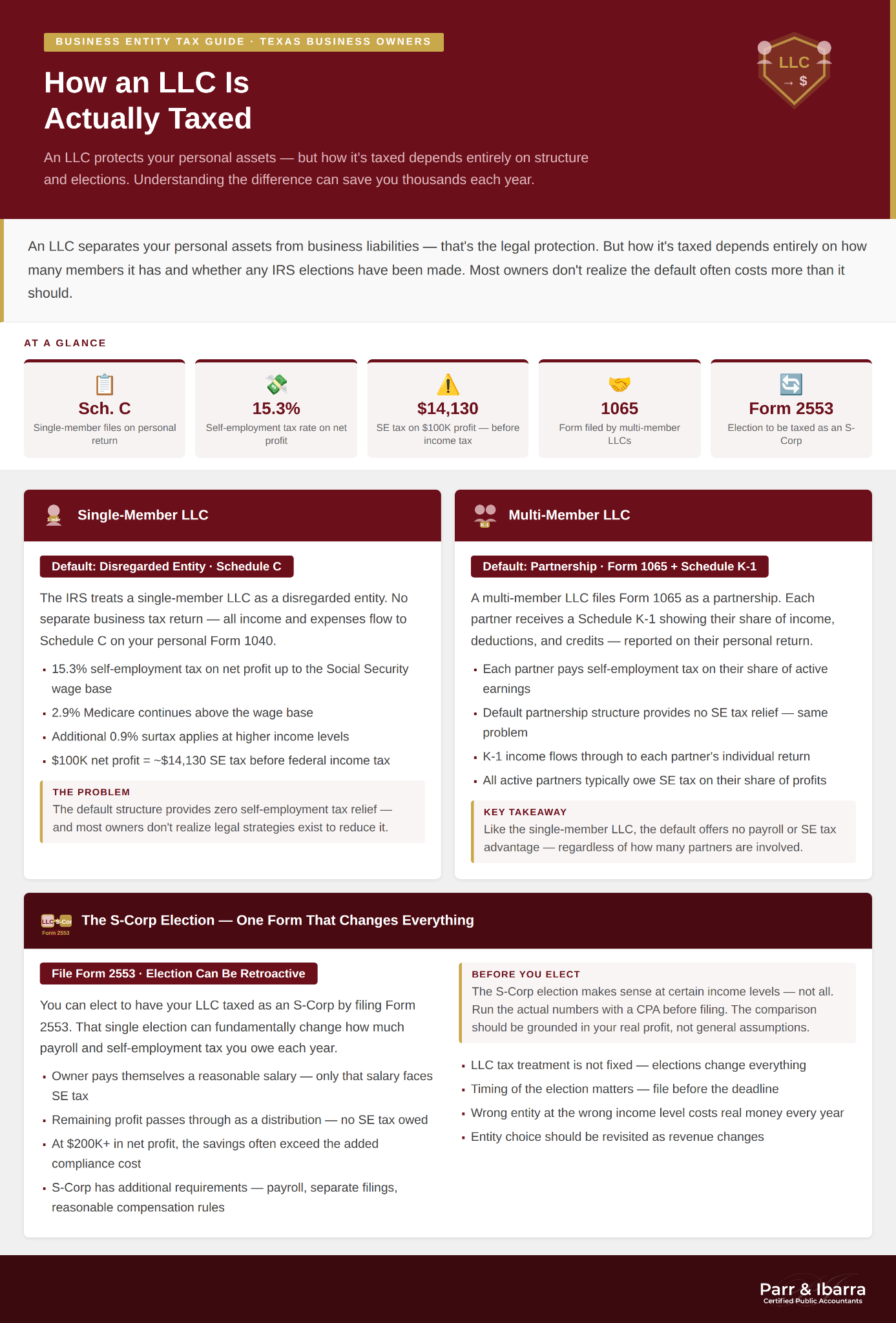
By default, the IRS treats a single-member LLC as a disregarded entity. The business does not file its own tax return. The owner reports all business income and expenses on Schedule C, attached to their personal Form 1040.
The problem is self-employment tax. As a single-member LLC owner, you owe self-employment tax at 15.3% on your net business profit up to the Social Security wage base. That covers both the employee and employer portions of Social Security and Medicare. Above the wage base, you continue to owe 2.9% for Medicare, with an additional 0.9% surtax at higher income levels.
If your business earns $100,000 in net profit, you are paying approximately $14,130 in self-employment tax before federal income tax even enters the picture. Many business owners do not realize there are legal strategies to reduce that burden substantially.
Multi-Member LLC
A multi-member LLC is treated as a partnership by default. The business files Form 1065, and each partner receives a Schedule K-1 showing their share of income, deductions, and credits. Each partner then reports that income on their personal return and pays self-employment tax on their share of active business earnings.
Like the single-member LLC, the default partnership structure provides no self-employment tax relief. All active partners typically owe self-employment tax on their share of profits.
One important note: the tax treatment of your LLC is not fixed. You can elect to have your LLC taxed as an S-Corp by filing Form 2553. That single election can fundamentally change how much payroll and self-employment tax you owe each year. Before that election makes sense, it is worth understanding the full landscape of business entity structures and their tax implications so the comparison is grounded in your actual numbers, not general assumptions.
How an S-Corp Is Taxed
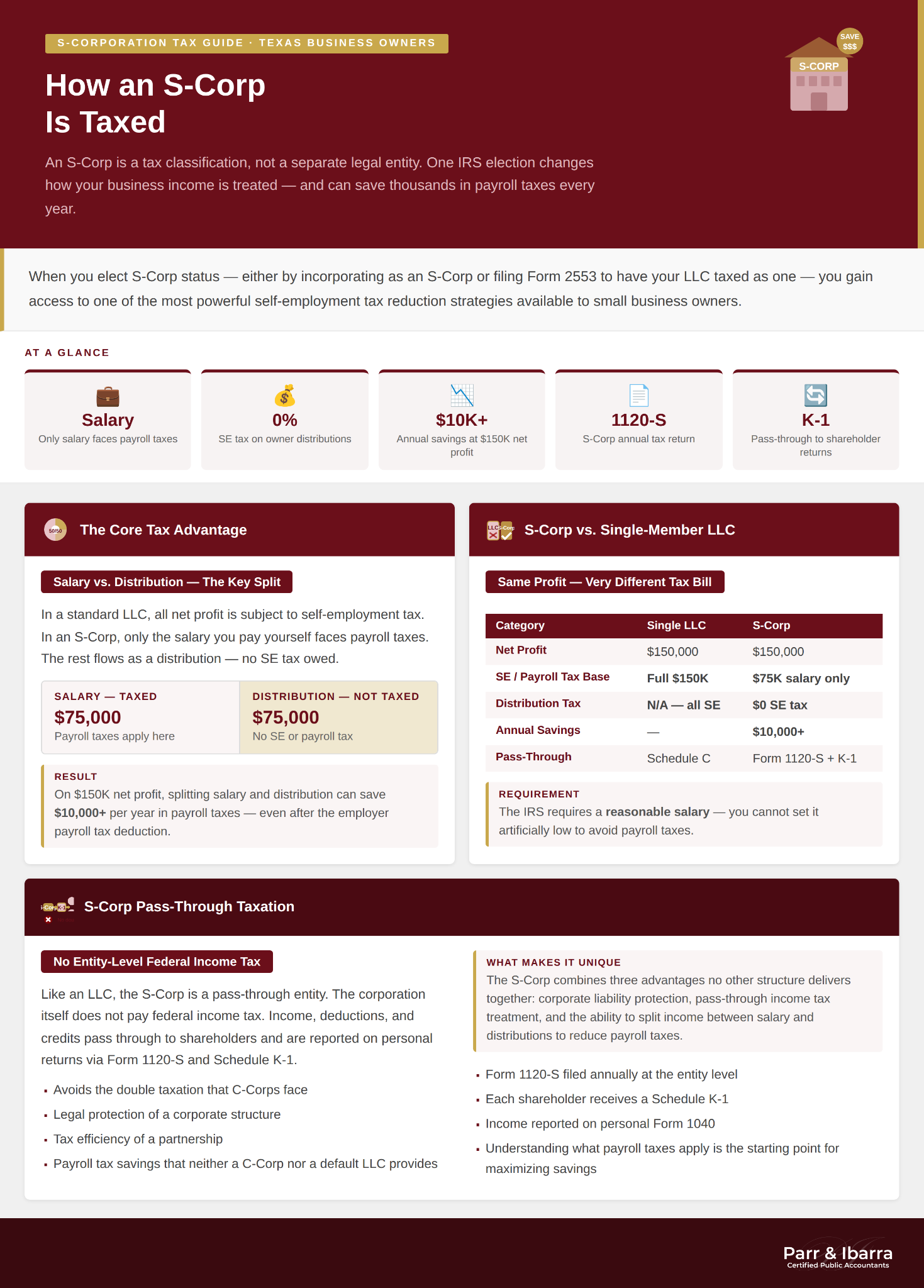
An S-Corporation is not a separate legal entity in the way a C-Corp is. It is a tax classification, a special election made with the IRS that changes how your business income is treated for federal tax purposes. When you elect S-Corp status, whether through incorporating as an actual S-Corp or filing Form 2553 to have your LLC taxed as an S-Corp, you gain access to one of the most powerful self-employment tax reduction strategies available to small business owners.
The Core Tax Advantage
In a standard LLC, all net profit is subject to self-employment tax. In an S-Corp, only the salary you pay yourself is subject to payroll taxes. The remaining profit flows through as an owner distribution and is not subject to self-employment or payroll taxes.
For example: your business generates $150,000 in net profit. As a single-member LLC, the entire amount is subject to self-employment tax. As an S-Corp owner, you might pay yourself a reasonable salary of $75,000 and take the remaining $75,000 as a distribution. Payroll taxes apply only to the $75,000 salary. The distribution avoids them entirely. At those numbers, the annual payroll tax savings can exceed $10,000, even after accounting for the employer payroll tax deduction.
Understanding what types of payroll taxes apply to S-Corp owner-employees versus sole proprietors is the starting point for understanding exactly where those savings come from and how to preserve them correctly.
S-Corp Pass-Through Taxation
Like an LLC, the S-Corp is a pass-through entity. The corporation itself does not pay federal income tax at the entity level. Income, deductions, and credits pass through to shareholders and are reported on their personal returns via Form 1120-S and Schedule K-1. This avoids the double taxation that C-Corps face and gives you the legal protection of a corporate structure combined with the tax efficiency of a partnership, plus the payroll tax savings that neither a C-Corp nor a default LLC provides.
When Does an S-Corp Election Actually Make Sense?
The answer depends on your net profit, your state, your industry, and your personal tax situation. That said, there are general benchmarks that apply to most situations.
The Profit Threshold
Most tax professionals agree that an S-Corp election becomes financially advantageous when net business profit reliably exceeds $50,000 to $60,000 annually. Below that threshold, the costs of payroll, the Form 1120-S filing, and the added compliance requirements frequently exceed the self-employment tax savings.
Above that threshold, the math typically tips in favor of the S-Corp. A business earning $80,000 in net profit might save $5,000 to $8,000 annually. A business earning $200,000 might save $15,000 or more. Those savings compound year after year and represent real wealth that stays in your pocket. Evaluating whether your current tax situation is already costing you more than it should is a useful first step before committing to any structural change.
Factoring in the Real Costs
Before committing to an S-Corp election, the additional costs need to be part of the calculation. Payroll processing fees, an additional tax return (Form 1120-S), potential state-level fees, and quarterly tax filing requirements at the federal and state level all factor in. A proper analysis subtracts these expenses from your projected payroll tax savings to arrive at the true net benefit.
Knowing how to determine the correct amount of payroll taxes to withhold matters once payroll is running, and the compliance obligations around it are worth understanding before you make the election, not after.
Texas-Specific Considerations
Texas is one of the most favorable states for small business owners from a tax perspective. There is no state personal income tax, which means the self-employment tax savings from an S-Corp election flow directly to the owner without being offset by state income taxes. This makes the S-Corp election particularly attractive for Texas-based business owners compared to counterparts in California, New York, or Illinois.
Texas does impose a Franchise Tax on most business entities including LLCs and S-Corps. However, for most small businesses the effective rate is low, and the No Tax Due threshold means many smaller businesses owe nothing. For business owners in Keller, Texas, and the broader DFW area, working with a local CPA who understands these Texas-specific requirements is an important part of getting the entity election right.
The Reasonable Salary Requirement
The IRS is fully aware that S-Corp owners could exploit the salary-versus-distribution split by paying themselves a minimal salary and taking most income as distributions. To prevent this, S-Corp owner-employees are required to pay themselves a reasonable salary for the work they perform.
What the IRS Considers Reasonable
The IRS does not publish a specific formula, but it evaluates several factors: what an outside employee would be paid for the same work, what comparable businesses pay for similar roles, the time and effort devoted to the business, and the company’s overall financial health. Many tax professionals recommend setting S-Corp salary at roughly 40% to 60% of net profit, though this is a general guideline rather than an IRS rule. A software consultant earning $300,000 in net profit cannot justify a $25,000 salary. An IRS audit would likely recharacterize those distributions as wages, resulting in back payroll taxes, penalties, and interest.
Understanding how an IRS audit actually works is useful context here, because unreasonable S-Corp compensation is one of the most common triggers for examination. IRS audit risks have shifted in ways that affect businesses at every revenue level, and the documentation supporting your salary decision is your primary defense if questions arise.
Documenting Your Salary Decision
When a CPA helps you determine your S-Corp salary, they will typically compile industry salary surveys, document your specific roles and responsibilities in writing, and maintain a record of how the compensation figure was determined. This creates an audit trail that supports your position if the IRS ever asks. Treating this as an afterthought is a mistake. Knowing what records to keep for your business applies to salary documentation as much as it does to expense receipts.
How the LLC to S-Corp Election Actually Works
If you already have an LLC and want to be taxed as an S-Corp, you do not need to dissolve the LLC and form a new corporation. You file Form 2553 with the IRS to make the S-Corp election. The LLC continues to exist as a legal entity under state law, but the IRS treats it as an S-Corp for federal tax purposes.
Steps to make the election: confirm your LLC meets S-Corp eligibility requirements (domestic company, no more than 100 shareholders, only one class of stock, all owners must be U.S. citizens or resident aliens and not other corporations or partnerships). Complete Form 2553 and have all shareholders sign it. File by the applicable deadline, which is generally 75 days from the date of formation for a new business, or two months and 15 days into the tax year for an existing LLC converting mid-year. Set up payroll for yourself and begin paying a documented, reasonable salary. Work with your CPA to transition your accounting from Schedule C or Form 1065 to Form 1120-S.
Ongoing Compliance Requirements
Once the S-Corp election is made, you take on a set of ongoing responsibilities. Running payroll at least quarterly. Filing quarterly payroll tax returns using Form 941. Preparing and filing Form 1120-S by the March deadline each year. Issuing W-2 forms to yourself each January.
These obligations are manageable with the right systems. Bookkeeping basics for small businesses outlines the foundational financial hygiene that makes S-Corp compliance straightforward rather than burdensome. The businesses that find S-Corp compliance stressful are almost always the ones that did not set up proper bookkeeping and payroll systems from the start.
Common Mistakes to Avoid
Waiting too long to make the election: Some business owners learn about the S-Corp strategy when their profits are already well into six figures. Every year they operate as a standard LLC, without the election, the excess self-employment taxes cannot be recovered. Making the decision proactively, ideally before profits get high, is always better than reacting after the fact.
Paying an unreasonably low salary: Paying yourself almost nothing in salary to maximize distributions invites scrutiny. The goal is to pay a defensible, reasonable salary and take distributions on top of that amount. Getting this wrong is expensive, and fixing it after an audit is more expensive still.
Commingling personal and business finances: S-Corps require a higher level of financial discipline than a sole proprietorship. How poor financial practices can put your LLC liability shield at risk explains exactly what happens when this boundary breaks down. A dedicated business bank account and consistent bookkeeping are non-negotiable for S-Corp compliance.
Ignoring payroll tax obligations: Once you are running payroll, the compliance obligations multiply. Understanding the tax implications of having employees versus contractors matters if you bring on staff alongside your own payroll, and misclassification is one of the IRS’s most actively enforced areas.
Failing to document the salary decision: If the IRS ever questions your compensation, contemporaneous documentation is your support. Industry salary surveys, a written description of your role and responsibilities, and records showing when and how the figure was determined are all part of that file. Treating this as optional is a mistake with real financial consequences.
Advanced S-Corp Tax Strategies for 2026
Once the basics are in place, several additional strategies can amplify the tax benefits of your S-Corp under current law.
Maximize Retirement Contributions
One of the most powerful advantages of an S-Corp is the ability to contribute to a retirement plan as both employer and employee. As an S-Corp owner-employee, you can make elective deferrals up to the annual 401(k) limit as an employee, plus employer profit-sharing contributions of up to 25% of your W-2 compensation. Working with a CPA on a retirement strategy ensures that the contribution levels are calibrated to your actual income and entity structure each year, not just set once and forgotten. S-Corp owners specifically should also understand how SEP-IRA rules apply to their structure, as contribution mechanics differ from what applies to sole proprietors.
Health Insurance Deduction
S-Corp owner-employees who own more than 2% of the corporation can deduct health insurance premiums as an above-the-line deduction on their personal return, but only if those premiums are included in W-2 wages. The S-Corp pays or reimburses the premium, includes it in the owner’s W-2, and the owner deducts it on their personal return. Done correctly, this is a meaningful deduction that reduces your adjusted gross income.
Bonus Depreciation and Section 179 in 2026
With 100% bonus depreciation permanently restored under the OBBBA, S-Corp owners who purchase qualifying assets in 2026 can write off the full cost in the year of purchase. Leveraging bonus depreciation alongside other post-reform strategies is particularly valuable for S-Corp owners who are also investing in real estate or significant capital equipment. Coordinating large asset purchases with your overall income picture for the year can materially reduce your tax bill.
QBI Deduction Planning
With the QBI deduction now permanent, long-term planning is more valuable than ever. S-Corp owner distributions count as qualified business income for the QBI deduction, while W-2 wages paid to yourself do not. Understanding how your salary-versus-distribution split affects the size of your QBI deduction is an important part of optimizing your overall tax position. Tax strategies built specifically for founders and entrepreneurs cover this interaction in more detail, along with other planning moves that apply specifically to business owners managing equity, compensation, and distributions simultaneously.
For taxpayers above the income phase-in range, the deduction is limited to the greater of 50% of W-2 wages paid by the business, or 25% of W-2 wages plus 2.5% of the unadjusted basis of qualifying property. Getting the salary level right is not just about payroll taxes. It also determines the size of your QBI deduction. These two goals sometimes pull in different directions, and finding the right balance requires modeling your actual numbers.
Pass-Through Entity Tax Elections
Many states permit Pass-Through Entity tax elections that allow the entity to pay state income tax at the entity level, with shareholders receiving a credit on their personal return. Because the entity-level state tax is fully deductible for federal purposes, a PTE election effectively allows shareholders to deduct state income taxes beyond the SALT cap. For business owners with operations in high-tax states, this can generate a 4% to 5% effective savings on state income taxes.
LLC or S-Corp: Which Is Right for You?
After working through the tax mechanics, the compliance requirements, the savings potential, the law changes, and the common pitfalls, the LLC vs S-Corp question comes down to your specific numbers and goals.
An LLC with default taxation is the right choice if your net profit is below $50,000, if you are just starting out and want simplicity, if the cost of payroll and an S-Corp return would consume most of your potential savings, or if your income is too irregular to justify a fixed payroll structure.
An S-Corp election makes sense if your net profit consistently exceeds $60,000 per year, if you are committed to maintaining proper payroll and bookkeeping systems, if you want to maximize retirement contributions and benefit from the advanced strategies above, and if you are working with a qualified CPA who can handle the compliance properly.
There is no universal answer. The right structure for a freelance consultant in Keller, Texas earning $90,000 is not the same as the right structure for a multi-member professional services firm earning $500,000. Top tax strategies for high-income professionals cover what the planning picture looks like as income climbs, and that context matters when deciding how aggressively to optimize your structure. The goal of entity selection is not simply to save taxes today. It is to build a sustainable, compliant tax strategy that supports your long-term financial goals and adapts as your business grows.
About Parr & Ibarra CPA
Making the right LLC vs S-Corp decision requires more than reading a guide. It requires someone who knows your specific numbers, the current state of IRS rules including all the changes from the One Big Beautiful Bill Act, Texas state tax requirements, and your business goals.
Parr & Ibarra CPA is based in Keller, Texas, and specializes in tax strategy for small business owners and entrepreneurs across the DFW area. The team analyzes your current situation, models the potential savings under 2026 law, handles the S-Corp election paperwork if it makes sense, sets up payroll, and manages ongoing compliance from start to finish.
If you are wondering whether an S-Corp election makes sense for your business, or want a second opinion on the structure you already have, schedule a 60-minute consultation at aibarra.cpa or call 817.562.5375. The team will walk you through the numbers, answer your questions, and give you a clear recommendation based on your actual situation and the tax laws that apply to you as a business owner in Texas.
Frequently Asked Questions
What is the main tax difference between an LLC and an S-Corp?
In a default LLC, all net profit is subject to self-employment tax at 15.3% up to the Social Security wage base. In an S-Corp, only the owner’s reasonable salary is subject to payroll taxes. Remaining profit taken as a distribution avoids self-employment tax entirely. For profitable businesses, this distinction can mean thousands of dollars in annual savings.
When does an S-Corp election make financial sense?
Generally when net business profit consistently exceeds $50,000 to $60,000 per year. Below that threshold, the added costs of payroll and an additional tax return often exceed the savings. Above it, the math typically favors the S-Corp by a meaningful margin.
How does 100% bonus depreciation affect S-Corp owners in 2026?
S-Corp owners who purchase qualifying equipment, vehicles, technology, or furniture in 2026 can write off the full cost in the year of purchase rather than depreciating it over several years. This can substantially reduce taxable income in years with significant capital spending and is one of the most immediate benefits of the OBBBA for business owners.
What is a reasonable salary for an S-Corp owner?
There is no IRS-published formula, but most tax professionals recommend 40% to 60% of net profit as a starting point. The salary must be defensible based on what an outside employee would be paid to do the same work. Too low a salary invites IRS scrutiny. Too high a salary increases payroll taxes unnecessarily. The right number requires a documented analysis based on your role, industry, and business financials.
Can I convert my existing LLC to an S-Corp without dissolving it?
Yes. You file Form 2553 with the IRS, and your LLC continues to exist as a legal entity under state law while being treated as an S-Corp for federal tax purposes. The election must be filed by specific deadlines depending on when you want it to take effect. Your CPA handles this paperwork and coordinates the transition of your accounting and payroll systems.
Does the QBI deduction apply to S-Corp owners?
Yes, S-Corp owners can claim the 20% QBI deduction on their distribution income, subject to income thresholds and W-2 wage limitations at higher income levels. Importantly, the salary you pay yourself does not count as qualified business income. How you structure your salary-versus-distribution split directly affects the size of your QBI deduction, which is why getting that balance right requires modeling both payroll tax savings and QBI deduction impacts together.
What happens if I miss the S-Corp tax filing deadline?
The IRS imposes a penalty of $245 per shareholder per month the return is late, up to 12 months. A 10-shareholder S-Corp filing six months late could face $14,700 in penalties, separate from any unpaid taxes. Filing for an extension using Form 7004 before the deadline avoids late-filing penalties, though it does not extend the time to pay any taxes owed.
This article is intended for informational purposes and reflects general tax principles as of 2026. Tax situations vary. Consult a qualified CPA like Parr & Ibarra CPA before making tax or investment decisions.

