
You need to file Form 706 if the gross estate plus adjusted taxable gifts and the specific exemption exceeds the year-of-death threshold, currently $15,000,000 for deaths in 2026. You may also need to file below that number to elect portability of the deceased spouse’s unused exclusion. Nonresidents who were not citizens follow separate rules under Form 706-NA.
TL;DR:
- Estates with a gross value exceeding $15 million in 2026 must file Form 706, and failure to do so can prevent preserving the spouse’s unused exemption.
- Executors often underestimate estate value and should include assets like real estate, business interests, life insurance, joint property, and lifetime gifts at fair market value.
- Nonresident decedents file Form 706-NA with a much lower, fixed $60,000 threshold based only on U.S.-situated assets, not worldwide estate.
- Filing deadlines are nine months after death, with extensions possible but not delaying tax payments, which accrue interest and penalties if late.
- Supporting documents such as appraisals, account statements, and policy details are essential for accurate valuation and IRS compliance.
Who must file Form 706: the filing test explained
The filing test is not about what heirs actually inherit. It is about the total value of everything the decedent owned or controlled at death, combined with certain lifetime gifts.
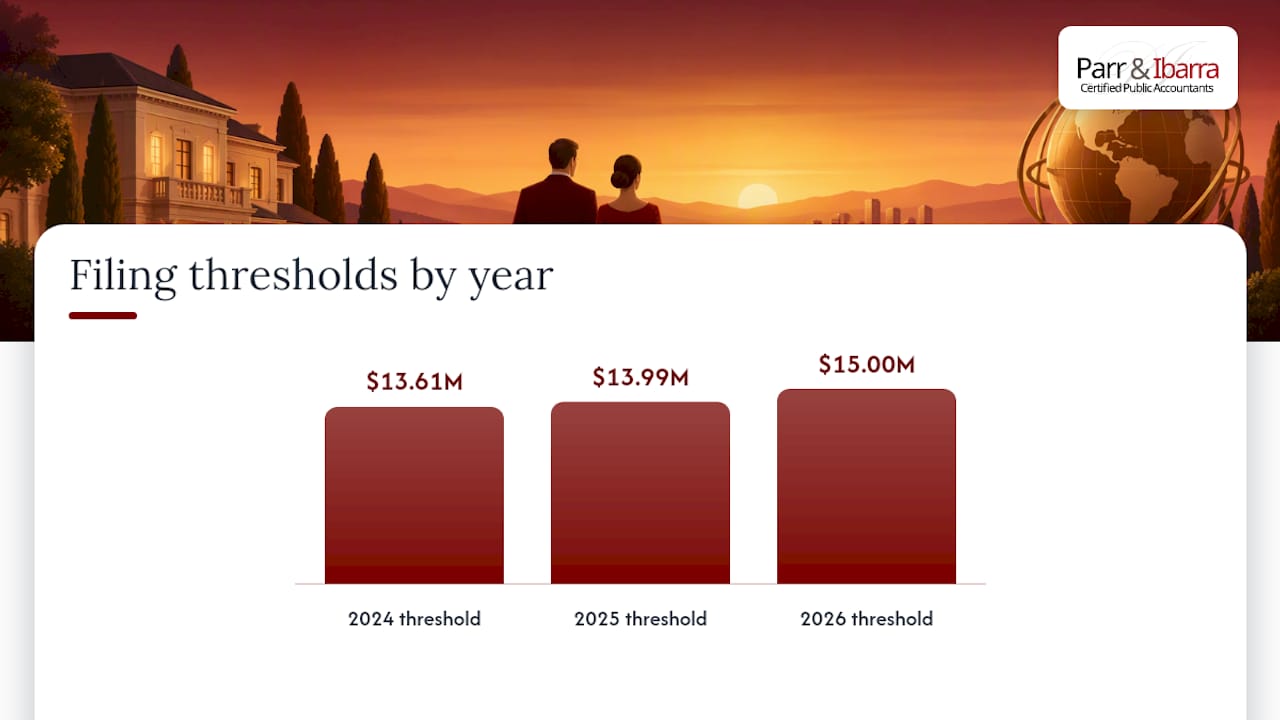
For U.S. citizens and residents, Form 706 is generally required when the gross estate plus adjusted taxable gifts and the specific exemption that exceeds the filing threshold for the year of death. The thresholds are indexed each year: $13,610,000 for 2024, $13,990,000 for 2025, and $15,000,000 for 2026, according to the same IRS guidance. An estate under that number owes no federal estate tax and, in most cases, does not need to file at all.
Portability changes that calculation. A surviving spouse can inherit any unused portion of the decedent’s exemption, called the deceased spousal unused exclusion, but only if the executor files a timely Form 706 to make that election. Skip the filing, and the exclusion is lost even if the estate was nowhere near the threshold.
That leaves executors with three practical situations:
- The gross estate plus adjusted taxable gifts clearly exceeds the threshold: filing is mandatory.
- The estate is well below the threshold and there is no surviving spouse or no interest in portability: filing is optional.
- The estate is below the threshold but a surviving spouse exists: filing to preserve portability is often worth doing anyway.
How to estimate the gross estate and include lifetime gifts (practical checklist)
Executors frequently underestimate the gross estate because it includes far more than probate assets. According to the IRS estate tax overview, the gross estate includes real estate, business interests, life insurance where the decedent held incidents of ownership, retirement accounts, jointly held property, certain trust assets, and lifetime gifts brought back into the calculation as adjusted taxable gifts. Everything is valued at fair market value as of the date of death.
Adjusted taxable gifts are gifts made during life that exceeded the annual exclusion and were reported on a gift tax return. Pulling old Form 709 filings, if any exist, is often the fastest way to reconstruct that history.
A workable estimation process looks like this:
- Build a full asset list, including jointly held property, trust interests, and any life insurance the decedent could control.
- Pull recent account statements, deeds, and appraisals for real estate and business interests.
- Add adjusted taxable gifts from prior gift tax returns to the gross estate figure.
- Compare the combined total against the year-of-death threshold.
- Bring in a certified appraiser or CPA when business interests, closely held stock, or hard-to-value real estate are involved.
Pro Tip: Value public securities and bank accounts first since they are quick and precise, then move to appraised assets like real estate and business interests, which take longer and often shift the total more than executors expect.
Nonresident decedents and Form 706-NA: when the rules differ
Decedents who were not U.S. citizens and not U.S. residents at death do not use Form 706. Their estates generally file Form 706-NA, which applies a filing test based on U.S.-situated assets rather than the worldwide estate.
The Form 706-NA filing threshold is far lower and is not adjusted for inflation. IRS guidance references a $60,000 threshold for this form, a figure that has stayed fixed for decades while the Form 706 threshold has climbed into the millions.
- Misclassifying a nonresident decedent as a citizen or resident can lead to filing the wrong form entirely.
- Domicile and situs rules determine which assets count, and both can be legally complex for cross-border estates.
- An estate planning attorney or CPA familiar with international estates should confirm classification before any filing decision is made.
Deadlines, extensions, and payment timing
Form 706 is due nine months after the decedent’s date of death. That deadline applies whether the estate owes tax or is filing solely to elect portability.
Executors who need more time can file Form 4768 for an automatic six-month extension to file. That extension covers the paperwork, not the money.
- An extension to file does not extend the deadline to pay; interest and penalties can accrue on unpaid tax from the original nine-month due date.
- Estates that cannot pay in full may qualify for a payment plan or an installment election, similar to the options available for other IRS balances.
- Executors expecting to owe tax should plan payment method early, including electronic options through EFTPS for same-day payments.
Filing on time and paying late is a common and costly mix-up. The paperwork extension buys breathing room for schedules and valuations, not for the tax bill itself.
What to include with Form 706: schedules, valuations, and supporting documents
Form 706 is built around a series of schedules, each documenting a category of assets, deductions, or elections. The Instructions for Form 706 list Schedules A through I, covering real estate, stocks and bonds, mortgages and cash, life insurance, jointly owned property, and other categories.
Each schedule needs its own backup:
- Real estate and closely held business interests generally require a formal appraisal dated near the death.
- Life insurance proceeds need the policy contract and a statement from the insurer confirming the payout.
- Bank and brokerage holdings need account statements as of the date of death.
- Trust assets need the trust instrument and a breakdown of what the decedent could control or benefit from.
Supplemental or amended returns exist for cases where new information surfaces after the original filing. They use separate mailing addresses depending on submission type, according to the IRS filing page. Keeping dated records of every valuation, especially professional appraisals, protects the estate if the IRS later questions a figure.
Common mistakes executors make when deciding to file
Most filing errors trace back to a handful of repeat mistakes.
- Leaving out adjusted taxable gifts or the portability election when estimating whether filing is required.
- Deciding not to file a short Form 706 simply to preserve portability, then losing that exclusion permanently.
- Assuming Form 4768 also extends the payment deadline, which triggers interest and possible penalties on unpaid tax.
- Skipping a professional appraisal for a business interest or unusual asset, then facing an IRS challenge to the reported value.
Pro Tip: Document every valuation decision in writing, including why an asset was valued a certain way, so the reasoning holds up if the return is ever reviewed.
When to hire a CPA for Form 706 decisions
Estates with business interests, hard-to-value assets, or an open portability question benefit from a CPA’s involvement well before the nine-month clock runs out. Valuation disputes and missed elections are the two costliest outcomes in this process, and both are largely preventable with early planning. Executors weighing whether to file should treat that decision as a professional consultation, not a guess based on probate value alone.
— Adan
How Parr & Ibarra CPA can help with Form 706
Estate filings rarely stay simple once business interests, real estate, or a surviving spouse’s portability election enter the picture. Parr & Ibarra CPA works with executors and families across these situations as part of its estate planning and elder planning services, combining tax compliance work with the valuation support that Form 706 often demands.
- Estate and elder planning guidance for executors weighing whether a filing is required.
- Tax compliance and preparation support for the return itself, including coordination on schedules and documentation.
- Access to a professional team for estates with business interests or other complex holdings.
Executors who want a second opinion before the nine-month deadline can review the firm’s estate and elder planning services and request a consultation.
This article is general information, not a substitute for advice from a qualified financial advisor. Consult a qualified financial professional about your own circumstances before acting on anything here.
FAQ
Who is required to file IRS Form 706?
Executors of estates where the gross estate plus adjusted taxable gifts and the specific exemption exceeds the year-of-death threshold must file. Executors of smaller estates may also need to file to elect portability for a surviving spouse.
What are the common mistakes when filing Form 706?
The most frequent errors involve leaving out adjusted taxable gifts, missing the portability election, and assuming an extension to file also extends the deadline to pay. Undervaluing business interests or real estate without a professional appraisal is another recurring problem, according to the IRS instructions for Form 706.
How long do you have to file a 706 return?
Executors have nine months from the decedent’s date of death to file Form 706. Filing Form 4768 grants an automatic six-month extension to file, though it does not extend the deadline to pay any tax owed.
What’s the difference between Form 706 and Form 1041?
Form 706 reports the value of an entire estate at death and determines whether federal estate tax is owed or whether a portability election should be made. Income earned by the estate or a trust after death, such as interest or rental income, is reported on a different income tax return, and the two forms serve entirely different purposes under IRS estate tax guidance.

