

Tax preparation is the process of organizing, calculating, and filing your tax returns to comply with IRS regulations and maximize your financial outcomes. For individuals and small business owners, getting this process right means more than avoiding penalties. It means capturing every deduction you are legally owed and building a financial record that holds up under scrutiny. Programs like IRS Free File, VITA, and professional firms like Parr & Ibarra CPA each serve different needs at different income levels. This guide walks you through every stage of the process, from gathering documents to filing accurately and avoiding the mistakes that trigger audits.
What documents do you need for tax preparation?
Organized records are the foundation of an accurate tax return. Missing a single form, like a 1099 from a freelance client or a 1098 for mortgage interest, can cost you a deduction or trigger an IRS notice. Gathering everything before you start saves time and prevents costly amendments later.
The documents you need depend on your income sources and filing situation. Most filers need the following:
- W-2 forms from every employer for the tax year
- 1099 forms for freelance income, interest, dividends, or retirement distributions
- Schedule K-1 if you are a partner in a business or S-corporation shareholder
- 1098 forms for mortgage interest and student loan interest
- Receipts and records for deductible business expenses, charitable contributions, and medical costs
- Prior year tax return to confirm carryover amounts and verify your adjusted gross income (AGI)
- Social Security numbers for yourself, your spouse, and any dependents
Small business owners need additional records: profit and loss statements, payroll records, vehicle mileage logs, and home office measurements. If you are self-employed, the IRS has specific receipt documentation rules that determine which expenses qualify as deductions.
| Document Type | Typical Source |
|---|---|
| W-2 | Employer payroll department |
| 1099-NEC / 1099-MISC | Clients, banks, brokerages |
| 1098 (mortgage interest) | Mortgage lender |
| Business expense receipts | Vendors, credit card statements |
| Prior year return | Your own records or prior preparer |
| EIN confirmation | IRS or GovComplete |

Pro Tip: Scan and store all tax documents in a dedicated cloud folder as they arrive each january. By the time filing season opens, your records are already organized and accessible from any device.
How do you prepare and file your tax return step by step?
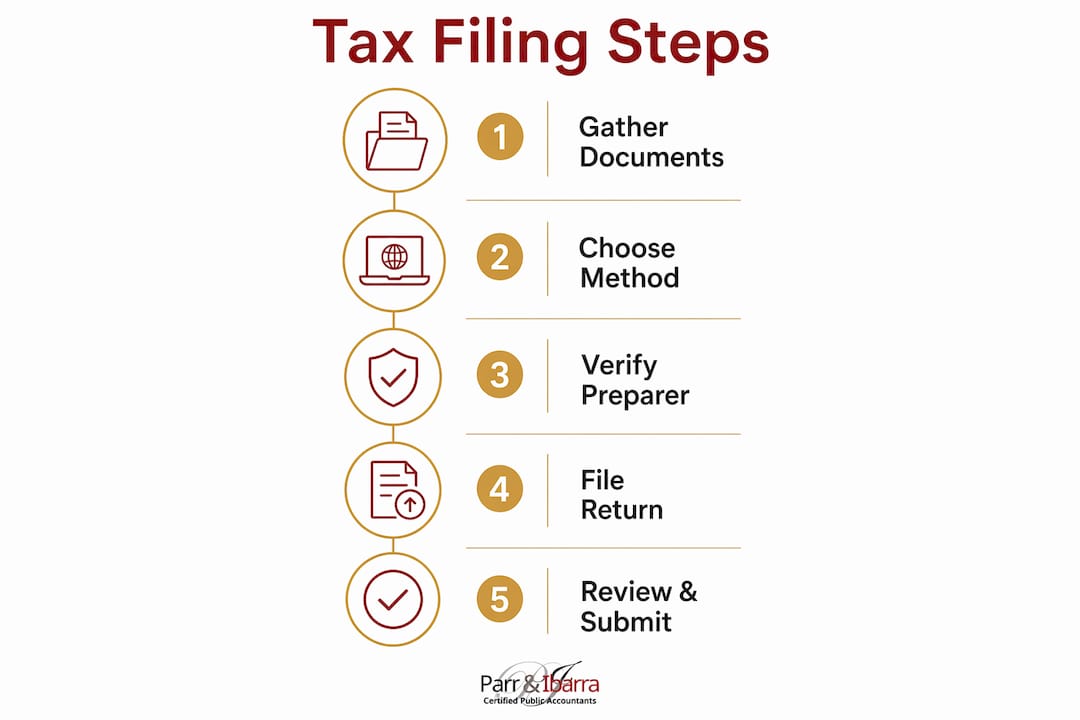
The filing process follows a clear sequence. Skipping steps or rushing through them is the most common reason returns get rejected or refunds get delayed. Here is the full process from start to submission.
- Gather all documents listed above before opening any tax form or software.
- Choose your filing method: DIY software, IRS Free File, a VITA volunteer site, or a licensed CPA.
- Select the correct filing status: single, married filing jointly, married filing separately, head of household, or qualifying surviving spouse.
- Report all income accurately, including wages, freelance earnings, rental income, and investment gains.
- Claim deductions and credits: decide between the standard deduction and itemizing. For 2026, the standard deduction is a strong choice for most filers, but itemizing wins when mortgage interest, state taxes, and charitable contributions exceed the threshold.
- Complete all required schedules: Schedule C for self-employment income, Schedule E for rental income, and Schedule SE for self-employment tax.
- Review every line before submitting. Math errors and transposed Social Security numbers are the top causes of IRS notices.
- E-file your return. E-filing is faster, safer, and more accurate than paper filing because it includes automatic math checks and delivers IRS confirmation within 24 hours.
- Set up direct deposit for your refund. It is the fastest way to receive your money.
- Keep copies of your filed return and all supporting documents for at least three years.
The choice between DIY and professional help depends on complexity. A single W-2 filer with no investments or business income can handle their own return with confidence. A small business owner with multiple income streams, depreciation schedules, and payroll obligations benefits from professional tax return assistance.
Pro Tip: Before hiring any paid preparer, verify they have a valid Preparer Tax Identification Number (PTIN). By law, every paid preparer must include their PTIN on every federal return they sign. You can confirm a preparer’s PTIN through the IRS Directory of Federal Tax Return Preparers.
One area many filers overlook is refundable tax credits. The Earned Income Tax Credit requires you to file a return even if your income falls below the filing threshold. Filing is the only way to claim it.
What are the most common tax preparation mistakes?
Errors on tax returns delay refunds, generate IRS notices, and in serious cases, trigger audits. Most mistakes are preventable with a careful review before submission.
The most frequent errors include:
- Wrong filing status: Choosing “single” instead of “head of household” when you support a dependent costs you a larger standard deduction and better tax brackets.
- Mismatched Social Security numbers: A single transposed digit causes automatic rejection.
- Unreported income: Forgetting a 1099 from a side gig or a bank interest statement is a common audit trigger because the IRS receives copies of those forms directly from payers.
- Missed deductions: Failing to deduct home office expenses, vehicle mileage, or health insurance premiums as a self-employed person leaves real money on the table.
- Math errors on manual returns: Paper filers are far more likely to make arithmetic mistakes than e-filers. Software eliminates this category of error entirely.
- Missing signatures: An unsigned return is legally invalid. The IRS will reject it and treat it as if it was never filed.
- Skipping the double-check: Programs like VITA require a mandatory second review by a second trained volunteer before any return is submitted. That process catches errors that a single reviewer misses.
The double-review model used by VITA is worth noting for DIY filers. Before you submit, have a second person, whether a spouse, a business partner, or a CPA, review your return independently. Fresh eyes catch errors that familiarity hides.
What free or low-cost tax filing services are available?
Several IRS-backed programs provide free tax filing services to eligible filers. These are not informal services. They are staffed by trained, IRS-certified volunteers and carry the same legal standing as returns prepared by paid professionals.
- IRS Free File: Available to any taxpayer with an AGI of $89,000 or less. Access it only through IRS.gov/freefile. Many filers accidentally land on commercial software sites that charge fees. The true Free File portal is the only legitimate entry point.
- VITA (Volunteer Income Tax Assistance): Serves taxpayers earning $69,000 or less, people with disabilities, and limited-English-speaking filers. All volunteers are IRS-certified and trained annually on current tax law.
- TCE (Tax Counseling for the Elderly): Focuses on taxpayers age 60 and older, with particular expertise in pension and retirement income issues.
- AARP Foundation Tax-Aide: In 2025, this program helped 1.7 million taxpayers save $1.3 billion through free, double-checked tax filing. It operates in more than 3,600 communities with 28,000 volunteers.
- Low Income Taxpayer Clinics (LITCs): These clinics assist taxpayers in disputes with the IRS, including audits, appeals, and collection issues. They also provide tax education for those who speak English as a second language.
Pro Tip: Free IRS-supported programs train volunteers every year on the latest tax law changes. In many cases, those volunteers are more current on recent legislation than unverified commercial preparers. Credentials matter more than cost.
Key Takeaways
Accurate tax preparation requires organized records, the right filing method, and a verified preparer or trusted IRS-backed program to maximize deductions and avoid costly errors.
| Point | Details |
|---|---|
| Gather documents first | Collect all W-2s, 1099s, receipts, and prior year returns before starting your return. |
| Verify your preparer | Confirm any paid preparer holds a valid PTIN, required by law on every signed return. |
| Use IRS Free File correctly | Access IRS Free File only through IRS.gov/freefile to avoid unnecessary fees. |
| E-file for speed and accuracy | Electronic filing includes automatic math checks and delivers IRS confirmation faster than paper. |
| File even if not required | Refundable credits like the Earned Income Tax Credit are only available by filing a return. |
What I have learned from watching people get tax prep wrong
The biggest mistake I see is treating tax filing as a once-a-year scramble rather than a year-round habit. People show up in april with a shoebox of receipts and no clear picture of what they earned or spent. That approach guarantees missed deductions and rushed errors.
The second mistake is trusting a preparer based on price alone. A low fee does not mean a careful return. I have seen returns prepared by unlicensed individuals that missed thousands in legitimate deductions or, worse, claimed deductions the filer could not support with documentation. The PTIN requirement exists for a reason. Use it as your first filter, not an afterthought.
What actually works is simple: keep a running record of income and expenses throughout the year, not just in march. Small business owners who maintain clean books with the help of a firm like Parr & Ibarra CPA arrive at filing season with everything already organized. They also catch planning opportunities, like retirement contributions or equipment purchases, before the tax year closes. You can see how that plays out in real client situations through Parr & Ibarra CPA’s client case studies.
The IRS-backed programs are genuinely underused. VITA and AARP Tax-Aide volunteers are trained on current law every single year. For eligible filers, these programs deliver accuracy that rivals paid preparers. The double-review requirement alone makes them more rigorous than many solo preparers working without oversight.
Start early, keep records clean, and verify credentials before handing your financial information to anyone.
— Adan
How Parr & Ibarra CPA supports your tax filing needs
Parr & Ibarra CPA works with individuals and small business owners across the Dallas-Fort Worth area who want more than a completed return. The firm’s team of over 20 professionals, including multiple CPAs, focuses on proactive planning that reduces your tax burden before the filing deadline arrives.

Whether you need help understanding which deductions apply to your business, staying current with the 2026 IRS filing requirements, or building a year-round financial strategy, Parr & Ibarra CPA provides the depth of a large firm with the personal attention of a local partner. The firm also covers bookkeeping, payroll, and CFO advisory services, so your tax position reflects your full financial picture. You can also review the firm’s tax deadline calendar to make sure no critical date slips by.
FAQ
What is tax preparation and why does it matter?
Tax preparation is the process of organizing your financial records, completing the required IRS forms, and filing your return accurately and on time. It matters because errors delay refunds, and missed deductions cost you money you are legally entitled to keep.
Who qualifies for IRS Free File?
Taxpayers with an adjusted gross income of $89,000 or less qualify for IRS Free File in 2026. Access it only through IRS.gov/freefile to avoid commercial sites that charge fees.
How do I verify a tax preparer’s credentials?
Ask for their Preparer Tax Identification Number (PTIN) and confirm it through the IRS Directory of Federal Tax Return Preparers. By law, every paid preparer must include a valid PTIN on every federal return they sign.
What is the difference between VITA and AARP Tax-Aide?
VITA serves taxpayers earning $69,000 or less, people with disabilities, and limited-English speakers. AARP Foundation Tax-Aide focuses on older adults but is open to filers of any age and helped 1.7 million taxpayers in 2025.
Should I file a tax return if I am not legally required to?
Filing is worth doing even when not required. Refundable credits like the Earned Income Tax Credit are only available through a filed return, and many filers who skip filing leave money unclaimed.

