

A small business tax calendar setup is the process of organizing every federal filing, payment, payroll, and information reporting deadline into one master schedule built around your specific business structure. Without it, you face IRS underpayment penalties that begin accruing the day you miss a payment. The IRS requires quarterly estimated tax payments on April 15, June 15, September 15, and January 15 of the following year. Parr & Ibarra CPA works with Dallas-Fort Worth small business owners year-round to build exactly this kind of integrated system, covering federal, state, payroll, and owner payment deadlines in one place.
What components and forms must be included in a small business tax calendar?
Your tax calendar must reflect your business entity type. Each structure carries different filing dates and forms, and mixing them up is one of the most common sources of missed deadlines.
Filing deadlines by entity type
Partnerships and S-corporations must file income tax returns by march 16 for calendar-year filers, using Form 1065 or Form 1120-S respectively. Sole proprietors and C-corporations have until april 15, filing Schedule C or Form 1120. Extended pass-through entity returns are generally due by september 15. Knowing which category you fall into is the first step in building an accurate tax schedule for entrepreneurs.
Payroll and information returns
Payroll deadlines run on their own track. W-2 and 1099-NEC forms must reach employees, contractors, and the government by february 2, 2026. Form 941, the quarterly payroll tax return, is due the last day of the month following each quarter. Missing these dates triggers separate penalties from your income tax obligations.
Key forms to track in your calendar:
- Schedule C (sole proprietors, due april 15)
- Form 1065 (partnerships, due march 16)
- Form 1120-S (S-corporations, due march 16)
- Form 1120 (C-corporations, due april 15)
- Form 941 (quarterly payroll, due april 30, july 31, october 31, january 31)
- W-2 / 1099-NEC (due february 2, 2026)
| Deadline | Form | Entity Type |
|---|---|---|
| February 2, 2026 | W-2, 1099-NEC | All employers |
| March 16, 2026 | 1065, 1120-S | Partnerships, S-Corps |
| April 15, 2026 | Schedule C, 1120 | Sole Props, C-Corps |
| April 15, 2026 | Q1 Estimated Tax | All self-employed |
| September 15, 2026 | Extended 1065, 1120-S | Pass-through entities |
Pro Tip: State and local tax obligations run on entirely different calendars than federal deadlines. Build a separate state checklist alongside your federal one, or you risk avoidable state penalties that the IRS calendar will never warn you about.
What do you need before setting up your tax calendar?
Gathering the right documents and tools before you start saves hours of backtracking. A calendar built on incomplete records will have gaps that cost you money.
Here is what to collect before you begin:
- Prior year tax returns. These confirm your entity type, filing history, and any carryforward items that affect current year estimates.
- Payroll records. You need total wages paid, deposit schedules, and Form 941 history to map payroll deadlines accurately.
- Vendor and contractor information. Confirm which vendors received $600 or more so you know exactly how many 1099-NEC forms you must file.
- State tax account numbers and filing schedules. Every state where you operate has its own registration, filing, and payment calendar.
- Prior year estimated tax payment records. These show whether you underpaid and help you set accurate payment amounts for 2026.
For tools, the IRS Electronic Federal Tax Payment System (EFTPS) and IRS Direct Pay handle federal estimated payments and payroll deposits. A digital calendar, whether Google Calendar, Microsoft Outlook, or a dedicated tax deadline platform, lets you set automated reminders. Assign one person inside your business as the owner of each deadline. Without a named owner, deadlines get missed when everyone assumes someone else handled it.
Pro Tip: Build an evidence folder for every deadline item. Store your filed return, extension confirmation, and payment proof together. This folder becomes your first line of defense in an audit or amendment.
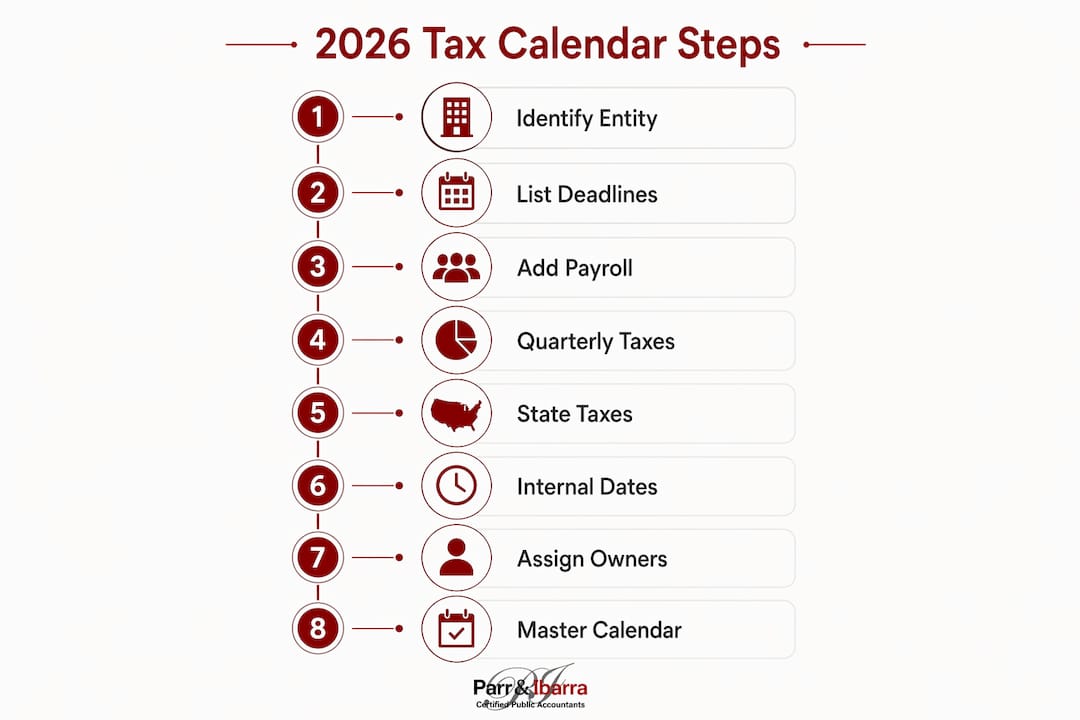
How to build your small business tax calendar step by step
This process works for any business structure. Work through each step in order, and you will have a complete master calendar by the end.
Step 1: Identify your business entity and tax classification.
Confirm whether you file as a sole proprietor, partnership, S-corp, or C-corp. Your entity type determines every filing date and form number on your calendar.
Step 2: List all federal filing and payment deadlines by date.
Use the entity table above. Write each deadline, the corresponding form, and the payment amount or estimate next to it. Do not skip extensions. Even if you plan to file on time, knowing the extended deadline protects you if something goes wrong.
Step 3: Add payroll deposit and reporting deadlines.
Payroll deposit schedules depend on your deposit frequency, which the IRS assigns based on your prior year tax liability. Semiweekly depositors have different dates than monthly depositors. Add Form 941 due dates for each quarter.
Step 4: Incorporate quarterly estimated tax deadlines.
The four estimated quarterly tax payment dates are april 15, june 15, september 15, and january 15 of the following year. Calculate each payment based on your projected annual income, or use the prior year safe harbor method to avoid underpayment penalties.
Step 5: Map state and local tax requirements.
Add state income tax, franchise tax, sales tax, and unemployment insurance filing dates. These do not align with IRS dates. A Texas-based business, for example, faces a franchise tax report due may 15 that has no federal equivalent.
Step 6: Set internal deadlines 1–2 weeks before each legal date.
Internal deadlines give you time to resolve missing K-1s, reconcile payroll, or fix errors before the statutory date passes. This single habit prevents the majority of late filings.
Step 7: Assign a responsible person to each deadline.
Every line item on your calendar needs a named owner. For small teams, this might be you, your bookkeeper, or your CPA. For larger operations, split ownership between payroll, income tax, and state filings.
Step 8: Link everything into one master calendar.
Use a spreadsheet or digital calendar to consolidate all deadlines. Color-code by category: federal income tax, payroll, estimated payments, and state obligations. Set automated reminders at 30 days, 14 days, and 3 days before each date.
| Calendar Layer | What It Covers | Reminder Lead Time |
|---|---|---|
| Federal income tax | Entity returns, extensions | 30 days |
| Estimated payments | Q1–Q4 owner payments | 14 days |
| Payroll | 941, W-2, 1099-NEC, deposits | 7 days |
| State and local | Franchise, sales, unemployment | 30 days |
| Internal deadlines | Document prep, reconciliation | 14 days before legal date |
Pro Tip: Tax planning for small businesses works best when your calendar doubles as a planning trigger. When a quarterly estimated payment date appears, use it as a prompt to review your year-to-date income and adjust your projection.
What mistakes should you avoid when managing your tax calendar?
Most calendar failures come from the same small set of errors. Recognizing them early keeps your compliance record clean.
Common mistakes to avoid:
- Tracking only federal deadlines and ignoring state and local obligations
- Treating the legal due date as the target instead of the internal deadline
- Failing to update the calendar after a change in entity status, payroll size, or state registration
- Keeping payment proofs and filed returns in separate locations with no clear filing system
- Assuming your CPA will catch everything without your active involvement
The legal responsibility for timely filing and payments stays with the business owner, even when a CPA handles the preparation. Your calendar is your system of record, not your accountant’s.
Midyear adjustments matter more than most owners realize. If your revenue spikes in Q2, your Q3 estimated payment should increase to match. Missed estimated payments trigger IRS underpayment penalties that accrue from the due date forward. Review your estimates after every quarter close.
Tax planning is a year-round process that starts January 1, not in March or April. Starting tax planning early in the year opens opportunities for entity elections, retirement contributions, and pass-through entity tax strategies that are simply unavailable once the year is half over. Early planning is the single biggest difference between businesses that manage their tax burden and those that react to it.
Pro Tip: Set a recurring monthly calendar review, 15 minutes is enough, to check for upcoming deadlines, confirm payments were posted, and update any estimates based on recent revenue. This habit catches problems before they become penalties.
Key Takeaways
A well-built small business tax calendar integrates federal, state, payroll, and estimated payment deadlines into one master system with internal buffers and named owners for every obligation.
| Point | Details |
|---|---|
| Entity type drives your dates | Partnerships and S-corps file by march 16; sole props and C-corps by april 15. |
| Quarterly payments have four fixed dates | April 15, june 15, september 15, and january 15 are non-negotiable federal deadlines. |
| Internal deadlines prevent late filings | Set every deadline 1–2 weeks early to allow time for corrections and missing documents. |
| State calendars run separately | State income, franchise, and sales tax dates do not align with IRS deadlines. |
| Evidence folders protect you in audits | Store filed returns, payment proofs, and extension forms together for every deadline. |
Why your tax calendar is the most underrated business tool you own
Most business owners treat the tax calendar as a compliance checklist. That framing undersells it. After working with small business owners across the Dallas-Fort Worth area, I have seen the calendar function as the backbone of every major financial decision a business makes during the year.
The clients who avoid surprises at year-end are almost always the ones who use their estimated payment dates as forced checkpoints. When april 15 arrives and they write that Q1 check, they also review their profit-and-loss statement, adjust their owner compensation, and flag any new deductions to capture before december 31. The calendar creates the discipline. The discipline creates the savings.
The most overlooked piece is the evidence folder. I have seen amended returns and audit responses take weeks longer than necessary because payment proofs were scattered across email threads and bank statements. One folder per deadline, organized by date, cuts that time to hours. It also signals to the IRS that your business runs with intention, which matters more than most owners expect.
My honest advice: do not wait until you have the perfect system. Build a rough calendar this week with the eight steps above, assign owners, and set your first round of reminders. You can refine it as you go. A rough calendar beats no calendar every single time.
— Adan
How Parr & Ibarra CPA supports your tax calendar and planning
Parr & Ibarra CPA works with small business owners in the Dallas-Fort Worth area who want more than a once-a-year filing relationship. The team of over 20 professionals, including multiple CPAs, builds integrated tax calendars that cover federal returns, quarterly estimated payments, payroll compliance, and state obligations in one coordinated system.
If you are ready to move from reactive filing to proactive planning, the tax planning best practices page outlines how Parr & Ibarra CPA structures year-round support for small business owners. For a full view of 2026 filing requirements and how they apply to your entity type, the IRS filing guide is a practical starting point. Parr & Ibarra CPA is built for business owners who want clarity, not surprises.
FAQ
What is a small business tax calendar?
A small business tax calendar is a master schedule of every federal, state, payroll, and estimated tax deadline organized by date and business entity type. It functions as both a compliance tool and a year-round planning framework.
When are quarterly estimated taxes due in 2026?
The four quarterly estimated tax deadlines in 2026 are april 15, june 15, september 15, and january 15, 2027. Missing any of these dates triggers IRS underpayment penalties that accrue from the due date forward.
What forms does a small business tax calendar need to track?
A complete calendar tracks Form 1065 or 1120-S for pass-through entities, Schedule C or Form 1120 for sole proprietors and C-corps, Form 941 for quarterly payroll, and W-2 and 1099-NEC forms due by february 2, 2026.
How do I organize tax documents for my calendar?
Build an evidence folder for each deadline that holds the filed return, payment confirmation, and any extension forms together. This system supports both small business bookkeeping accuracy and audit readiness.
Do state tax deadlines match federal deadlines?
State tax deadlines do not align with IRS dates. State income, franchise, sales tax, and unemployment filings each follow their own schedules, which means a separate state checklist is required alongside your federal calendar.

