
IRS audit representation means an authorized tax professional, either an attorney, CPA, or enrolled agent, speaks and acts on your behalf during an IRS examination. You do not have to face the IRS alone, and under Publication 1, the Taxpayer Bill of Rights explicitly guarantees your right to representation. The single most important thing you can do right now:
- Stop all unscripted contact with the IRS. Do not call back, respond to questions, or volunteer documents before a representative reviews your situation.
- Locate the audit notice. The IRS always initiates contact by mail. The notice number (CP2000, Letter 2205, etc.) tells your representative exactly what is at stake.
- File Form 2848 (Power of Attorney). This authorizes your representative to communicate directly with the IRS on your behalf. Until it is on file, the IRS will keep calling you.
- Schedule a diagnostic review. A qualified representative, such as the team at Parr & Ibarra CPA in Dallas-Fort Worth, will assess the scope, identify risks, and map a response strategy before any IRS contact occurs.
Being selected for an audit does not mean the IRS suspects fraud. It means your return was flagged for review, and how you respond from this point forward shapes the outcome.
Key Takeaways
IRS audit representation gives you the right to have a qualified professional, an attorney, CPA, or enrolled agent, handle every stage of an IRS examination on your behalf, starting with filing Form 2848 before any IRS contact occurs.
| Point | Details |
|---|---|
| File Form 2848 first | Authorization routes IRS contact to your representative and protects you from unscripted examiner calls. |
| Three audit types, three approaches | Correspondence, office, and field audits each require different representation tactics and carry different cost levels. |
| Cost scales with complexity | Simple correspondence audits cost far less than field audits or appeals; get a written fee estimate before signing. |
| Free help exists | LITCs provide free or low-cost representation for qualifying taxpayers in audits, appeals, and Tax Court cases. |
| Parr & Ibarra CPA | The firm handles diagnostics, Form 2848 filing, IRS communication, and appeals for DFW-area taxpayers. |
This article is general information, not a substitute for advice from a qualified financial advisor. Consult a qualified financial professional about your own circumstances before acting on anything here.
What does IRS audit representation actually cover?
IRS audit representation covers every interaction between you and the IRS during an examination: submitting documents, attending interviews, negotiating proposed changes, and filing administrative appeals or Tax Court petitions if the examiner’s conclusions are wrong. The scope of what your representative can do depends on the authority you grant in writing, but a full power of attorney under Form 2848 allows them to act in virtually every capacity short of signing your return.
IRS audits fall into three types, and representation looks different in each:
| Audit Type | Where It Happens | What Representation Typically Does |
|---|---|---|
| Correspondence (mail) | By mail only | Drafts and submits written responses, organizes supporting documents, negotiates adjustments by letter |
| Office audit | IRS office | Attends the interview, presents records, limits examiner’s line of questioning to the notice’s stated scope |
| Field audit | Taxpayer’s home, business, or representative’s office | Manages the examiner’s access, coordinates document production, handles interviews and follow-up requests |
Correspondence audits are the most common and often the most manageable. Field audits are the most intensive and carry the highest risk of scope expansion, which is exactly why having a representative present matters most there.
Publication 3498 lays out the full examination process, including your rights before, during, and after an audit, and references both Form 2848 and Form 8821 as the mechanisms for authorizing representation and information access. According to FS-2006-10, audit selection does not imply wrongdoing, and taxpayers retain full appeal rights, including administrative appeals and Tax Court petitions, regardless of audit type.
Who can represent you before the IRS?
Three categories of professionals hold unlimited representation rights before the IRS:
- Attorneys licensed by a state bar. They can represent you in all IRS proceedings, including Tax Court litigation.
- Certified Public Accountants (CPAs) licensed by a state board. CPAs handle the full range of audit, appeals, and collection matters.
- Enrolled Agents (EAs) credentialed directly by the IRS. EAs specialize in tax matters and carry federal authorization that is not state-limited.
All three operate under Circular 230, the IRS’s conduct rules for practitioners. Circular 230 governs competence standards, conflicts of interest, and the Office of Professional Responsibility (OPR), which investigates and disciplines practitioners who violate those rules.
Beyond those three, a narrower set of practitioners holds limited rights:
- Enrolled retirement plan agents and enrolled actuaries may represent taxpayers in matters specific to their specialty areas.
- Unenrolled return preparers can represent clients only for returns they prepared and signed, and only in examinations, not appeals or collection matters.
- Law students and accounting students in supervised clinical programs may represent qualifying taxpayers in limited settings.
Verifying credentials matters. Check a CPA’s license through the relevant state board (in Texas, the Texas State Board of Public Accountancy). Verify an attorney through the state bar. For enrolled agents and Circular 230 disciplinary history, the IRS OPR publishes a searchable practitioner database. Never hire a representative who cannot point you to a verifiable credential.
How representation works during an audit: what to expect from start to finish
The process has three distinct stages, and a good representative drives each one.
Stage 1: Intake and authorization
Your representative conducts a diagnostic review of the notice, the years under examination, and the specific issues flagged. They pull the relevant returns, identify potential exposures, and file Form 2848 so the IRS routes all future contact through them. From that point, you should not receive direct calls from the examiner.
Your right to pause an IRS interview is real and immediate. Under IRS procedures described in Publication 3498, you may request that an examiner suspend an in-person interview at any time so you can consult a representative. You do not need to explain why. Exercise this right before answering any substantive question.
Stage 2: Document exchange and interviews
The representative organizes and submits documentation in response to the Information Document Request (IDR). For office and field audits, they attend interviews, manage what the examiner sees, and keep the scope from expanding beyond the original notice. Statements made early in an audit can limit defense options later, which is why practitioners consistently advise against any direct taxpayer contact with examiners before a diagnostic review.
Stage 3: Closing, proposed changes, and appeals
After the examination, the IRS issues a Revenue Agent’s Report (RAR) with proposed adjustments. Your representative reviews the RAR, negotiates with the examiner or their manager, and files a protest to the IRS Independent Office of Appeals if the proposed changes are wrong. If Appeals does not resolve the dispute, the next step is Tax Court or another federal court.
Pro Tip: If you receive a Notice of Deficiency, a 90-day window opens to petition Tax Court. Missing that deadline waives your right to pre-payment judicial review. Escalate to a tax attorney immediately upon receipt.
Timelines vary, but some correspondence audits may resolve within a few months. Office and field audits can take from several months to over a year when appeals are involved. The Taxpayer Advocate Service notes that examiners will suspend an interview if you request time to consult a representative, a procedural protection worth knowing before you walk into any IRS office.
How much does IRS audit representation cost?
Cost depends almost entirely on audit type and complexity. A simple correspondence audit handled by a CPA or enrolled agent might run a few hundred to a couple of thousand dollars in professional fees. An office audit with multiple years and several disputed deductions typically costs more. A full field audit, especially one involving a business, unreported income allegations, or the need for forensic accounting, can run into the tens of thousands of dollars when appeals or litigation follow.
| Audit Scenario | Typical Billing Approach | Relative Cost Range |
|---|---|---|
| Correspondence audit (single issue) | Flat fee or hourly | Lower end |
| Office audit (one to two years) | Hourly or flat fee | Moderate |
| Field audit (business, multiple years) | Hourly or retainer | Higher |
| Appeals and Tax Court litigation | Hourly plus litigation costs | Highest |
The main cost drivers:
- Number of tax years under audit. Each additional year multiplies document review and response time.
- Complexity of the issues. Unreported income, hobby loss rules, and transfer pricing disputes require more analysis than a missing receipt.
- Need for expert witnesses or forensic accounting. Complex valuations or fraud allegations add a separate layer of cost.
- Whether the case goes to appeals or litigation. Most audits settle at the examination level; escalation multiplies fees significantly.
For taxpayers who cannot afford professional fees, Low Income Taxpayer Clinics (LITCs) provide free or low-cost representation in audits, appeals, and collection disputes. LITCs are independent of the IRS and serve taxpayers whose income falls below a threshold set annually. The Taxpayer Advocate Service also assists taxpayers experiencing significant financial hardship or systemic IRS problems, though TAS does not provide legal representation in the same way an LITC does.
Pro Tip: Get a written fee estimate before signing an engagement letter. A reputable firm will give you a realistic range based on the audit type and years involved, not a vague “it depends.”
How do you choose the right IRS audit representative?
Start with credentials, then dig into experience. A CPA who primarily prepares returns is not the same as a CPA who regularly handles IRS examinations and appeals. Ask directly.
Key criteria:
- Credential type and standing. Confirm the license is current and clean. For a complex field audit or potential litigation, an attorney or a CPA with litigation support experience is worth the additional cost.
- Audit-specific experience. Ask how many audits they have handled in the past two years, and specifically whether they have experience with your audit type (correspondence, office, or field) and the issues flagged in your notice.
- Who actually attends the audit. At larger firms, a senior partner may sell the engagement and a junior associate may show up. Clarify this upfront.
- Fee transparency. A written engagement letter with a defined scope, billing rate, and escalation process is non-negotiable. Practitioners advise that a clear engagement letter with scope, billing expectations, and escalation steps reduces disputes and improves response speed.
- Documented outcomes. Ask for case studies or anonymized examples of similar matters they have resolved. Parr & Ibarra CPA publishes case studies that illustrate the firm’s work across audit and advisory engagements.
Questions worth asking any candidate:
- “Have you handled audits involving [my specific issue: home office deductions, S-corp distributions, real estate losses]?”
- “What is your typical timeline for a case like mine?”
- “Will you personally attend any IRS interviews, or will someone else?”
- “What is your fee estimate, and what triggers additional billing?”
Red flags to walk away from:
- Any guarantee of a specific outcome. No one can promise the IRS will accept a position.
- Refusal to provide a written engagement letter or fee estimate.
- No CAF number or unfamiliarity with the Form 2848 filing process.
- Pressure to sign immediately without time to review the engagement terms.
How do you authorize a representative with the IRS?
Two forms handle this, and they do different things.
Form 2848 (Power of Attorney and Declaration of Representative) gives your representative the authority to act on your behalf: speak to IRS personnel, submit documents, receive notices, and negotiate on your behalf. The form requires your signature, your representative’s signature and CAF number, and a specific description of the tax matters and years covered. Once processed, the IRS records it in the Centralized Authorization File (CAF) system, which routes IRS communications to your representative automatically.
- You can limit the authority granted. If you only want a representative to handle document submission for one year, say so on the form.
- Filing options include mail, fax, and electronic submission through the IRS’s Tax Pro Account for eligible practitioners.
- To revoke a prior authorization, submit a new Form 2848 with “REVOKE” written across the top, or send a written revocation to the IRS.
Form 8821 (Tax Information Authorization) is narrower. It lets a designated person inspect and receive your tax information, but it does not authorize them to speak or act on your behalf. Use it when you want an advisor to review your account without granting full representation rights, for example, when a financial planner needs to see your transcript.
Confirm CAF recording after filing. Call the IRS Practitioner Priority Service or check through your representative’s Tax Pro Account to verify the authorization is active before any IRS contact occurs.
Free and low-cost options: LITCs and the Taxpayer Advocate Service
Not every taxpayer can afford professional representation fees. Two resources exist specifically for that gap.
Low Income Taxpayer Clinics (LITCs) are independent organizations, often affiliated with law schools or nonprofit legal aid groups, that provide free or low-cost representation to qualifying taxpayers in audits, appeals, and collection disputes. They also offer education and outreach in multiple languages. To find a clinic near you, use the LITC locator published by the Taxpayer Advocate Service, or consult IRS Publication 4134.
- Eligibility is income-based, with thresholds adjusted annually.
- LITCs handle the same IRS proceedings a paid representative would, including Tax Court cases.
- Many clinics serve non-English-speaking taxpayers and can provide representation in the taxpayer’s primary language.
The Taxpayer Advocate Service (TAS) is an independent organization within the IRS that helps taxpayers experiencing significant hardship, including those facing immediate financial harm from IRS collection actions or those stuck in systemic processing delays. TAS does not replace a representative in an audit, but it can intervene when normal IRS channels are not working.
To use either resource effectively, bring your audit notice, the last two years of tax returns, and any correspondence you have already received. An LITC intake interview works similarly to a paid firm’s diagnostic, just without the fee.
Parr & Ibarra CPA: how our IRS audit representation works
Parr & Ibarra CPA is a Dallas-Fort Worth CPA firm with a team of over 20 professionals, including multiple CPAs, who handle IRS audit representation alongside the firm’s broader tax, accounting, and advisory services.
How the process works:
- Diagnostic review. The engagement begins with a review of your notice, the years under examination, and the specific issues flagged, before any IRS contact occurs.
- Authorization. The firm files Form 2848 so all IRS communication routes through the team, not to you directly.
- Document organization. The team organizes and prepares the documentation package in response to the IDR, reducing the risk of over-disclosure.
- Direct IRS communication. Parr & Ibarra CPA handles correspondence, attends office and field audit interviews, and manages examiner requests.
- Closing and appeals. If the examiner proposes adjustments the firm disputes, it handles the closing conference, manager escalation, and formal protest to the IRS Independent Office of Appeals.
- Litigation support. For matters requiring technical accounting analysis or expert testimony, the firm’s CPA expert witness and litigation support services provide that capability in-house.
The firm’s financial statement audit and compliance audit experience means the team understands audit procedures from both sides of the table. Fee estimates are provided in writing before engagement, and the engagement letter defines scope, billing, and escalation steps clearly.
Why representation matters more than most taxpayers realize
Most taxpayers treat an IRS audit notice the way they treat a parking ticket: an annoyance to handle quickly and move on from. That instinct is understandable, but it is often the most expensive mistake they make.
The IRS examiner’s job is to verify your return, and they are trained to ask questions that expand scope when answers are vague or inconsistent. A taxpayer who calls back without preparation, volunteers extra documents, or answers questions outside the notice’s stated scope can turn a narrow correspondence audit into a multi-year field examination. Representation is not just about having someone fill out forms. It is about controlling what the IRS sees, when they see it, and how it is framed.
The other thing most taxpayers underestimate is the appeals process. The IRS Independent Office of Appeals resolves a significant share of disputed cases, often on terms more favorable than the original examiner’s proposed adjustment. But reaching Appeals requires a timely, well-drafted protest, and most taxpayers do not know the procedural window exists until it has closed. A representative who has been through that process knows when to push and when to settle, and that judgment is worth more than the hourly rate suggests.
Ready to get started with Parr & Ibarra CPA?
An IRS audit notice has a response deadline. The sooner a qualified representative reviews your situation, the more options remain available. Parr & Ibarra CPA serves individuals and business owners across Dallas-Fort Worth with transparent, written fee estimates and a team that handles every stage of the audit process directly.
To prepare for your diagnostic appointment, gather:
- The IRS notice (including the notice number and response deadline)
- Tax returns for the years under examination
- Bank statements and supporting documents for the issues flagged
- Any prior IRS correspondence related to this matter
Everything you share is confidential and handled in accordance with your rights under Publication 1. If you are a DFW-area business owner also looking to reduce audit risk going forward, the firm’s tax planning for Texas business owners services address the proactive side of that equation. Schedule your diagnostic at Aibarra.
Sources
FAQ
What is IRS audit representation?
IRS audit representation is when a licensed tax professional, such as an attorney, CPA, or enrolled agent, is authorized via Form 2848 to act on your behalf during an IRS examination, handling all communication, document submission, and negotiations with the IRS.
How much does IRS audit representation cost?
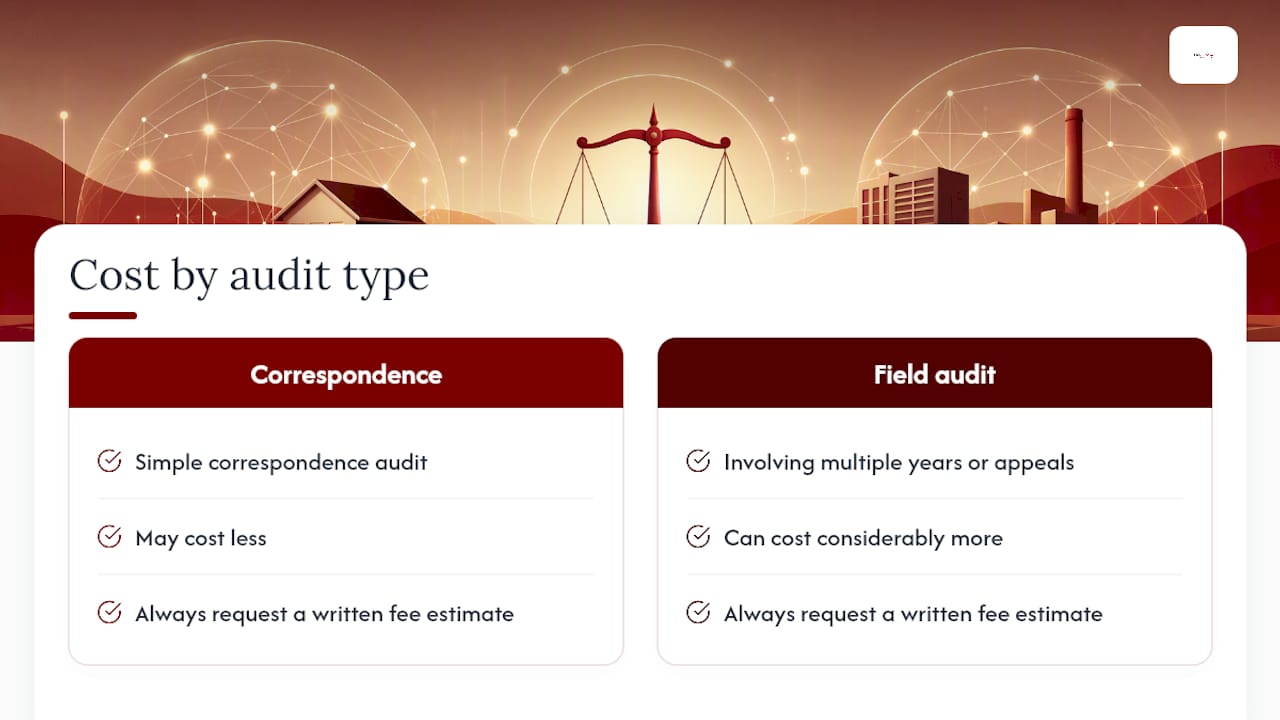
Cost varies by audit type and complexity: a simple correspondence audit may cost less, while a field audit involving multiple years or appeals can cost considerably more. Always request a written fee estimate before engaging a representative.
Is the IRS still conducting audits?
Yes. The IRS continues to conduct audits by mail and in person; taxpayers are notified by mail and retain full rights to representation and appeal regardless of audit type.
What triggers an IRS audit?
Common triggers include significant discrepancies between reported income and third-party information returns, unusually large deductions relative to income, and certain business expense patterns. Audit selection does not imply wrongdoing, as FS-2006-10 makes clear.
Can I represent myself in an IRS audit?
You can, but doing so carries real risk. Taxpayers who respond without preparation often expand the audit’s scope inadvertently. A qualified representative controls what the IRS sees and can pursue appeals that most self-represented taxpayers do not know are available.

