
If you own an S corporation and pay yourself mostly through distributions, the IRS has a clear position: shareholder-employees who perform services must receive a reasonable W-2 salary before taking any non-wage distributions. That rule comes directly from IRS guidance on S corporation compensation, and ignoring it is one of the fastest ways to trigger a payroll tax audit.
The practical action right now: run a market-based compensation check using Bureau of Labor Statistics (BLS) wage data, set a defensible W-2 salary, run payroll, and document everything contemporaneously. Parr & Ibarra CPA works through exactly this process with S-corp clients across Dallas-Fort Worth.
- Pay yourself a W-2 salary that reflects what you’d pay an outside hire for the same work.
- Use public benchmarks (BLS, Salary.com, PayScale) to price the role, not a gut-feel number.
- Document the analysis in a written memo before distributions go out.
- Run regular payroll, deposit taxes on time, and file W-2s and Form 941 each quarter.
- Review compensation annually, especially when revenue or duties change.
Key Takeaways
S-corp shareholder-employees must receive a reasonable W-2 salary for services before taking non-wage distributions, and that salary must be documented with market data before distributions go out.
| Point | Details |
|---|---|
| Pay W-2 wages first | Distributions taken before a reasonable salary is paid are subject to IRS reclassification as wages. |
| Use BLS and market data | Pull BLS OES percentile data for your occupation and metro to set a defensible, documented salary. |
| Document contemporaneously | A dated comp memo referencing a named data source is the single most persuasive audit exhibit. |
| Run regular payroll | Consistent pay periods and on-time Form 941 deposits reduce both audit risk and penalty exposure. |
| Parr & Ibarra CPA | The firm provides written compensation analyses, payroll setup, and audit support for S-corp owners in Dallas-Fort Worth. |
What does “reasonable compensation” legally mean for an S corp?
The legal foundation sits in two places. IRC §162(a)(1) allows a deduction for “a reasonable allowance for salaries or other compensation for personal services actually rendered.” Treasury Regulation §1.162-7(b)(3) tightens that to what “would ordinarily be paid for like services by like enterprises under like circumstances.” Together, they create a fact-based standard, not a formula.
The IRS has built its S-corp enforcement posture on top of that standard. IRS Fact Sheet FS-2008-25 makes the agency’s position explicit: if an S corporation pays no officer compensation or only token amounts while distributing profits, the IRS will reclassify those distributions as wages. The Form 1120-S instructions reinforce this, requiring that officer compensation be reported separately and that it reflect services actually performed.
Why does reclassification hurt so much? Wages carry both the employer and employee share of FICA, plus FUTA, with standard rates applying up to the Social Security wage base and a Medicare rate beyond that. Distributions do not. An owner who routes compensation through distributions instead of salary may avoid a substantial amount in self-employment-equivalent taxes on earnings up to the Social Security wage base. The IRS knows the math, and so do its auditors.
One additional wrinkle: health insurance premiums paid by the S-corp for shareholders owning more than 2% must be reported as wages in Box 1 of Form W-2, per IRS guidance on W-2 reporting. Those premiums may be excluded from Boxes 3 and 5 if the plan covers a class of employees, but they still flow through payroll.
Key legal anchors:
- IRC §162(a)(1): deductibility standard for compensation
- Treas. Reg. §1.162-7(b)(3): the “like services, like enterprises” fact-based test
- IRS authority under IRC and employment tax rules to reclassify distributions as wages when compensation is absent or unreasonable
- Form 1120-S instructions: officer compensation line requires a separate, defensible figure
How does the IRS actually decide if your salary is reasonable?
The IRS does not use a single formula. Auditors and Tax Court judges weigh a cluster of factors drawn from decades of case law. The Tax Adviser’s 2024 analysis summarizes the accepted multi-factor framework practitioners use to build defensible positions.
The core IRS factors:
- Training, education, and experience the shareholder brings to the role
- Duties performed and time devoted to the business
- The character and condition of the company (size, complexity, revenue)
- Comparable compensation paid by similar businesses for similar services
- Dividend and distribution history relative to compensation paid
- Whether a formula or agreement was used to set compensation, and when it was established
The case law is instructive. In Watson v. Commissioner (8th Circuit, 2012), a CPA shareholder paid himself $24,000 per year while taking $203,000 in distributions. The court upheld reclassification of a substantial portion of those distributions as wages, finding the salary bore no relationship to the value of services provided. In Glass Blocks Unlimited v. Commissioner, the Tax Court similarly found that a zero-salary position for an active owner was indefensible when the company’s revenue flowed directly from the owner’s labor.
The pattern across cases is consistent: when gross receipts trace primarily to the shareholder’s personal services, the compensation bar rises. When income derives mainly from capital, equipment, or non-shareholder employees, distributions are more defensible. Intent matters, but contemporaneous documentation matters more.
Pro Tip: Never set compensation after the fact to match what you already distributed. Courts treat retroactive salary adjustments as evidence of intent to avoid payroll taxes, which compounds the penalty exposure.
How do you calculate a defensible reasonable salary?
Treas. Reg. §1.162-7(b)(3) and practitioner guidance recognize three primary methodologies. Use whichever fits your situation, or combine them.
The market (comparable salary) approach
Price the owner’s role as if you were hiring an outside employee to do the same work. Pull BLS Occupational Employment and Wage Statistics for the relevant occupation code and metro area, then cross-reference with Salary.com or PayScale for industry-specific adjustments. Use the 50th or 75th percentile depending on the owner’s experience and the company’s size.
The cost/task approach
Break the owner’s duties into discrete tasks: sales, operations management, bookkeeping, client delivery, HR. Price each task at its market rate for that function. Sum the components. This approach is especially useful for owners who wear many hats at part-time intensity, because it often produces a lower, equally defensible salary than a single comparable-role lookup.
The income/independent-investor test
Ask: what return would a passive investor expect on the capital deployed in this business? If the business generates $500,000 in profit and a reasonable investor return on the equity base is $80,000, the remaining $420,000 is arguably attributable to the owner’s labor and should be compensated as wages. This approach works when comparable wage data is scarce.
Worked example: small consulting S-corp
- Owner performs consulting delivery (40 hrs/week) and business development (10 hrs/week).
- BLS SOC code for Management Consultants (13-1111), Dallas-Fort Worth metro, 50th percentile: approximately $105,000/year.
- Business development adjustment (10% of time at sales manager rate ~$95,000): adds ~$9,500.
- Blended market salary estimate: $114,500.
- Employer FICA cost (7.65% on first $176,100): ~$8,759.
- Recommended W-2 salary: $114,500, with employer payroll taxes funded separately from the S-corp.
| Step | What you do | Source/tool |
|---|---|---|
| 1. Identify occupation codes | Match duties to BLS SOC codes | BLS OES database |
| 2. Pull metro wage data | Download percentile wages for your city | BLS.gov wage search |
| 3. Cross-reference | Confirm with Salary.com or PayScale | Salary.com, PayScale |
| 4. Apply task weighting | Adjust for part-time duties or multiple roles | Cost/task worksheet |
| 5. Document the analysis | Write a dated comp memo | Internal memo or CPA-prepared |
It is a rule of thumb that practitioners invented, and courts have rejected it. Practitioner guidance is consistent: a fact-based, documented analysis tied to market data is the only defensible approach.
Pro Tip: Pull and save the actual BLS data export as a PDF with the download date. That timestamped printout becomes Exhibit A in any audit response.
How do you run payroll and report the salary correctly?
Getting the compensation number right is only half the job. The IRS also expects proper payroll mechanics.
Form W-2 requirements:
- Box 1 (wages): include the W-2 salary plus any health insurance premiums paid by the S-corp for >2% shareholders
- Boxes 3 and 5 (Social Security and Medicare wages): include the salary; health premiums may be excluded if the plan covers a class of employees
- File W-2s with the Social Security Administration by January 31
Form 941 (quarterly):
- Report wages paid, federal income tax withheld, and both the employee and employer shares of FICA each quarter
- Deposit federal payroll taxes semi-weekly or monthly depending on your lookback period; most small S-corps qualify for monthly deposits
- Form 941 instructions detail deposit schedules and penalty rates for late deposits
Form 940 (annual FUTA):
- Report federal unemployment tax on the first $7,000 of each employee’s wages
- FUTA rate is 6.0% before the state credit; most employers pay an effective rate of 0.6% after the credit
Form 1120-S:
- Line 7 (compensation of officers) must reflect the W-2 salary
- The salary reduces ordinary income flowing to Schedule K-1; distributions appear separately on Schedule K-1 as non-wage distributions
For small business payroll tax obligations, staying on a regular payroll schedule is far cheaper than catching up after the fact.
What documentation makes your position audit-proof?
A contemporaneous, dated compensation memo tied to a named public data source is the single most persuasive audit exhibit, according to practitioner consensus. Build the file before distributions go out, not after you receive an IRS notice.
Core documentation checklist:
- Written compensation analysis memo (dated, signed, referencing BLS or salary survey data)
- Job description listing specific duties and estimated weekly hours per function
- BLS OES data export or salary survey printout with download date and percentile used
- Board minutes or shareholder resolution approving the compensation amount and effective date
- Payroll reports showing regular, consistent pay dates throughout the year
- Copies of W-2s and Forms 941 for each year under review
- Time records or a time-allocation summary if the cost/task approach was used
What each document proves:
- Comp memo: shows the analysis was contemporaneous and data-driven, not reverse-engineered.
- Job description: establishes the scope of services that justify the salary level.
- BLS export: provides the independent market benchmark auditors expect to see.
- Board minutes: shows corporate formality and that the salary was set by a deliberate decision.
- Payroll reports: proves wages were actually paid on a regular schedule, not in a year-end lump.
- W-2s and 941s: confirms tax deposits were made and employment taxes were remitted.
If prior years lacked reasonable compensation: The remediation path matters. Regularized payroll with retroactive W-2s processed through proper payroll runs and accompanied by tax deposits is far less likely to raise intent-based issues than an ad hoc lump-sum payment or a 1099 issued after the fact.
Pro Tip: Set a calendar reminder each January to update your comp memo before the first payroll run of the year. A one-page update citing the current BLS data takes 30 minutes and closes the biggest gap in most audit files.
What triggers an IRS audit and what does reclassification actually cost?
The IRS has increased enforcement on pass-through entities, and payroll tax audits can pull reasonable compensation into scope even when the original exam was about something else. IRS Fact Sheet FS-2008-25 and practitioner commentary confirm that reclassification is a routine audit outcome when compensation is absent or clearly below market.
Top audit triggers:
- Zero or token officer compensation on Form 1120-S while distributions are large
- Distributions that are a multiple of the reported salary with no documented rationale
- Inconsistent payroll history (salary paid some years, skipped in others)
- Aggressive Employee Retention Credit (ERC) claims that draw a follow-up payroll exam
- Large year-end lump-sum salary payments instead of regular periodic payroll
What reclassification costs:
When the IRS reclassifies distributions as wages, the bill includes:
- Employer FICA (7.65% on the reclassified amount up to the Social Security wage base, 1.45% above)
- Employee FICA (same rates, now owed by the corporation as a withholding agent)
- FUTA on the first $7,000 of reclassified wages
- Interest on unpaid employment taxes from the original due date
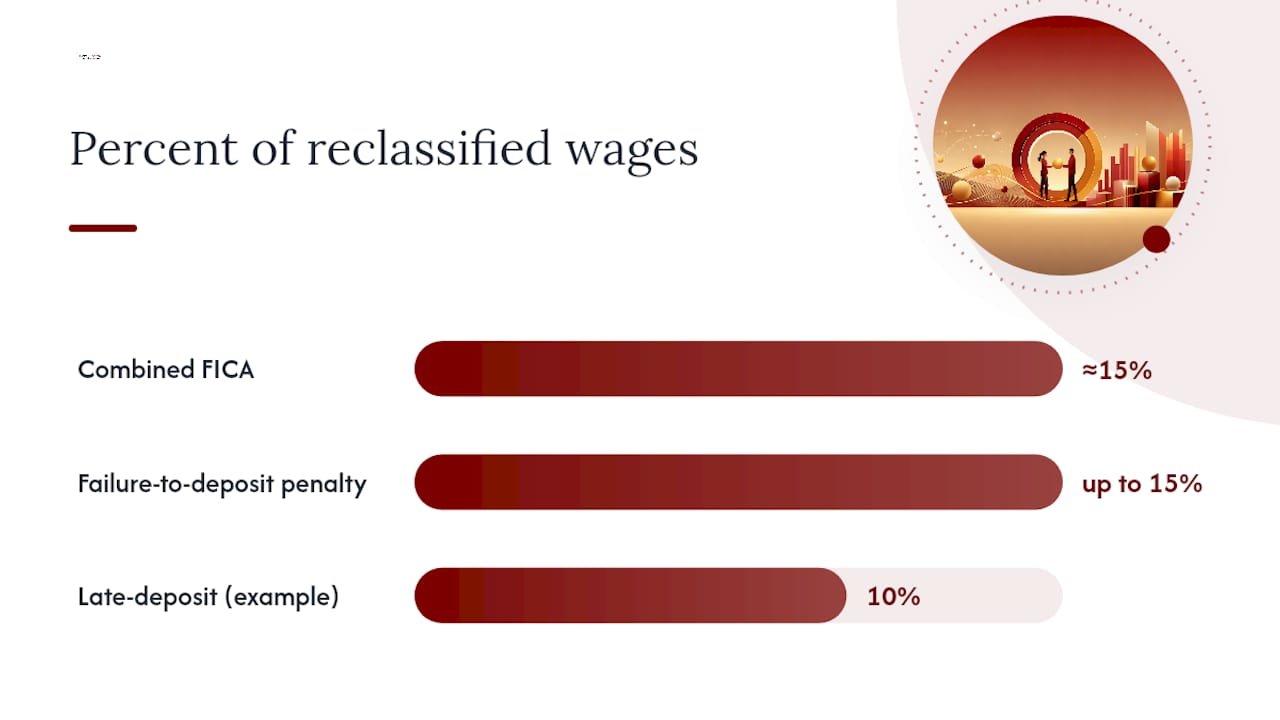
- Failure-to-deposit penalties (up to 15%)
- Potential Trust Fund Recovery Penalty (TFRP): the IRS can assess the employee share of FICA personally against any “responsible person” who willfully failed to collect and remit it
On a six-figure reclassification, combined employer and employee FICA alone can amount to roughly 15% of that amount, before interest and penalties. Add a 10% late-deposit penalty and two years of interest, and the total exposure on a single year can exceed $20,000.
The TFRP is the sharpest risk. It is assessed personally, it survives bankruptcy, and it applies to anyone with authority over payroll decisions, not just the owner.
Your six-step plan to set or fix your S-corp salary
A practical, repeatable framework ties duties to market data, documents the analysis, and treats the salary as the market-priced cost of hiring someone else to do the owner’s work.
Document your duties and time. Write a job description listing every function you perform and estimate weekly hours per function. Be specific: “client project delivery, 30 hrs/week; business development, 8 hrs/week; bookkeeping, 2 hrs/week.”
Gather market comparables. Pull BLS OES data for your occupation code and metro area. Download the percentile table as a PDF. Cross-reference with Salary.com or PayScale. Note the source, date, and percentile you selected.
Choose and calculate your method. For most owners, the market approach (step 2) is sufficient. Use the cost/task approach if you have multiple part-time roles. Apply the independent-investor test if your revenue is capital-intensive rather than service-driven. See the tax-efficient owner compensation strategy guide for additional planning considerations.
Set up payroll and withhold correctly. Use a payroll platform or CPA-managed payroll to run regular, consistent pay periods. Withhold federal income tax, employee FICA, and state income tax where applicable. Deposit employer FICA on schedule.
Document the decision formally. Draft a one-to-two-page compensation memo. Hold a board meeting (even a single-member S-corp should document this), pass a resolution approving the salary, and sign the minutes. File W-2s by January 31 and Form 941 each quarter.
Consult a CPA for past-year remediation. If prior years had zero or below-market compensation, do not try to fix it with a late lump-sum payment alone. A CPA can calculate the exposure, process corrected payroll runs, file amended 941s, and negotiate with the IRS if needed. Trigger points for immediate engagement: large distributions without any W-2, ownership across multiple S-corps, or interstate payroll complexity.
Pro Tip: Your W-2 salary also affects your QBI deduction and retirement plan contributions. A salary that is too low can reduce your SEP-IRA contribution limit and may limit your QBI deduction if your business is a specified service trade. Run the full picture before locking in a number.
A perspective on how we approach reasonable-compensation analyses
The most common mistake I see is owners who set their salary once, never update it, and have no paper trail. When an IRS notice arrives, they scramble to reconstruct a rationale that should have been written down years earlier. Courts and auditors read that scramble as evidence of intent.
At Parr & Ibarra CPA, the process is data-first and document-first. We start with a BLS pull for the relevant occupation and metro, cross-reference with at least one commercial salary survey, and then apply the cost/task breakdown when an owner’s duties span multiple roles. The deliverable is a written compensation memo, board minutes, and a payroll setup that runs on a consistent schedule from day one.
What surprises most clients is how often the defensible salary is lower than what they feared. A multi-role owner with significant administrative and part-time duties frequently lands at a salary well below the single-role comparable, because the task-level analysis reflects actual time allocation rather than a worst-case comparable. That lower, documented number is more defensible than a higher number picked to look conservative.
We also build the compensation review into the annual tax planning cycle, not as a standalone project. Revenue changes, duties shift, and the BLS updates its data annually. A salary set in 2022 may be incorrect in 2026, and the IRS knows that too.
Parr & Ibarra CPA can handle your compensation review and payroll setup
Setting a defensible S-corp salary requires market data, proper payroll mechanics, and documentation that holds up under scrutiny. Parr & Ibarra CPA delivers all three for S-corp owners across Dallas-Fort Worth: a written compensation analysis tied to BLS and industry survey data, board minutes, payroll setup and ongoing management, and audit support if the IRS ever asks questions.
The firm’s team of over 20 professionals, including multiple CPAs, handles compensation analyses, payroll management, past-year remediation, and ongoing tax planning for small business owners under one roof. You get a documented, defensible position and a payroll system that runs correctly from the start, not a spreadsheet and a guess.

Schedule a compensation review with Parr & Ibarra CPA today and leave the audit exposure behind.
Sources
The sources below are the primary references auditors expect to see in a compensation file and the practitioner guides most useful for implementation.
- S corporation compensation and medical insurance issues | Internal Revenue Service
- Advising S Corporation Clients on Reasonable Compensation
- BLS wage data | Bureau of Labor Statistics
- How to Pay Yourself From an S‑Corp | WageProof
This article is general information, not a substitute for advice from a qualified financial advisor. Consult a qualified financial professional about your own circumstances before acting on anything here.
FAQ
What is the IRS rule for S corp reasonable compensation?
The IRS requires that shareholder-employees who perform services for an S corporation receive a reasonable W-2 salary before the corporation makes non-wage distributions. The standard is what a similar business would pay an outside hire for the same work, based on Treas. Reg. §1.162-7(b)(3).
How do I calculate a reasonable salary for an S corp owner?
Pull BLS Occupational Employment and Wage Statistics for your occupation code and metro area, select the 50th or 75th percentile based on your experience, and cross-reference with Salary.com or PayScale. Document the analysis in a dated memo before taking distributions.
What happens if my S corp salary is too low?
The IRS can reclassify distributions as wages, triggering back employer and employee FICA, FUTA, failure-to-deposit penalties, interest, and potentially the Trust Fund Recovery Penalty assessed personally against the responsible person.
Is the 60/40 salary-to-distribution rule safe?
No. The 60/40 rule has no basis in statute or case law and has been rejected by courts. A fact-based, documented market analysis is the only defensible approach under Treas. Reg. §1.162-7(b)(3).
When should I hire a CPA for S corp compensation?
Engage a CPA immediately if your S-corp has taken large distributions without a corresponding W-2, if you own multiple S-corps, or if prior years had zero officer compensation. Parr & Ibarra CPA provides compensation analyses, payroll setup, and audit support for S-corp owners in Dallas-Fort Worth.

