

If you’re looking for alternatives to criadv.com (Carr, Riggs & Ingram), five firm types cover the realistic range: PE-backed national firms, national independent firms, regional/mid-market firms, niche specialists, and a local Dallas–Fort Worth CPA. Here’s the shortlist:
- PE-backed national firms (e.g., RSM US LLP, BDO USA) — best for mid-market companies needing scale, technology platforms, and deep bench depth
- National independent firms (e.g., Plante Moran) — best for clients who want national reach without private equity ownership complexity
- Regional/mid-market firms (e.g., Carr, Riggs & Ingram itself, before PE expansion) — best for growing businesses that want a named partner and regional expertise
- Niche specialists — best when your vertical (nonprofit, real estate, medical) demands industry-specific tax strategies and benchmarks
- Parr & Ibarra CPA — the recommended local option for Dallas–Fort Worth business owners who want big-firm capabilities with direct partner access and no corporate intermediary
What are the best criadv.com alternatives?
The table below compares five representative alternatives across the dimensions that matter most when switching or evaluating firms.

| Dimension | PE-Backed National | National Independent | Regional/Mid-Market | Niche Specialist | Parr & Ibarra CPA (Local DFW) |
|---|---|---|---|---|---|
| Best for | Mid-market, PE-portfolio companies | Multi-state businesses, partnerships | Growing SMBs, regional industries | Nonprofits, real estate, medical/dental | DFW business owners, entrepreneurs, real estate investors |
| Firm size & reach | several thousand staff, national | a couple thousand staff, national | a few hundred staff, regional | a small team of specialists, vertical-focused | around twenty professionals, DFW-focused |
| Service breadth | Tax, audit, advisory, CFO, M&A | Tax, audit, advisory, wealth | Tax, bookkeeping, payroll, advisory | Deep vertical tax + compliance | Tax, bookkeeping, payroll, outsourced CFO, audit, nonprofit, real estate |
| Pricing model | Value-based, retainer | Hourly + retainer | Fixed-fee or retainer | Hourly or project-based | Fixed-fee, monthly retainer |
| Ownership/backing | PE-backed (APS structure) | Partnership | Partnership | Partnership or solo | Partnership |
| Technology | Proprietary client portals, CFO hubs | Cloud accounting, client portals | Cloud tools, regional platforms | Vertical-specific software | Cloud accounting, client portal |
| Client experience | Regional relationship team, national resources | Dedicated manager, partner access | Named partner, local office | Deep specialist, limited generalist | Dedicated team, direct CPA access |
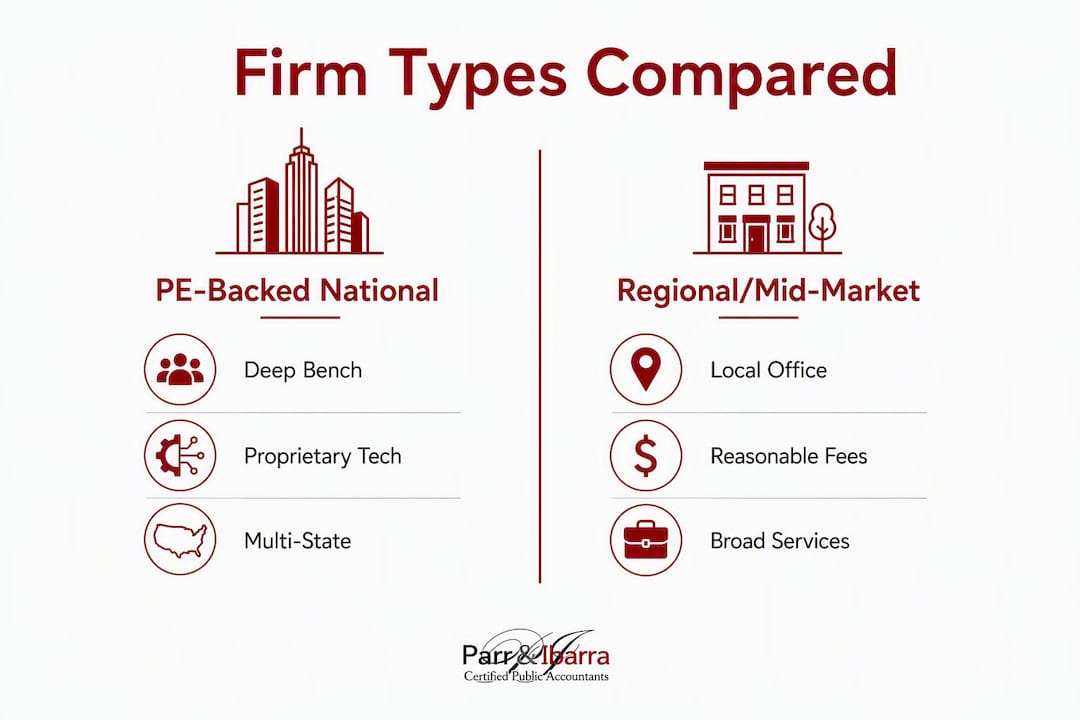
The closest mirror to CRI’s breadth and technology is a PE-backed national firm like RSM US LLP or BDO USA. They match CRI’s service depth and platform investment. The trade-off: you may deal with an Alternative Practice Structure (two separate billing entities) and less predictable partner continuity. Niche specialists and local firms like Parr & Ibarra CPA do not replicate that scale, but they often deliver more relevant advisory for owner-operated businesses.
How do you choose the right CPA firm alternative?
Start with three filters before you talk to anyone: industry expertise, advisory depth, and pricing transparency.
Selection criteria to evaluate:
- Industry expertise: Does the firm serve clients in your vertical with published benchmarks, not just general tax experience?
- Advisory depth: Can they deliver outsourced CFO or controller services, or only compliance work?
- Technology stack: Do they use cloud accounting tools with a client portal, or are you emailing PDFs?
- Pricing model: Is pricing fixed-fee, retainer, or hourly? Fixed and retainer models are easier to budget.
- Team access: Will you have a named CPA, or rotate through staff?
- Geographic coverage: Does the firm have a physical presence or dedicated team in your market?
- Onboarding costs: Ask explicitly about cleanup fees before signing — these are often the largest line on the first invoice.
Interview questions worth asking:
- “Are you PE-backed, and do you operate under an Alternative Practice Structure with separate billing entities?”
- “What is your onboarding fee if my books need cleanup?”
- “Can you share a sample engagement letter and a sample advisory roadmap tied to KPIs?”
- “Who is my named CPA, and what is their availability if I need a same-week call?”
Red flags: vague scopes of work, no sample engagement letter on request, surprise onboarding surcharges not disclosed upfront, and no industry-specific benchmarks in their pitch deck.
Pro Tip: Ask for a sample advisory roadmap tied to your specific KPIs, not a generic service list. A firm that can produce one in the sales process will almost certainly deliver one in the engagement. A firm that cannot is selling compliance, not advisory.
Sector-focused CPAs command higher rates but deliver tailored tax strategies and relevant benchmarks that generalist firms routinely miss — especially for nonprofits, real estate portfolios, and medical practices.
What pricing and engagement models should you expect?
Accounting firms are moving decisively away from hourly billing toward fixed-fee and retainer structures. Ignition’s 2025 U.S. Accounting and Tax Pricing Benchmark, based on 219 U.S.-based firms, confirms this shift across tax, bookkeeping, and CFO services.
| Service | Typical Price Range | Pricing Model |
|---|---|---|
| Individual/business tax return (CPA) | $400–$1,200+ | Fixed fee per return |
| Bookkeeping + tax retainer | $300–$1,200/mo | Monthly retainer |
| Outsourced CFO services | $2,000–$6,000+/mo | Retainer or value-based |
| Onboarding/cleanup surcharge | $150–$400+ one-time | One-time onboarding/cleanup fee |
Source: Jupid 2026 CPA Cost Guide
The onboarding surcharge is the most commonly missed cost. Firms frequently add a one-time charge of $150–$400+ when books are disorganized before regular retainer work begins. Always ask for this figure in writing before signing.
Pricing frameworks worth understanding: fixed fees per service (predictable, easy to compare), tiered monthly packages labeled Essential/Growth/Strategic, and value-based pricing for advisory work where the firm’s output is tied to a business outcome rather than hours logged. Value-based pricing suits CFO-level advisory; fixed fees suit compliance work.
Typical engagement timeline: initial call (1–2 weeks to schedule), engagement letter (1 week to negotiate and sign), onboarding and cleanup (2–6 weeks depending on book condition), then monthly advisory cadence begins.
National vs. regional vs. niche: which firm type fits your situation?
National PE-backed firms
Pros: deep bench, proprietary technology, M&A advisory, multi-state coverage. Cons: PE-backed expansion often creates an Alternative Practice Structure with two separate billing entities, and partner continuity is harder to guarantee post-acquisition. Best use case: a fast-growth company with PE investors that needs audit, tax, and M&A advisory under one roof.
Regional/mid-market firms
Pros: named partner, local office, reasonable fees, broad service coverage. Cons: technology investment varies widely; some regional firms lag on cloud tools and client portals. Best use case: an owner-operated business with $2M–$20M in revenue that wants a relationship, not a ticket number.
Niche specialists
Pros: deep vertical expertise, industry benchmarks, specialized compliance (nonprofit, law firm IOLTA, real estate cost segregation). Cons: limited generalist coverage; you may need a second firm for payroll or bookkeeping. Best use case: a nonprofit director or real estate investor where the tax strategy is the primary value driver.
A hybrid approach works well for many owner-operated businesses: a local CPA handles bookkeeping, payroll, and tax planning while a niche advisor covers industry-specific strategies. This keeps costs manageable and ensures both compliance and specialized advisory are covered.
What is Carr, Riggs & Ingram, and who owns it?
Carr, Riggs & Ingram (CRI) is a top 25 nationally ranked accounting and advisory firm offering tax, audit, assurance, and business advisory services. In January 2025, CRI merged with CapinCrouse, a firm known for nonprofit and faith-based organization audits, expanding CRI’s nonprofit practice significantly.
Following outside investment, CRI operates under an Alternative Practice Structure: a licensed CPA firm handles attest services (audits, reviews), while a separate advisory entity covers consulting and non-attest work. Expect separate engagement letters and billing entities if you work with a PE-backed firm structured this way.
To verify current ownership or rankings, check Accounting Today’s annual Top 100 Firms list, INSIDE Public Accounting’s rankings, or CRI’s own press releases. PE-backed firms can change ownership structure quickly through acquisitions, so confirm directly with the firm rather than relying on older web content.
Key Takeaways
The most practical move when evaluating criadv.com alternatives is to match firm type to your business stage: PE-backed national firms for scale, niche specialists for vertical depth, and a local CPA like Parr & Ibarra CPA for hands-on DFW advisory.
| Point | Details |
|---|---|
| Match firm type to business stage | PE-backed firms suit mid-market scale; niche specialists suit vertical compliance; local CPAs suit owner-operated businesses. |
| Ask three questions upfront | Confirm PE ownership/APS structure, onboarding cleanup fees ($150–$400+), and request a sample engagement letter before signing. |
| Expect retainer-based pricing | Most firms have shifted to fixed-fee or monthly retainers ($300–$1,200/mo for bookkeeping + tax); hourly billing is declining. Outsourced CFO services typically run $2,000–$6,000+ per month. |
| Verify ownership before committing | CRI and similar PE-backed firms can change structure quickly; check Accounting Today or INSIDE Public Accounting for current rankings. |
| Parr & Ibarra CPA for DFW clients | A team of 20+ professionals, including multiple CPAs, offering tax planning, bookkeeping, payroll, and outsourced CFO services in Dallas–Fort Worth. |
The case for knowing what you’re actually comparing
Most business owners searching for alternatives to a firm like CRI are really asking a different question: “Do I need national scale, or do I need someone who actually knows my business?” Those are not the same thing, and the answer shapes everything from pricing to partner access.
The conventional wisdom says bigger is safer. In accounting, that is often backwards. A PE-backed firm with thousands of staff can absolutely handle a multi-state audit. But for a DFW business owner who needs proactive tax planning, clean books, and a CFO-level conversation once a quarter, that scale creates friction, not value. You get a relationship manager, not a CPA who knows your P&L.
What actually matters: industry knowledge, a named contact who picks up the phone, and pricing that does not surprise you at onboarding. Those three things are easier to find at a firm built around relationships than at one built around acquisitions.
Parr & Ibarra CPA serves DFW businesses that want more than compliance
For Dallas–Fort Worth business owners who want the depth of a national firm without the corporate distance, Parr & Ibarra CPA covers the full range: proactive tax planning, bookkeeping, payroll, outsourced CFO and controller services, audit, nonprofit compliance, and real estate advisory. The team includes 20+ professionals and multiple CPAs, all focused on owner-operated businesses, entrepreneurs, and real estate investors in the DFW area.
Onboarding is straightforward: an initial call to assess your situation, an engagement letter within a week, a cleanup phase if needed, and then a monthly advisory cadence. No rotating staff, no surprise billing entities. Start with a tax planning consultation to see where the firm fits your situation.
Useful sources
- Ignition 2025 U.S. Accounting and Tax Pricing Benchmark — primary benchmark for pricing trends and fee structures across 219 U.S. firms
- Accounting Today: CRI merges with CapinCrouse — for verifying CRI’s current ownership, M&A activity, and APS structure
- Jupid 2026 CPA Cost Guide — fee benchmarks for tax returns, bookkeeping retainers, and onboarding surcharges
- Arvori CPA Pricing Guide 2025 — explains when niche specialists justify higher rates and how to evaluate vertical expertise
- Uku: How to Price Accounting Services — explains fixed-fee, tiered, and value-based pricing frameworks
When evaluating RFP responses, use the Ignition benchmark to sanity-check proposed fees and the Jupid guide to anticipate onboarding costs. Cross-reference any ownership or ranking claim against Accounting Today or INSIDE Public Accounting directly.
FAQ
Who owns Carr, Riggs & Ingram?
CRI received outside (private equity) investment and now operates under an Alternative Practice Structure, separating its licensed CPA firm from its advisory entities. Confirm current ownership through Accounting Today’s Top 100 list or CRI’s own press releases, as PE-backed structures can change through acquisitions.
How much do accounting firms typically charge?
CPAs typically charge $400–$1,200+ for a tax return, $300–$1,200 per month for a combined bookkeeping and tax retainer, and $2,000–$6,000+ per month for outsourced CFO services, according to Jupid’s 2026 guide.
What is CRI’s current national ranking?
CRI is ranked among the top 25 accounting and advisory firms nationally, per PrimeGlobal’s firm directory. For the most current ranking, check Accounting Today’s annual Top 100 Firms list or INSIDE Public Accounting’s rankings.
When does a local CPA beat a national firm?
A local CPA is usually the better fit when you need a named contact, proactive planning, and direct partner access rather than audit depth or multi-state M&A advisory. For DFW business owners, Parr & Ibarra CPA offers that combination across tax, bookkeeping, payroll, and outsourced CFO services.
What is an Alternative Practice Structure in accounting?
An Alternative Practice Structure (APS) separates a licensed CPA firm (which handles audits and attest work) from a separate advisory or consulting entity. PE-backed firms commonly use this structure, which means you may receive separate engagement letters and invoices from two different legal entities.

