

Business tax planning in Hurst, TX means deliberately organizing your finances to pay the least tax legally possible while staying fully compliant with local, state, and federal rules. For Hurst business owners, that means navigating Texas Franchise Tax, an 8.25% combined sales tax rate, and federal filing requirements that vary by entity type. Get it right and you protect cash flow, avoid penalties, and free up capital for growth. Miss it and you’re paying more than you owe.
Every Hurst business owner needs to understand these core obligations:
- Texas Franchise Tax: Applies to most business entities that exceed the no-tax-due threshold, even though Texas has no personal state income tax
- Sales and use tax: Hurst businesses selling goods or services must collect and remit at the local combined rate
- Federal returns: The form you file depends on your entity structure
- Quarterly estimated taxes: Required for most self-employed owners and pass-through entities
- Business structure: Your entity type directly shapes which taxes apply and at what rates
What does effective business tax planning in Hurst, TX actually involve?
Tax planning is not a once-a-year event. It runs year-round and covers several distinct layers of compliance and strategy.
- Texas Franchise Tax filing: Entities above the no-tax-due threshold must file a Franchise Tax Report. Many owners assume no personal income tax means no state business tax. That assumption is wrong and costly.
- Sales and use tax compliance: Businesses selling in Texas must register, collect at the correct rate, and file returns monthly or quarterly depending on volume.
- Federal returns by entity type: C-Corps file Form 1120, S-Corps file Form 1120-S, partnerships file Form 1065, and sole proprietors report on Schedule C of Form 1040.
- Business structure selection: Whether you operate as an LLC, S-Corp, or sole proprietor affects your deductions, self-employment tax exposure, and overall rate. Structure choice has a direct impact on both federal and state obligations.
- Quarterly estimated payments: Most small business owners owe estimated taxes four times per year to avoid underpayment penalties.
Pro Tip: Texas tax law changes regularly. Subscribe to the Texas Comptroller’s email updates so you catch rate changes, threshold adjustments, and new filing requirements before they affect your next return.
Why proactive planning saves Hurst entrepreneurs real money
Waiting until April to think about taxes is one of the most expensive habits a business owner can have. Proactive planning, done throughout the year, produces measurably better outcomes.
| With proactive planning | Without proactive planning |
|---|---|
| Deductions identified before year-end | Deductions missed after the filing deadline |
| Quarterly payments managed to avoid penalties | Surprise tax bills with interest and penalties |
| Entity structure optimized for tax efficiency | Overpaying due to wrong structure |
| Cash flow predictable and planned | Cash flow disrupted by unexpected tax obligations |
| Franchise Tax obligations tracked and filed on time | Late filing penalties from overlooked state requirements |
Texas business owners frequently underestimate the Franchise Tax filing obligation, expecting that no personal income tax means no state business tax exposure. That gap in understanding is one of the most common and avoidable sources of penalties for Hurst businesses.
Proactive tax planning is not about finding loopholes. It is about knowing the rules well enough to use every legitimate advantage before the opportunity closes.
How to choose a qualified tax planner for your Hurst business
Not every tax preparer has the knowledge to handle business taxes in Texas. Here is what to look for before you hire anyone.
- CPA certification: A licensed CPA has met rigorous education, exam, and continuing education requirements. Verify licensure through the Texas State Board of Public Accountancy.
- Texas-specific experience: Your planner should know the Franchise Tax inside out, understand Hurst’s local sales tax structure, and have handled multi-entity Texas filings before.
- Year-round availability: A preparer who disappears after April 15 cannot help you with quarterly planning, mid-year structure changes, or audit support.
- Comprehensive services: The best planners also handle bookkeeping, payroll, and advisory work. Fragmented service means fragmented strategy.
- Transparent communication: You should hear from your planner proactively, not only when you call with a problem.
Pro Tip: Ask any prospective tax planner how they stay current on Texas Comptroller guidance and IRS rule changes. A vague answer is a red flag. A good planner names specific resources, professional associations, or continuing education programs they rely on.

How Parr & Ibarra CPA serves Hurst business owners
Parr & Ibarra CPA brings a team of over 20 professionals, including multiple CPAs, with deep roots in the Dallas-Fort Worth area. Their approach to entrepreneurial business services goes well beyond filing returns. They work with clients throughout the year on tax strategy, bookkeeping, payroll, and CFO-level advisory, so every financial decision connects back to a clear tax outcome.
What sets the firm apart is the combination of big-firm depth and genuine local focus. Hurst business owners get personalized attention from CPAs who understand Texas Franchise Tax, local sales tax obligations, and the specific pressures facing small businesses in this market.
What local Hurst, TX tax rules mean for your business
Hurst sits within Tarrant County and operates under a layered tax structure. The combined sales tax rate is 8.25%, made up of 6.25% Texas state sales tax and a 2% special tax. There is no separate city or county sales tax layer on top of that for most Hurst addresses, but zip code boundaries matter. Businesses near the 76053 or 76054 zip codes should confirm the exact jurisdiction rate before collecting.

At the state level, the Texas Comptroller administers both Franchise Tax and sales tax. The City of Hurst works with Tarrant County Appraisal District on property tax assessments, which affect businesses that own real estate or significant equipment. Federal obligations layer on top of all of this, with deadlines and forms that vary by entity type.
What does business tax planning cost in Hurst, TX?
Pricing varies based on complexity, not just business size. A sole proprietor with straightforward income might pay a few hundred dollars for annual preparation. An LLC or S-Corp with payroll, multiple revenue streams, and quarterly filings will typically pay more, reflecting the additional time and expertise involved.
Most full-service CPA firms in the Hurst area offer either flat-fee packages for defined services or hourly billing for advisory work. Year-round planning relationships, which include quarterly check-ins and proactive strategy, generally cost more upfront but tend to produce net savings that exceed the fee. Parr & Ibarra CPA’s pricing is not publicly listed; contact the firm directly for a quote based on your specific situation.
What the engagement process looks like from start to finish
Most business owners can expect the following sequence when working with a local tax planning professional in Hurst.
- Initial consultation (Week 1–2): You share your current structure, financials, and filing history. The planner identifies gaps and opportunities.
- Strategy development (Week 2–4): The planner maps out a tax plan covering entity structure, deductions, quarterly payment schedule, and state filing obligations.
- Implementation (Ongoing): You execute the plan with support, including bookkeeping alignment, payroll setup if needed, and quarterly estimated tax payments.
- Year-end review (November–December): Final adjustments before december 31 to capture any remaining deductions or income-timing opportunities.
- Filing and compliance (January–April): Returns are prepared and filed, with extensions requested where appropriate.
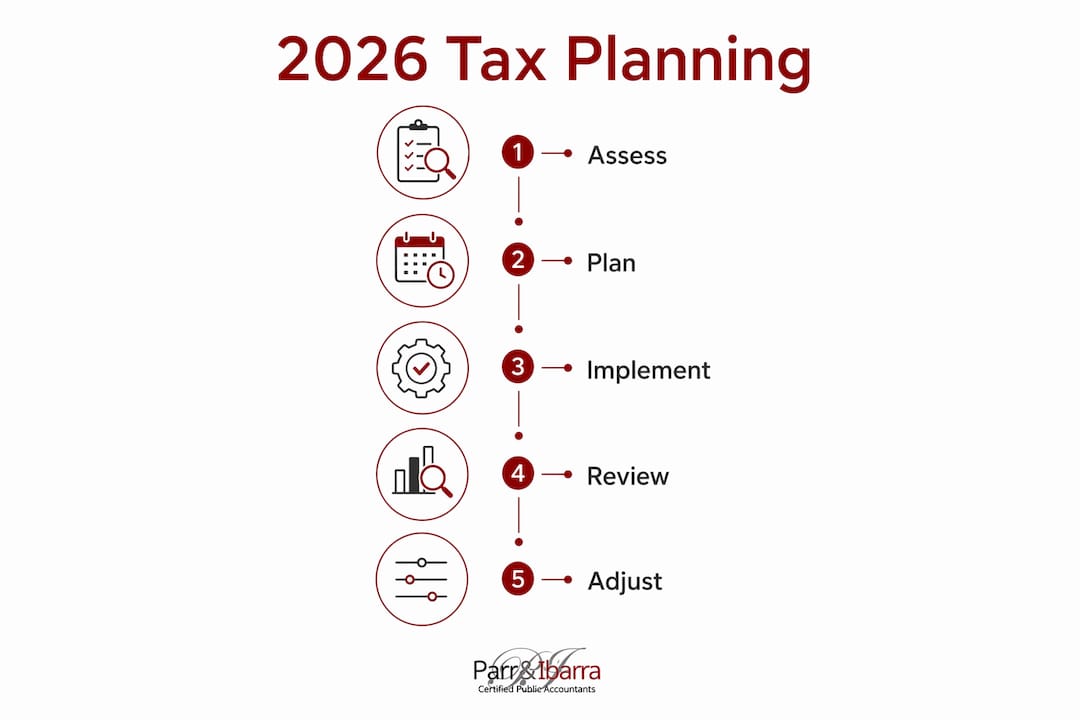
Engaging a planner early in the year, rather than in March, gives you the full runway to act on the strategy rather than just document what already happened. Parr & Ibarra CPA’s 2026 tax planning strategies outline exactly what that proactive calendar looks like for business owners this year.
Key Takeaways
Hurst business owners who plan taxes proactively throughout the year consistently avoid penalties, capture more deductions, and maintain stronger cash flow than those who treat tax as a once-a-year task.
| Point | Details |
|---|---|
| Local sales tax rate | Hurst’s combined sales tax rate is 8.25%, consisting of 6.25% Texas state sales tax plus a 2% special tax. |
| Franchise Tax is mandatory | Texas has no personal income tax, but most business entities must still file a Franchise Tax Report. |
| Structure drives tax outcomes | Your entity type determines which federal forms you file and how much self-employment tax you owe. |
| Proactive planning beats reactive filing | Year-round planning captures deductions and avoids penalties that last-minute filers routinely miss. |
| Engage early in the year | Starting the planning process in January rather than March gives you time to act, not just report. |

Parr & Ibarra CPA works with Hurst business owners year-round to build tax strategies that actually fit their business, not generic advice applied to every client the same way. Whether you need help with Franchise Tax compliance, quarterly planning, or a full financial advisory relationship, the team is ready to help. Explore tax planning best practices or reach out directly to start a conversation about your 2026 tax strategy.

