

Estate planning is the legal process of arranging how your assets, medical decisions, and financial affairs will be managed and distributed after your death or if you become incapacitated. Despite its importance, only 24% of U.S. adults have a will. That gap leaves most families exposed to state-directed asset distribution and court-appointed guardianship. A thorough plan covers five core pillars: a Last Will and Testament, a Revocable Living Trust, a Financial Power of Attorney, a Medical Power of Attorney, and a Living Will. Getting these documents in place protects your loved ones and gives you control over decisions that matter most.
What documents does an estate plan require?
Every estate plan starts with a Last Will and Testament. This document names who inherits your assets, who raises your minor children, and who serves as executor to carry out your wishes. Without a will, your state’s intestacy laws decide all of that for you, and the results rarely match what you would have chosen.
A Revocable Living Trust works alongside your will, not instead of it. A trust provides probate avoidance, privacy, and control that a will alone cannot deliver. Assets held in a trust transfer directly to beneficiaries without going through court, which saves time and keeps your affairs private. The trust is “revocable” because you can change or dissolve it at any time while you are alive and competent.
A Financial Power of Attorney names someone to manage your bank accounts, pay bills, and handle tax matters if you become incapacitated. Without one, your family may need a court-ordered conservatorship to access funds, even for routine expenses. A Medical Power of Attorney designates someone to make healthcare decisions on your behalf when you cannot speak for yourself.

A Living Will, also called an advance health care directive, spells out your wishes for end-of-life medical treatment. It removes the burden of impossible decisions from your family during a crisis. Together, these five documents form a complete plan.
| Document | Primary function | Key benefit |
|---|---|---|
| Last Will and Testament | Distributes assets, names guardian | Legal foundation for all inheritance |
| Revocable Living Trust | Holds and transfers assets | Avoids probate, maintains privacy |
| Financial Power of Attorney | Manages finances during incapacity | Prevents court conservatorship |
| Medical Power of Attorney | Directs healthcare decisions | Ensures your medical wishes are followed |
| Living Will | States end-of-life treatment preferences | Relieves family of difficult choices |
Pro Tip: A pour-over will acts as a safety net. It directs any assets you forgot to place in your trust into the trust upon your death, though those assets will still pass through probate first.
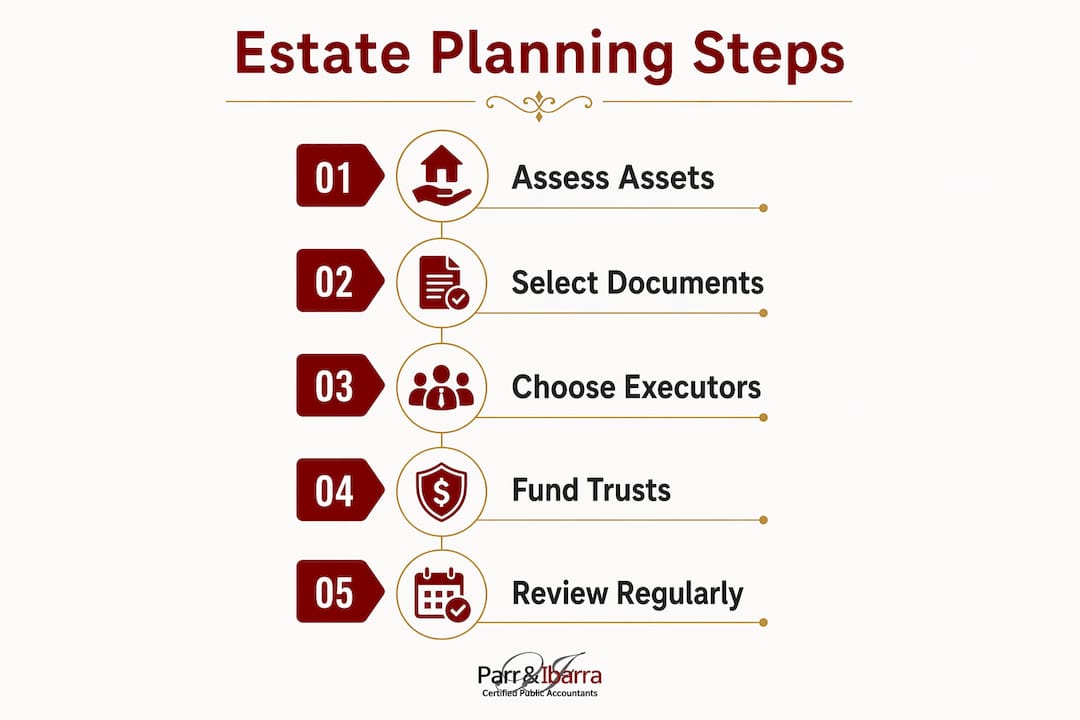
How to create an estate plan step by step
Starting with basic documents reduces the pressure to get everything perfect upfront and allows you to refine the plan as life changes. Analysis paralysis stops more families from planning than complexity ever does. Begin simply, then build.
List every asset and debt. Write down real estate, bank accounts, investment accounts, retirement accounts, life insurance policies, and business interests. Note what you own outright versus jointly. This inventory becomes the foundation for every decision that follows.
Decide who inherits what. Name specific beneficiaries for each asset category. Consider what happens if a primary beneficiary dies before you. Naming contingent beneficiaries prevents assets from falling into a default distribution.
Choose your fiduciaries carefully. Your executor carries out your will. Your trustee manages trust assets. Your agents under your powers of attorney act on your behalf during your lifetime. Selecting a trustworthy fiduciary matters more than the documents themselves, because these people execute your plan under real pressure, often during grief.
Fund your trust. Creating a trust document is only half the work. You must retitle real estate, bank accounts, and investment accounts into the trust’s name. An unfunded trust provides no probate protection at all.
Set up your powers of attorney. Execute both a Financial Power of Attorney and a Medical Power of Attorney while you are healthy and competent. Courts will not accept these documents if you lack capacity when you try to sign them.
Review the plan after major life events. Marriage, divorce, the birth of a child, a significant inheritance, or the death of a named fiduciary all require a plan review. A will written before your second marriage may still name your first spouse.
Pro Tip: Work with a qualified estate planning attorney when your plan involves a trust, a business interest, or blended family dynamics. An attorney from a firm like James Burns Law can catch gaps that generic online documents miss.
What are the most common estate planning mistakes?
Most estate plans fail not because the documents are wrong, but because families skip steps or let plans go stale. These are the errors that cause the most damage.
- Having no will at all. Estate planning is critical for anyone with assets or minor children. Without a will, the state decides who raises your children and who receives your property.
- Creating a trust but not funding it. An unfunded trust sends assets through probate just as if the trust never existed. Retitling assets is not optional.
- Ignoring beneficiary designations. Retirement accounts, life insurance policies, and payable-on-death bank accounts pass by beneficiary designation, not by will. Failing to update beneficiary designations is one of the most common and costly mistakes in inheritance planning.
- Skipping powers of attorney. Many families focus entirely on what happens after death and ignore incapacity planning. A Financial Power of Attorney and a Medical Power of Attorney are just as urgent as a will.
- Choosing the wrong fiduciary. Naming a sibling as executor because it feels fair, rather than because they are capable and organized, creates conflict and delays. Choose based on competence and trustworthiness, not sentiment.
- Never updating the plan. A plan written ten years ago may name people who have died, divorced, or become estranged. Review your documents every three to five years and after every major life change.
How does estate planning reduce probate costs and taxes?
Probate is the court process that validates a will and oversees asset distribution. The probate process typically costs 3–7% of the gross estate value and lasts six months to over a year. On a $500,000 estate, that means up to $35,000 in fees before a single dollar reaches your heirs.
A Revocable Living Trust bypasses probate entirely for assets held inside it. Living trusts avoid probate and public record, which speeds up asset distribution and keeps your financial affairs out of the courthouse. Beneficiary designations on retirement accounts and life insurance also transfer assets outside of probate, making them powerful tools in any inheritance planning strategy.
On the tax side, a Financial Power of Attorney lets your agent manage tax filings and payments if you become incapacitated. This prevents missed deadlines and penalties that can erode estate value. For larger estates, strategies like irrevocable trusts, annual gifting programs, and family limited partnerships can reduce the taxable estate before death. Understanding capital gains tax implications on inherited assets also helps heirs plan their own tax exposure after receiving an inheritance.
| Approach | Probate required | Privacy | Speed of transfer |
|---|---|---|---|
| Will only | Yes | No (public record) | Slow (6–12+ months) |
| Revocable Living Trust | No | Yes | Fast (weeks) |
| Beneficiary designations | No | Yes | Fast (weeks) |
Pro Tip: Review your IRS obligations as part of your estate plan. The Parr & Ibarra CPA IRS tax guide covers filing requirements that affect estate and gift tax planning.
Key Takeaways
A complete estate plan requires five core documents, properly funded trusts, and regularly updated beneficiary designations to protect your family and reduce probate costs.
| Point | Details |
|---|---|
| Five core documents | Every plan needs a will, trust, financial POA, medical POA, and living will. |
| Fund your trust | Retitle assets into the trust’s name or probate avoidance is lost entirely. |
| Fiduciary selection | Choose executors and trustees based on competence, not family obligation. |
| Beneficiary designations | Update retirement accounts and insurance policies after every major life event. |
| Probate costs real money | Probate fees run 3–7% of estate value and delay transfers by six months or more. |
Why I think most families get estate planning backwards
Most people treat estate planning as a document problem. They focus on getting the will worded correctly or deciding between a will and a trust, and they spend months researching before they sign anything. That delay is the real risk.
What I have seen repeatedly is that the families who suffer the most are not the ones with imperfect documents. They are the ones with no documents at all, or with a trust that was never funded, or with a Financial Power of Attorney that expired before it was needed. The paperwork matters far less than the action of actually completing it.
The will versus trust debate is largely a false dilemma. Both tools serve different purposes and work best together. A will handles guardianship and catches assets that fall outside the trust. A trust handles probate avoidance and incapacity. Treating them as competitors means you end up with a weaker plan than if you had used both.
The choice of fiduciary deserves far more attention than it gets. I have watched well-drafted estate plans collapse because the named executor was disorganized, emotionally overwhelmed, or in conflict with other heirs. Pick someone who is calm under pressure, financially literate, and willing to ask for help. That decision shapes everything.
Start now with the basics. A simple will, a durable Financial Power of Attorney, and a Medical Power of Attorney put you ahead of most American families. Build from there as your assets and family situation grow more complex.
— Adan
How Parr & Ibarra CPA can support your estate plan
Estate planning intersects directly with tax strategy, and that is where many families leave money on the table.

Parr & Ibarra CPA works with individuals and families in the Dallas-Fort Worth area to align their estate plans with proactive tax strategies. The team helps clients understand estate tax implications, structure asset transfers efficiently, and coordinate with estate planning attorneys to make sure the financial and legal pieces fit together. With over 20 professionals on staff, including multiple CPAs, Parr & Ibarra CPA provides the kind of year-round guidance that goes well beyond tax season. If your estate includes real estate holdings, the firm’s real estate tax strategies can help you maximize deductions and reduce your heirs’ tax burden. Reach out to Parr & Ibarra CPA to schedule a consultation.
FAQ
What is estate planning and who needs it?
Estate planning is the legal process of arranging how your assets and personal affairs will be managed after death or incapacity. It applies to anyone with assets or minor children, not just the wealthy.
What is the difference between a will and a trust?
A will directs asset distribution through probate court, while a revocable living trust transfers assets directly to beneficiaries without court involvement. Both documents are complementary and most thorough plans use both.
What does a financial power of attorney cover?
A Financial Power of Attorney authorizes a named agent to manage bank accounts, pay bills, file taxes, and handle financial transactions if you become incapacitated. Without one, your family may need a court order to access funds.
How often should I update my estate plan?
Review your estate plan every three to five years and after any major life event such as marriage, divorce, the birth of a child, or a significant change in assets. Outdated beneficiary designations and named fiduciaries are among the most common problems in older plans.
How can I avoid probate?
Placing assets in a properly funded Revocable Living Trust and naming beneficiaries on retirement accounts and life insurance policies are the most direct ways to avoid probate costs and delays. Both methods transfer assets outside of court and typically within weeks.

