
The contribution has to be added to the owner’s W-2 wages, and the owner then claims it back as an above-the-line deduction under IRC §223 on Form 8889 and Form 1040 Schedule 1. This treatment traces directly to Notice 2005-8.
Before you fund anything, do three things:
- Confirm the owner is enrolled in a qualifying high-deductible health plan.
- Tell payroll the contribution belongs in Box 1, not coded as Code W.
- Track total contributions from all sources so nobody blows past the annual limit.
Key Takeaways
| Point | Details |
|---|---|
| 2% rule changes everything | Shareholders owning more than 2% are treated like partners, not employees, for HSA purposes under IRC §1372. |
| Box 1, not Code W | Corporate HSA contributions for these owners belong in W-2 Box 1, never in Box 12 with Code W. |
| Aggregate limits apply | Corporate, payroll, and personal contributions all count toward the same annual HSA limit. |
| Fix errors fast | Use Form 941-X and a corrected W-2 to resolve miscoded contributions before filing deadlines. |
| Get a professional review | Parr & Ibarra CPA reviews payroll coding and HSA reporting for Dallas-Fort Worth S corp owners to catch errors before they cost a deduction. |
Where to Verify HSA Rules for S Corp Owners
- Notice 2005-8 establishes the legal basis for 2% shareholder HSA treatment.
- Notice 2008-01 clarifies employment tax rules for other employees.
- Publication 15-B covers the broader fringe-benefit rules employers rely on.
This article is general information, not a substitute for advice from a qualified financial advisor. Consult a qualified financial professional about your own circumstances before acting on anything here.
HSA for S Corp Owners: The 2% Shareholder Rule Explained
Everything about HSA for S corp treatment hinges on one number: 2%. IRC §1372 says any shareholder who owns more than 2% of an S corporation’s stock gets treated like a partner in a partnership, not like a regular W-2 employee, for fringe benefit purposes. That single rule is why HSA contributions for owners behave differently than they do for everyone else on the payroll.
Notice 2005-8 spells out the mechanics. When an S corporation contributes to a more-than-2% shareholder-employee’s HSA, the IRS treats that payment as a guaranteed payment. Guaranteed payments are includible in the shareholder’s gross income. The shareholder then deducts the contribution on their personal return under section 223.
The reporting consequence is where most payroll teams stumble:
- For a 2% shareholder, the HSA contribution goes into W-2 Box 1 as taxable wages.
- It does not get coded as Code W in Box 12, which is reserved for regular employees whose contributions are excluded from income.
Mixing those two up is the single most common mistake tied to S Corp HSA contributions, and it usually costs the owner their deduction.
Employer Contributions vs. Personal Contributions: Tax and Payroll Treatment
A regular employee’s HSA contribution through payroll is excluded from federal income tax, excluded from FICA, and shows up in Box 12 with Code W. A more-than-2% shareholder’s contribution follows a different path entirely.

| Regular employee | More-than-2% shareholder | |
|---|---|---|
| W-2 reporting | Box 12, Code W | Box 1 (taxable wages) |
| Income tax treatment | Excluded | Included, then deducted on Form 8889 |
| FICA/Medicare | Excluded | Generally still excluded from FICA wages under the guaranteed-payment framework, but treatment varies by payroll setup |
That FICA nuance creates what practitioners sometimes call the “savings gap.” The net income tax outcome ends up similar for the owner after the deduction, but the owner doesn’t capture the same payroll tax savings that a rank-and-file employee gets automatically through a cafeteria plan. Employers and owners should plan for that gap rather than assume parity.
Before you close the books on any pay period involving HSA funding, verify:
- The contribution amount landed in Box 1, not Box 12.
- No FICA was withheld on the contribution if your payroll provider follows the guaranteed-payment treatment.
- The owner’s personal HDHP enrollment is documented and current.
Pro Tip: Ask your payroll provider to run a test paycheck before the first HSA contribution of the year. Catching a wrong wage code on paycheck one is a five-minute fix. Catching it in December means amending twelve months of W-2 data.
How to Fund an HSA for S Corp Owners the Right Way
There are three common ways money ends up in an S corp owner’s HSA, and each one has its own paperwork trail.
- Direct corporate contribution. The S corporation deposits money straight into the owner’s HSA. Payroll adds that amount to Box 1 wages for the pay period in which the deposit happens. The corporation deducts it as a business expense; the owner reports it as income and then deducts it again on Form 8889.
- Payroll salary-addition method. Instead of a separate deposit, the company adds the HSA amount to the owner’s gross wages for the period, and the owner moves that money into the HSA personally. This keeps the wage coding simple since the whole amount is already taxable compensation.
- Direct personal contribution. The owner funds the HSA out of pocket, with no involvement from the S corporation’s payroll at all, and claims the full deduction on Form 8889 when filing.
Whichever method you use, the annual contribution limit is aggregated across every source: corporate contributions, payroll additions, and personal deposits all count toward the same ceiling. Owners age 55 and older can add a catch-up contribution on top of the standard limit.
Pro Tip: Many advisors steer S corp owners toward funding the HSA personally rather than through payroll, specifically to sidestep the wage-coding errors that plague the corporate-contribution method. It’s not that corporate funding is wrong. It’s that fewer moving parts means fewer chances to miscode a W-2.
If a payroll mistake already happened, Form 941-X corrects the employment tax return, and the W-2 may need a correction alongside it. Loop in whoever manages your compensation and benefits documentation before you make any of these calls, since HSA funding decisions often intersect with reasonable-compensation questions for S corp owners.
Common HSA Mistakes S Corp Owners Should Avoid
The Treasury and IRS guidance on HSA reporting for S corporation shareholders points to a recurring, expensive error: reporting a 2% shareholder’s employer HSA contribution as Code W in Box 12 instead of folding it into Box 1. That single miscode can cause double taxation or, worse, cause the owner to lose the offsetting deduction entirely.
Watch for these five failure points:
- Coding the contribution as Code W instead of adding it to Box 1 wages.
- Exceeding the aggregate annual limit once corporate and personal deposits have been combined.
- Assuming FICA treatment without confirming it with your payroll software.
- Funding an HSA for an owner who isn’t actually enrolled in a qualifying HDHP.
- Letting reimbursements from the HSA overlap with reimbursements already covered by the health plan.
Run this checklist quarterly, or at minimum before year-end close:
- Confirm payroll coding matches Box 1, not Box 12, for every 2% shareholder.
- Reconcile total HSA deposits against the annual limit across all funding sources.
- Pull a sample W-2 and check the entries against actual payroll records.
- File HDHP enrollment paperwork somewhere you can find it in April.
If you’ve overcontributed, withdraw the excess before the tax filing deadline to avoid the excise tax. If a W-2 already went out with the wrong code, Form 941-X and a corrected W-2 are your path back to compliance. Firms working through a corrected filing sometimes bring in outside support for federal tax return issues when the correction touches multiple prior years.
When Employer HSA Funding Might Not Count as Wages
There are narrow situations where employer-funded HSA amounts for an owner might avoid full wage inclusion, generally tied to how section 3121(a)(2)(B) interacts with the guaranteed-payment framework described in Notice 2005-8 and clarified further in Notice 2008-01.
The exclusion possibilities here are fact-dependent and rare. They hinge on how the specific payment is structured, who received it, and whether it fits the guaranteed-payment definition exactly as the IRS notices describe it.
Don’t build a compensation plan around one of these edge cases without a tax professional confirming it applies to your specific ownership structure first.
A Worked Example: example HSA Contribution for an S Corp Owner
Here’s what happens on paper:
- Payroll adds that amount to the owner’s W-2 Box 1 wages, not Box 12 Code W.
- The corporation deducts the contribution as a business expense on its return.
- The owner reports the contribution as part of taxable wages when filing their personal return.
- The owner then files Form 8889, claiming an above-the-line deduction, which offsets the wage inclusion dollar for dollar.
- Net result: the owner pays no additional income tax on the contribution, provided total HSA funding from all sources stays within the annual limit.
The action item is simple: confirm Box 1 includes the $3,000, confirm Box 12 does not show Code W for that amount, and reconcile the total against the year’s contribution ceiling. Bring this example to payroll and your CPA and ask them to confirm the W-2 coding and, if needed, the Form 941-X status.
Why Some Advisors Prefer Owner-Funded HSAs
Many advisors lean toward personal funding for the simple reason that it removes payroll from the equation entirely: no wage coding, no FICA guesswork, no Box 1 versus Box 12 confusion. Corporate funding still earns its place when a company wants the HSA contribution documented as part of a formal compensation package or reflected on the financials as a benefit expense. Either way, bring payroll and your CPA into the conversation before the first dollar moves.
Get Your HSA and Payroll Reporting Right the First Time
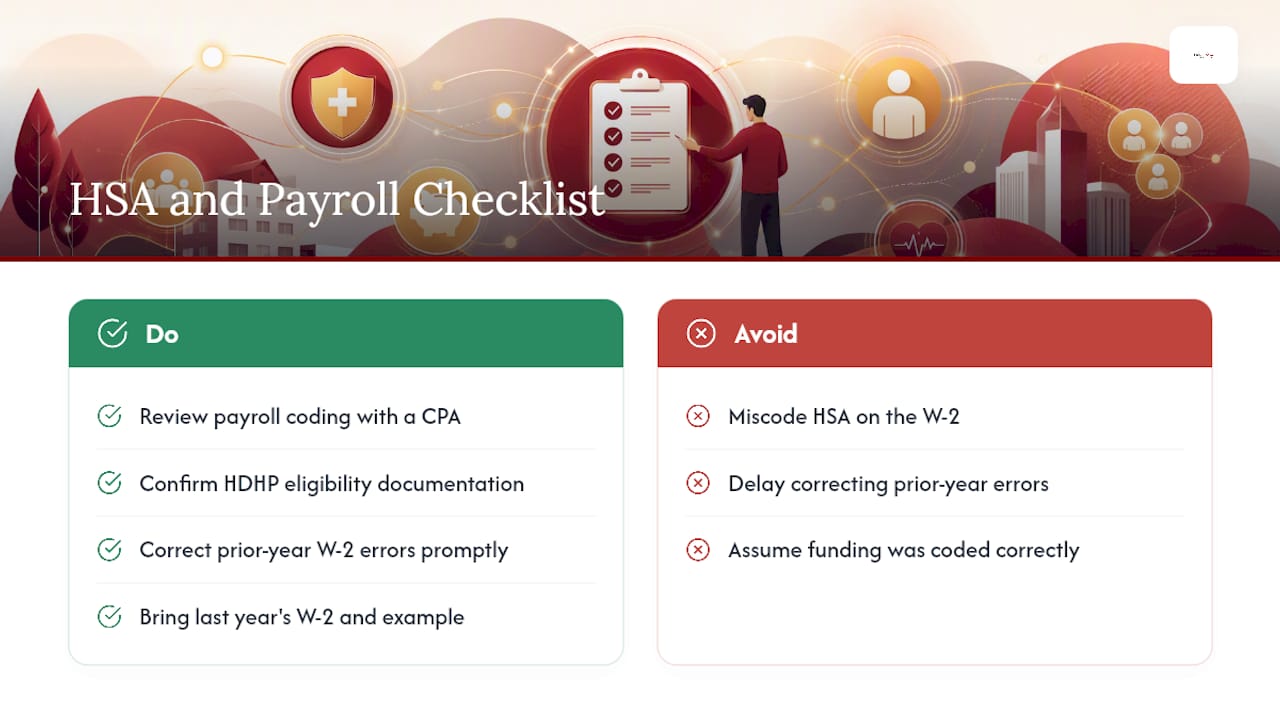
Getting HSA treatment wrong on a single W-2 can mean an owner loses a deduction they were entitled to, or worse, triggers a payroll tax correction months later. Parr & Ibarra CPA works directly with Dallas-Fort Worth business owners to review payroll coding, confirm HDHP eligibility documentation, and correct prior-year W-2 errors before they compound into bigger problems. If you’ve already made an HSA funding decision this year and aren’t sure it was coded correctly, bring last year’s W-2 and the worked example above to a tax planning consultation and get a second set of eyes on it before your next payroll run.
Sources
- Notice 2005-8
- Treasury and IRS release guidance clarifying the tax treatment and reporting for HSAs and S corporation shareholders
- Publication 15-B, Employer’s Tax Guide to Fringe Benefits
- Notice 2008-01

