

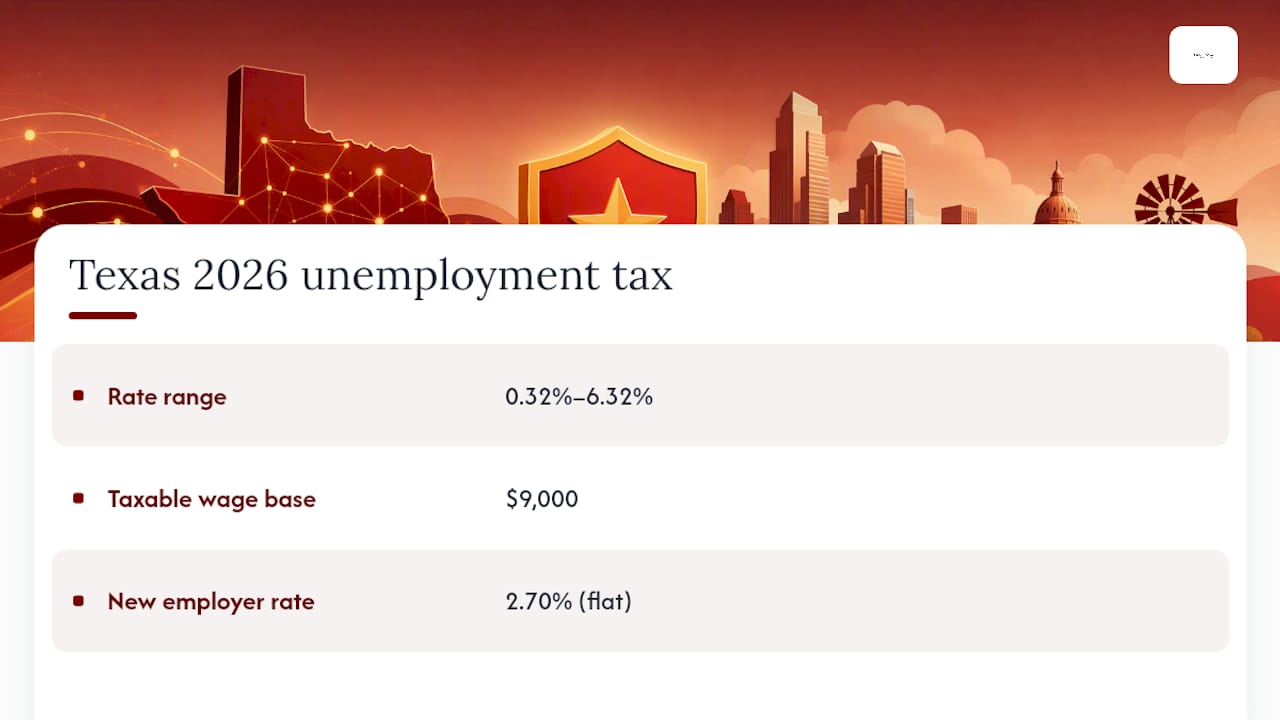
Texas unemployment tax rates for 2026 range from a low rate to a high rate, applied to the first $9,000 of each employee’s wages, and new employers pay a flat rate until they build an experience history. Every dollar comes out of the employer’s pocket. Texas is one of the few states with no employee-side withholding for unemployment insurance, so your workers never see a deduction for it on a pay stub.
That single fact changes how you should think about this tax. It’s not a payroll deduction you pass through, it’s a direct cost of running a business in Texas, and it moves up or down based on decisions you make about hiring, firing, and how carefully you document separations.
- 2026 rate range: a defined minimum to maximum rate
- New-employer rate: a specific introductory rate, applies before you have enough claims history to earn an experience rating
- Taxable wage base: the first $9,000 paid to each employee per calendar year
- Who pays: 100% employer-funded, with zero withholding from employee wages
Quick fact: A business with 20 employees, all at the new-employer rate of 2.70%, owes roughly $4,860 in Texas unemployment tax for the year, based on the Texas Workforce Commission’s 2026 tax rate schedule.
Key Takeaways
Texas unemployment tax costs employers between $28.80 and $568.80 per employee annually in 2026, depending entirely on claims history and how fast HR responds to disputes.
| Point | Details |
|---|---|
| Know your wage base | Only the first $9,000 of each employee’s annual wages is taxed for unemployment purposes. |
| Register within 10 days | New employers must set up a TWC account within 10 days of becoming liable to avoid penalties. |
| Respond to claims fast | The 14-day response window for unemployment claims determines whether a chargeback hits your rate. |
| Control what you can | Your General Tax Rate reflects your own claims history; RTR, OA, and DTR are set statewide and can’t be influenced. |
| Get advisory support | Parr & Ibarra CPA helps Dallas-Fort Worth employers model voluntary contributions and audit separation documentation to limit chargebacks. |
What Is the Texas Unemployment Tax and How Is It Calculated?
The Texas unemployment tax, formally the State Unemployment Tax Act (SUTA) contribution, applies only to the taxable wage base, meaning the first $9,000 you pay each employee in a calendar year. Wages above that threshold owe nothing further in state unemployment tax for that worker, no matter how much they earn the rest of the year.
Here’s how the math plays out at different points on the 2026 rate scale:
- Lowest rate times taxable wage base equals the minimal tax per employee for the year.
- New-employer rate times taxable wage base equals the introductory tax per employee for the year.
- Highest rate times taxable wage base equals the maximal tax per employee for the year.
Multiply whichever figure applies by your headcount, and you have your annual liability.
Quick fact: A 50-employee company at the high end of the range (6.32%) owes roughly $28,440 a year, compared to just $1,440 at the lowest published rate, based on the TWC 2026 rate schedule. That spread is the entire reason rate management matters.
Timing matters too. If you hire someone in October, you still owe tax on the first $9,000 of their wages, but you’re unlikely to hit that ceiling before year-end, so you’ll likely pay tax on their full wages for the remainder of the calendar year. The wage base resets every January 1, regardless of when someone started.
What Components Make Up Your Effective Tax Rate?
Your actual bill isn’t one flat number. It’s five stacked pieces, and only one of them is really in your control.
- General Tax Rate (GTR): Calculated from your benefit ratio, meaning how much unemployment benefits have been charged against your account relative to your taxable payroll, multiplied by a statewide adjustment factor. This is the piece you can move by managing claims well.
- Replenishment Tax Rate (RTR): Set at 0.21% for 2026, this covers benefits paid out that couldn’t be charged to a specific employer’s account. Every employer pays it; you can’t reduce it through your own behavior.
- Obligation Assessment (OA): 0.00% for 2026, a bond-repayment component the state uses when it needs to cover trust fund shortfalls with borrowed money.
- Deficit Tax Rate (DTR): Also 0.00% for 2026, added only when the statewide trust fund balance drops below a target level.
- Employment and Training Investment Assessment (ETIA): A small statutory add-on, plus a separate interest tax component set at 0.01% for 2026, according to TWC’s published rate structure.
Add those together and you get your total rate. The GTR is the only lever you can actually pull. Everything else is set statewide, based on the overall health of the trust fund, and applies to every employer regardless of their claims history.
How Do You Register and File Texas Unemployment Taxes?
Texas gives you a 10-day window to register once you become a liable employer, whether that liability starts on your first day of hiring or the day you cross a wage threshold. You register through the TWC’s online registration system, and there’s no paper alternative for most new employers anymore.
Once registered, quarterly filing is non-negotiable. Reports and payments are due by the last day of the month following the end of each quarter:
- Q1 (Jan–Mar): due April 30
- Q2 (Apr–Jun): due July 31
- Q3 (Jul–Sep): due October 31
- Q4 (Oct–Dec): due January 31
You file and pay through TWC’s Unemployment Tax Services (UTS) system, which accepts ACH debit, EFT, and credit card payments. Most employers are required to pay electronically. A hardship waiver exists for those without reliable internet or computer access, but it’s not something to request out of convenience. TWC has flagged electronic payment as the default expectation, and skipping it without an approved waiver can trigger civil penalties on top of the tax owed.
Pro Tip: Set calendar reminders 10 days before each quarterly deadline, not on the deadline itself. UTS occasionally has processing delays during peak filing weeks, and a payment that posts a day late still counts as late.
How Can You Reduce Chargebacks and Lower Your Rate?
Your General Tax Rate is a rearview mirror. It reflects the last three years of chargebacks against your account, which means every claim you fail to contest, every sloppy separation record, and every missed deadline follows you for years, not months.

The single highest-leverage habit is responding to claim notices fast. Texas gives employers a 14-day window to respond to an unemployment claim with documentation. Miss it, and you typically forfeit your right to contest, even if the separation was entirely justified and well-documented internally. That claim becomes a chargeback, and chargebacks feed directly into the benefit ratio that sets your GTR.
Build these habits into your payroll and HR routine:
- Respond to every claim notice within 14 days, with dates, written policies, and any witness statements attached.
- Run a quarterly audit of separation paperwork, not just when someone leaves, to confirm managers are documenting terminations correctly in real time.
- Train supervisors on what “misconduct” and “voluntary quit” actually mean under Texas unemployment law, since misclassifying a separation is one of the most common reasons employers lose contests they should have won.
- Model voluntary contributions against your projected rate increase before you write a check. TWC allows employers to pay down their benefit ratio directly, but it only makes financial sense when the one-time payment costs less than the extra tax you’d otherwise owe over the following year.
- If you’re acquiring another business, pull its TWC account history before closing. Successor liability means you can inherit chargebacks tied to the previous owner’s payroll, and that history can quietly push your blended rate higher the moment the deal closes.
Pro Tip: Before making a voluntary contribution, ask your accountant to run the numbers both ways: the one-time payment versus the projected rate increase spread across your full payroll for the next tax year. TWC’s chargeback estimate tool can model the scenario, but it only gives estimates, not a binding number, so treat it as a planning input rather than a final answer.
How Should You Manage Your UTS Account and Payroll Access?
Most compliance failures aren’t dramatic. They’re administrative drift: nobody updated the account contact, the password reset went to an employee who left two years ago, or nobody’s looked at the chargeback detail since the last audit.
Fix that by treating your UTS account like any other piece of financial infrastructure:
- Assign a senior owner or officer as the account administrator, then delegate specific permissions to payroll staff instead of sharing one login across the team.
- Keep contact information and user profiles current, and recover or reset credentials the moment someone with access leaves the company.
- Review your statement of account and chargeback detail on a set schedule, monthly if you have frequent turnover, quarterly at minimum, rather than only when a rate notice arrives.
- Enroll in eCorres for electronic notices so claim documents and rate determinations don’t get lost in a mailroom or an inbox nobody checks.
- If your headcount exceeds 1,000 employees, follow TWC’s alternate filing guidance for bulk wage reporting, since the standard UTS interface is built around smaller employers.
None of this is complicated. It just requires someone to own it consistently.
What Texas Employers Get Wrong About Unemployment Tax
Most advice on this topic treats unemployment tax like a fixed cost, something you calculate once a year and forget about. That’s backwards. Your rate three years from now is being written today, in how your managers document a termination this week or whether payroll flags a claim notice before the 14-day clock runs out.
The bigger blind spot is worker classification. Employers who lean on independent contractors to sidestep unemployment tax often misjudge the line. TWC applies its own test for employment status, and misclassifying a worker doesn’t just risk back taxes, it can trigger penalties and retroactive liability once TWC reclassifies the relationship. If someone’s schedule, tools, and daily supervision look like an employee’s, calling them a contractor on paper won’t hold up in an audit.
The advice that actually works isn’t glamorous: document separations the day they happen, respond to claim notices immediately, and revisit your chargeback detail on a schedule instead of reactively. Rate mitigation is a compliance habit, not a once-a-year tax strategy session. Businesses that treat it that way consistently land closer to the bottom of the rate range than the top.
Get Help Lowering Your SUTA Exposure in Dallas-Fort Worth
Reading the rate schedule is one thing. Building the internal habits that actually keep your General Tax Rate down, consistent separation documentation, fast claim responses, a payroll system that flags deadlines before they’re missed, is where most Dallas-Fort Worth employers run out of bandwidth. Parr & Ibarra CPA works directly with Texas business owners to close that gap, pairing payroll management with the kind of proactive tax planning that treats unemployment tax as a cost you manage year-round, not a surprise on a rate notice.
The firm’s advisory team can also model whether a voluntary contribution actually saves you money before you write that check, and review your separation documentation practices so a preventable chargeback doesn’t follow your account for the next three years. If your rate notice caught you off guard this year, schedule a payroll compliance review with Parr & Ibarra CPA and find out exactly where your exposure is coming from.
Sources
FAQ
What Is the Texas Unemployment Tax Rate for 2026?
Rates for 2026 range from 0.32% to 6.32%, applied to the first $9,000 of each employee’s wages, with new employers paying a flat 2.70% until an experience rating applies.
Do Employees Pay Any Portion of Texas Unemployment Tax?
No. Texas unemployment tax is 100% employer-funded, and no amount is withheld from employee paychecks.
When Do I Need to Register for a Texas Unemployment Tax Account?
You must register within 10 days of becoming a liable employer, using TWC’s online registration system.
How Often Do I File Texas Unemployment Tax Reports?
Quarterly. Reports and payments are due by the last day of the month following each quarter, for example April 30 for the first quarter.
Can I Lower My Texas Unemployment Tax Rate?
Yes, mainly by managing your General Tax Rate through fast claim responses, solid separation documentation, and evaluating voluntary contributions with help from an advisor like Parr & Ibarra CPA.

