
S corporations generally do not pay federal income tax, but that does not mean the IRS is out of the picture until April. Shareholders must make estimated tax payments on their pass-through income throughout the year, and the S corporation itself must make installment payments when certain corporate-level taxes total $500 or more. Here is what you need to know right now:
- Shareholders: You owe estimated tax on your K-1 income, wages, and other taxable items if you expect to owe at least $1,000 after withholding and credits.
- The S corporation entity: It only makes estimated payments for specific corporate-level taxes, such as built-in gains tax, excess net passive income tax, and investment credit recapture tax, and only when those taxes reach the $500 threshold.
- Safe harbors: Pay at least 90% of your current-year tax or meet the full prior year’s tax obligation (a higher threshold applies if your prior-year adjusted gross income was above a certain level) to avoid underpayment penalties.
- Immediate next step: Pull last year’s return, note your prior-year tax liability, and estimate your current-year K-1 income. That two-minute check tells you whether you need to make a payment this quarter.
Key Takeaways
S corporations generally do not pay federal income tax, but shareholders must make quarterly estimated payments on pass-through income, and the entity itself owes installment payments when corporate-level taxes reach $500 or more.
| Point | Details |
|---|---|
| Entity vs. shareholder obligation | The S corp pays estimated tax only on built-in gains, excess net passive income, and investment credit recapture when those total $500+. |
| Individual threshold | Shareholders owe estimated tax if they expect to owe at least $1,000 after withholding and credits. |
| Safe-harbor rule | Pay 90% of current-year tax or 100% of prior-year tax (110% if prior-year AGI exceeded $150,000) to avoid penalties. |
| Key deadlines | Individual quarterly payments are due April 15, June 15, September 15, and January 15; corporate calendar-year payments follow the same dates except December 15 replaces January 15. |
| Parr & Ibarra CPA | Parr & Ibarra CPA helps DFW S-corp owners calculate quarterly payments, set up EFTPS, and coordinate state and federal obligations year-round. |
How S corp estimated taxes work: entity vs. shareholder responsibilities
The pass-through structure of an S corporation splits tax responsibility in a way that surprises many first-time owners. The entity files Form 1120-S to report income, deductions, and credits, but the tax itself flows to shareholders on Schedule K-1. That means shareholders carry the estimated tax obligation on their personal returns.
Corporate-level taxes that can trigger entity payments:
- Built-in gains tax (applies when an S corporation converted from a C corporation and sells appreciated assets within the recognition period)
- Excess net passive income tax (applies when passive income exceeds 25% of gross receipts and the corporation has accumulated earnings and profits from a prior C corporation period)
- Investment credit recapture tax
Shareholder-level obligations:
- Estimated tax on K-1 ordinary business income, rental income, and other pass-through items
- Estimated tax on W-2 wages paid by the S corporation (withholding from payroll usually covers this, but gaps are common)
- Self-employment tax does not apply to S-corp distributions, but payroll taxes apply to reasonable W-2 compensation
The table below summarizes who pays what and which forms are involved.
| Taxpayer | What triggers payment | Primary form |
|---|---|---|
| S corporation (entity) | Built-in gains, excess net passive income, investment credit recapture totaling $500+ | Form 1120-S instructions; Form 2220 for penalty |
| Shareholder (individual) | K-1 pass-through income, wages, capital gains, other taxable items | Form 1040-ES |
For a deeper look at how owner compensation interacts with these obligations, the tax-efficient owner compensation strategy guide covers the salary-versus-distribution split in detail.
When does an S corporation itself owe estimated tax payments?
Most S corporations never trigger entity-level estimated payments because they have no built-in gains exposure and no accumulated earnings and profits from a prior C corporation period. But if your S corporation does face one of the three corporate-level taxes, the rules are specific.
The $500 threshold: Per the Form 1120-S instructions, the corporation must make installment payments when the total of built-in gains tax, excess net passive income tax, and investment credit recapture tax is $500 or more for the year.
Checklist to determine whether your S corporation must pay:
- Did your company convert from a C corporation within the applicable recognition period?
- Does the corporation have passive income exceeding 25% of gross receipts, AND does it have accumulated C-corp earnings and profits?
- Has any previously claimed investment credit become subject to recapture?
- Will the total of all applicable taxes reach $500 or more?
If you answered yes to any of the first three and yes to the fourth, the corporation owes installment payments. The required annual payment is generally calculated using methods described in the Form 1120-S instructions, comparing current-year and prior-year tax amounts.
The IRS is clear: an S corporation that expects $500 or more in built-in gains, excess net passive income, or investment credit recapture tax must make estimated installment payments. Waiting until the annual return is filed will trigger an underpayment addition under 26 U.S.C. §6654.
How to calculate estimated taxes for shareholders and the S corporation
Shareholder calculation (personal return)
- Estimate your adjusted gross income (AGI). Add your expected W-2 wages from the S corporation, your projected K-1 ordinary income, any capital gains, and other income sources.
- Subtract deductions. Apply your standard deduction or estimated itemized deductions to arrive at estimated taxable income.
- Calculate your estimated tax. Apply the current tax brackets to taxable income, then add self-employment tax if applicable (note: S-corp distributions are not subject to self-employment tax, but wages are subject to payroll taxes).
- Subtract withholding and credits. Deduct federal income tax withheld from your W-2 wages and any refundable credits you expect.
- Apply the safe-harbor test. Per Form 1040-ES, you generally avoid penalties if your estimated payments plus withholding cover at least 90% of your current-year tax OR 100% of your prior-year tax (110% if your prior-year AGI exceeded $150,000).
- Divide by four. The required annual payment divided by four gives your baseline quarterly installment.
Safe-harbor rules at a glance:
- 90% rule: Pay at least 90% of the tax you will owe for the current year.
- 100% rule: Pay at least 100% of last year’s total tax liability.
- 110% rule: If your prior-year AGI exceeded $150,000 ($75,000 if married filing separately), pay 110% of last year’s tax.
When the annualized method helps
If your S corporation income arrives unevenly, such as a retail business that earns most of its profit in the fourth quarter, equal quarterly installments can cause you to overpay early and underpay late. The annualized income installment method under section 6655(e) lets you base each installment on actual year-to-date income annualized to a full year. This can materially reduce one or more quarterly payments and lower penalty exposure. The Form 1120-S instructions describe both the annualized and adjusted seasonal methods for corporate-level payments; shareholders use the annualized method via Form 2210 on their personal returns.
Pro Tip: If your K-1 income spikes in Q3 or Q4, run the annualized calculation before making your September 15 payment. Paying a larger installment then, rather than equal quarters all year, can eliminate a penalty that equal payments would have triggered.
Federal due dates you need to calendar right now
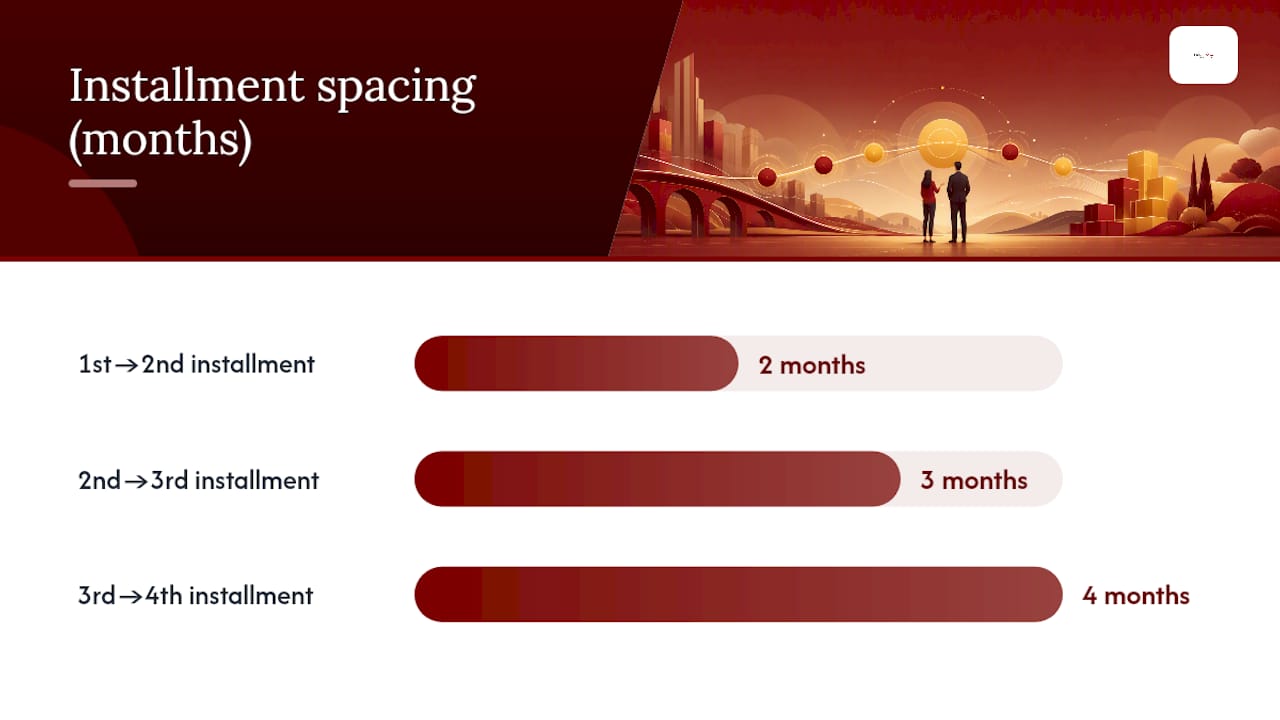
For calendar-year individual shareholders, the four quarterly due dates follow a pattern that does not divide the year evenly. The gap between the first and second installments is only two months, while the gap between the second and third is three months.
| Payment period | Individual due date | Corporate (calendar year) due date |
|---|---|---|
| January 1 – March | April 15 | April 15 |
| April 1 – May | June 15 | June 15 |
| June 1 – August | September 15 | September 15 |
| September 1 – December | January 15 (following year) | December 15 |
Weekend and holiday rule: When a due date falls on a Saturday, Sunday, or legal holiday, the deadline shifts to the next business day. Always verify the exact date for the current year rather than assuming the 15th is the deadline.
Fiscal-year corporations: Installments are due on the 15th day of the 4th, 6th, 9th, and 12th months of the fiscal year, per the 2025 Form 1120-S instructions.
Filing extensions do not extend payment deadlines. If you file a Form 7004 extension for the S corporation or a Form 4868 extension for your personal return, your payment is still due by the original deadline. Mark your calendar using a dedicated tax deadline calendar to avoid confusing the filing extension with a payment extension.
Also note that Form 1120-S itself is due March 15 for calendar-year S corporations, and K-1s must be issued to shareholders by that date. Shareholders who receive a late K-1 may need to file an amended return or extension for their personal return.
Payment channels and the forms you will actually use
The IRS offers several ways to pay, and the right choice depends on whether you are paying as an individual shareholder or on behalf of the corporation.
- EFTPS (Electronic Federal Tax Payment System): The preferred method for businesses. You can schedule payments up to 365 days in advance, which is useful for setting up all four quarterly installments at the start of the year. Payments must be scheduled by 8 PM ET the day before the due date. Enroll at eftps.gov.
- IRS Direct Pay: Available for individual taxpayers paying personal estimated tax. No enrollment required; payments are made directly from a bank account.
- Debit or credit card: Accepted through IRS-authorized payment processors, though a processing fee applies.
- Paper vouchers (Form 1040-ES): Each quarterly package includes a payment voucher. If you mail a check, use the voucher to ensure the payment is applied to the correct period and taxpayer identification number.
Forms reference:
- Form 1040-ES: Used by individual shareholders to calculate and submit quarterly estimated payments. The package includes worksheets for computing your required annual payment.
- Form 1120-S: The S corporation’s annual return. The instructions detail how to calculate and pay corporate-level estimated taxes.
- Form 2220: Used to compute the underpayment penalty for corporations. If the S corporation owes a penalty, this form calculates it and attaches to Form 1120-S.
- Form 2210: The individual equivalent of Form 2220, used to calculate underpayment penalties on personal returns.
Matching payments to the right ID: Shareholders pay using their Social Security number or individual taxpayer identification number, not the corporation’s EIN. Mixing these up is a common mistake that causes payments to be misapplied.
For a full overview of estimated quarterly taxes for small-business owners, that guide covers the mechanics in plain language.
Underpayment penalties, safe harbors, and how to get a waiver
The IRS computes underpayment additions under 26 U.S.C. §6654 by applying the federal short-term interest rate plus 3 percentage points to the underpaid amount for each day it remains unpaid. The penalty is calculated per installment, so a missed April payment accrues a longer penalty period than a missed September payment.
Under §6654, the penalty is not a flat fee. It accrues from the due date of each installment to the earlier of the date the payment is made or the return due date. Paying late is always better than not paying at all, but the safe-harbor rules are the cleanest way to eliminate the penalty entirely.
The three safe harbors that eliminate the penalty:
- Pay at least 90% of the current year’s tax liability through withholding and estimated payments.
- Pay 100% of the prior year’s tax liability (requires a prior-year return covering a full 12 months).
- Pay 110% of the prior year’s tax liability if your prior-year AGI exceeded $150,000.
Common exceptions and waiver circumstances:
- Casualty, disaster, or unusual circumstances: The IRS may waive the penalty when underpayment results from a casualty, disaster, or other unusual circumstance where imposing the penalty would be inequitable.
- Retirement or disability: Taxpayers who retired after reaching age 62 or became disabled in the current or prior year may qualify for a waiver if the underpayment was due to reasonable cause and not willful neglect.
- First-year taxpayers: If you had no tax liability in the prior year and were a U.S. citizen or resident for the full year, the prior-year safe harbor applies and the penalty is waived.
Waivers are narrow. The IRS does not grant them simply because income was lower than expected. Document your situation carefully and attach a written explanation when filing.
State estimated tax rules vary more than you might expect
Federal rules are only half the picture. Every state with an income tax has its own estimated payment requirements, and some states impose franchise taxes or minimum levies that create a cash obligation even when federal pass-through income is modest.
California: The California Franchise Tax Board imposes a franchise tax on S corporations equal to 1.5% of net income, with an $800 annual minimum. California also has its own estimated prepayment schedule, which can differ from the federal calendar. S corporations doing business in California must plan for this separate state obligation regardless of their federal estimated tax position.
Minnesota: The Minnesota Department of Revenue requires S corporation shareholders to make estimated payments on their Minnesota taxable income. Minnesota follows a similar four-installment structure but has its own thresholds and due dates. Check the Minnesota Department of Revenue website directly for current rates and deadlines, as state rules change more frequently than federal rules.
Practical guidance for any state:
- Check your state revenue department’s website at the start of each year, not in March.
- Some states require the corporation itself to make composite estimated payments on behalf of nonresident shareholders.
- State minimum taxes or franchise fees may be due even in a loss year.
- Federal and state payment deadlines do not always align, so maintain separate calendars.
A worked example and quick worksheet you can copy
Here is a realistic scenario for a single-owner S corporation with $100,000 of pass-through profit.
She pays herself a W-2 salary of $60,000, and the corporation generates $100,000 of ordinary income. Her K-1 shows $100,000 of pass-through income. Federal income tax withheld from her W-2 is $9,000.
Step-by-step calculation:
- Estimated AGI: $60,000 (salary) + $100,000 (K-1 income) = $160,000
- Standard deduction (2026): Approximately $15,000 (single filer; verify current-year amount)
- Estimated taxable income: $160,000 minus $15,000 = $145,000
- Estimated federal income tax: Apply current brackets to $145,000 (use IRS tax tables or Form 1040-ES worksheet for the exact figure)
- Subtract withholding: $9,000 already withheld from W-2
- Required annual payment (90% rule): 90% of estimated total tax, minus $9,000 withholding
- Quarterly installment: Divide the required annual payment by 4
Quick worksheet template:
- Expected AGI: $______
- Estimated deductions: $______
- Estimated taxable income: $______
- Estimated total federal tax: $______
- Expected W-2 withholding: $______
- Required annual payment (90% or prior-year safe harbor): $______
- Quarterly installment: $______ divided by 4 = $______
Pro Tip: Run this worksheet in January using prior-year numbers as a baseline, then update it after you receive your K-1 in March. A mid-year update in June catches income surprises before the September 15 deadline.
Common mistakes S corp owners make and how to avoid them
Underestimating reasonable compensation. The IRS scrutinizes S-corp owners who pay themselves below-market salaries to minimize payroll taxes. Beyond the audit risk, a low salary means less withholding, which shifts more of your tax burden to quarterly estimated payments. If you miss those payments, the penalty accrues on a larger underpaid amount.
Failing to coordinate among multiple shareholders. When an S corporation has two or more shareholders, each one is responsible for their own estimated payments based on their K-1 share. A common gap: one shareholder assumes the other is handling it, or one shareholder increases withholding while the other makes no payments at all. Document each shareholder’s expected K-1 share and their payment plan at the start of the year.
Missing state prepayments. Many S-corp owners focus entirely on federal deadlines and overlook state obligations until they file. California’s $800 minimum franchise tax, for example, is due regardless of profitability. A missed state payment generates its own penalty, separate from any federal underpayment.
Recalculate after each quarter and adjust the next installment.
Relying on distributions instead of salary for withholding. Distributions do not carry withholding. Every dollar shifted from salary to distribution is a dollar that must be covered by a quarterly estimated payment instead.
Best practices:
- Set up EFTPS at the start of the year and schedule all four payments immediately, even if you adjust them later.
- Use the annualized income installment method when your income is seasonal or lumpy.
- Keep a simple quarterly worksheet (the template above works) and update it after each quarter closes.
- Coordinate with your bookkeeper to get accurate year-to-date income figures before each payment deadline.
Pro Tip: Schedule your four EFTPS payments in January using the prior-year safe-harbor amount. You can always cancel and reschedule if your income changes. This eliminates the risk of forgetting a deadline entirely.
For a broader view of tax planning best practices that reduce your annual tax burden, that resource covers year-round strategies beyond estimated payments.
Why proactive estimated tax planning protects more than just your cash flow
Most S-corp owners treat estimated taxes as a compliance checkbox: calculate the number, send the payment, move on. That framing misses the real opportunity.
The quarterly payment cycle is actually the best forcing function you have for reviewing your business’s financial position four times a year. When you sit down to calculate an estimated payment, you are also looking at year-to-date income, payroll costs, and deductions. That review catches problems early: a salary that has drifted below reasonable compensation thresholds, a K-1 allocation that no longer matches the shareholder agreement, or a state filing obligation that slipped through.
The owners who get hit with the largest underpayment penalties are rarely the ones who miscalculated. They are the ones who skipped the calculation entirely, assumed last year’s number was close enough, and discovered in April that their income had grown significantly. The safe-harbor rules exist precisely to protect you from that scenario, but only if you use them deliberately.
One more thing worth saying plainly: the interaction between reasonable compensation, payroll withholding, and quarterly estimated payments is where most S-corp tax errors originate. Getting that split right is not a one-time decision. It needs to be reviewed at least annually, and ideally each quarter as the business’s profitability becomes clearer.
Parr & Ibarra CPA handles the quarterly math so you can focus on the business
S corp estimated taxes are manageable once the system is set up, but the setup itself takes time you probably do not have in the middle of running a business. Parr & Ibarra CPA works with S-corp owners in the Dallas-Fort Worth area to calculate quarterly payments, review reasonable compensation, set up EFTPS schedules, and coordinate state prepayments alongside federal obligations. The firm’s team of over 20 professionals, including multiple CPAs, handles the full cycle: payroll, bookkeeping, and proactive tax planning strategies that keep your estimated payments accurate as your income changes through the year. If you want to stop guessing at quarterly numbers and start working from a plan, schedule a consultation with Parr & Ibarra CPA today.
Sources
- Estimated taxes | Internal Revenue Service
- 26 U.S.C. §6654 — Failure by individual to pay estimated income tax
- Estimate Business Taxes and Prepayments
This article is general information, not a substitute for advice from a qualified financial advisor. Consult a qualified financial professional about your own circumstances before acting on anything here.
FAQ
Does an S corp need to pay estimated taxes?
An S corporation must make estimated installment payments only when its built-in gains tax, excess net passive income tax, or investment credit recapture tax totals $500 or more, per the Form 1120-S instructions. Most S corporations never reach this threshold; the estimated tax obligation typically falls on individual shareholders.
How do you calculate estimated taxes for S corp shareholders?
Shareholders estimate their AGI including K-1 pass-through income and W-2 wages, subtract deductions, calculate the estimated federal tax, subtract withholding, and divide the remaining required annual payment by four. Form 1040-ES includes worksheets that walk through each step.
What safe harbor rules apply to S corp estimated taxes?
Under 26 U.S.C. §6654, you avoid the underpayment penalty if your payments cover at least 90% of the current year’s tax or 100% of the prior year’s tax (110% if your prior-year AGI exceeded $150,000).
How is an S corporation taxed in the United States?
An S corporation is a pass-through entity: it files Form 1120-S to report income and deductions, but the tax liability flows to shareholders via Schedule K-1 and is reported on their personal returns. The corporation itself pays tax only on specific corporate-level items such as built-in gains.

