
A backdoor Roth IRA is a two-step process: you make a nondeductible contribution to a traditional IRA, then convert that balance to a Roth IRA. The IRS allows Roth conversions without income limits, which is exactly what makes this technique useful for high earners who are phased out of contributing directly to a Roth. The strategy is legal under current law, but it only stays clean if you report it correctly and understand what can go wrong.
Before you do anything else, confirm two things: you will file Form 8606 with your tax return, and you have no existing pre-tax IRA balances sitting in traditional, SEP, or SIMPLE IRAs. That second point is where most high-income taxpayers get surprised.
Core constraints at a glance:
- Annual contribution limit: $7,000 for 2026 ($8,000 if you are 50 or older); this cap applies to all IRA contributions combined
- No income limit on conversions: the backdoor route exists precisely because conversions carry no MAGI ceiling
- Pro rata rule: if you hold any pre-tax IRA dollars, the IRS taxes your conversion proportionally across all non-Roth IRA balances
- Five-year rule: each conversion starts its own five-year clock for penalty-free withdrawal of converted principal before age 59½
- Form 8606 is not optional: failing to file it risks being taxed on the same after-tax dollars twice
Key Takeaways
A backdoor Roth IRA is legal, tax-efficient, and worth executing annually for high earners who have no pre-tax IRA balances and file Form 8606 every year without exception.
| Point | Details |
|---|---|
| Two-step process | Contribute nondeductibly to a traditional IRA, then convert to Roth; no MAGI limit on conversions. |
| Pro rata rule risk | Pre-tax IRA balances (traditional, SEP, SIMPLE) reduce the nontaxable portion of your conversion proportionally. |
| Form 8606 is mandatory | Filing it annually records your after-tax basis and prevents double taxation of the same dollars. |
| Five-year conversion clock | Each conversion starts its own five-year penalty clock; withdrawing converted principal before age 59½ and before five years triggers the 10% penalty. |
| Parr & Ibarra CPA | Provides Form 8606 preparation, IRA aggregation analysis, and 401(k) roll-in coordination for Dallas-Fort Worth clients executing backdoor Roth strategies. |
How the backdoor Roth IRA process actually works
The mechanics are straightforward once you see the sequence. Where people stumble is in the timing and the account setup, not the concept.
Step-by-step:
- Open a traditional IRA at your chosen custodian if you do not already have one. Charles Schwab and Vanguard both support this process, though their settlement timelines and conversion interfaces differ.
- Make a nondeductible contribution. For 2026, the limit is $7,000 ($8,000 if you are 50 or older). You are not taking a deduction here. That after-tax basis is what protects you from paying tax on it again at conversion.
- Keep the contribution in cash (money market or settlement fund). Do not invest it in stocks or funds yet. Any earnings between contribution and conversion become taxable at conversion. A few days of money market interest is negligible; a month of equity gains is not.
- Request the conversion. Log into your custodian’s platform or call them directly and convert the traditional IRA balance to your Roth IRA. If you do not already have a Roth IRA at that custodian, open one first.
- Confirm the conversion amount. Ideally, the converted amount equals exactly your contribution. If any earnings accrued, they will be taxable.
- Invest inside the Roth. Once the funds land in the Roth IRA, invest them however you like. The tax-free growth clock starts now.
On timing: Vanguard’s guide notes that custodians may impose a short settlement hold before a conversion can be processed. At Vanguard, contributions from a bank account typically require a few business days to settle before conversion is available. Charles Schwab’s process is similar. Check your custodian’s specific policy before assuming you can convert the same day you contribute.
Some advisors recommend waiting a few days between contribution and conversion to create a clear paper trail showing the contribution and conversion as separate events. Others convert immediately to minimize the window for taxable earnings to accumulate. Both approaches are defensible. The Investopedia procedural guide covers both timing philosophies and their tradeoffs.
Pro Tip: If your custodian holds the contribution in a default settlement fund that earns interest, even a small amount, convert as soon as the hold lifts. A $3 earnings amount is not worth the complexity of a partially taxable conversion.
What the 2026 contribution limits mean for your backdoor plan
The IRS sets IRA contribution limits annually, and the 2026 figures matter for sizing your backdoor contribution correctly.
2026 IRA contribution limits:
- Under age 50: $7,000 per person
- Age 50 or older (catch-up): $8,000 per person
- Married couple (both contributing): up to $14,000 combined ($16,000 if both are 50 or older), each in their own IRA
- Contribution deadline: April 15, 2027 (for the 2026 tax year), though many practitioners recommend contributing and converting before December 31, 2026 to simplify the pro rata calculation
Direct Roth IRA MAGI phaseouts for 2026 (the reason high earners need the backdoor route):
- Single / head of household: phaseout begins at $150,000 MAGI; direct contributions are eliminated above $165,000
- Married filing jointly: phaseout begins at $236,000 MAGI; eliminated above $246,000
- Married filing separately (and lived with spouse): phaseout begins at $0; eliminated above $10,000
These phaseout figures are published by the IRS and updated annually. Confirm the current year’s numbers on the IRS Roth IRA contribution limits page before executing.
| Filing Status | 2026 Phaseout Begins | Direct Roth Eliminated Above |
|---|---|---|
| Single / Head of Household | $150,000 MAGI | $165,000 MAGI |
| Married Filing Jointly | $236,000 MAGI | $246,000 MAGI |
| Married Filing Separately | $0 MAGI | $10,000 MAGI |
If your income exceeds these ceilings, a direct Roth contribution is not available to you. The backdoor conversion route has no MAGI ceiling, which is the entire point.
Tax-year vs. calendar-year note: You can make a 2026 IRA contribution any time from January 1, 2026 through April 15, 2027. However, if you contribute in early 2027 for 2026 and convert in 2027, the conversion appears on your 2027 return while the contribution basis appears on your 2026 Form 8606. That split-year approach is manageable but adds complexity. Contributing and converting in the same calendar year keeps everything on one return.
How conversions are taxed and what the pro rata rule actually does
This is where the backdoor Roth IRA rules get expensive if you ignore them. The tax treatment of your conversion depends entirely on whether you hold any pre-tax IRA money elsewhere.

The pro rata rule, plainly stated: The IRS does not let you cherry-pick which dollars you convert. Per IRS Publication 590-B, when you convert funds from a traditional IRA to a Roth IRA, the taxable portion is determined proportionally across all your non-Roth IRAs combined, including traditional, SEP, and SIMPLE IRAs. It does not matter which account the conversion came from.
The formula:
Worked example:
Suppose you have:
- $7,000 nondeductible contribution (your after-tax basis)
- $93,000 in a rollover IRA from a previous employer (all pre-tax)
- Total non-Roth IRA balance at December 31: $100,000
The remaining $6,510 is taxable as ordinary income. You contributed $7,000 of after-tax money and still owe tax on most of it. That rollover IRA is the culprit.
The SmartAsset guide emphasizes that the pro rata calculation uses your December 31 IRA balances, not the balance at the time of conversion. A roll-in of pre-tax funds completed after your conversion but before December 31 still counts against you for that year.
Strategies to reduce pro rata tax exposure:
- Roll pre-tax IRAs into your employer 401(k). If your plan accepts incoming rollovers, moving pre-tax IRA dollars into the 401(k) removes them from the IRA aggregation calculation. This is the most effective fix available, and it must be completed by December 31 of the conversion year to affect that year’s pro rata math.
- Convert the entire traditional IRA balance. If the pre-tax amount is small, converting everything at once (and paying the tax) may be cleaner than carrying a partial basis for years.
- Pay conversion tax from non-retirement funds. Never withhold from the converted amount to cover taxes. Withholding reduces the Roth balance and, if you are under 59½, the withheld amount is treated as a distribution subject to the 10% penalty.
- Time conversions to low-income years. A year with lower ordinary income means the taxable conversion amount is taxed at a lower marginal rate.
Pro Tip: If you own a business and have a SEP-IRA, those balances are fully included in the pro rata calculation. A SEP-IRA with $200,000 in pre-tax funds will make your backdoor Roth nearly worthless from a tax standpoint. Consider whether a solo 401(k) or SEP-IRA structure better fits your situation before contributing to a traditional IRA for backdoor purposes.
The five-year rules you need to understand before withdrawing
There are actually two distinct five-year rules for Roth IRAs, and they apply to different things. Conflating them is a common mistake.
Rule 1: The five-year rule for Roth IRA earnings. Your Roth IRA must be at least five years old (measured from January 1 of the first year you contributed or converted to any Roth IRA) before earnings can be withdrawn tax-free. This clock runs once per taxpayer, not per account.
Rule 2: The five-year rule for Roth conversions. Each conversion amount has its own five-year holding period for penalty purposes. The clock starts on January 1 of the year the conversion occurred.
So a conversion done in November 2026 starts its clock on January 1, 2026, and the five-year period ends on January 1, 2031.
Ordering rules for Roth distributions: The IRS uses a specific ordering sequence when you withdraw from a Roth IRA:
- Regular contributions (always penalty-free and tax-free)
- Conversion amounts (in order from oldest to newest)
- Earnings
This ordering means that if you have made regular Roth contributions in prior years, those come out first before any converted amounts are touched.
Exceptions to the 10% early withdrawal penalty (per IRS guidance on early distribution exceptions):
- Age 59½ or older
- Death or permanent disability
- Substantially equal periodic payments (SEPP / 72(t))
- First-time home purchase (up to $10,000 lifetime, earnings only)
- Qualified higher education expenses
- Health insurance premiums while unemployed
- Unreimbursed medical expenses exceeding a threshold
State tax note: Several states do not conform to federal Roth conversion rules. Texas has no state income tax, so Dallas-Fort Worth residents face no state-level complication. If you live in or move to a state with income tax, confirm how that state treats Roth conversions before executing.
The practical implication for high-income earners doing annual backdoor conversions: each year’s conversion carries its own five-year clock. If you plan to access converted funds before 59½, track each conversion year separately and understand which tranche you are withdrawing from.
How to report a backdoor Roth on your tax return
The reporting process involves three forms, and understanding how they interact prevents costly errors.
The three forms:
- Form 8606 (filed by you with your tax return)
- Form 1099-R (sent by your custodian, reports the conversion as a distribution)
- Form 5498 (sent by your custodian, reports IRA contributions)
Per IRS guidance on Form 8606, this form serves two purposes: it records your nondeductible (after-tax) contribution to the traditional IRA, and it calculates how much of your conversion is taxable. Without it, the IRS has no record of your after-tax basis, and you risk being taxed on those dollars again when you eventually withdraw from the Roth.
Step-by-step reporting sequence:
- Receive Form 1099-R from your custodian in January or February. The distribution code in Box 7 will typically show code 2 (early distribution, exception applies) or code 7 (normal distribution if you are 59½ or older). The gross distribution in Box 1 will show the full converted amount. Box 2a (taxable amount) may show the full amount or be left blank, because the custodian does not know your basis.
- Receive Form 5498 from your custodian. This confirms your IRA contribution. It typically arrives in May, after the tax filing deadline, so do not wait for it to file. Your own records of the contribution are sufficient.
- Complete Form 8606, Part I to report the nondeductible contribution. Line 1 is your nondeductible contribution amount. Line 14 carries your cumulative basis forward from prior years.
- Complete Form 8606, Part II to calculate the taxable portion of the conversion. This is where the pro rata calculation happens. Line 6 asks for your total year-end IRA balances (December 31 of the conversion year), which determines the nontaxable percentage.
- Attach Form 8606 to your Form 1040. The taxable conversion amount flows to Schedule 1 and then to your Form 1040 as ordinary income.
Critical details to track:
- Keep copies of Form 8606 for every year you have made nondeductible contributions. Missing a prior year’s filing complicates basis calculations and may require amended returns.
- The December 31 IRA balance on Line 6 of Form 8606 includes all traditional, SEP, and SIMPLE IRA balances, not just the account you converted from.
- Form 1099-R reporting from your custodian will show the full conversion amount as a distribution. Your Form 8606 is what reduces the taxable portion to the correct figure.
Penalty for not filing Form 8606: The IRS can assess a $50 penalty for each failure to file. More damaging is the practical consequence: without the form, you have no documented basis, and the IRS may treat the entire conversion as taxable. If you missed prior years, file amended returns (Form 1040-X with the missing Form 8606) to restore your basis records.
Common mistakes that create permanent tax costs
These are the scenarios that show up repeatedly in CPA practices, and most of them are preventable with a few straightforward steps.
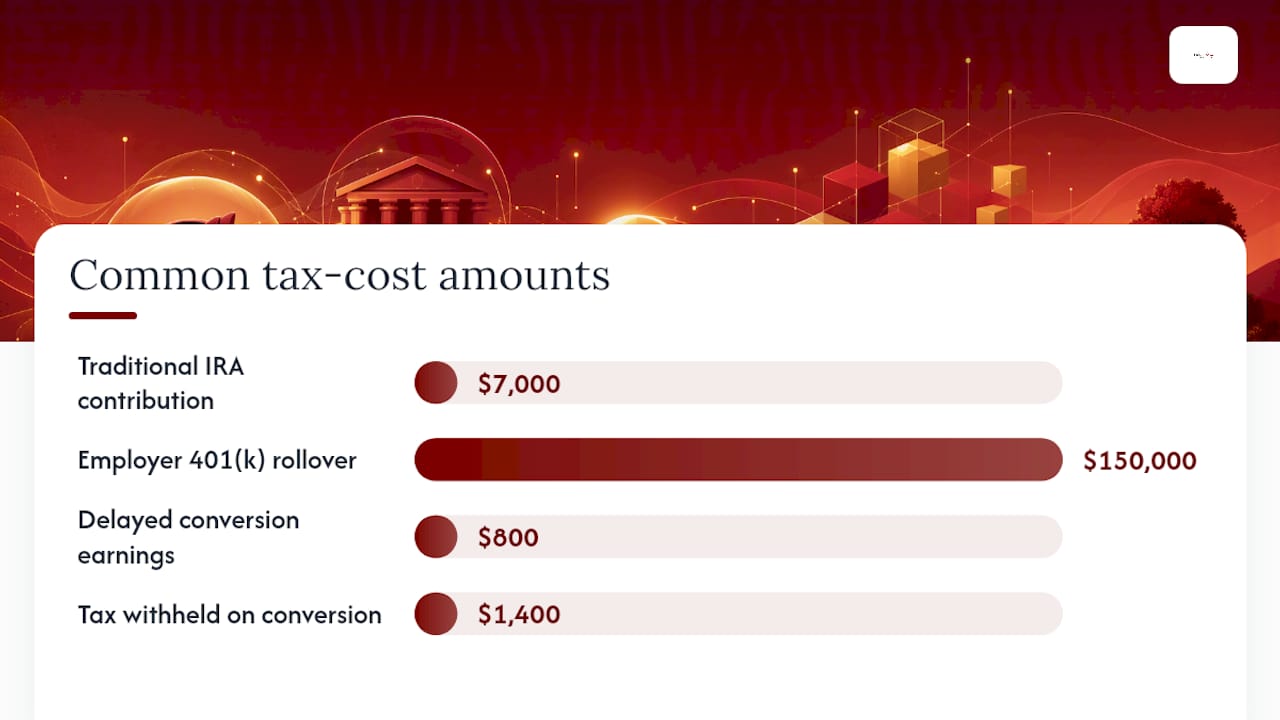
Mistake 1: Rolling a 401(k) into an IRA the same year as a backdoor conversion. A client contributes $7,000 to a traditional IRA in January, planning a clean backdoor conversion. In March, they roll a $150,000 former employer 401(k) into a rollover IRA. The fix: roll the 401(k) into the new employer’s plan instead, or delay the backdoor contribution until the rollover decision is made.
Mistake 2: Missing Form 8606 for multiple years. A client has made nondeductible IRA contributions for five years but never filed Form 8606. When they finally convert, they have no documented basis and face a fully taxable conversion. Correcting this requires filing five amended returns, which is time-consuming and sometimes triggers IRS correspondence. The fix: file Form 8606 every single year you make a nondeductible contribution, even if no conversion occurs that year.
Mistake 3: Converting with taxable earnings due to delayed conversion. A client contributes $7,000 in January and invests it in an equity fund. By the time they convert in October, the account has grown to $7,800. The $800 in earnings is fully taxable at conversion. The fix: keep the traditional IRA contribution in cash or a money market fund until conversion is complete.
That $1,400 withheld never reaches the Roth IRA, reducing the tax-free balance permanently. The fix: pay any conversion tax from a taxable account, not from the IRA funds.
Practical fix checklist:
- Confirm all pre-tax IRA balances before contributing; consider rolling them into an active employer 401(k) if the plan allows
- File Form 8606 every year with a nondeductible contribution, regardless of whether a conversion occurs
- Convert to cash or money market before converting; do not invest the traditional IRA contribution
- Pay estimated taxes on the conversion from non-retirement funds
- Keep custodian forms (1099-R, 5498) and Form 8606 copies indefinitely; basis tracking is a multi-decade record-keeping obligation
- If state income tax applies, confirm your state’s treatment of Roth conversions before executing
Pro Tip: If you have multiple years of undocumented nondeductible contributions, a CPA can reconstruct your basis using bank records and prior tax returns. It is worth the effort. Every dollar of undocumented basis that gets taxed again at conversion is a permanent loss.
When the pro rata calculation produces a meaningful taxable amount, the efficiency of the backdoor strategy drops significantly. At that point, a CPA review of your full IRA picture, including whether a 401(k) roll-in is feasible, is worth the engagement cost. Parr & Ibarra CPA handles exactly this kind of IRA aggregation analysis for Dallas-Fort Worth clients.
How the mega backdoor Roth differs and when it makes sense
The mega backdoor Roth operates through a 401(k) plan, not an IRA, and the contribution capacity is dramatically larger. But it requires specific plan features that many employers do not offer.
How it works: After you have maxed your regular 401(k) elective deferrals ($23,500 for 2026, or $31,000 if you are 50 or older with catch-up), some plans allow additional after-tax employee contributions up to the overall Section 415 limit ($70,000 for 2026). Those after-tax contributions can then be converted to Roth either through an in-plan Roth conversion or an in-service distribution rolled to a Roth IRA.
Per MassMutual’s guide on backdoor and mega backdoor mechanics, two explicit plan features must appear in the 401(k) plan document: (1) the ability to accept after-tax employee contributions beyond the elective deferral limit, and (2) either in-service distributions of after-tax money or an in-plan Roth conversion mechanism. Most large employer plans do not include both.
Mega backdoor vs. regular backdoor:
- Contribution capacity: The IRA-based backdoor is capped at $7,000 ($8,000 with catch-up). The mega backdoor can allow up to roughly $46,500 in additional after-tax contributions per year (the gap between elective deferrals and the Section 415 limit), depending on employer contributions and plan design.
- Plan permission required: The IRA backdoor works at any custodian. The mega backdoor requires your specific employer plan to allow it.
- Complexity: The IRA backdoor involves two steps at a custodian. The mega backdoor involves plan administrator coordination, potentially ERISA counsel review, and careful tracking of after-tax vs. pre-tax 401(k) balances.
- Pro rata rule: The IRA-based backdoor is subject to IRA aggregation rules. The mega backdoor operates inside the 401(k) and is not affected by IRA balances.
Checklist to confirm your plan qualifies for the mega backdoor:
- Does your plan allow after-tax employee contributions beyond the elective deferral limit?
- Does your plan allow in-service distributions of after-tax amounts?
- Alternatively, does your plan offer an in-plan Roth conversion feature?
- Does your plan document specify how earnings on after-tax contributions are treated at distribution?
- Has your plan administrator confirmed these features are currently active (not just in the document)?
If your plan does not allow in-service distributions or in-plan conversions, after-tax contributions are still possible but the Roth conversion cannot happen until you leave the employer. That limits the strategy’s usefulness considerably.
Who should use a backdoor Roth and who should skip it
The backdoor Roth IRA is not universally the right move. The case for it is strong in specific circumstances and weak in others.
Strong candidates:
- High earners with no existing pre-tax IRA balances (or who can roll them into a 401(k))
- Business owners and executives who want tax diversification across pre-tax and after-tax retirement accounts
- Individuals planning for estate flexibility, since Roth IRAs have no required minimum distributions (RMDs) during the original owner’s lifetime
- Those with a long time horizon where tax-free compounding outweighs the current-year tax cost of conversion
Weaker candidates or situations to reconsider:
- Anyone with large pre-tax IRA balances who cannot roll them into an employer plan; the pro rata tax can make the strategy inefficient or even counterproductive
- Individuals in high state income tax states where the conversion triggers a significant additional state tax bill
- Those who may need to access the converted funds within five years and are under 59½
- High earners in their peak earning years where the marginal rate on the conversion is very high; sometimes deferring is still the better call
Pros and cons summary:
Decision signals that warrant a CPA consultation:
- You have more than $50,000 in traditional, SEP, or SIMPLE IRA balances
- You are considering a 401(k) roll-in to clear the pro rata problem
- You are doing conversions in multiple years and have not tracked Form 8606 basis consistently
- Your state has income tax and you are unsure how it treats Roth conversions
- You are a business owner with a SEP-IRA or SIMPLE IRA that complicates the aggregation calculation
For a broader view of how Roth accounts fit into a complete investment strategy for individuals and business owners, the account type is one piece of a larger tax-efficient allocation picture.
Your step-by-step checklist for a compliant 2026 backdoor Roth
Use this as your execution guide or hand it directly to your CPA or custodian.
- Confirm you are phased out of direct Roth contributions. Check your 2026 MAGI against the phaseout thresholds above. If you are below the phaseout, a direct Roth contribution is simpler.
- Audit your existing IRA balances. List every traditional, SEP, and SIMPLE IRA you own. Calculate the pro rata impact before contributing. If the taxable portion is unacceptably high, evaluate whether a 401(k) roll-in is feasible.
- Roll pre-tax IRAs into your employer 401(k) if possible. Confirm your plan accepts incoming rollovers. This must be completed and reflected in your December 31 balance to affect the current year’s pro rata calculation.
- Open a traditional IRA at your chosen custodian (Vanguard, Charles Schwab, or another) if you do not already have one.
- Make the nondeductible contribution. Contribute $7,000 (or $8,000 if 50 or older) for 2026. Do not take a deduction on your tax return. Keep the funds in cash or a money market fund.
- Wait for the custodian’s settlement hold to clear. Confirm the hold period with your custodian. Do not invest the funds during this window.
- Convert the traditional IRA balance to your Roth IRA. If you do not have a Roth IRA at that custodian, open one first. Convert the full balance, including any minimal earnings.
- Do not withhold taxes from the conversion. Instruct the custodian to convert the full amount. Set aside funds from a taxable account to cover any tax due.
- Adjust estimated tax payments if needed. If the conversion creates a meaningful taxable amount, increase your Q4 estimated tax payment or adjust withholding to avoid an underpayment penalty.
- File Form 8606 with your 2026 tax return. Part I records the nondeductible contribution. Part II calculates the taxable conversion amount using your December 31 IRA balances.
- Reconcile custodian forms. Match your Form 1099-R (conversion) and Form 5498 (contribution) against your Form 8606 entries. Keep all three documents permanently.
- Store records indefinitely. Your Form 8606 basis carries forward until you fully deplete the Roth IRA. Losing these records creates a tax problem decades from now.
Key deadlines:
- Contribution deadline for 2026: April 15, 2027 (but convert in 2026 for simplest reporting)
- December 31, 2026: the date that determines your IRA balances for the pro rata calculation
- Tax return filing deadline: April 15, 2027 (or October 15, 2027 with extension, but Form 8606 must be filed with the return)
A practitioner’s view on when backdoor Roths are worth the effort
The backdoor Roth IRA is one of the few remaining tax-free growth opportunities available to high-income earners, and the IRS has not issued a single document explicitly blessing the strategy as a named tactic. That matters. The technique rests on two separately legal actions: a nondeductible IRA contribution and a Roth conversion. Both are explicitly permitted. But the absence of an IRS “approval letter” for the combined strategy means that meticulous documentation and Form 8606 filing are not optional extras. They are the entire compliance foundation.
What I see most often is not people making the wrong decision about whether to do a backdoor Roth. It is people making the right decision and then executing it sloppily. A missed Form 8606, a forgotten rollover IRA, a conversion done while the funds were invested in equities: these are not conceptual errors. They are process errors, and they create real, permanent tax costs that cannot be undone after the fact.
The strategy earns its keep for clients who have no pre-tax IRA exposure, a long runway for tax-free compounding, and the discipline to track basis across years. For business owners with SEP-IRAs or rollover IRAs from prior employers, the analysis is more nuanced and almost always benefits from a CPA review before the first contribution is made.
Parr & Ibarra CPA handles the details that cost you money
High-income earners executing a backdoor Roth IRA face the same three failure points every year: untracked pre-tax IRA balances, missing Form 8606 filings, and conversion timing that creates unnecessary taxable income. Parr & Ibarra CPA addresses all three as part of proactive tax planning for business owners and individuals in the Dallas-Fort Worth area.
The firm’s services relevant to backdoor Roth execution include Form 8606 preparation and multi-year basis reconstruction, IRA aggregation analysis, 401(k) roll-in coordination, and retirement account design consulting. For clients with complex IRA structures or annual conversion programs, Parr & Ibarra CPA offers both one-time reviews (a single engagement to audit your IRA picture and execution plan) and ongoing retainer arrangements that cover year-round tax planning, estimated payment coordination, and filing.
If you are ready to execute a 2026 backdoor Roth or want a second opinion on a prior conversion, schedule a consultation with the Parr & Ibarra CPA team.
Sources
These are the primary references for the rules and procedures covered in this guide. Confirm current-year figures directly from IRS sources before executing.
- Individual Retirement Arrangements (IRAs) (IRS)
- Backdoor Roth IRA: What it is and how to set it up – Vanguard
- Backdoor Roth IRA (Investopedia)
- How to Do a Backdoor Roth Conversion (SmartAsset)
Before relying on any custodian-specific steps: confirm your custodian’s current settlement policies, conversion interface, and any plan-specific rules directly with your plan administrator or custodian representative. Custodian procedures change, and a step that worked at one firm may differ at another.
This article is general information, not a substitute for advice from a qualified financial advisor. Consult a qualified financial professional about your own circumstances before acting on anything here.
FAQ
Do I have to file Form 8606 every year I do a backdoor Roth?
Yes. Per IRS Form 8606 guidance, you must file it for every year you make a nondeductible IRA contribution and for every year you convert a traditional IRA to a Roth. Missing it risks being taxed on your after-tax basis a second time.
Does the pro rata rule apply if I only have one traditional IRA with no pre-tax money?
No. If your only traditional IRA contains exclusively after-tax (nondeductible) contributions and no pre-tax dollars, the entire conversion is nontaxable. The pro rata rule only creates a tax problem when pre-tax IRA balances exist across any combination of traditional, SEP, or SIMPLE IRAs.
Can I do a backdoor Roth if I have a rollover IRA from a former employer?
You can, but the rollover IRA balance is included in the pro rata calculation under IRS Publication 590-B, which will make most or all of your conversion taxable. The standard fix is to roll the pre-tax rollover IRA into your current employer’s 401(k) before December 31 of the conversion year, if the plan accepts incoming rollovers.
How does the mega backdoor Roth differ from the standard backdoor?
The standard backdoor uses an IRA and is capped at $7,000 ($8,000 with catch-up) per year. The mega backdoor operates through a 401(k) plan’s after-tax contribution feature and can allow significantly larger amounts, but requires your employer plan to explicitly permit after-tax contributions plus either in-service distributions or in-plan Roth conversions.
What happens if I convert and then my income turns out to be below the Roth phaseout?
Nothing penalizes you for converting when you could have contributed directly. You simply have a Roth IRA funded through conversion rather than direct contribution. The tax treatment is the same, and the five-year clock for the conversion still applies. You could also make a direct Roth contribution for that year on top of the conversion, subject to the annual contribution limit.

